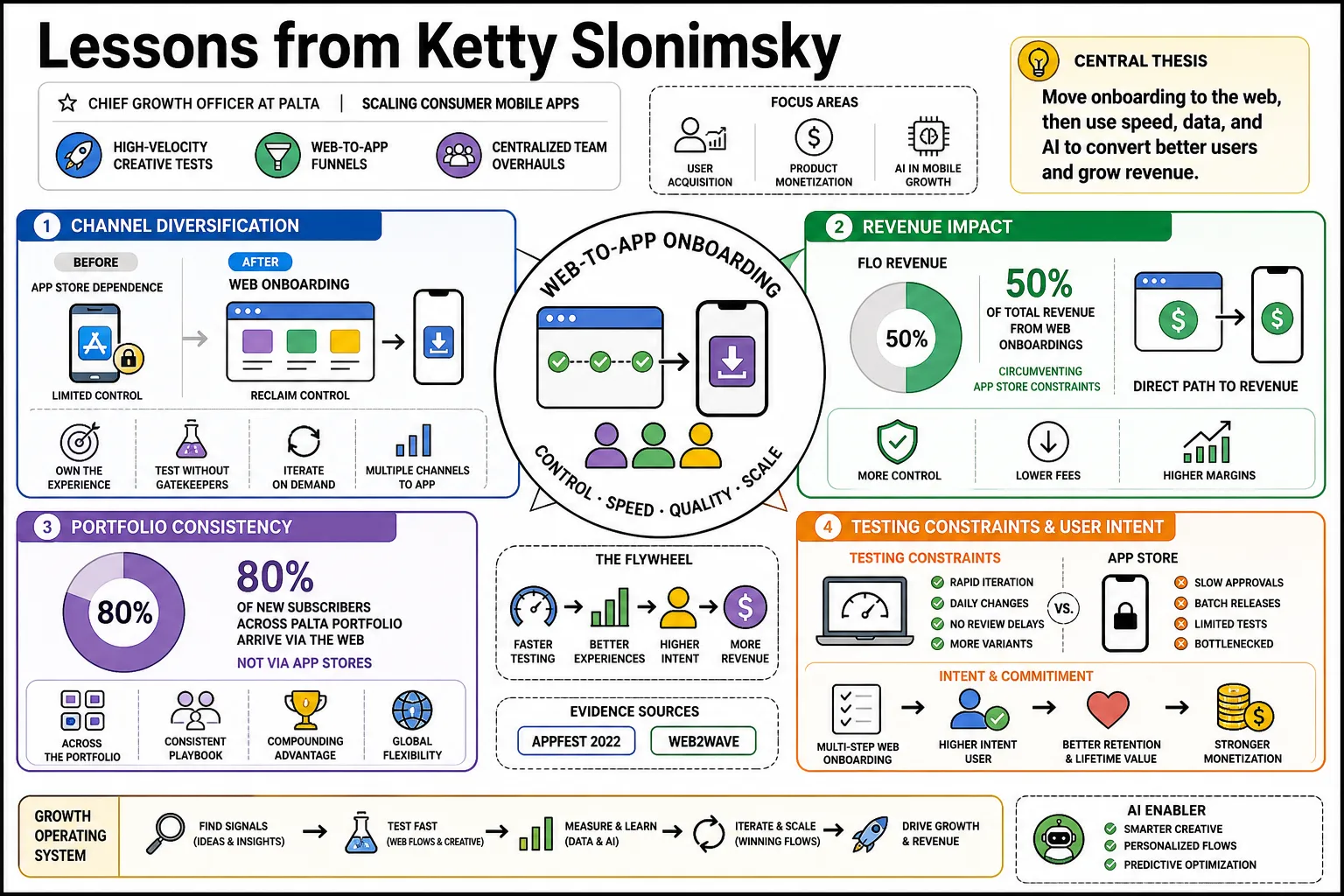
Lessons from Ketty Slonimsky
As Chief Growth Officer at Palta, Ketty Slonimsky scales consumer mobile apps like Flo and Simple. Her work centers on the hard mechanics of growth: running high-velocity creative tests, building web-to-app funnels, and overhauling centralized teams. This profile breaks down her approach to user acquisition, product monetization, and the use of AI in mobile growth.
Part 1: Web-to-App Onboarding
- On Channel Diversification: Slonimsky presents web onboarding as a major growth layer because it diversifies acquisition, captures high-intent search demand, and can produce stronger LTV and retention than mobile-only flows. — Reference: Appfest 2022 talk on centralized growth and web onboarding
- On Revenue Impact: "Flo currently generates half of its total revenue directly through web onboardings, circumventing traditional app store constraints." — Source: Web2Wave
- On Portfolio Consistency: "Across the entire Palta portfolio, 80 percent of new subscribers now arrive via the web rather than direct app store downloads." — Source: Web2Wave
- On Testing Constraints: Her Appfest talk frames web onboarding as an experimentation engine: the growth team can keep refining hooks, value propositions, activation, pricing, and monetization without treating the app store as the only surface. — Reference: Appfest 2022 talk on web-funnel experimentation
- On Intent and Commitment: "A user who completes a multi-step web onboarding sequence demonstrates higher intent before even downloading the application." — Source: The Twenty Minute VC
- On Pricing Flexibility: "Web channels enable teams to experiment with pricing tiers and promotional structures without store platform limitations." — Source: The Twenty Minute VC
- On Centralized Efforts: Slonimsky says Palta built a centralized growth function to create common standards, economies of scale, repeatable processes, and stronger cross-company collaboration. — Reference: Appfest 2022 talk on Palta's centralized growth function
- On First Impressions: "The web funnel acts as the actual first impression of the product, meaning its design must be as polished as the app itself." — Source: The Twenty Minute VC
- On Acquisition Costs: "Driving traffic to a web funnel often yields a more predictable acquisition cost because you are controlling the entire landing experience." — Source: Web2Wave
- On Cross-Platform Tracking: In Palta's model, centralized user acquisition supports channel mix, attribution, incrementality, tracking, and creative production so app teams can evaluate growth across web and mobile more coherently. — Reference: Appfest 2022 talk on attribution and acquisition infrastructure
Part 2: Creative Velocity & Testing
- On Insane Velocity: "Scaling a consumer product today requires an insane creative velocity, often demanding hundreds to thousands of new ad variants per week." — Source: GrowthTalent
- On Volume vs. Perfection: "When testing a thousand creatives a week, the goal is not individual perfection but rapid identification of statistically significant winners." — Source: The Twenty Minute VC
- On Beating Competitors: "Smaller teams can outmaneuver larger competitors simply by experimenting more rapidly and testing unconventional creative angles." — Source: GrowthTalent
- On Fatigue: "Creative fatigue sets in faster than ever on modern social platforms, meaning your winning ad will decay within days, not months." — Source: The Twenty Minute VC
- On the Core Function of Marketing: "Modern growth marketing is less about media buying and almost entirely about systematic creative production." — Source: GrowthTalent
- On Data-Driven Ideation: "Creative teams must be directly integrated with data teams so that every new concept is informed by the performance of the last." — Source: The Twenty Minute VC
- On Automation: "You cannot hit a volume of a thousand creatives manually; teams must build or buy systems to automate variant generation." — Source: GrowthTalent
- On Localizing Assets: "True high-frequency testing requires localizing creatives not just for language, but for the specific visual idioms of different platforms." — Source: The Twenty Minute VC
- On The Danger of Assumptions: "Never assume you know what creative will resonate. The most polished asset often loses to the rawest, least expected variant." — Source: The Twenty Minute VC
Part 3: Growth Leadership & Team Structure
- On Centralization: Slonimsky's centralization argument is selective: acquisition can be shared, while product and CRM remain closer to each app because they are part of the product's unique development. — Reference: Appfest 2022 talk on what to centralize
- On Hiring Profiles: "When hiring for growth, prioritize analytical rigor and a willingness to test over traditional marketing backgrounds or brand experience." — Source: App Growth Summit
- On Alignment: Her growth operating model aligns acquisition, product growth, CRM, activation frameworks, pricing, monetization, cross-sell, and bundling around one portfolio-level strategy. — Reference: Appfest 2022 talk on growth-function pillars
- On Reporting Structures: "Growth teams should have direct access to engineering resources without having to fight for space on the core product roadmap." — Source: App Growth Summit
- On Defining Success: Slonimsky uses concrete funnel metrics such as the share of users reaching the paywall to judge whether the team is selling the story and value proposition effectively. — Reference: Appfest 2022 talk on web-funnel metrics
- On Skill Gaps: "Traditional marketers often struggle in modern growth roles because they index on intuition rather than iterative, numbers-driven experimentation." — Source: App Growth Summit
- On Cross-Functional Friction: Palta's group model depends on synergy between apps: Slonimsky points to teams borrowing tactics, competencies, data, audiences, and mentors across the portfolio to improve growth. — Reference: Appfest 2022 talk on cross-company collaboration
- On Team Culture: "You have to cultivate a culture where failed experiments are celebrated as long as the learnings are documented and applied." — Source: App Growth Summit
- On Speed of Execution: The 20Growth episode agenda centers experimentation-heavy growth work, from onboarding and retention to organic loops, creator channels, metrics, and engagement tactics. — Reference: Listen Notes episode agenda for Slonimsky on growth execution
- On Resource Allocation: "Do not spread your growth team too thin across unproven channels; concentrate engineering and creative power where you have early signal." — Source: App Growth Summit
Part 4: Rethinking Metrics: LTV and CAC
- On LTV Fallacies: "Many consumer apps fail because they build models around hypothetical three-year LTVs that never materialize in the real world." — Source: The Twenty Minute VC
- On Payback Periods: "Instead of focusing on lifetime value, growth teams should obsess over shortening the payback period to reinvest capital faster." — Source: The Twenty Minute VC
- On CAC Reality: "The cost to acquire a customer will always rise over time on ad networks; your monetization must outpace this inevitable decay." — Source: Podcast Republic
- On Early Churn: "The most important part of the LTV curve is the first thirty days. If you lose users there, no long-term model will save the economics." — Source: The Twenty Minute VC
- On Misleading Metrics: "Averages hide the truth. You must segment LTV and CAC by channel, device, and even specific creative variants to see what actually works." — Source: Podcast Republic
- On Financial Discipline: "Growth models are only useful if they are rooted in actual cash in the bank, rather than projected accounting revenue." — Source: The Twenty Minute VC
- On Marginal Costs: "Teams often celebrate scale while ignoring that the marginal cost of the next ten thousand users is exponentially higher than the first." — Source: Podcast Republic
- On Network Economics: "Do not assume your CAC will decrease with scale. In mobile acquisition, scale usually breeds inefficiency unless offset by viral loops." — Source: The Twenty Minute VC
- On Model Decay: "Financial models built on past performance decay rapidly. You must continuously adjust your LTV assumptions based on the most recent cohort data." — Source: Podcast Republic
Part 5: Influencer Marketing Strategies
- On Scale: "To use influencers to scale growth insanely fast, you must treat influencer outreach as a high-volume performance channel, not a boutique PR effort." — Source: The Twenty Minute VC
- On Briefing Creators: In the 20Growth episode, Slonimsky treats influencers as a growth channel that needs disciplined fit between the creator, audience, value proposition, and the campaign's measurement logic. — Reference: 20VC episode page on using influencers to grow
- On Measurement: "Influencer marketing only scales when you establish rigorous tracking mechanisms, such as custom promo codes and dedicated landing pages." — Source: The Twenty Minute VC
- On Micro-Influencers: Her influencer-growth discussion is better supported as a portfolio of creator tests than as a single celebrity-bet lesson: the public episode page foregrounds influencer scaling as a growth discipline. — Reference: 20VC episode page on influencer growth
- On Content Reusability: "The true value of an influencer campaign is securing the rights to run their organic content as paid ads across other platforms." — Source: The Twenty Minute VC
- On Platform Nuance: The episode agenda separates influencers, organic growth, onboarding, retention, metrics, and push notifications, which points to Slonimsky's broader lesson that growth tactics have to fit the channel and user journey. — Reference: Listen Notes episode agenda for 20Growth with Slonimsky
- On Long-Term Relationships: "Instead of one-off posts, build long-term ambassador programs with influencers who actually use and believe in the product." — Source: The Twenty Minute VC
- On Risk Tolerance: Slonimsky's growth framing accepts failed ventures and failed tests as part of the job; the point is to keep learning through measurable experiments rather than protect every campaign from failure. — Reference: 20VC episode page on failed ventures and growth lessons
- On Audience Overlap: "When scaling influencer spend, be careful of audience saturation. Hitting the same demographic through fifty different creators has diminishing returns." — Source: The Twenty Minute VC
- On Authentic Integration: For creator-led growth, her public episode framing supports a practical lesson: influencer campaigns work best when they connect the product's real value to the creator's audience instead of treating the placement as a generic ad buy. — Reference: 20VC episode page on influencer-led growth
Part 6: Subscription Monetization
- On Second Subscriptions: "Introducing 'second subscriptions' or premium add-ons is a critical lever for driving higher average revenue per user." — Source: GrowthTalent
- On Pricing Psychology: "Subscription pricing is rarely rational. Testing different price points and billing intervals almost always uncovers hidden revenue." — Source: Me.sh
- On Trial Conversion: "A free trial is useless if the product does not demonstrate its core value within the first three days of usage." — Source: GrowthTalent
- On Cannibalization: "Do not fear that adding a cheaper tier will cannibalize your premium plan; often, it captures a completely different segment of the market." — Source: Me.sh
- On Cancellation Flows: "The cancellation flow is a retention opportunity. Offering dynamic discounts or pausing options can salvage a significant percentage of churn." — Source: GrowthTalent
- On Feature Gating: "The decision of which features to put behind a paywall should be fluid and constantly tested against user engagement metrics." — Source: Me.sh
- On Annual vs. Monthly: "Pushing users toward annual plans improves immediate cash flow, but you must ensure the product warrants a year-long commitment to avoid refund spikes." — Source: GrowthTalent
- On Perceived Value: "Monetization succeeds when the perceived value of the subscription significantly outweighs the daily cost in the user's mind." — Source: Me.sh
- On Global Pricing: "Applying a flat US price globally limits growth. You must localize your subscription pricing to match the purchasing power of each specific region." — Source: GrowthTalent
Part 7: AI in Creative Work & Distribution
- On Vibe Working: "2026 is the year of 'vibe working,' where the manual labor of execution is handled by AI, leaving humans to manage the overarching tone and direction." — Source: ElevenLabs Summit
- On Human Perspective: "As AI commoditizes the production of content, distinctive human perspective and taste become the most valuable assets a creative team possesses." — Source: HRB Magazine
- On OpenAI as a Platform: "Growth teams must prepare for OpenAI and other LLM interfaces to become major distribution platforms that rival traditional search engines." — Source: ElevenLabs Summit
- On Creative Automation: "Generative AI allows mobile teams to achieve the 'insane creative velocity' needed today without linearly scaling their headcount." — Source: HRB Magazine
- On Judgment over Output: "The role of a marketer is shifting from creating assets to evaluating and curating the high volume of assets generated by AI models." — Source: ElevenLabs Summit
- On Workflow Integration: "AI should not be treated as a separate tool, but deeply integrated into the daily workflows of how onboarding flows and ad copy are tested." — Source: HRB Magazine
- On Synthetic Testing: "In the near future, we will use AI to simulate user reactions to new features before writing a single line of production code." — Source: ElevenLabs Summit
- On Personalization at Scale: "Generative AI finally makes true one-to-one personalization possible in onboarding, tailoring the flow to the specific intent of each user." — Source: HRB Magazine
- On The Future of Search: "As users turn to conversational AI for answers, apps must optimize their content to be easily referenced and recommended by these models." — Source: ElevenLabs Summit
Part 8: Scaling Consumer Products
- On Product-Led Growth: "Sustainable scaling in consumer apps requires the product itself to drive acquisition through built-in virality and seamless sharing mechanics." — Source: Israel Mobile Summit
- On Focusing on the Core: "Before attempting to scale horizontally, you must ensure that your core utility is universally understood and sticky for your target demographic." — Source: AppsFlyer
- On Portfolio Synergy: "When managing a portfolio of apps, the infrastructure for billing, data, and growth testing should be shared to accelerate the launch of new products." — Source: Israel Mobile Summit
- On Market Saturation: "Once a primary market reaches saturation, growth depends entirely on operationalizing rapid expansion into secondary geographic regions." — Source: AppsFlyer
- On Technical Debt: "Scaling growth too fast on a fragile backend will break the user experience. Engineering stability must precede massive acquisition pushes." — Source: Israel Mobile Summit
- On Retention vs. Acquisition: "Acquisition without retention is just a leak in the bucket. Every dollar spent on top-of-funnel must be matched by a focus on habit formation." — Source: AppsFlyer
- On the Reality of Hypergrowth: "Hypergrowth is rarely a straight line. It is usually a series of plateaus followed by breakthroughs discovered through aggressive experimentation." — Source: Israel Mobile Summit
- On User Feedback: "At scale, qualitative feedback is just as important as quantitative data. You must talk to the users who churn to understand the gaps in your model." — Source: AppsFlyer
- On Long-Term Strategy: "The tactical levers of growth will change every year, but the fundamental strategy of building a resilient, adaptable team remains constant." — Source: Israel Mobile Summit