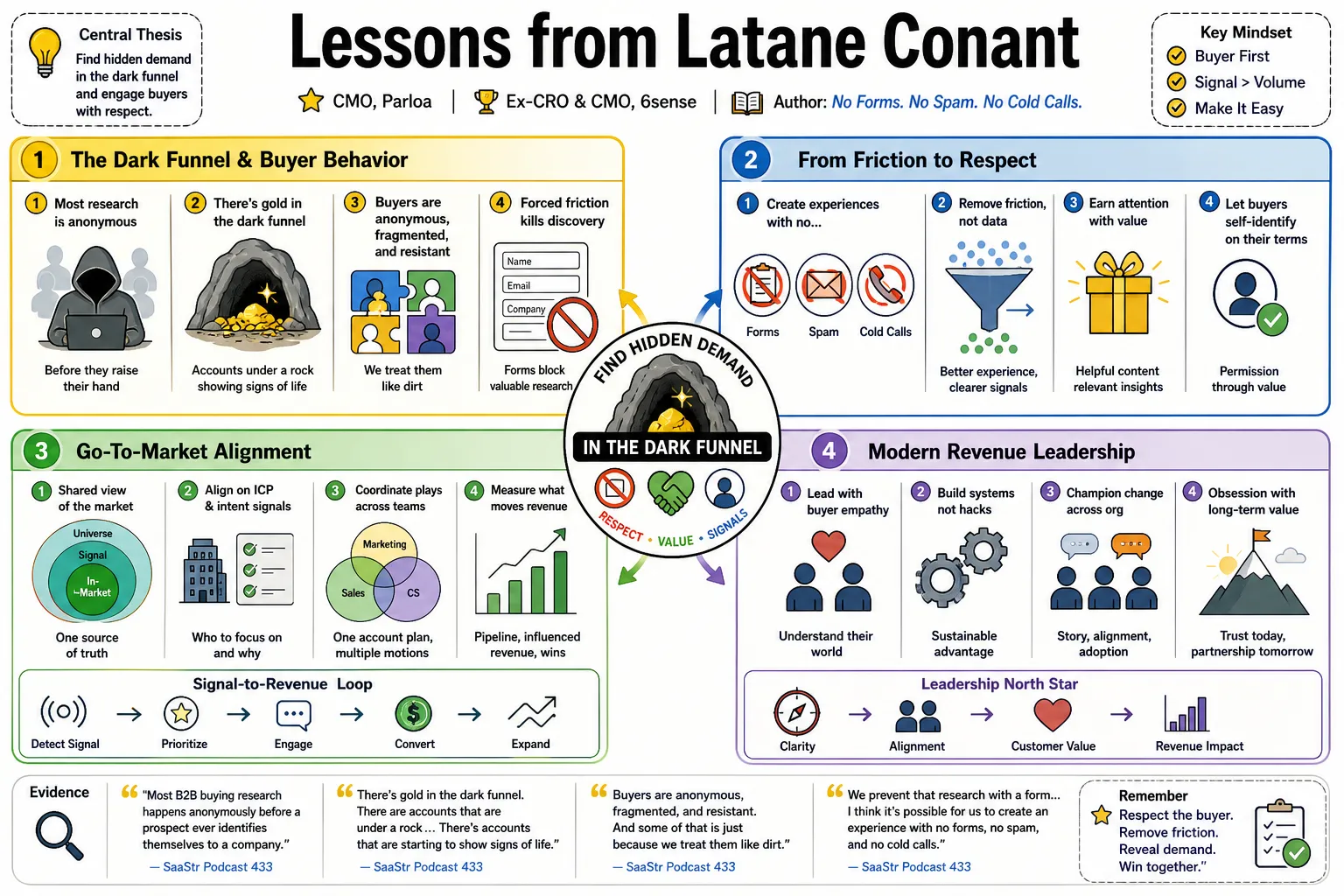
Lessons from Latane Conant
Latané Conant is the Chief Marketing Officer at Parloa and previously served as the CRO and CMO at 6sense. She is best known for her book No Forms. No Spam. No Cold Calls., which outlines how B2B companies can use intent data to target buyers actively in-market rather than relying on volume-based outreach. This profile collects her frameworks on the "Dark Funnel," go-to-market alignment, and modern revenue leadership.
Part 1: The Dark Funnel and Buyer Behavior
- On the reality of B2B research: "Most B2B buying research happens anonymously before a prospect ever identifies themselves to a company." — Source: SaaStr Podcast 433
- On uncovering hidden demand: "There’s gold in the dark funnel. There are accounts that are under a rock... There’s accounts that are starting to show signs of life." — Source: SaaStr Podcast 433
- On buyer resistance: "Buyers are anonymous, fragmented, and resistant. And some of that is just because we treat them like dirt." — Source: SaaStr Podcast 433
- On forced friction: "We prevent that research with a form... I think it’s possible for us to create an experience with no forms, no spam, and no cold calls." — Source: SaaStr Podcast 433
- On the Under a Rock rule: "Target accounts are essentially living under a rock. They’re not actively researching products and solutions and they’re showing no signs of intent. How to connect with accounts in the target state: Don’t." — Source: SaaStr Podcast 433
- On anonymous behavior: "A qualified account looks at anonymous behavior and known behavior to look for patterns and say, 'this account is in this buying stage.'" — Source: SaaStr Podcast 433
- On the limits of traditional tracking: "Our old-school tactics not only treat our future customers like dirt, they also encourage the anonymous buying we’re trying to combat." — Source: SaaStr Podcast 433
- On identifying life: "Gosh, if you’re a marketer, wouldn’t it be nice to know exactly which accounts are ideal for you and are starting to show signs of life?" — Source: SaaStr Podcast 433
- On modern buyer journeys: "We’re at a crossroads in B2B marketing and sales. The buying journey has changed, and the old playbook no longer works." — Source: SaaStr Podcast 433
Part 2: Dismantling the Old Playbook
- On form fills: "Instead of waiting for a form fill, revenue teams must use AI to identify intent signals from accounts already researching your solution." — Source: SaaStr Podcast 433
- On mass outreach: "Sending mass 'spam' emails and making unsolicited cold calls are outdated tactics that alienate modern buyers." — Source: SaaStr Podcast 433
- On the volume trap: "I can gather hundreds of thousands of MQLs and pass them over, and sometimes that feels really good... but less is more." — Source: SaaStr Podcast 433
- On going on offense: "Stop playing defense and go on offense by using data to predict which accounts are actually in-market." — Source: SaaStr Podcast 433
- On providing value upfront: "Instead of forcing prospects to fill out forms to access information, focus on providing value upfront to build trust." — Source: SaaStr Podcast 433
- On warm engagement: "Replace cold outreach with 'warm' engagement based on intent data that shows a prospect is actually in-market." — Source: SaaStr Podcast 433
- On wasting addressable markets: "Don't waste effort on your entire Total Addressable Market. Use AI and intent signals to identify which accounts in your ICP are currently researching solutions." — Source: SaaStr Podcast 433
- On removing friction: "The core philosophy of modern B2B marketing is to ditch friction-heavy tactics in favor of data-driven, personalized engagement." — Source: SaaStr Podcast 433
- On the customer-first mandate: "A customer-first approach means respecting the buyer's journey and allowing them to consume content without artificial barriers." — Source: SaaStr Podcast 433
Part 3: Account-Based Marketing and Intent Data
- On precision marketing: "I define ABM as using data, using analytics to make sure that you are doing the right things at the right time to accounts most likely to buy." — Source: SalesTech Star
- On scaling ABM: "The critical aspect of ABM is being able to use AI and big data and orchestration capabilities to actually do ABM at scale." — Source: SalesTech Star
- On the simplicity of ABM: "ABM is really just good marketing." — Source: SaaStr Podcast 433
- On intent as fuel: "Intent data is the fuel for ABM. It allows companies to stop guessing and start engaging with the right accounts." — Source: SaaStr Podcast 433
- On first-party engagement: "The first category of intent is what I call 'first-party engagement.' This means they’re on your website, they’re chatting with your chatbot, they’re consuming your content." — Source: SaaStr Podcast 433
- On moving beyond firmographics: "Move beyond basic firmographics. Understand an account's tech stack, who is on their buying committee, and what specific keywords they are researching." — Source: Forbes
- On Account-Based Experience (ABX): "Move beyond simple Account-Based Marketing to a full experience where sales and marketing are aligned to provide value to the right people at the right time." — Source: Forbes
- On eliminating guesswork: "We’re trying to get rid of hope and wish. A qualified account looks at behavior patterns to determine exact buying stages." — Source: SaaStr Podcast 433
- On lighting up the dark funnel: "By lighting up the dark funnel, companies create a better experience for the buyer and a more efficient engine for the seller." — Source: SaaStr Podcast 433
- On deep insights: "True intent means knowing exactly who is researching, which keywords they use, and what pain points drive their search." — Source: SaaStr Podcast 433
Part 4: Sales and Marketing Alignment
- On the alignment mandate: "ABM either dies or thrives on Sales-Marketing alignment; there’s no in-between." — Source: SaaStr Podcast 433
- On complementary outreach: "When Marketing runs plays on specific accounts or contacts and Sales isn’t doing complementary outreach, the whole thing falls short." — Source: SaaStr Podcast 433
- On unified revenue functions: "For us, there became a tipping point of maturity... suddenly, there needs to be a lot more alignment between all the go-to-market functions." — Source: Forbes
- On avoiding silos: "It becomes really hard to effectively see the whole picture and make good decisions because everyone’s looking in their own little forest." — Source: Forbes
- On the one big tent: "Alignment in service of our customers has always been core to our mission, but by bringing all our revenue functions under one big tent, we’ll be poised to take it to a whole new level." — Source: Forbes
- On marketing's voice with sales: "We sell to sales, and we need to have a bigger voice with sales. That requires marketing to speak the language of pipeline." — Source: Forbes
- On eliminating friction between teams: "The division between sales and marketing often stems from using different data to evaluate the exact same customer journey." — Source: Forbes
- On shared accountability: "When sales and marketing look at the same intent signals, they stop arguing about lead quality and start collaborating on account strategy." — Source: Forbes
- On orchestration: "Orchestration capabilities ensure that when marketing warms an account, sales knows exactly when and how to reach out." — Source: SalesTech Star
- On treating buyers as a shared asset: "The buyer does not care if they are talking to sales or interacting with marketing; they just want a seamless experience." — Source: SalesTech Star
Part 5: Rethinking Metrics and MQLs
- On the problem with MQLs: "Marketers are more than just an MQL. Gathering hundreds of thousands of MQLs might feel good, but it often distracts from actual revenue." — Source: SaaStr Podcast 433
- On pipeline quotas: "Marketing should be held accountable for future-proofing revenue. Success should be measured by pipeline contribution." — Source: SaaStr Podcast 433
- On tracking real engagement: "Focus on metrics like new accounts engaged, accounts progressing through the buying cycle, opportunity rates, and account win rates." — Source: SaaStr Podcast 433
- On the 6QA: "The 6sense Qualified Account replaces the MQL by looking at a blend of anonymous and known behaviors to predict buying stages." — Source: SaaStr Podcast 433
- On data readiness: "Monday I call it the Monday Metrics Marathon... every functional area comes with their core KPIs. I feel data-ready for the rest of the week." — Source: Forbes
- On replacing FOMO: "I don’t have FOMO; I have fear of not being prepared." — Source: Forbes
- On dispassionate analysis: "Find the Red. Marketing leaders must be dispassionate and data-driven about their own performance to identify what isn't working." — Source: Forbes
- On benchmarking: "Use a structured approach to compare your performance against competitors and industry standards to understand true baseline health." — Source: Forbes
- On boardroom confidence: "Confidence in the boardroom comes from rigorous preparation and being the most knowledgeable person about the data." — Source: Forbes
Part 6: Customer Marketing and Experience
- On the broken state of CX: "The state of enterprise customer experience is broken, which is why solving it must become an irrational, all-in cause." — Source: Forbes Councils
- On overlooked growth: "Many CMOs overlook their existing customer base as a primary source of growth, focusing too heavily on net-new acquisition." — Source: Forbes Councils
- On moving beyond case studies: "Customer marketing must evolve past simply collecting case studies. It should be a mechanism to drive product adoption and realized value." — Source: Forbes Councils
- On adoption as a metric: "Track how many customers are increasing adoption. If adoption stalls, expansion revenue will lag months later." — Source: Forbes Councils
- On earning loyalty: "Loyalty doesn't come from a product simply working; it comes from customers feeling 'taken care of' when they have high-stakes needs." — Source: Forbes Councils
- On simple positioning: "Avoid 'word salad' and industry jargon. A tagline should be simple, honest, and something customers can connect with." — Source: Tercera
- On inside-out branding: "Brands are built from the inside. Marketing must be intentional about company culture, as it eventually manifests outward to the customer." — Source: Tercera
- On the X Factor in tech: "The right tech at the right time must solve a universal problem that’s been plaguing enterprise customer experience leaders for years." — Source: Parloa
- On cutting through noise: "There’s a lot of noise in the agentic AI space, and messaging must cut through in a way that resonates with buyers personally." — Source: Parloa
Part 7: Career Transitions and the CRO Role
- On the CMO to CRO path: "Most CROs have grown up through one path, and that is being a sales leader. What my role represents is a more portfolio approach to a career." — Source: Forbes
- On non-traditional backgrounds: "I am not the perfect candidate for a traditional CRO, but I had enough of a portfolio to unify the revenue functions." — Source: Forbes
- On the title 'Chief Market Officer': "My mantle is 'market' and we actually talked about me continuing to just have the title Chief Market Officer before taking on the CRO role." — Source: Forbes
- On choosing a cause: "I don’t do 'just a job.' I do causes: the irrational, all-in kind that consumes your mind and demands everything." — Source: Parloa
- On evaluating new roles: "When considering a new role, I ask two questions: Is this a cause I believe in? Is this a company that can win?" — Source: Parloa
- On putting companies on the map: "Sure, we’ve been flying under the radar... but it’s time to change that. Because putting companies on the map? That’s what my team and I do." — Source: Parloa
- On reporting structures: "I am on the record saying do not take a CMO job unless you report to the CEO." — Source: Forbes
- On fake CMO roles: "If the CRO is just a head of sales, and they want you to do demand gen, that’s not a CMO job." — Source: Forbes
- On early-stage positioning: "For early-stage companies, find an existing category first. Being a 'category of one' is often a long, expensive road." — Source: Tercera
Part 8: Modern Leadership and Team Building
- On the difficulty of transitions: "The first year in any new gig is like having a baby. If you remembered how hard it was, you would never have another baby." — Source: Forbes
- On team dynamics: "Think of your team in terms of a talented band, not a solo artist." — Source: Forbes
- On vulnerability: "Vulnerability is the new superpower for leaders in the AI era." — Source: Forbes
- On building context: "Customers and investors need context to understand where you fit in the market; don't force them to learn a completely new paradigm if you don't have to." — Source: Tercera
- On accountability: "True leadership means taking ownership of the entire customer journey, rather than limiting focus to the segment your department controls." — Source: Forbes
- On embracing data: "A culture that fears data will always hide behind vanity metrics; a strong team uses data to expose weaknesses and fix them." — Source: Forbes
- On continuous preparation: "The discipline of the Monday Metrics Marathon ensures that leadership is never caught off guard by the realities of the business." — Source: Forbes
- On solving universal problems: "Great marketing cannot fix a product that doesn't solve a deeply felt, universal problem for the enterprise." — Source: Parloa
- On organizational maturity: "As a company reaches a tipping point of maturity, fragmented leadership must evolve into unified, cross-functional orchestration." — Source: Forbes
- On the ultimate goal: "The ultimate objective of any revenue leader is to replace friction and guesswork with predictability and trust." — Source: Forbes