Leela Srinivasan is a marketing executive and current CEO of Parity, where she focuses on closing the gender income gap for professional women athletes. During her time as CMO at companies like SurveyMonkey and Lever, she built marketing strategies around customer feedback and data-driven recruiting. This profile collects her perspectives on marketing, leadership, talent acquisition, and the business of women's sports.
Part 1: The Feedback Economy and Customer Insights
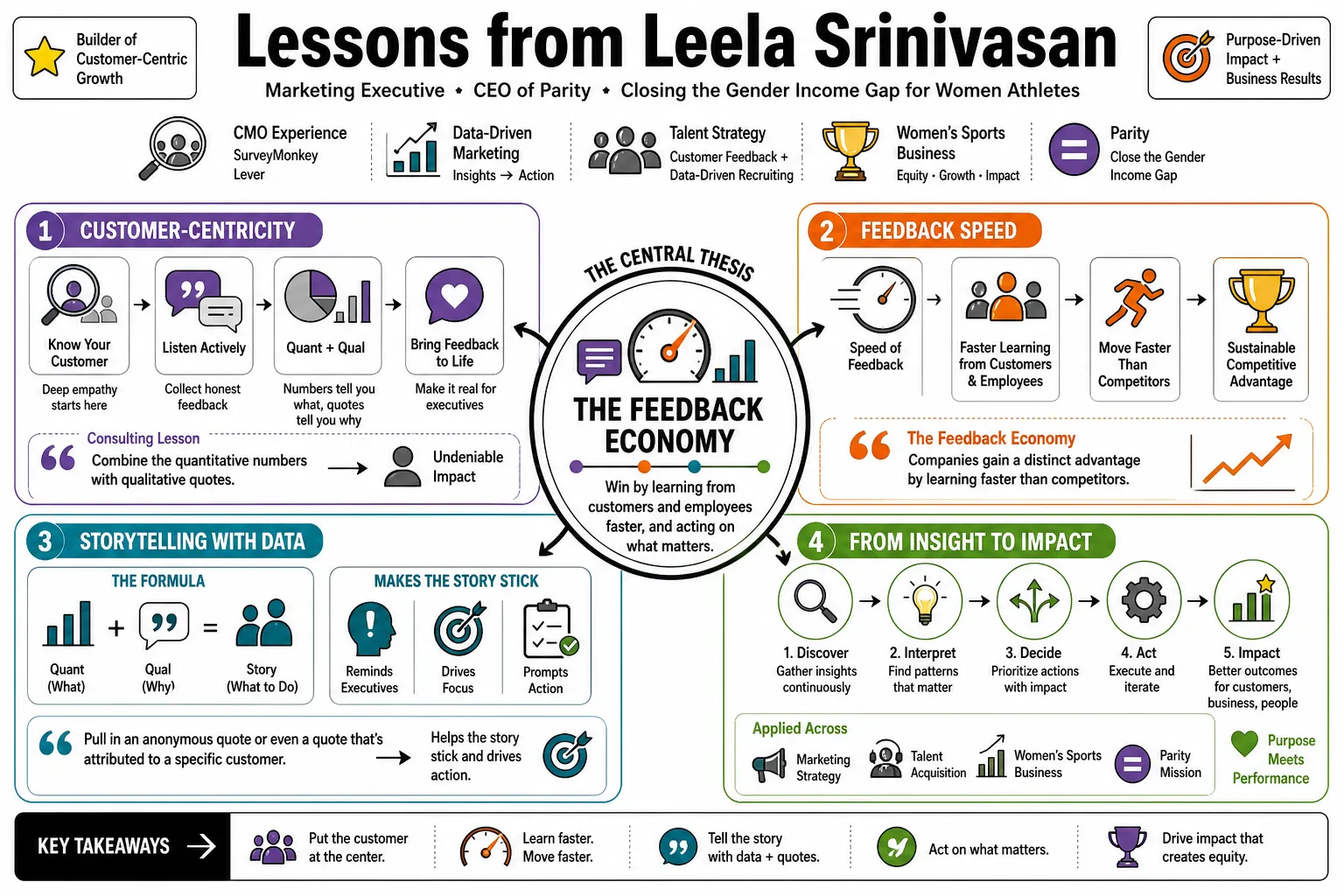
- On Customer-Centricity: "One of the best lessons I learned from my consulting days is the power of combining the quantitative numbers with qualitative quotes. The impact this can have in bringing customer feedback to life for an executive is undeniable." — Source: Intercom
- On Feedback Speed: "The feedback economy means that companies gain a distinct advantage by learning from their customers and employees faster than competitors do." — Source: SaaStr
- On Storytelling with Data: "The storytelling aspect of being able to pull in an anonymous quote or even a quote that's attributed to a specific customer into that dialogue will just help that story stick more and remind executives of the importance of acting on whatever is that you've learned." — Source: Intercom
- On Buyer Sentiment: "We use surveys continuously to understand what buyers actually need, rather than guessing what they want to hear." — Source: Stage 2 Capital
- On Listening to Users: "When transitioning from a consumer product to an enterprise solution, the first step is asking the existing user base what features they are willing to pay for." — Source: OpenView Partners
- On Adapting to Change: "During uncertain periods, rapid polling helps organizations gauge employee sentiment and adjust policies in real time." — Source: Stage 2 Capital
- On Brand Trust: "Launching a major campaign requires tapping into customer data to measure results, otherwise you cannot build sustained trust." — Source: CustomerThink
- On Data Overload: In Demand Gen Visionaries, Srinivasan says prospects are being pinged constantly and that marketers need to understand what unique value they can bring to the conversation. That supports the more defensible lesson that the way through data and message overload is to identify the few insights that are genuinely useful to the buyer. — Reference: Demand Gen Visionaries on cutting through noisy prospect environments
- On Actionable Insights: "Feedback is useless unless it is attached to a mechanism that forces the organization to change its behavior based on the results." — Source: SaaStr
- On Empathy: "Understanding the emotional state of your buyers gives you the context needed to market to them appropriately, especially during a crisis." — Source: CustomerThink
Part 2: Recruiting and Talent Acquisition
- On Proactive Sourcing: "Relying purely on incoming job applications is insufficient; proactive sourcing and employee referrals yield much higher success rates." — Source: CIO
- On Mutual Evaluation: "In a competitive market, recruiting is a two-way dialogue where both the candidate and the company are evaluating each other." — Source: HR Dive
- On Human Connection: "The most effective talent teams use recruiting technology to facilitate connection, not to remove the human element from the process." — Source: HR Dive
- On Marketing and Talent: "Recruiting teams need to think like marketers and sales professionals by carefully analyzing conversion rates at each stage of the hiring funnel." — Source: The Undercover Recruiter
- On Candidate Experience: "Long, inefficient interview processes alienate top talent before you even make an offer." — Source: SHRM
- On Building Relationships: "Recruiting should focus on building genuine relationships with candidates rather than treating them as transactional data points." — Source: CIO
- On Speed in Hiring: "Streamlining your hiring process while maintaining cultural alignment helps secure candidates in high-demand fields." — Source: SHRM
- On Internal Referrals: "Your current employees are your best source of truth and your most effective channel for attracting new, culturally aligned talent." — Source: CIO
- On Transparency: "Being clear about what the role entails and what the company culture is actually like prevents mismatched expectations down the line." — Source: HR Dive
Part 3: Women in Sports and Parity
- On Generational Shifts: "Gen Z has normalized women's sports in a way that no prior generation has." — Source: Forbes
- On Authentic Ambassadorship: HumanizeHer's summary of Srinivasan's Parity conversation says brands already working with Parity are finding authentic partnerships based on shared values rather than follower counts alone. That supports the narrower lesson that athlete-brand work is strongest when it reflects real alignment, not just generic sponsorship inventory. — Reference: HumanizeHer on authentic athlete-brand partnerships through shared values
- On The Pay Gap: "The financial reality for many female athletes means they have to balance multiple jobs while competing at an elite level, and brands have a clear opportunity to change that." — Source: HumanizeHer Podcast
- On Brand Opportunity: In The Internationalist, Srinivasan says brands that do not forge partnerships with women athletes are missing a massive opportunity. That directly supports the lesson that women's sports is not a niche charity lane but a meaningful growth and brand-building opportunity. — Reference: The Internationalist interview on the opportunity in partnering with women athletes
- On Visibility: The Internationalist write-up on Parity's research says women's sports still receives only a small share of media coverage and that simply finding how and where to watch can be half the battle. That supports a safer lesson that audience growth depends partly on improving distribution and discoverability, not just on the quality of the product itself. — Reference: The Internationalist on media coverage and discoverability for women's sports
- On Creator Economics: "Elite women athletes are natural content creators who bring high engagement rates to the brands they partner with." — Source: Parity
- On Closing the Gap: "Creating economic opportunity for women athletes requires a systemic approach to connecting them with sponsorship dollars." — Source: HumanizeHer Podcast
- On Audience Growth: "The viewership numbers for women's sports are breaking records because the product has always been good; it was the distribution that lagged." — Source: Fast Company
- On Meaningful Sponsorships: "Brands should look beyond placing a logo on a jersey and focus on telling the athlete's story to drive deeper engagement." — Source: Parity
- On Market Momentum: "We are past the tipping point for women's sports; it is now a rapidly growing market that demands serious marketing investment." — Source: Forbes
Part 4: B2B Marketing and Growth
- On Product-Led Growth: "Building a go-to-market function within a product-led company requires aligning marketing tightly with how users naturally adopt the software." — Source: OpenView Partners
- On Enterprise Transition: "Moving from a self-serve model to enterprise sales involves training the marketing team to support complex, multi-stakeholder deals." — Source: OpenView Partners
- On Building Foundations: "Early-stage B2B marketing is about establishing clear product positioning before you spend heavily on demand generation." — Source: CNBC Events
- On Sales Alignment: "Marketing and sales must operate from the same playbook, using the same definitions for what constitutes a qualified lead." — Source: MarTech
- On Scaling Marketing: "As you scale, the marketing function must evolve from a generalist structure to highly specialized teams focused on distinct parts of the funnel." — Source: Fast Company
- On Community Building: "Creating events like Talent Connect showed me that bringing your best customers together creates an organic marketing engine." — Source: CNBC Events
- On Content Strategy: In Demand Gen Visionaries, Srinivasan says marketers should ask what insight will add value for the prospect, make that the central meat of the campaign, and then leverage it across viable channels. That supports the lesson that content strategy works best when it starts from buyer questions and distributes one useful core idea deliberately. — Reference: Demand Gen Visionaries on value-led campaign content
- On Differentiation: "In crowded B2B markets, you win by having a sharper point of view and communicating it more clearly than the competition." — Source: MarTech
- On Growth Metrics: "Focus on the few metrics that actually indicate customer success and revenue growth, rather than getting distracted by vanity numbers." — Source: OpenView Partners
Part 5: Leadership and Team Building
- On Building Culture: In her VoyageRaleigh interview, Srinivasan says the hardest culture problem she faced was a company where the culture as practiced was misaligned with her personal values, and that leaving was the right call. That supports the more defensible lesson that culture is defined by lived behavior, not by what an organization says about itself. — Reference: VoyageRaleigh on culture as practiced versus culture as written
- On Imposter Syndrome: "Even experienced executives face imposter syndrome; the key is to recognize it and push forward anyway." — Source: HumanizeHer Podcast
- On Mentorship: "A strong professional network provides both a sounding board for tough decisions and a pipeline for future hires." — Source: Dartmouth Tuck
- On Hiring Marketers: "When hiring for my team, I look for curiosity and adaptability over a specific checklist of past experiences." — Source: Real Creative Leadership
- On Work-Life Balance: "Navigating a high-growth executive career while raising a family requires setting strict boundaries and asking for help when needed." — Source: HumanizeHer Podcast
- On Cross-Functional Trust: "The CMO needs to build high-trust relationships with the Head of Sales and the Head of Product to be effective." — Source: OpenView Partners
- On Fostering Diversity: "Diverse teams build better products and run better campaigns because they bring a wider range of perspectives to the table." — Source: CIO
- On Managing Growth: "Leading a team through hyper-growth requires you to constantly communicate the 'why' behind strategic shifts." — Source: Fast Company
- On Decisiveness: "It is usually better to make a fast decision and adjust course later than to wait for perfect information." — Source: Real Creative Leadership
Part 6: Personal Branding and Authenticity
- On Defining Personal Brand: "You've probably heard the phrase that trust is consistency over time. I think brand is also consistency over time and really delivering on the promises that you lay out there." — Source: Real Creative Leadership
- On Actions over Words: "It's one thing to say, 'I'm going to change my personal brand,' but that has to show up in your actions and your interactions with others." — Source: Real Creative Leadership
- On Long-Term Reputation: "Know that life is long and if you've made mistakes in the past, that's okay. Everybody grows, everybody learns. The point is to show how you're learning." — Source: Real Creative Leadership
- On Internal Branding: "Your internal reputation within your company matters just as much as your external profile on platforms like LinkedIn." — Source: MarketHer
- On Professional Networking: "Networking should not be transactional; it is about building genuine connections before you actually need a favor." — Source: Dartmouth Tuck
- On Thought Leadership: "True thought leadership comes from sharing specific, actionable lessons rather than generic business platitudes." — Source: MarketHer
- On Authenticity: "People connect with leaders who are willing to admit their failures and discuss how they overcame them." — Source: HumanizeHer Podcast
- On Career Narratives: "You have to be able to clearly articulate the thread that connects your past roles to your current objectives." — Source: Real Creative Leadership
- On Visibility: "Doing good work is the baseline; you also have to ensure that key stakeholders are aware of the impact you are driving." — Source: MarketHer
Part 7: Career Transitions and Learning
- On Early Career Lessons: "Starting in sales taught me the mechanics of how revenue is actually generated, which made me a much better marketer later on." — Source: Fast Company
- On Consulting Skills: "Management consulting trained me to break down complex business problems into manageable, solvable components." — Source: Intercom
- On Educational Value: "Earning an MBA gave me a broad understanding of business operations beyond my specific functional expertise." — Source: Dartmouth Tuck
- On Moving to Tech: "Transitioning into the technology sector required learning how to operate at a significantly faster pace with less formal structure." — Source: HumanizeHer Podcast
- On Joining Startups: In Startup Grind and VoyageRaleigh, Srinivasan describes building a career across early-stage startups, mid-stage companies, and larger public businesses while repeatedly broadening her skill set. The safer takeaway is that startup moves reward people willing to learn fast, stretch beyond a narrow job description, and choose roles for scope and impact. — Reference: Startup Grind on Leela Srinivasan's nonlinear career path
- On Mission-Driven Work: "Moving to Parity was a deliberate choice to align my professional skills with a mission I care deeply about." — Source: HumanizeHer Podcast
- On Continuous Learning: "The most successful executives are those who treat every role as an opportunity to acquire a new set of skills." — Source: Real Creative Leadership
- On Leaving Roles: "Knowing when to leave a comfortable position is necessary for continued professional growth." — Source: Dartmouth Tuck
- On Industry Shifts: In VoyageRaleigh, Srinivasan says that once she understood the inequity between men's and women's sports, she couldn't unsee it and wanted to help solve the problem at Parity. That supports the lesson that moving into a new industry can work when the mission is strong enough to justify applying an existing playbook in a new context. — Reference: VoyageRaleigh on moving from tech marketing into women's sports
- On Resilience: "Every career pivot involves a period of discomfort while you learn the specific dynamics of a new industry." — Source: HumanizeHer Podcast
Part 8: Brand Strategy and Execution
- On Rebranding: "A successful rebrand is not just a new logo; it must reflect a fundamental evolution in the company's product and mission." — Source: Velocity Partners
- On Campaign Execution: "The best marketing campaigns connect an emotional truth with a clear, rational business benefit." — Source: CustomerThink
- On Brand Voice: "Developing a distinct brand voice helps a company stand out in a market where competitors have similar feature sets." — Source: SaaStr
- On Experiential Marketing: "In-person events remain one of the most effective ways to solidify relationships with your most valuable customers." — Source: CNBC Events
- On Public Relations: "PR should be integrated directly into your marketing strategy, not treated as an isolated function." — Source: MarTech
- On Category Creation: "Defining a new category requires educating the market on the problem before you try to sell them the solution." — Source: OpenView Partners
- On Global Marketing: "Scaling a brand internationally means adapting your messaging to respect local cultural nuances while maintaining core brand values." — Source: Fast Company
- On Budget Allocation: In Demand Gen Visionaries, Srinivasan says she thinks about demand generation as a portfolio of tactics at different stages of maturation, scaling the mature ones while continuing to experiment with the next set of channels. That supports the lesson that budget allocation should follow evidence and stage, not habit or channel fashion. — Reference: Demand Gen Visionaries on treating demand gen as a portfolio of approaches
- On Customer Advocacy: "Your most powerful marketing asset is a successful customer who is willing to speak publicly about their experience." — Source: SaaStr