Lessons from Loren Padelford
Loren Padelford grew Shopify Plus from zero to $1 billion in revenue by pitching it as the anti-enterprise choice for fast-growing merchants. He runs sales like a strict math problem and judges performance on actual results rather than hours logged. This profile explains his methods for building revenue engines and managing teams.
Part 1: The Science of Sales and Scaling
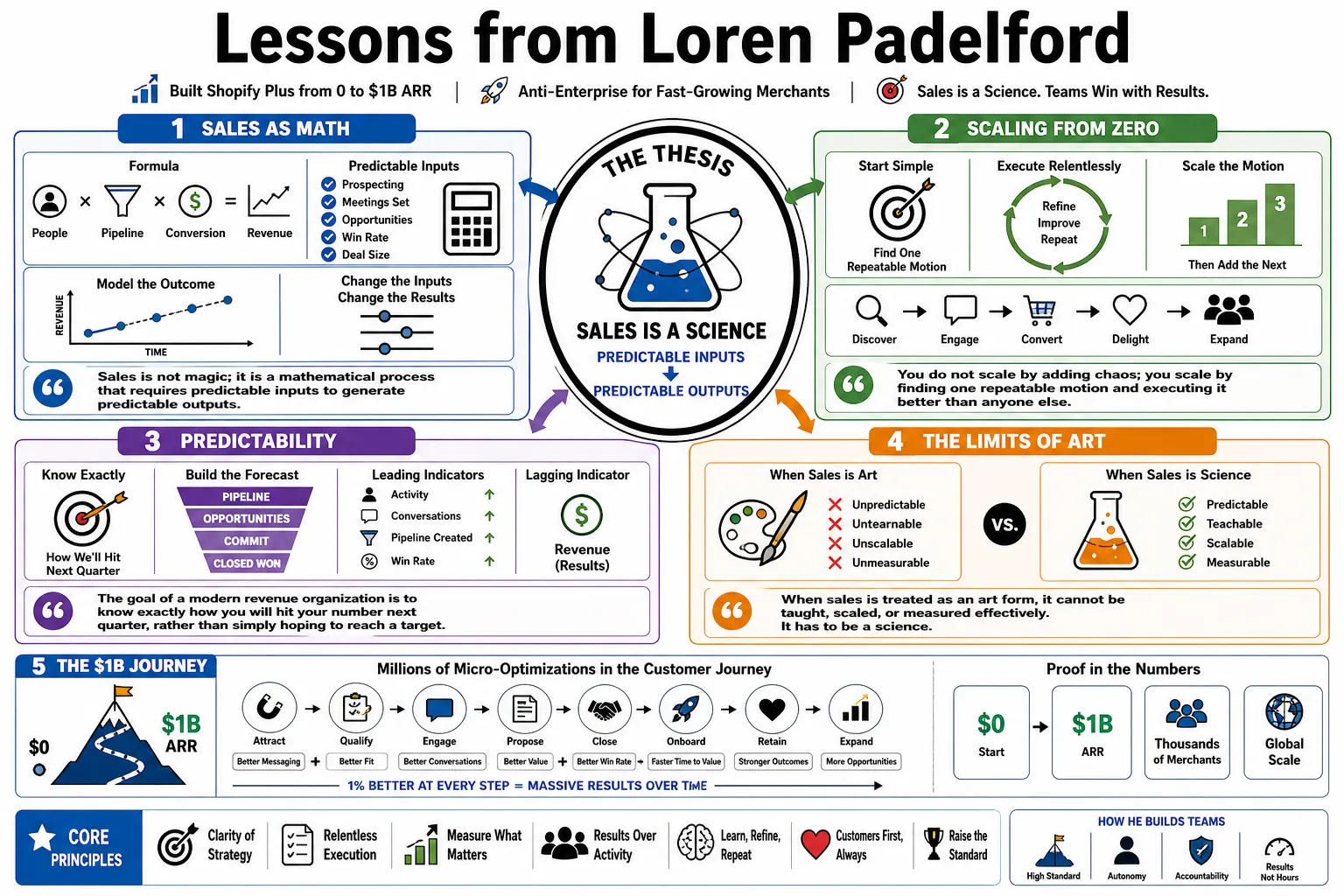
- On Sales as Math: "Sales is not magic; it is a mathematical process that requires predictable inputs to generate predictable outputs." — Source: [The Science of Scaling]
- On Scaling from Zero: "You do not scale by adding chaos; you scale by finding one repeatable motion and executing it better than anyone else." — Source: [SaaStr Podcast]
- On Predictability: "The goal of a modern revenue organization is to know exactly how you will hit your number next quarter, rather than simply hoping to reach a target." — Source: [Drift Interview]
- On The Limits of Art: "When sales is treated as an art form, it cannot be taught, scaled, or measured effectively. It has to be a science." — Source: [The Science of Scaling]
- On the One Billion Dollar Journey: "Getting to a billion in ARR is not about one massive deal; it is about millions of micro-optimizations in the customer journey." — Source: [BetaKit]
- On Deal Velocity: "Time is the enemy of all deals. The faster you can move a prospect from curiosity to value, the higher your win rate will be." — Source: [Positioning with April Dunford]
- On Funnel Metrics: "If you do not understand your conversion rates at every single stage of the funnel, you are not running a sales team; you are running a casino." — Source: [The Science of Scaling]
- On Growth Ceilings: "Most companies stop growing because their internal processes break under the weight of their own complexity, rather than because the market is tapped." — Source: [SaaStr Podcast]
- On Departmental Alignment: "Marketing and sales cannot operate as silos. They are two halves of the exact same revenue equation." — Source: [Drift Interview]
- On Constant Experimentation: "You must consistently run controlled experiments in your sales process, because what worked at ten million will break at one hundred million." — Source: [The Science of Scaling]
Part 2: Leadership and Team Building
- On Measuring Success: "Index on impact, not work. I do not care how many hours you sat at your desk; I care about what you actually achieved." — Source: [The Science of Scaling]
- On Autonomy: "Hire adults, give them clear goals, and then get out of their way. Micromanagement is a tax on high performance." — Source: [Authority Magazine]
- On Burnout: "The grind is glorified by people who do not know how to work efficiently. Sustainable growth requires rested minds." — Source: [Warren Weeks Podcast]
- On Empathy in Leadership: "You cannot lead a team effectively if you do not understand the daily friction they experience on the floor." — Source: [SaaStr Podcast]
- On Decision Making: "A good decision made today is infinitely better than a perfect decision made next month." — Source: [BetaKit]
- On Accountability: "True accountability is not about punishment when things go wrong; it is about ownership of the outcome from day one." — Source: [Drift Interview]
- On Sales Coaching: "The primary job of a sales manager is to coach their reps to close their own deals, rather than stepping in to close deals for them." — Source: [The Science of Scaling]
- On Taking Time Off: "Taking eight weeks of vacation is a structural requirement for maintaining a high-functioning executive brain." — Source: [Authority Magazine]
- On Internal Meetings: "Most internal meetings are simply a way to distribute anxiety. Default to asynchronous communication whenever possible." — Source: [SaaStr Podcast]
- On Non-Traditional Hiring: "Hire great people, not necessarily great salespeople. Some of the best reps come from teaching or hospitality." — Source: [Drift Interview]
Part 3: The Future of Retail and E-commerce
- On Pandemic Acceleration: "Covid has acted like a time machine: it brought 2030 to 2020, forcing a decade of digital transformation into a single year." — Source: [Retail Tech Podcast]
- On The End of Chains: "The era of the chains is over. The future belongs to independent merchants who can use global technology to compete." — Source: [PMQ Pizza Magazine]
- On Borderless Markets: "Globally, anything is a market. The internet has erased geographical constraints for ambitious brands." — Source: [BetaKit]
- On Customer Expectations: "Consumers no longer tolerate friction. If your checkout process takes more than three clicks, you are losing money." — Source: [Retail Tech Podcast]
- On Direct-to-Consumer Dynamics: "DTC is a fundamental restructuring of the relationship between the maker and the buyer." — Source: [The Science of Scaling]
- On Retail Evolution: "Physical retail is not dead, but boring retail is. Stores must become experiential showrooms." — Source: [Retail Tech Podcast]
- On Brand Authenticity: "In a world of infinite choices, the only sustainable competitive advantage is a deeply authentic brand story." — Source: [SaaStr Podcast]
- On Commerce Infrastructure: "Commerce is moving from a monolithic architecture to a headless, composable ecosystem where speed is paramount." — Source: [BetaKit]
- On Local Business Frontiers: "The next great frontier of commerce is giving neighborhood businesses enterprise-grade tools, rather than focusing entirely on global mega-brands." — Source: [PMQ Pizza Magazine]
Part 4: The Psychology of Buying and Selling
- On Emotional Purchasing: "People buy with emotion and justify with logic. Even in enterprise software, you are selling to a human being." — Source: [Positioning with April Dunford]
- On Active Listening: "The best salespeople talk the least. They ask surgically precise questions and then they listen aggressively." — Source: [Drift Interview]
- On Handling Rejection: "Sales is a profession of rejection. I look for people who have failed at something significant and learned how to recover." — Source: [SaaStr Podcast]
- On Intellectual Curiosity: "The most important trait in a new hire is insatiable curiosity. You can teach product knowledge; you cannot teach the desire to learn." — Source: [The Science of Scaling]
- On Compensation Behavior: "Comp plans drive behavior. If your team is doing the wrong things, look closely at exactly how you are paying them." — Source: [Drift Interview]
- On Building Trust: "You do not build trust by pitching features; you build trust by demonstrating that you deeply understand the customer's specific problem." — Source: [Positioning with April Dunford]
- On Interviewing Tactics: "Stop asking candidates where they see themselves in five years. Ask them to teach you something complicated in five minutes." — Source: [Authority Magazine]
- On Ego Management: "Check your ego at the door. The market does not care how smart you think you are; it only cares about the value you deliver." — Source: [Warren Weeks Podcast]
- On Continuous Refinement: "Training is a continuous process of psychological and tactical skill refinement, rather than an event that happens in week one." — Source: [The Science of Scaling]
Part 5: Vertical SaaS and Small Businesses
- On The SMB Playbook: "Selling to small businesses requires a completely different playbook. You must add value first, because they have zero time for traditional cold outreach." — Source: [SaaStr Podcast]
- On Independent Operators: "Vertical platforms succeed because they give independent shops the digital scale to compete with global chains." — Source: [PMQ Pizza Magazine]
- On SMB Empathy: "A small business owner is doing payroll, sweeping the floor, and dealing with vendors. Your software must solve a problem instantly." — Source: [The Science of Scaling]
- On Niche Focus: "Vertical SaaS wins by solving one hundred percent of the problems for a specific industry, rather than fifty percent of the problems for everyone." — Source: [BetaKit]
- On Local Economies: "Empowering local businesses with better technology is the most effective way to preserve the unique character of our communities." — Source: [PMQ Pizza Magazine]
- On SMB Churn: "In the SMB space, churn is often a function of business failure rather than software dissatisfaction. You have to help them survive to keep them as customers." — Source: [SaaStr Podcast]
- On Mobile Setup: "If an independent operator cannot set up your tool on their phone while waiting for a delivery, the process is too complicated." — Source: [The Science of Scaling]
- On Tool Consolidation: "Small businesses do not want ten different logins. They want one unified operating system for their entire business." — Source: [Retail Tech Podcast]
- On Vertical Networks: "The true power of vertical SaaS lies in building a powerful network effect within a specific industry, rather than simply providing workflow automation." — Source: [BetaKit]
Part 6: Rethinking Enterprise and Go-to-Market Strategy
- On The Anti-Enterprise Stance: "We built Shopify Plus as an anti-enterprise solution, intentionally stripping away the bloat, the implementation fees, and the multi-year timelines." — Source: [The Science of Scaling]
- On Legacy Software: "Traditional enterprise software is designed to trap the customer. Modern software must be designed to empower them." — Source: [Positioning with April Dunford]
- On Procurement Friction: "If your software requires a nine-month procurement process, you are building for the past." — Source: [SaaStr Podcast]
- On Agility Over Complexity: "High-growth merchants do not want to buy an IT project; they want to buy a business outcome that deploys in weeks." — Source: [BetaKit]
- On Pricing Transparency: "Enterprise pricing has historically been a black box. Transparency is now a highly effective competitive weapon." — Source: [Positioning with April Dunford]
- On Value Realization: "The clock starts ticking the moment the contract is signed. Time-to-value is the most important metric in SaaS." — Source: [The Science of Scaling]
- On Disrupting Incumbents: "You disrupt legacy incumbents by ruthlessly removing friction from the buying and onboarding process, instead of building more features." — Source: [SaaStr Podcast]
- On Product-Led Growth: "Your product should do the heavy lifting in the sales process. If it requires a fifty-page manual to understand, it is fundamentally broken." — Source: [Drift Interview]
- On Market Stratification: "Software markets are stratifying. You must decide exactly who you serve and intentionally ignore the rest." — Source: [SaaStr Podcast]
- On Onboarding Trajectories: "Your onboarding process sets the trajectory for a customer's entire lifetime value. Do not cut corners in the first thirty days." — Source: [The Science of Scaling]
Part 7: Career Trajectory and Personal Philosophy
- On Choosing Success: "Success is a choice we all make every day. It requires deliberate, consistent action over long periods of time." — Source: [Authority Magazine]
- On Non-Linear Paths: "Career trajectories are rarely linear. Starting in photocopier sales taught me more about human psychology than any business textbook." — Source: [Authority Magazine]
- On Skill Adaptation: "The exact skillset that got you to a VP role is not the same skillset that will make you a successful C-level executive." — Source: [Warren Weeks Podcast]
- On Professional Focus: "You can only be world-class at two or three things at a time. Everything else is distraction pulling you away from your goals." — Source: [The Science of Scaling]
- On Taking Risks: "Taking career risks is absolutely essential. If you are not slightly terrified by your next role, you are not truly growing." — Source: [Authority Magazine]
- On Work-Life Integration: "Being a dedicated parent and pursuing hobbies like DJing makes me a sharper executive, rather than a distracted one." — Source: [Warren Weeks Podcast]
- On Building Pipelines: "Scaling a company requires building a leadership pipeline internally. You cannot constantly import your executives from the outside." — Source: [SaaStr Podcast]
- On Diversity of Thought: "If everyone on your revenue team looks and thinks exactly the same, you have a massive strategic blind spot." — Source: [Drift Interview]
- On Necessary Terminations: "Delaying letting someone go who is a poor fit is unfair to the company, the team, and most importantly, to the individual." — Source: [The Science of Scaling]
Part 8: The Impact of Technology and Automation
- On Purposeful Automation: "Tools like Shopify Flow are about freeing human capital from repetitive, low-value tasks, rather than eliminating jobs." — Source: [Retail Tech Podcast]
- On Artificial Intelligence: "Artificial intelligence will not replace salespeople, but salespeople who use AI will rapidly replace those who do not." — Source: [Positioning with April Dunford]
- On Data Hygiene: "Your insights are only as good as your data. If your CRM is a mess, your strategic decisions will inevitably be wrong." — Source: [The Science of Scaling]
- On Blockchain Potential: "Technologies like blockchain have the potential to fundamentally rewire supply chain transparency and consumer trust." — Source: [Retail Tech Podcast]
- On Regulated Expansion: "Expanding into regulated markets like cannabis forces a platform to mature its compliance and security architecture at an accelerated pace." — Source: [Retail Tech Podcast]
- On Asynchronous Messaging: "The phone call is dying. Asynchronous messaging is how modern consumers want to interact with local businesses." — Source: [Warren Weeks Podcast]
- On Technical Debt: "In hyper-growth, technical debt is inevitable. The trick is knowing which debt to pay down immediately and which to simply ignore." — Source: [BetaKit]
- On Mobile-First Reality: "We passed the mobile tipping point years ago. If your platform is not fully functional on a smartphone, it is functionally irrelevant." — Source: [SaaStr Podcast]
- On the Ultimate Goal of Tech: "The true purpose of business technology is to fade completely into the background so the merchant can focus entirely on their craft." — Source: [PMQ Pizza Magazine]