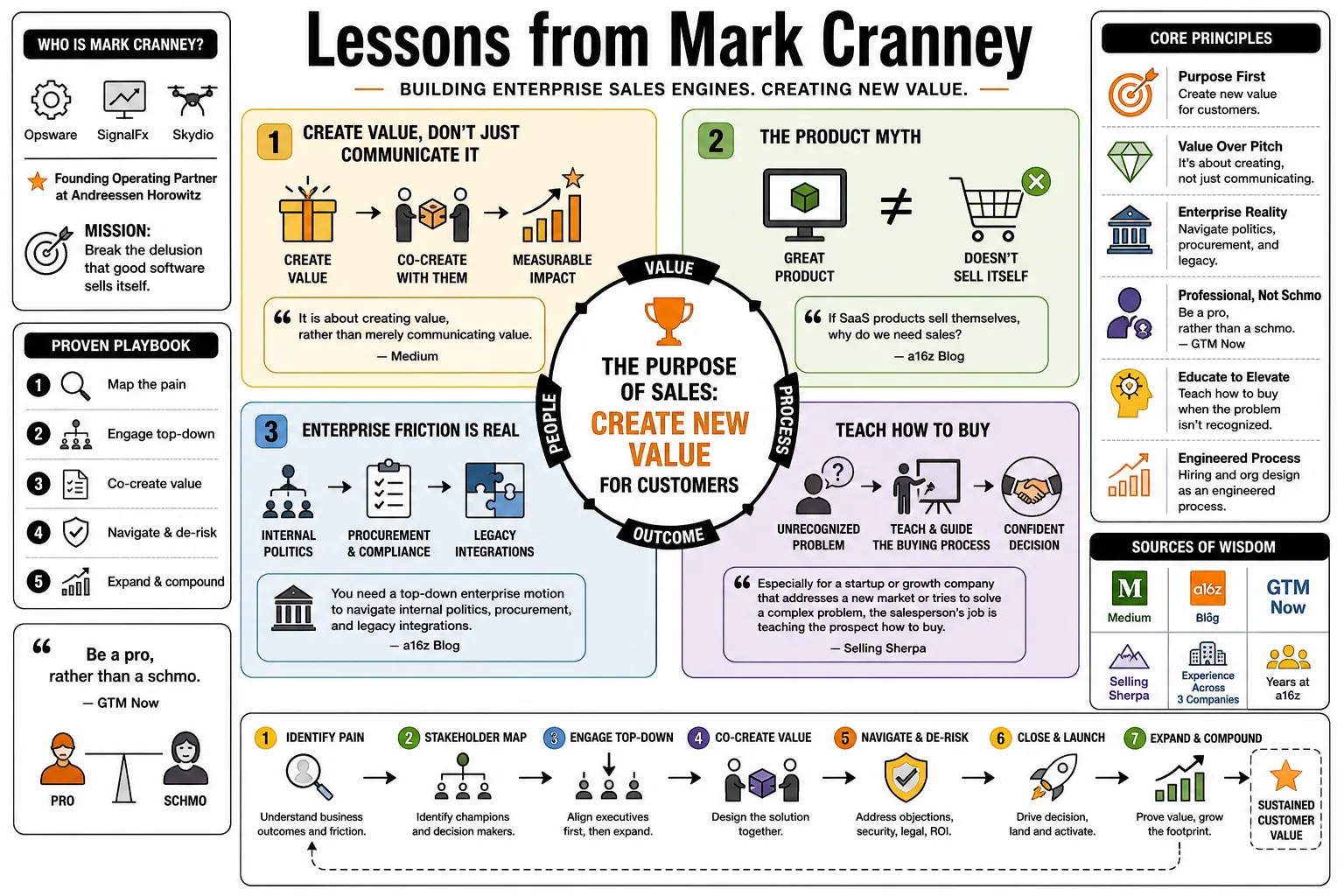
Lessons from Mark Cranney
Mark Cranney built the enterprise sales engines for Opsware, SignalFx, and Skydio. As a founding operating partner at Andreessen Horowitz, he spent years breaking technical founders of the delusion that good software sells itself. His frameworks strip the mystery out of enterprise sales, treating hiring and organizational pain mapping as a strictly engineered process.
Part 1: The Core Philosophy of Sales
- On The Purpose of Sales: "The true purpose of sales is to create new value for customers." — Source: Medium
- On Creating Value: "It is about creating value, rather than merely communicating value." — Source: Medium
- On The Product Myth: "If SaaS products sell themselves, why do we need sales?" — Source: a16z Blog
- On Enterprise Friction: "You need a top-down enterprise motion to navigate internal politics, procurement, and legacy integrations." — Source: a16z Blog
- On The Profession: "Be a pro, rather than a schmo." — Source: GTM Now
- On Solving Unrecognized Problems: "Especially for a startup or growth company that addresses a new market or tries to solve a complex problem, the salesperson's job is teaching the prospect how to buy." — Source: Selling Sherpa
- On Incumbents: "Terrorize incumbents by weaponizing your product's unique technical advantages." — Source: Selling Sherpa
- On The Sales Ecosystem: "Sales is a team sport requiring tight alignment between product, marketing, and the field." — Source: GTM Now
- On Sales as Consulting: "The best salespeople act as consultants who help the customer navigate internal politics and technical hurdles." — Source: Selling Sherpa
- On The Real Competitor: "One of the biggest competitors in enterprise sales is the prospect's tendency to do nothing." — Source: a16z Blog
Part 2: Process, Playbooks, and Discipline
- On Process Over Heroics: "A repeatable process always triumphs over individual hero sales reps." — Source: Medium
- On Sales Leaders: "CEOs should hire sales leaders who can build a playbook instead of those who only know how to execute an existing one." — Source: GTM Now
- On Pitch Certification: "Reps must pitch-certify on every stage of the deal in a rigorous 90-day bootcamp." — Source: Selling Sherpa
- On Unconscious Competence: "Train reps until their knowledge of the product and process becomes second nature." — Source: Medium
- On Scaling Revenue: "Moving sales from a personality-driven activity to an engineering-like process is how you scale." — Source: The Hard Thing About Hard Things
- On Forecasting Errors: "Accurate forecasting requires a scalable methodology to avoid common traps like the 'Fifty/Fifty Freddie' approach." — Source: Medium
- On The Playbook's Scope: "A playbook must be a comprehensive document covering everything from hiring profiles to technical validation steps." — Source: The Hard Thing About Hard Things
- On Foundational Alignment: "A bootcamp ensures sales, marketing, and product groups sing from the same sheet of music." — Source: GTM Now
- On Skipping Steps: "Founders should avoid outsourcing sales process design or enablement too early." — Source: a16z Blog
Part 3: Hiring, Talent, and "The Pro Mindset"
- On Intelligence and Empathy: "Look for high IQ and EQ to ensure both intelligence and emotional awareness." — Source: Selling Sherpa
- On Courage: "Hire for the courage to push through resistance, go around gatekeepers, and challenge prospect assumptions." — Source: Selling Sherpa
- On Competitive Spirit: "Look for a track record of progression and a competitive student-of-the-game mentality." — Source: GTM Now
- On Progression: "Competence leads to confidence, which leads to conviction, which leads to courage." — Source: Selling Sherpa
- On Preparation: "To operate professionally, you must consume data, study, practice, drill, and rehearse continuously." — Source: GTM Now
- On Strengths: "Hire for specific strengths rather than attempting to fix a candidate's weaknesses." — Source: Selling Sherpa
- On The Wrong Profile: "I avoid hiring guys who failed the engineering test and simply put on a clean shirt." — Source: The Hard Thing About Hard Things
- On Perseverance: "Enterprise reps need the grit to survive a tortuous, multi-quarter buying process." — Source: Selling Sherpa
- On Stage Presence: "Seek reps with the 'woo' factor, defined as the ability to win others over and command a room." — Source: Selling Sherpa
- On Frontline Work: "Getting shot at and shooting back on the front lines is far more fun than sitting on the sidelines." — Source: Medium
Part 4: Competitive Strategy and Execution
- On Setting Traps: "If you are not laying competitive traps, you are stepping in them." — Source: Selling Sherpa
- On Shaping the Deal: "Laying traps means working with the prospect early to define the evaluation criteria in a way that favors your unique strengths." — Source: Selling Sherpa
- On Reactive Selling: "If you wait for the prospect to send an RFP, you are stepping into a trap laid by a competitor who arrived earlier." — Source: Medium
- On Exposing Weaknesses: "Define criteria that highlight your strengths while actively exposing competitor deficiencies." — Source: Selling Sherpa
- On Proof of Concepts: "The technical validation event is where traps are sprung. Un-defined success metrics allow competitors to highlight your missing features." — Source: Medium
- On Differentiation: "Answering 'why you' over someone else is the specific purpose of technical validation events." — Source: Selling Sherpa
- On Multi-Level Selling: "You must lay traps at three distinct levels inside an organization: CxO, middle management, and individual users." — Source: Selling Sherpa
- On Boxing Out: "Help the customer navigate their internal hurdles while simultaneously boxing out the competition." — Source: GTM Now
- On Controlling the Narrative: "Buying criteria are never neutral. If you fail to influence them, your competitor will dictate the terms." — Source: Selling Sherpa
Part 5: Creating vs. Communicating Value
- On The Definition of Value Creation: "The value of a go-to-market organization is helping customers determine what their buying criteria should be." — Source: Medium
- On Unknown Needs: "You often sell a product the customer did not realize they needed, making it your job to frame the problem." — Source: The Hard Thing About Hard Things
- On Moving Beyond Features: "Solve unrecognized business problems instead of simply showing and telling product features." — Source: a16z Blog
- On Teaching the Customer: "The salesperson must help the customer define their requirements in a way that favors the startup's architecture." — Source: a16z Blog
- On Business Alignment: "Value is created when you map technology capabilities directly to high-level corporate initiatives." — Source: Medium
- On Strategic Value: "At the CxO level, value creation means focusing entirely on strategic vision and ROI." — Source: Selling Sherpa
- On Operational Value: "For middle management, creating value means demonstrating operational efficiency and offering peace of mind." — Source: Selling Sherpa
- On End-User Value: "For the individual user, value is created by proving ease of use and showing how the software makes their daily work better." — Source: Selling Sherpa
- On Worldview Shifts: "Creating value means fundamentally changing how the prospect views their business problem and the available solutions." — Source: Medium
Part 6: Building the Go-To-Market Organization
- On Institutionalizing GTM: "Go-to-market is a core competency that must be treated as rigorously as product engineering." — Source: a16z Blog
- On Turnaround Mechanics: "Building a world-class sales organization is what takes a company from a near-death experience to a massive acquisition." — Source: The Hard Thing About Hard Things
- On Operational Breadth: "I prefer the granularity of operating day-to-day across sales, marketing, customer success, and product." — Source: Medium
- On Executive Alignment: "Establish an Executive Briefing Center to systematically connect startup founders with executives from the Fortune 500." — Source: a16z Blog
- On Product Synergy: "Sales and product management must work together closely. Bring product managers into the field to hear customer objections firsthand." — Source: Medium
- On Defining Roles: "Founders need to be intimately involved in defining the sales playbook instead of handing it off to early hires." — Source: a16z Blog
- On System Builders: "CEOs require an executive who can build a mechanical system, rather than a big personality who relies on closing skills." — Source: The Hard Thing About Hard Things
- On Granularity: "A successful GTM organization requires extreme operational granularity and the drill discipline of a football team." — Source: GTM Now
- On Bootstrapping GTM: "Technical founders must accept that capturing market share requires a repeatable, rigorous enterprise process." — Source: a16z Blog
Part 7: Enterprise Sales Tactics and "The Three Whys"
- On The Three Whys: "Every successful enterprise deal must definitively answer three questions: Why buy? Why you? Why now?" — Source: Medium
- On 'Why Buy?': "You must establish the overarching business case for change and identify the core business pain." — Source: Selling Sherpa
- On 'Why You?': "Define the unique competitive advantage that makes your solution the only logical choice." — Source: Selling Sherpa
- On 'Why Now?': "Establish the compelling event or the financial cost of inaction to force a timeline." — Source: Selling Sherpa
- On Qualification: "The selling process proceeds smoothly if you qualify the prospect correctly. Most friction comes from skipping this step." — Source: Medium
- On The MEDDICC Framework: "Utilize the MEDDICC methodology to qualify deals properly and ensure a scalable process." — Source: Medium
- On The Five-Quarter Forecast: "Transition to a rolling five-quarter forecast to demand extreme predictability from your revenue leaders." — Source: The Hard Thing About Hard Things
- On Navigating Levels: "Always map the distinct buying criteria across the CxO, middle management, and individual user tiers." — Source: Selling Sherpa
- On Overcoming Resistance: "Success requires the courage to challenge a prospect's assumptions rather than accepting their initial stated needs." — Source: GTM Now
Part 8: Market Transitions and Founder Advice
- On Technical Founders: "Founders who believe their code will sell itself must unlearn this assumption to survive in the enterprise sector." — Source: a16z Blog
- On Software versus Hardware: "While innovation happens in software, developing custom hardware is sometimes necessary to fully capitalize on autonomous capabilities." — Source: Skydio Press
- On Hardware Transitions: "The first chapter of a market story is written by hardware-centric solutions, while the next is led by software and autonomy." — Source: Skydio Press
- On American Innovation: "We proved that an American company can compete and set the standard in the hardware industry." — Source: Skydio Press
- On Fear of Sales: "You sell. Get over your aversion to it and embrace the function as critical to survival." — Source: Medium
- On The Timing of Sales Hires: "The right time to hire your first sales leader depends on achieving repeatable product-market fit, not a finished codebase." — Source: a16z Blog
- On Sales Culture: "Build a high-performance sales culture that avoids feeling toxic to the engineering team by rooting the process in deep technical knowledge." — Source: a16z Blog
- On Market Evolution: "Every business is transitioning into a software company, creating broad innovation opportunities across all sectors." — Source: Medium
- On Turnarounds: "A near-death corporate turnaround requires professionalizing the sales force above all other operational changes." — Source: The Hard Thing About Hard Things
- On The Ultimate Goal: "The objective is to build a professional discipline that scales your company's revenue predictably and relentlessly." — Source: Medium