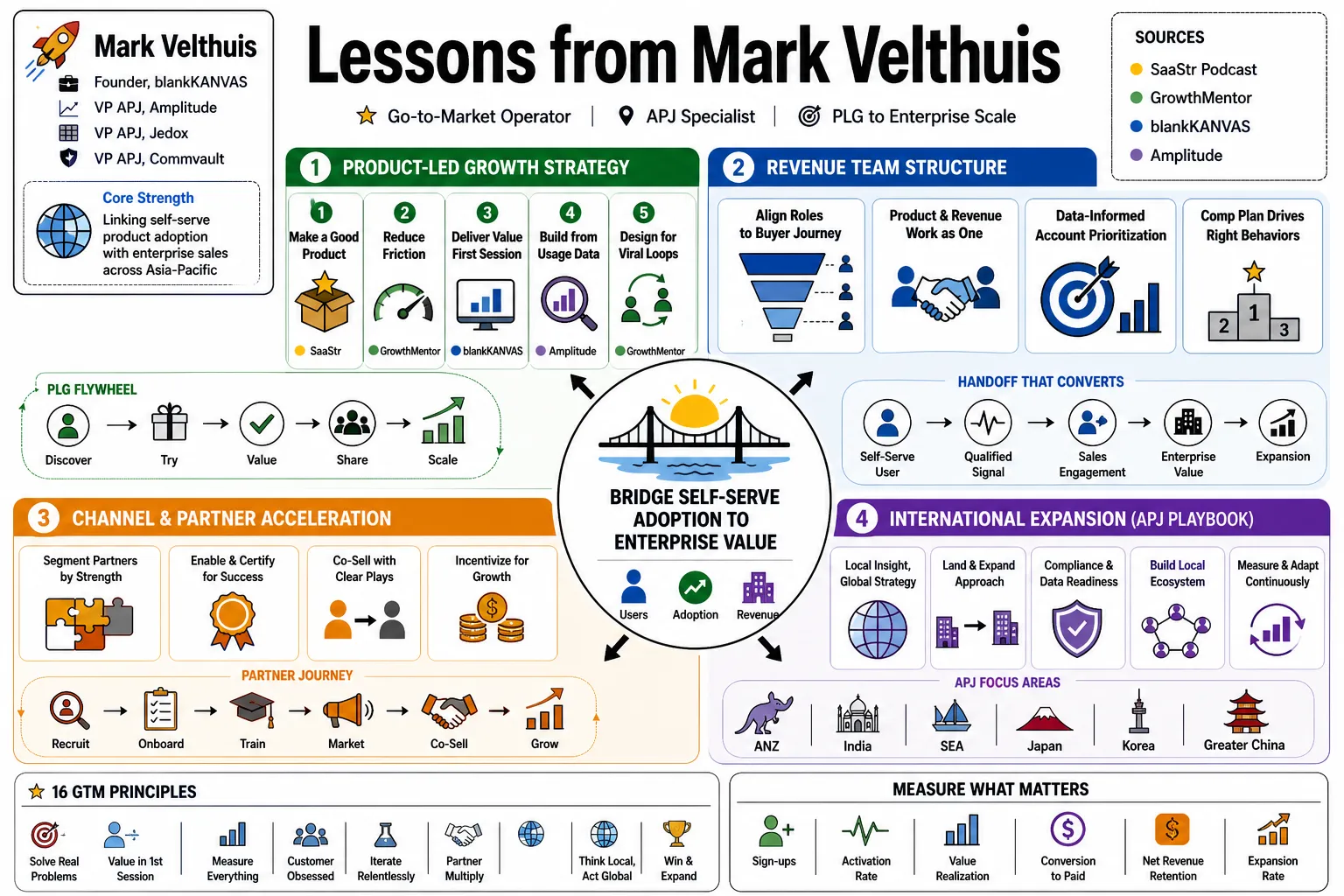
Lessons from Mark Velthuis
Mark Velthuis is a go-to-market operator and the founder of blankKANVAS, having previously served as VP of APJ for Amplitude, Jedox, and Commvault. He specializes in linking self-serve product adoption with enterprise sales across the Asia-Pacific. This collection details his methods for structuring revenue teams, managing channel partnerships, and expanding internationally.
Part 1: Product-Led Growth Strategy
- On the foundation of PLG: "The absolute prerequisite for any product-led motion is simply making a good product that solves a real problem; without that, no amount of marketing will sustain growth." — Source: SaaStr Podcast
- On user friction: "Reducing friction in the initial user experience is the primary mechanism for accelerating self-serve adoption in software." — Source: GrowthMentor
- On trial conversions: "A high volume of free sign-ups is meaningless if the product doesn't deliver immediate, measurable value within the first session." — Source: blankKANVAS
- On feature development: "Features should be prioritized based on user telemetry and actual usage data, rather than on what sales thinks will close the next deal." — Source: Amplitude
- On viral loops: "Built-in collaboration tools often serve as the most effective organic growth engine for B2B applications." — Source: GrowthMentor
- On product-qualified leads (PQLs): "A true PQL is a user who has triggered specific behaviors that correlate historically with enterprise upgrades, rather than someone who merely logged in three times." — Source: SaaStr Podcast
- On retention over acquisition: "If your churn rate outpaces your self-serve acquisition, you have a product problem, not a top-of-funnel problem." — Source: blankKANVAS
- On the role of marketing in PLG: "Marketing in a PLG model shifts from generating leads for sales to generating active users for the product." — Source: Commio
- On early monetization: "Introducing a paywall too early can stifle organic growth, but waiting too long trains your user base to expect permanent free access." — Source: GrowthMentor
- On data-driven iteration: "Every product change must be treated as an experiment where the success metric is predefined and tied to user engagement." — Source: Amplitude
Part 2: Sales-Led Growth Dynamics
- On the necessity of sales: "Certain enterprise deals, especially those involving complex integrations and security reviews, will never close through a self-serve checkout." — Source: SaaStr Podcast
- On outbound strategy: "Cold outreach is most effective when it is hyper-targeted and references specific business pain points rather than generic product features." — Source: blankKANVAS
- On deal velocity: "Enterprise sales cycles are inherently slow; the goal is to map the buyer's internal procurement process as early as possible to prevent late-stage stalls." — Source: GrowthMentor
- On value selling: Velthuis frames B2B sales around solving business problems and building a predictable revenue engine, not merely demonstrating features. — Reference: GrowthMentor profile on scalable growth and predictable revenue
- On executive sponsors: "No major software deal closes without an executive sponsor who sees the purchase as a strategic win for their own career." — Source: blankKANVAS
- On qualifying out: "The best sales reps know how to disqualify bad-fit prospects early to protect their own time and forecasting accuracy." — Source: GrowthMentor
- On handling objections: The better sales move is to treat buyer resistance as diagnostic input: understand what is holding the business back, then connect the sales process to that problem. — Reference: Do The Job episode on sales, growth, and business success
- On post-sale handoffs: "A broken transition from sales to customer success is the fastest way to guarantee a non-renewal twelve months down the line." — Source: blankKANVAS
- On forecasting discipline: "Accurate forecasting requires separating happy ears from verifiable steps the buyer has taken toward a signature." — Source: GrowthMentor
- On enterprise procurement: Enterprise selling has to account for the executives involved in the buying path; Velthuis describes work across IT, product, data, finance, and legal buyers. — Reference: GrowthMentor profile on B2B SaaS go-to-market work
Part 3: Blending PLG and SLG
- On the hybrid motion: "The most resilient SaaS companies eventually realize that product-led and sales-led motions are not mutually exclusive, but consecutive stages of scale." — Source: SaaStr APAC
- On sales timing: "The exact moment to inject a sales rep into a PLG motion is when product usage indicates the account has hit a ceiling that requires organizational buy-in to break through." — Source: SaaStr Podcast
- On rep behavior: "Sales professionals in a hybrid model must act more like consultants helping users unlock advanced value, rather than traditional hunters trying to force a close." — Source: GrowthMentor
- On compensation: "If you want sales teams to support product-led initiatives, you must align their compensation structures so they aren't penalized for deals that start as self-serve." — Source: blankKANVAS
- On data visibility: "Sales teams must have real-time visibility into product usage data to understand exactly how a prospect is already interacting with the software." — Source: Amplitude
- On bottom-up adoption: "Use the product to win the end-users, and use the sales team to win the CIO and the budget." — Source: SaaStr Podcast
- On preventing conflict: "Clear rules of engagement are required to prevent sales reps from aggressively calling users who simply want to be left alone to use the free tier." — Source: blankKANVAS
- On identifying expansion: "The best enterprise leads often sit in your existing user base, disguised as multiple individuals from the same domain signing up for separate free accounts." — Source: SaaStr APAC
- On organizational alignment: "Marketing, product, and sales can no longer operate in silos; a blended model requires a unified revenue operations function to manage the handoffs." — Source: SaaStr Podcast
Part 4: Scaling in the APAC Market
- On regional diversity: "Treating Asia-Pacific as a single homogenous market is the most common mistake western companies make; it is a collection of highly distinct regulatory and cultural environments." — Source: Tech in Asia
- On market saturation: "In heavily saturated markets like fintech in APAC, continuous product improvement is the primary driver of long-term retention." — Source: GrowthMentor
- On localizing strategy: "Go-to-market strategies that worked perfectly in North America often require fundamental rewiring to succeed in markets like Japan or Southeast Asia." — Source: blankKANVAS
- On relationship building: "In many Asian markets, business relationships must be cultivated deeply on a personal level before commercial trust is established." — Source: Tech in Asia
- On talent acquisition: "Scaling in APJ requires hiring local leaders who understand the nuances of their specific sub-regions rather than managing entirely from a central hub." — Source: GrowthMentor
- On pricing sensitivity: "Southeast Asia often requires different pricing tiers and packaging than the US market to align with local purchasing power and procurement norms." — Source: blankKANVAS
- On data sovereignty: "Navigating the varied data privacy and hosting regulations across different APAC countries is a primary hurdle for SaaS deployment in the region." — Source: Amplitude
- On channel reliance: "In regions like Japan, strong local channel partners and distributors are often strictly required to gain access to enterprise buyers." — Source: Tech in Asia
- On market entry: "Establishing a beachhead in Singapore or Australia is the standard playbook, but expanding from there requires distinct strategies for each subsequent country." — Source: GrowthMentor
- On long-term commitment: "Headquarters must be prepared to invest in the APAC region with a multi-year horizon; expecting immediate ROI usually leads to premature market exit." — Source: blankKANVAS
Part 5: Leadership and Go-To-Market Execution
- On leadership focus: "A GTM leader's primary job is removing internal friction so the sales and product teams can focus entirely on the customer." — Source: blankKANVAS
- On metrics: "Tracking too many KPIs creates operational noise; teams should focus on the two or three metrics that directly correlate to revenue and retention." — Source: GrowthMentor
- On organizational design: Velthuis treats GTM design as a choice among direct, indirect, and blended routes to market, with roles and country strategy matched to the market being opened. — Reference: GrowthMentor profile on APAC go-to-market strategy
- On cross-functional trust: "Revenue growth stalls when sales and product teams operate as adversaries rather than collaborators." — Source: blankKANVAS
- On hiring criteria: "Look for adaptability and a track record of problem-solving over industry-specific Rolodexes when hiring early-stage GTM leaders." — Source: GrowthMentor
- On strategy execution: "A mediocre strategy executed with intense discipline will always outperform a brilliant strategy that lacks operational follow-through." — Source: blankKANVAS
- On customer feedback: Velthuis emphasizes understanding customer impact: at Amplitude he connected product analytics to better product experiences, engagement, retention, and sales outcomes. — Reference: Amplitude announcement on Velthuis leading APJ sales
- On resource allocation: "Investing too heavily in top-of-funnel marketing before fixing a leaky retention bucket is a fast way to burn through capital." — Source: blankKANVAS
- On adapting to change: "The go-to-market playbook must be continuously rewritten as a company scales from ten million to fifty million and beyond." — Source: GrowthMentor
Part 6: Navigating Failures and Growth Mindset
- On the nature of failure: "A true growth mindset views operational setbacks and lost deals as mandatory tuition fees for learning the market." — Source: GrowthMentor
- On post-mortems: "Failing is only acceptable if it is followed by a rigorous, blameless analysis of what broke and how to prevent it from happening again." — Source: blankKANVAS
- On iteration: "The willingness to iterate quickly based on flawed initial launches is a stronger predictor of success than trying to engineer a perfect release." — Source: GrowthMentor
- On accountability: His leadership model starts with honest diagnosis: assess where the business is, what route to market fits, and what team design can realistically execute. — Reference: GrowthMentor profile on GTM leadership and strategy
- On lost deals: "Reviewing a lost enterprise deal often yields more actionable intelligence about product gaps than analyzing ten closed-won deals." — Source: blankKANVAS
- On resilience: "Sales teams must be culturally conditioned to handle high volumes of rejection without it affecting their performance on the next call." — Source: GrowthMentor
- On experimenting: "Teams should be given a safe environment to run controlled experiments with messaging and outreach, even if a portion of them fail." — Source: blankKANVAS
- On pivoting: "Recognizing when a market segment is fundamentally unresponsive and pivoting resources away is a required survival skill." — Source: GrowthMentor
- On personal growth: Velthuis links career growth to curiosity and guided development: the Do The Job episode presents his advice on carving out a career in business success. — Reference: Do The Job episode on career growth and business success
Part 7: Financial Planning and Data Analytics
- On digital transformation in finance: "The digitization of finance teams is no longer optional; it is required to provide the real-time modeling necessary for agile decision-making." — Source: FutureCFO PodChats
- On the impact of AI: "AI in financial planning and analysis shifts the finance function from reporting historical data to predicting future market scenarios." — Source: FutureCFO PodChats
- On data silos: "When sales, marketing, and finance operate off different datasets, management spends all its time arguing about the numbers instead of the strategy." — Source: Jedox Insights
- On agile forecasting: "Annual budgeting cycles are too rigid for modern software models; companies must adopt rolling forecasts to adapt to market volatility." — Source: FutureCFO PodChats
- On metrics that matter: "Digital analytics must move beyond surface-level vanity metrics and focus on specific user actions that correlate with long-term retention." — Source: Amplitude
- On scenario planning: "The ability to quickly model best, worst, and most-likely scenarios was proven essential during recent global market disruptions." — Source: FutureCFO PodChats
- On aligning sales and finance: "Sales compensation plans must be modeled carefully by finance to ensure that the behaviors being incentivized actually drive profitable growth." — Source: Jedox Insights
- On data democratization: "Putting actionable data directly into the hands of frontline managers empowers them to make localized decisions without waiting for central approval." — Source: Amplitude
- On predictive modeling: "Using historical telemetry to predict which accounts are likely to churn allows customer success to intervene before the decision is final." — Source: Jedox Insights
Part 8: Partnerships and Indirect Channels
- On the value of channels: "A strong indirect sales channel provides access to relationships and regional markets that a direct sales force would take years to penetrate." — Source: Commio
- On partner alignment: "Partnerships fail when vendors view them purely as outsourced sales rather than as businesses that need their own margin and strategic wins." — Source: blankKANVAS
- On cloud alliances: "Deep integrations with major cloud providers like AWS or Microsoft are often table stakes for enterprise procurement approval." — Source: GrowthMentor
- On technical enablement: "You cannot expect partners to sell a complex technical product if you do not invest heavily in training their pre-sales engineers." — Source: blankKANVAS
- On channel conflict: "Clear deal registration programs are mandatory to prevent direct sales reps from competing with channel partners over the same accounts." — Source: Commio
- On selecting partners: "Fewer, highly committed partners are vastly more effective than a massive directory of passive resellers who never proactively pitch the product." — Source: blankKANVAS
- On OEM relationships: "Embedding your technology within another company's platform through an OEM model can provide massive scale, but requires relinquishing control of the end-user relationship." — Source: GrowthMentor
- On joint marketing: "Co-marketing funds should be tied strictly to demand generation activities that produce measurable pipeline, rather than brand awareness events." — Source: blankKANVAS
- On the partner ecosystem: "A mature SaaS company doesn't just sell software; it builds an ecosystem of service providers, integrators, and consultants around its core platform." — Source: Commio