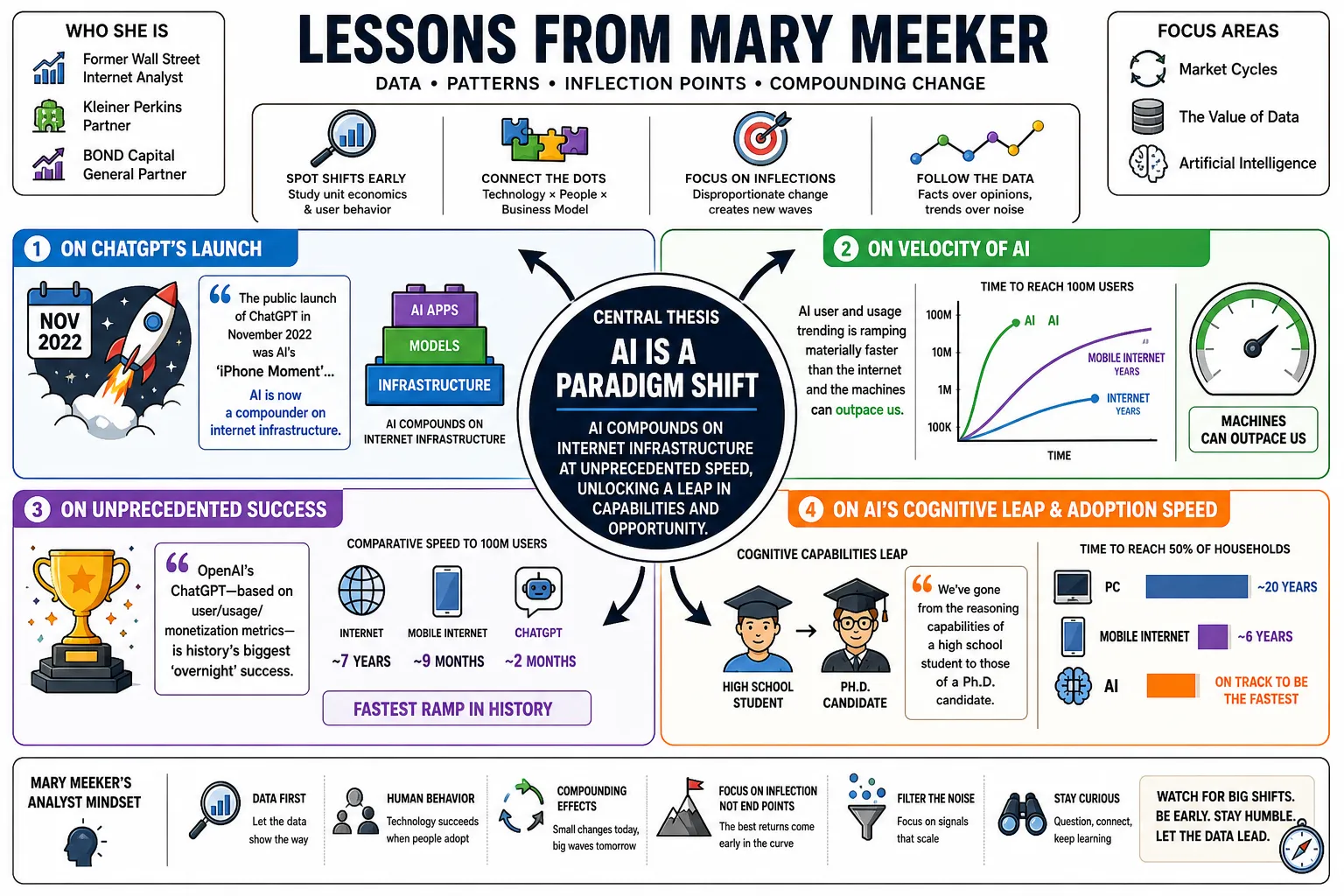
Mary Meeker is a venture capitalist and former Wall Street analyst whose data-dense Internet Trends reports tracked the shift from desktop to mobile. During her time at Morgan Stanley, Kleiner Perkins, and BOND Capital, she spotted technological shifts early by studying unit economics and user behavior. This profile collects her observations on market cycles, the value of data, and artificial intelligence.
Part 1: The AI Paradigm Shift
- On ChatGPT's Launch: "The public launch of ChatGPT in November 2022 was AI's 'iPhone Moment'… AI is now a compounder on internet infrastructure." — Source: [BOND Capital]
- On the Velocity of AI: "AI user and usage trending is ramping materially faster than the internet and the machines can outpace us." — Source: [BOND Capital]
- On Unprecedented Success: "OpenAI's ChatGPT—based on user/usage/monetization metrics—is history's biggest 'overnight' success." — Source: [ZDNet]
- On AI's Cognitive Leap: "We've gone from the reasoning capabilities of a high school student to those of a Ph.D. candidate." — Source: [ZDNet]
- On Adoption Speed: "While the PC took 20 years to reach 50% of households and the mobile internet took 6 years, AI is on track to reach that saturation point in roughly 3 years." — Source: [Forbes]
- On Capital Expenditure: "The Big Six tech giants spent $212 billion on AI-related capital expenditures in 2024 alone—a 63% year-over-year increase." — Source: [Substack]
- On the Cost of Computing: "The cost of running AI models, or inference, has dropped by 99.7% over the last two years." — Source: [Mindset AI]
- On the "Dog Year" Pace: "If a year in the internet business was like a 'dog year,' AI's pace is even more extreme, driven by 260% annual growth in training data since 2010." — Source: [Mindset AI]
- On Wealth Dynamics: "AI is an arena for intense competition the likes of which we've never seen before, creating a period for lots of wealth creation and wealth destruction." — Source: [BOND Capital]
- On the Point of No Return: "One thing is certain—it's gametime for AI, and it's only getting more intense… and the genie is not going back in the bottle." — Source: [BOND Capital]
Part 2: Investing & Valuation Metrics
- On Sustainable Customer Acquisition: "Customer Acquisition Cost must be lower than Lifetime Value, ideally aiming for a ratio of 3:1 or higher." — Source: [CMSWire]
- On Unsustainable Spending: "As internet penetration passed 50%, new growth is harder to find, leading to higher Customer Acquisition Costs which are becoming unsustainable." — Source: [Splunk]
- On Growth vs. Profitability: "The Rule of 40 is a key benchmark for software companies, where a company’s Growth Rate plus Profit Margin should equal at least 40%." — Source: [That Was The Week]
- On Valuation Expansion: "Companies with high retention and 'Rule of 40' compliance can see their Enterprise Value to Revenue multiples expand significantly." — Source: [That Was The Week]
- On Product-Led Growth: "A high Free-to-Paid Conversion Rate indicates a product-led growth engine that reduces the need for expensive sales teams." — Source: [Substack]
- On Pricing Power: "Average Revenue Per User points to which companies have the most headroom for price increases or better ad targeting." — Source: [Substack]
- On User Stickiness: "A high ratio of Daily Active Users to Monthly Active Users indicates 'stickiness,' which justifies a higher valuation multiple." — Source: [Glocal Partners]
- On Time Spent vs. Ad Spend: "If users spend 25% of their time on mobile but mobile only gets 15% of ad spend, there is a valuation gap or opportunity for growth." — Source: [BOND Capital]
- On Late-Stage Returns: "Top-tier internet companies are typically valued on EV/Revenue multiples which range from 3x to 10x depending on growth." — Source: [Forbes]
- On E-commerce Displacement: "Tracking e-commerce as a percentage of total retail helps value the displacement potential of internet companies against legacy incumbents." — Source: [Splunk]
Part 3: Data as Strategy & The Privacy Paradox
- On the Value of Data: "The rapid rise of gathered and analyzed digital data is often core to the holistic success of the fastest growing and most successful companies of our time." — Source: [American Marketing Association]
- On Data Firehoses: "Core constituents of consumers, businesses, and regulators are increasingly drinking from a data firehose and management challenges continue to rise for all parties." — Source: [Silicon Republic]
- On Privacy Trade-offs: "Privacy concerns are high but they're moderating... Users are more likely to share data for benefits." — Source: [Silicon Republic]
- On Love and Hate with Tech: "Just because I hate you doesn't mean I don't love you, referring to how consumers value the benefits of data-driven services while fearing the loss of privacy." — Source: [Silicon Republic]
- On Personalization: "Companies are increasingly using data to provide highly personalized consumer experiences, unlocking underutilized assets." — Source: [eBay Inc.]
- On Visual Data Dominance: "A picture is worth a thousand words... Visual stories sell, highlighting the shift from text-based search to image-based platforms." — Source: [BOND Capital]
- On Brand Authenticity: "As AI-generated content becomes indistinguishable from human content, brand trust and authenticity will become the primary competitive advantages." — Source: [GTMnow]
- On the Trust Test: "Companies that can prove their content is human-verified or transparently AI-assisted will win customer loyalty." — Source: [GTMnow]
- On the Threat to Data: "As data becomes more central to business strategy, the intensifying threats of cyberattacks and the debate over data ownership will grow." — Source: [eBay Inc.]
Part 4: The Evolution of the Internet & Mobile
- On the 1990s Killer Apps: "Email was the killer app of the 90s, and search will be the killer app of the future." — Source: [Morgan Stanley]
- On Underutilized Mediums: "The internet is the most underutilized advertising medium that's out there, highlighting the gap between online time and ad dollars." — Source: [BOND Capital]
- On the End of the Wild West: "The early days of a free Internet are over. We are living in a 'splinternet,' where your online experiences are increasingly determined by local regulation." — Source: [Silicon Republic]
- On Steve Jobs' Impact: "Before Steve Jobs, computers were utilitarian tools for computation. After Steve, computers became beautiful objects we could use in thousands of ways to aim to make life better." — Source: [BOND Capital]
- On Wearable Tech: "We think the next big things are the things on the sides of your head... Those would be your ears." — Source: [BOND Capital]
- On the Supremacy of Mobile: "Mobile is officially the First Screen, marking the point where mobile time spent surpassed TV." — Source: [eBay Inc.]
- On Democratizing Access: "The falling cost of smartphones and bandwidth is democratizing internet access globally, particularly in emerging markets." — Source: [eBay Inc.]
- On the Splintering Web: "The worldwide web as we know it is over and its place is something altogether different—a balkanized splinter." — Source: [Silicon Republic]
- On Polarization: "We will continue to see a world that gets more polarized and divisive due to less filtering, more amplification of extreme content, more vivid live images and videos." — Source: [Silicon Republic]
Part 5: Geopolitics & The Global Market
- On Global Tech Shifts: "China and India have a lot of upside... the US does not, loudly signaling that the center of gravity was shifting." — Source: [BOND Capital]
- On Chinese Innovation: "China is no longer just copying Western models but leading in areas like mobile payments and social commerce." — Source: [Substack]
- On China's Market Dominance: "By 2018, nine of the world's top 20 internet companies were Chinese, up from just two a few years prior." — Source: [Substack]
- On AI and Sovereignty: "AI is a sovereign technology, and the US-China rivalry is the defining geopolitical force of our era." — Source: [mi-3]
- On the Intelligence Arms Race: "We are in a global race for hearts, minds, and power, and U.S. universities must lead in AI to preserve democratic values." — Source: [Fast Company]
- On Chinese Automation: "China now has more industrial robots in operation than the U.S. and the rest of the world combined, positioning it as a leader in physical automation." — Source: [Substack]
- On Innovation and Regulation: "While it's crucial to manage for unintended consequences, it's also irresponsible to stop innovation and progress, especially in a world where other countries are doing different things." — Source: [Silicon Republic]
- On Economic Risk: "Adjusting to slower growth and higher debt in the aging population creates rising risk for all of us." — Source: [Silicon Republic]
- On the "Incumbent Advantage": "Unlike previous tech cycles where startups disrupted giants, incumbents like Microsoft, Google, Meta, and Nvidia moved early and aggressively in AI." — Source: [mi-3]
Part 6: Business Models & The On-Demand Economy
- On Consumer Expectations: "Consumers' expectation that they can get what they want with ease and speed will continue to rise." — Source: [GeekWire]
- On the Access Economy: "There is a fundamental shift from ownership to access, unlocking underutilized assets like cars and spare rooms through data." — Source: [Morningstar]
- On Business Transformation: "The on-demand economy changes fundamental underpinnings of business and can create rising demand for flexible workers." — Source: [GeekWire]
- On the Shrinking Organization: "AI will allow companies to shrink their organization size while simultaneously increasing output." — Source: [GTMnow]
- On AI-Native Startups: "AI-native startups are reaching $5M in ARR in nearly half the time it took traditional SaaS peers, with significantly fewer employees." — Source: [GTMnow]
- On Agentic Work: "AI is transitioning from a chatbot assistant to an agentic role, capable of performing complex, multi-step tasks independently." — Source: [Siemens]
- On Measuring Productivity: "Early data suggests an average 14% boost in workforce productivity due to AI, particularly in software development, legal services, and customer support." — Source: [Siemens]
- On the End of Easy Growth: "Easy growth is behind us, referring to the slowing of new internet user growth as global penetration reached 50%." — Source: [Silicon Republic]
- On Transportation's Future: "The rapid rise of autonomous vehicles is evident, with market share in specific regions growing from zero to double digits in months." — Source: [Substack]
Part 7: Human Capital, Talent, & Education
- On the University of the Future: "The university of the future will not look like the university of today... AI can be an all-purpose education tool that many have imagined but have never had." — Source: [BOND Capital]
- On Teachers as Coaches: "There will be a shift where teachers become coaches and students are treated as student-customers who use AI as a personalized tutoring tool." — Source: [Brew Markets]
- On Industry-Academia Partnerships: "Tech companies should provide resources like GPUs to schools to ensure they aren't left behind in the AI revolution." — Source: [Fast Company]
- On Winning with Talent: "Companies that get the best developers often win, reflecting the intelligence arms race." — Source: [Axios]
- On Acquiring Human Capital: "The most valuable asset in a volatile market is the ability to acquire human capital deliberately." — Source: [YouTube]
- On Betting on Founders: "Late-stage investing requires backing visionary founders who can navigate the event horizon of technological change." — Source: [YouTube]
- On Custom Lesson Plans: "AI will transform the classroom by creating custom lesson plans to fill individual student knowledge gaps." — Source: [Brew Markets]
- On the Need for Lifelong Learning: "Lifelong learning is crucial in the evolving work environment; the tools are getting better and more accessible." — Source: [Silicon Republic]
- On Human-Level Reasoning: "As AI reaches the reasoning capabilities of PhD candidates, the value of uniquely human strategic thinking increases." — Source: [ZDNet]
Part 8: Lifelong Learning & Founder Philosophy
- On Continual Evolution: "Investing is non-stop learning; you have to constantly update your mental models as technology shifts." — Source: [YouTube]
- On the Importance of Data: "By forcing yourself to synthesize vast amounts of data into a coherent narrative, you can spot under-the-radar trends years before the market." — Source: [YouTube]
- On Identifying Inflection Points: "The greatest successes come from identifying moments where a technology's adoption curve or cost structure changes fundamentally." — Source: [YouTube]
- On the "Better, Faster, Cheaper" Rule: "Look for technologies that compound to make services significantly better, faster, and cheaper for humans." — Source: [YouTube]
- On Execution over Perfection: "Speed and execution matter more than perfection, especially in fast-moving sectors where fear of making mistakes slows down incumbents." — Source: [YouTube]
- On Avoiding Dogma: "Growth investors often get caught up in momentum, while value investors get tunnel vision on price and miss massive technological shifts." — Source: [YouTube]
- On Market Resilience: "The underlying trend is more important than a temporary market crash; staying focused on long-term winners pays off." — Source: [YouTube]
- On Midwestern Roots: "The 'Hoosiers' mentality—where a small-town team can beat a big-city one—is a primary reason I am drawn to scrappy entrepreneurs." — Source: [Medium]
- On Owning Mistakes: "People did lose money on the stocks that I recommended... I wish we would have downgraded them, and I'll have to live with that the rest of my life." — Source: [The Guardian]
- On Asking the Right Questions: "Being data-first means asking the right questions to identify patterns before they become obvious to the rest of the world." — Source: [YouTube]