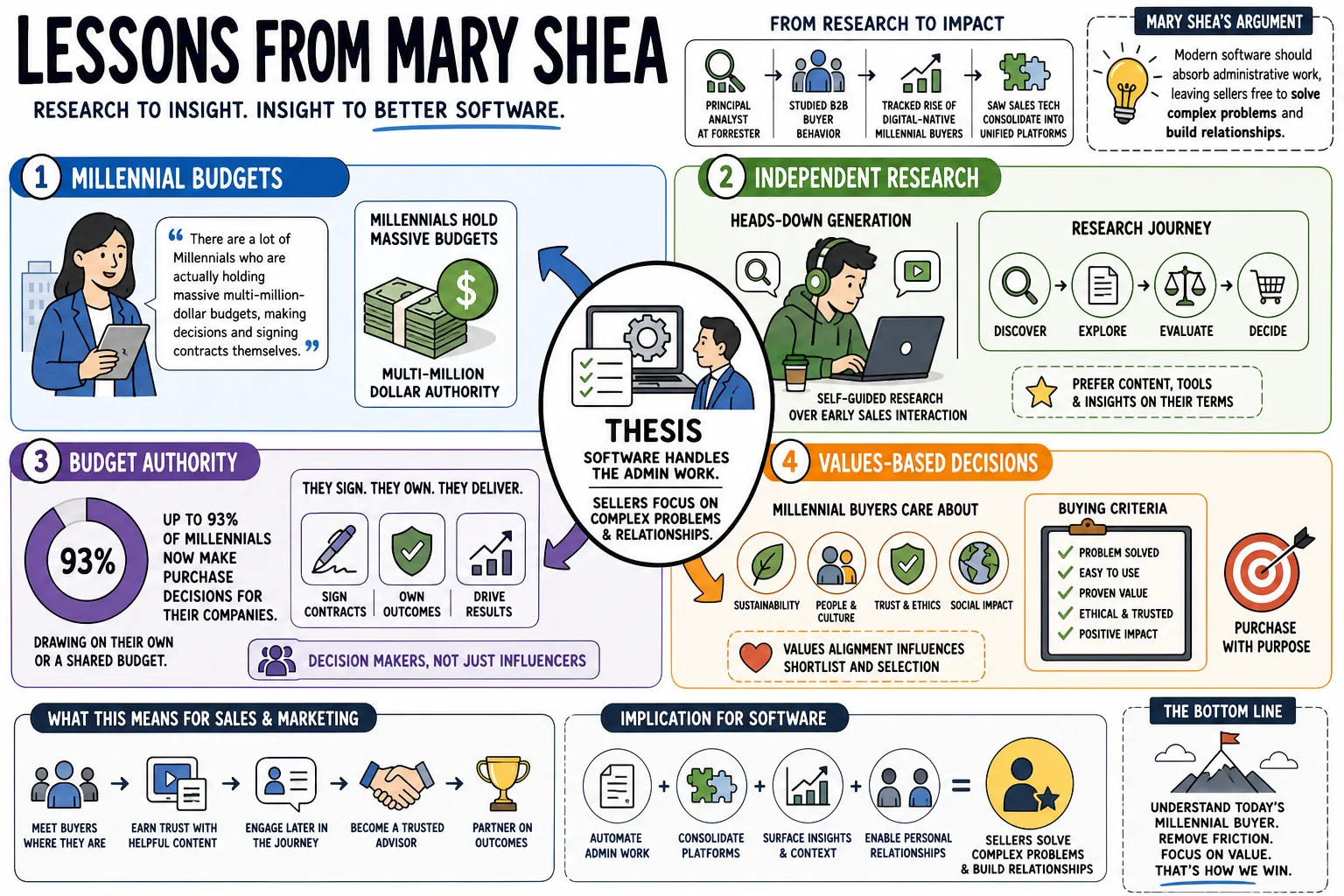
Lessons from Mary Shea
Before taking operational roles at Outreach and Mediafly, Dr. Mary Shea spent years studying B2B buyer behavior as a Principal Analyst at Forrester. Her research tracked the rise of digital-native millennial buyers and the consolidation of sales tech into unified platforms. This profile covers her argument that modern software should absorb administrative work, leaving sellers free to solve complex problems and build relationships.
Part 1: The Modern B2B Buyer
- On Millennial Budgets: "There are a lot of Millennials who are actually holding massive multi-million-dollar budgets, making decisions and signing contracts themselves." — Source: [Demand Gen Report]
- On the Millennial Disconnect: Many B2B marketers have not yet come to terms with the reality that Millennial buyers are holding the purse strings and require a fundamentally different approach. — Source: [Outreach]
- On Independent Research: The modern buyer is part of a heads-down generation that strongly prefers self-guided research over early-stage sales interactions. — Source: [Forrester]
- On Budget Authority: Up to 93% of Millennials now make purchase decisions for their companies, drawing on their own or a shared budget. — Source: [Outreach]
- On Values-Based Purchasing: "75% of millennials said they would re-consider purchasing a product if the company’s values did not match their own, compared with 68% of Gen X respondents." — Source: [Outreach]
- On Third-Party Validation: Millennial buyers find third-party resources like G2, TrustRadius, and peer networks significantly more impactful than traditional vendor-provided marketing content. — Source: [Data Axle]
- On the Risk of Exclusion: "If marketing and sales aren’t tuning their approach to this type of buyer, they may not make it far in the buying process and will be cut out of the decision." — Source: [Demand Gen Report]
- On Generational Seller Preferences: Millennials want a tech-savvy rep with strong problem-solving skills, whereas Gen X buyers prefer to explore independently and place higher value on a rep's industry experience. — Source: [Outreach]
- On the Future Majority: Millennials and Gen Z already comprise roughly two-thirds of the business buying landscape, turning traditional procurement entirely on its head. — Source: [Data Axle]
Part 2: The Consumerization of B2B
- On Professional Identity: "B2B buyers are consumers at home and they don't want to be a different person when they come to work." — Source: [Demand Gen Report]
- On Frictionless Transactions: Today's buyers expect the same ease, speed, and immediate access to information they receive from consumer applications when buying software for their business. — Source: [Forrester]
- On Digital Independence: Approximately 55% of all modern buyer interactions are now entirely self-guided. — Source: [Outreach]
- On Remote Preferences: The digitization of the buying process has triggered a permanent shift toward remote and virtual interactions over traditional phone calls or in-person meetings. — Source: [Visualize]
- On the High-Value Mandate: Buyers want contextual interactions; they expect their experiences with salespeople to be either profoundly high-value or completely frictionless. — Source: [Vengreso]
- On Co-Creation: Younger buyers are 30% more likely than older buyers to demand co-creation or co-innovation with the vendors they select. — Source: [Forrester]
- On Non-Linear Journeys: The modern B2B buying cycle is a complex, multi-threaded process where digital and human interactions frequently intersect. — Source: [Forrester]
- On Buyer Skepticism: Buyers are more informed and skeptical than ever, demanding that sellers act as trusted consultants rather than mere product vendors. — Source: [Adapter's Advantage]
- On Self-Service Expectations: Sellers must accommodate the reality that many buyers complete a significant portion of their research independently online before they ever agree to engage with sales. — Source: [Demand Gen Report]
- On Accelerating Change: "More things have changed in B2B sales in the last five years than in the previous fifty," largely driven by the digital transformation of the buyer. — Source: [ValueSelling Associates]
Part 3: The Expanding Buying Committee
- On Committee Size: "There are also likely to be multiple buyers involved in the sale process, between eleven and twenty-two people on the buy side evaluating a product or service, depending on its complexity." — Source: [GZ Consulting]
- On Finance's Early Entry: "These days, procurement and finance, whether it's the CFO or VP of Finance, are inserting themselves pretty early into the cycle." — Source: [GZ Consulting]
- On the End of the Lone-Wolf: "The lone-wolf seller is facing extinction. As buy-side teams increase in size, expectations and expertise, we also need the selling teams to increase." — Source: [SalesTechStar]
- On Matching the Buyer's Depth: Selling teams must increase their breadth and depth to meet the varied needs of a wide range of specialized buy-side stakeholders. — Source: [SalesTechStar]
- On the Committee as a Crowd: The B2B buying group has evolved from a small committee into a crowded room, requiring sellers to manage consensus across competing internal priorities. — Source: [GZ Consulting]
- On the CFO Gatekeeper Shift: The CFO has shifted from a final gatekeeper at the end of a deal to an active participant upfront, demanding clear proof of ROI and business impact from the beginning. — Source: [GZ Consulting]
- On Human Connection Amid Complexity: Despite the increase in stakeholders and technology platforms, people still buy from people, and empathy remains the key to navigating large buying groups. — Source: [Visualize]
- On Navigating Stakeholders: Sellers must influence a broad coalition of technical, financial, and operational constituents to secure a deal. — Source: [Forrester]
- On Enterprise Deals: A simple one-to-one B2B transaction is rare; enterprise deals require orchestrating a synchronized effort across an entire buying matrix. — Source: [SalesTechStar]
Part 4: Sales Automation & AI as Augmentation
- On Returning Humanity: "Automation is bringing more humanity to the sales process and, quite frankly, more humanity to the selling role." — Source: [ValueSelling Associates]
- On the Must-Have Era: "Sales automation is no longer a nice-to-have, but a must-have for companies that want to stay competitive in today's fast-paced sales landscape." — Source: [SuperAGI]
- On Relieving Administrivia: "Sellers, relieved of administrivia and armed with the very best engagement and intelligence platform, will be consultative." — Source: [SalesTechStar]
- On Offloading Low-Value Tasks: AI and automation free sellers from low-value, repetitive tasks, opening up a world where they can conduct better research and have deeper conversations. — Source: [ValueSelling Associates]
- On AI Augmentation: AI is designed to augment professionals, allowing reps to focus on the essential human aspects of navigating complex emotional landscapes. — Source: [HireQuotient]
- On the Consultative Destiny: "AI and automation put sellers on a path to fulfill their consultative destiny." — Source: [Adapter's Advantage]
- On Signal-Based Selling: Sellers should adopt signal-based selling, focusing on actionable insights derived from buyer behavior rather than simply compiling raw data. — Source: [Forrester]
- On Personalization at Scale: Modern automation is necessary because manual personalization at the scale required by today’s buyer is virtually impossible. — Source: [Allego]
- On Tech as an Arrow: "If I'm a revenue leader, I need to think about technology as another arrow in my quiver." — Source: [Vengreso]
- On Machine Intelligence: AI tools extract and analyze human behavioral data to provide direct intelligence that sellers can use to meticulously tailor their approach. — Source: [Allego]
Part 5: The Evolution of the Seller's Role
- On Empathy: As technology handles the administrative burden, the core of a seller's role shifts decisively toward empathy and intentionality. — Source: [SalesTechStar]
- On Relationship Building: "The research I’ve seen shows that sales leaders value in sellers a range of different attributes, but they love relationship building. I do think the relationship-building piece will never change." — Source: [ValueSelling Associates]
- On Storytelling with Data: It is insufficient to simply analyze data; modern sellers must be able to tell compelling stories with data to influence their constituents. — Source: [SalesTechStar]
- On Agile Teams: Sales teams of the future will be smaller, more agile, and fully-abled by technology to execute at a higher level. — Source: [SalesTechStar]
- On Quota Achievement: "I have a vision where, instead of 20% of employees making up 80% of the quota, 80%–90% of the sales team hits their quota." — Source: [SalesTechStar]
- On Selling Insights: "What differentiates us is not what we sell; it's what insights we bring, being focused on business outcomes instead of the top-down, inside-out Go-To-Market strategy." — Source: [Forrester]
- On the SDR Model: "I believe the SDR model designed back at Salesforce is broken. Every sales leader I talk to is struggling with the efficacy of that model." — Source: [Hard Skill Exchange]
- On Human Connections: "Buyers are people, and people crave human connections. The relationship-building piece will never change." — Source: [Forrester]
- On Digital Transactions: Even as more transactions close fully digitally, the necessity and impact of high-quality human seller engagement will actually increase. — Source: [Forrester]
Part 6: Sales Management & Leadership
- On the Year of the Manager: "2022 will be the 'year of the sales manager.' While this role has been historically under-supported, in 2022, sales managers will finally get the training and support they crave and deserve." — Source: [Hard Skill Exchange]
- On the Forgotten Persona: The front-line sales manager has long been the forgotten persona, caught between heavy investments in rep tools and executive dashboards. — Source: [Hard Skill Exchange]
- On Manager Enablement: Organizations must invest in manager enablement to help managers transition from acting as super-sellers to operating as data-driven coaches. — Source: [Hard Skill Exchange]
- On the Assembly Line: The traditional assembly-line approach to sales, rigidly specializing SDRs and AEs, has created a volume-based culture that modern buyers actively ignore. — Source: [Hard Skill Exchange]
- On Data vs. Gut: Sales leaders must migrate away from gut-level decision-making and embrace data-driven strategies for coaching and forecasting. — Source: [SalesTechStar]
- On Mental Well-Being: Innovative sales leaders are recognizing that the mental health and well-being of their teams is directly tied to revenue performance. — Source: [SalesTechStar]
- On Scaling Empathy: The sales manager is the primary lever for scaling a modern sales organization's capacity for empathy and relationship-building. — Source: [ValueSelling Associates]
- On Sales Readiness: Leaders must utilize data-driven assessments to guarantee their sales teams are genuinely ready for the complexities of modern B2B buying cycles. — Source: [Adapter's Advantage]
- On Buyer-First Revenue: Sales leaders need to pivot from internal metrics of volume toward a human-centric, buyer-first approach to revenue generation. — Source: [Hard Skill Exchange]
Part 7: Diversity, Equity, and Inclusion (DEI)
- On Tracking Diversity: "In 2022, sales leaders will monitor and track the diversity of their organization like any other metric or KPI." — Source: [OpsStars]
- On Buyer Expectations for Diversity: "While 85% of millennials agreed that 'sales teams need to be diverse and reflect the world around me,' only 65% of Gen Xers agreed." — Source: [Outreach]
- On the Broken System: When addressing the gender gap in sales, it must be understood that "it is not women who are broken but the system that is broken!" — Source: [OpsStars]
- On Representation: "67% of sales leaders believe it’s important for their teams to represent the world around them." — Source: [OpsStars]
- On Business Outcomes: Diversity in sales is a commercial requirement; "diversity of thought, backgrounds, and cultures contribute to better business outcomes." — Source: [OpsStars]
- On Brawn to Brains: The culture of sales is shifting from brawn to brains, elevating skills like empathy, listening, and collaboration that are prominent in diverse talent pools. — Source: [OpsStars]
- On Nurturing Talent: With DEI as a visible business priority, leaders must actively create internal programs to nurture and foster their existing underrepresented talent. — Source: [OpsStars]
- On the War for Talent: A verifiable commitment to diversity, equity, and inclusion acts as a distinct competitive advantage in winning the modern war for sales talent. — Source: [OpsStars]
- On Building Trust: Sales teams that accurately reflect their customer base are inherently better positioned to build rapid trust and drive consistent revenue. — Source: [OpsStars]
Part 8: Tech Consolidation & Revenue Enablement Platforms
- On the End of Point Solutions: "The days of companies putting together a pastiche of best-of-breed tools are well behind us." — Source: [Tech Funding News]
- On Unified Platforms: "Mediafly's platform allows business leaders to consolidate their enablement tools by uniting content management, digital sales rooms, revenue and conversation intelligence, and value selling tools." — Source: [Mediafly]
- On CRM Evolution: "The role of the CRM will evolve into more of a backend single source of truth, rather than the system that revenue team members operate in every day." — Source: [OpsStars]
- On Tech Convergence: "I expect revenue operations, revenue intelligence, and sales engagement will come together with engagement data at the center of everything." — Source: [Forrester]
- On the Non-CRM Trajectory: "You'd have to be living under a rock to not see the trajectory that sales technology providers, specifically non-CRM salestech companies, are on right now." — Source: [Demand Gen Report]
- On Siloed Data: Companies are tired of balancing siloed data and disconnected technologies that are expensive to maintain and result in incredibly poor user adoption. — Source: [Mediafly]
- On the Hidden Gem: "Mediafly has quietly compiled the most complete revenue enablement platform in the market... everything B2B teams need to successfully navigate today’s complex buying journey." — Source: [Demand Gen Report]
- On Predicting Growth: A unified revenue enablement platform is the critical mechanism to create confident sellers who can deliver efficient, predictable growth. — Source: [GZ Consulting]
- On Data Outside the CRM: For modern engagement to function, organizations must master getting data out of the legacy CRM and into agile sales engagement tools. — Source: [OpsStars]
- On Table Stakes: "With ROI of 666%, a modern sales enablement toolset becomes table stakes." — Source: [Forrester]