Lessons from Maryam Banikarim
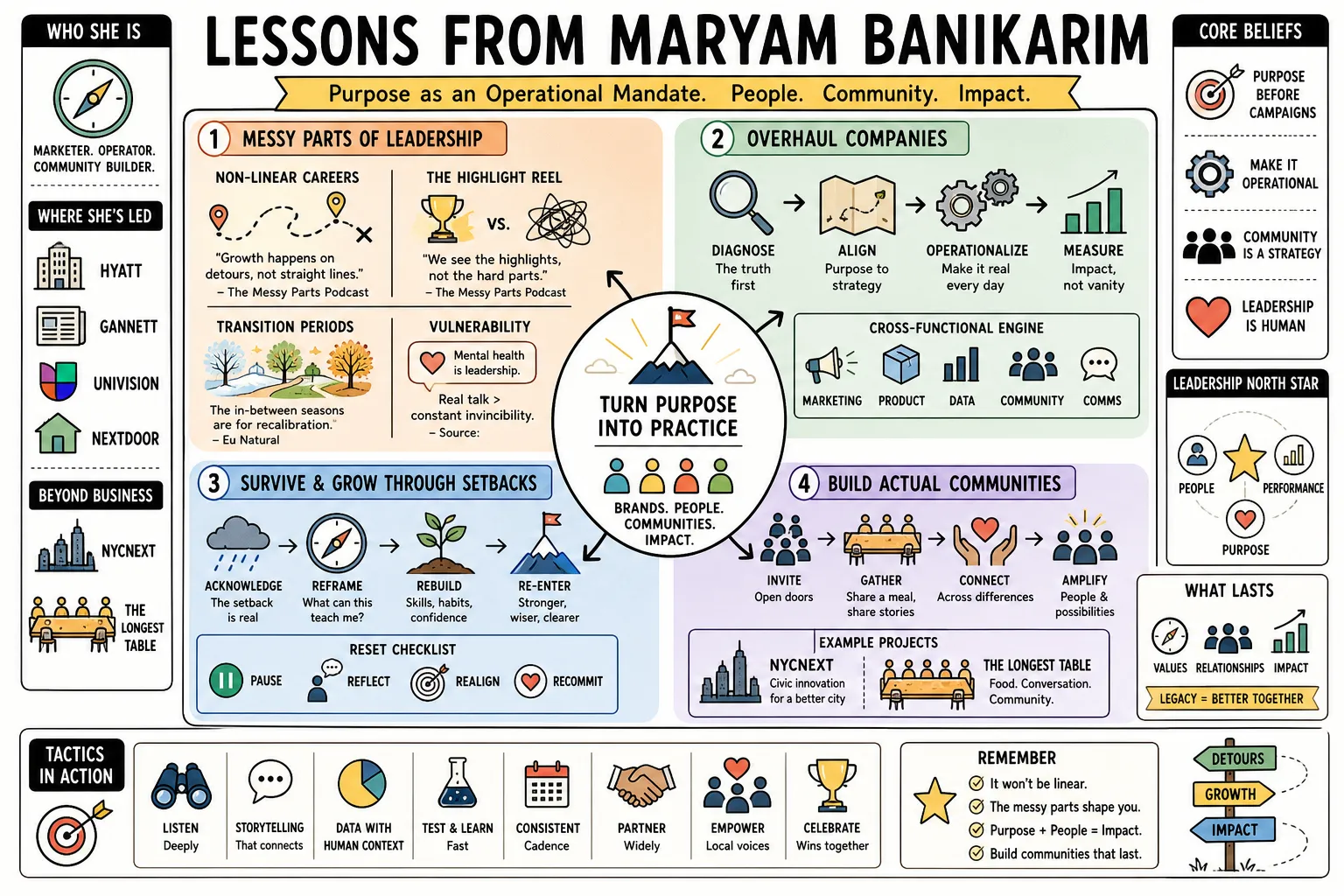
Maryam Banikarim has run marketing for Hyatt, Gannett, Univision, and Nextdoor by treating brand purpose as an operational mandate rather than a slogan. She applies that same pragmatism to civic projects like NYCNext and The Longest Table. This profile breaks down her tactics for overhauling companies, surviving career setbacks, and building actual communities.
Part 1: The Messy Parts of Leadership
- On non-linear careers: "The most significant professional growth rarely occurs on a straight path; it happens during the detours, setbacks, and unplanned transitions." — Source: The Messy Parts Podcast
- On the highlight reel: "We often only see the curated successes of executives, ignoring the brutal, unfiltered struggles that actually define their leadership style." — Source: The Messy Parts Podcast
- On transition periods: "The in-between seasons of a career are often ignored in professional settings, yet they are the most important times for personal recalibration." — Source: Eu Natural
- On vulnerability: "True leadership requires discussing mental health and the real toll of executive responsibility, rather than projecting constant invincibility." — Source: Substack: The Messy Parts
- On career disruption: Fast Company frames Banikarim's Rapid Response interview around career chaos, C-suite pressure, and betting on yourself, supporting a lesson about treating disruption as a prompt for reinvention. — Reference: Fast Company abridged Rapid Response interview
- On impostor syndrome: "Even the most successful founders and executives experience periods of profound doubt; the differentiator is whether they let it stall their decision-making." — Source: The Messy Parts Podcast
- On honesty in leadership: "Candid, brutally honest conversations about failure build more trust within an organization than flawless track records." — Source: City Parks Alliance
- On navigating ambiguity: "The ability to remain calm and decisive when the next step is completely unclear is a necessary skill for any modern executive." — Source: Fast Company
- On the illusion of control: "Leaders must accept that they cannot control every variable in their career or market; they can only control their response to the unexpected." — Source: The Messy Parts Podcast
- On shared struggles: "When leaders share their detours, they give their teams permission to take calculated risks without the paralyzing fear of failure." — Source: Substack: The Messy Parts
Part 2: Designing Community and Belonging
- On building belonging: "Belonging is not something that happens to you randomly; it is something you have to actively build, one interaction or long table at a time." — Source: UNHCR
- On civic action: "You do not need permission to improve your city; initiatives like NYCNext were born from citizens deciding to take ownership of their community's morale." — Source: MaryamB.com
- On local connection: "The strongest communities are built neighborhood by neighborhood, grounded in proximity and shared daily experiences." — Source: Nextdoor
- On breaking barriers: Open Plans describes The Longest Table as a 1,000-person outdoor potluck built to connect neighbors across age, background, and identity through a shared public meal. — Reference: Open Plans interview on The Longest Table
- On isolation: "In a hyper-connected digital world, physical community building requires proactive effort to combat rising rates of loneliness." — Source: The Continuum
- On cultural estrangement: "When you enter a new environment, you must work to bridge the gap between your background and the local culture to foster mutual understanding." — Source: UNHCR
- On shared value: "Communities thrive when every member feels they have a stake in the collective outcome, rather than a passive role as a resident." — Source: The Advertising Club
- On the arts and morale: Gothamist reports that Banikarim co-founded NYCNext's New York State of Mind project to celebrate artists, support the city's recovery, and encourage civic participation. — Reference: Gothamist coverage of NYCNext and New York State of Mind
- On proactive inclusion: "You cannot wait to be invited to the table; sometimes you have to build the table yourself and invite others to join." — Source: UNHCR
- On neighborhood dynamics: "Real community requires engaging with people who hold different viewpoints, united only by the fact that you share the same geographic space." — Source: Medium
Part 3: Purpose as a Growth Driver
- On defining purpose: "A company's purpose is not a marketing slogan; it must be a strategic North Star that dictates operational decisions and investments." — Source: The Continuum
- On transformation: "During periods of rapid corporate change, a clearly articulated purpose is the only thing that keeps a fractured organization moving in the same direction." — Source: Medium
- On brand differentiation: "Consumers increasingly demand that companies stand for something beyond their products; neutrality is no longer a viable long-term strategy." — Source: APB Speakers
- On employee loyalty: "The most effective way to retain top talent is to align their daily work with a broader mission they actually care about." — Source: IAW Foundation
- On the role of a Purpose Champion: "A true purpose champion goes beyond talking about the vision; they actively integrate it into the company's core operations alongside the CEO." — Source: APB Speakers
- On internal alignment: "If your employees do not believe in the company's purpose, your customers will instantly see through any external marketing campaigns." — Source: The Advertising Club
- On long-term growth: "Purpose-driven companies often outperform their peers because they have a clearer filter for which opportunities to pursue and which to reject." — Source: The Continuum
- On superficial marketing: "Slapping a social cause onto a brand without changing the underlying business model is a recipe for consumer backlash." — Source: Brand Innovators
- On corporate responsibility: "Companies have an obligation to use their scale and resources to positively impact the communities in which they operate." — Source: IAW Foundation
Part 4: Reframing Obstacles and Resilience
- On facing challenges: TED presents Banikarim's obstacle-course frame as a way to approach life's tests with curiosity and agency rather than treating every challenge as a static barrier. — Reference: TED talk page for Life's an obstacle course
- On the immigrant experience: Fast Company notes that Banikarim discusses growing up in Iran during revolution, giving her a distinct perspective on disruption, chaos, and the search for hope. — Reference: Fast Company abridged Rapid Response interview
- On curiosity over fear: Banikarim's TED talk centers on curiosity about whether she can navigate the next test, making curiosity a practical alternative to fear when plans break. — Reference: TED talk page for Life's an obstacle course
- On finding hope: "Even in the midst of global crises or personal displacement, you must actively search for reasons to be hopeful in order to keep moving forward." — Source: Fast Company
- On resilience: "Resilience is not an innate trait; it is a muscle built through repeated exposure to uncertainty and failure." — Source: UNHCR
- On perspective: City Parks Alliance describes Banikarim's work across executive roles, community movements, The Messy Parts, and The Longest Table, grounding a lesson about using setbacks and pivots as part of a larger career story. — Reference: City Parks Alliance speaker bio
- On adaptability: "The ability to rapidly discard a failed plan and pivot to a new strategy without ego is the core of professional survival." — Source: AAE Speakers
- On the can-do attitude: "Approaching problems with a default assumption that they are solvable changes the energy of the entire team working on them." — Source: MaryamB.com
- On navigating life: The TED talk title and summary frame life as an obstacle course, which supports a lesson about building agility for unexpected turns instead of expecting a perfect path. — Reference: TED talk page for Life's an obstacle course
Part 5: Transformation in Legacy Brands
- On legacy media: "Transforming a legacy brand like Gannett requires respecting its history while ruthlessly updating its business model for the digital era." — Source: Columbia Business School
- On hospitality: "At Hyatt, shifting the focus from simply renting rooms to fostering genuine community changed the way the brand approached customer loyalty." — Source: Brand Innovators
- On structural splits: "Navigating a company split requires over-communicating the strategic reasoning to prevent internal panic and maintain market confidence." — Source: Columbia Business School
- On cultural integration: "When trying to unify a diverse organization like Univision, you must find a common thread that resonates across all subdivisions." — Source: IAW Foundation
- On repositioning: "A successful rebrand is never merely a logo change; it is a fundamental shift in how the company defines its value to the consumer." — Source: Medium
- On the CMO role: "The modern Chief Marketing Officer must act as a bridge between the creative vision of the brand and the hard financial realities of the business." — Source: The Advertising Club
- On consumer trust: "Legacy brands have the advantage of established trust, but they must continuously earn that trust by evolving with their audience's needs." — Source: Brand Innovators
- On internal resistance: "Transformation will always face internal resistance from those comfortable with the status quo; leadership must address this friction directly." — Source: Fast Company
- On scale and agility: "The hardest challenge for a large corporation is maintaining the speed and agility of a startup without sacrificing its scale advantages." — Source: Medium
- On unified messaging: "A fragmented media company must ensure that its core message remains consistent, regardless of which platform the consumer is engaging with." — Source: IAW Foundation
Part 6: The Realities of the C-Suite
- On executive politics: Fast Company describes the Rapid Response conversation as covering C-suite pressure and hard-won wisdom about executive politics, making the lesson a paraphrase rather than an unsourced quotation. — Reference: Fast Company abridged Rapid Response interview
- On betting on yourself: The Rapid Response interview is explicitly framed around Banikarim's move through career chaos and the importance of betting on yourself when the executive environment changes. — Reference: Fast Company abridged Rapid Response interview
- On the top boss vs. champion: "A traditional top boss demands compliance; a purpose champion inspires commitment by showing how the work aligns with a larger goal." — Source: APB Speakers
- On executive isolation: "The higher you climb in an organization, the harder it is to get unfiltered, honest feedback about your performance and strategy." — Source: The Messy Parts Podcast
- On cross-functional collaboration: "Marketing cannot exist in a silo; the CMO must be deeply integrated with product, sales, and operations to be effective." — Source: Fast Company
- On decision fatigue: "Executives must build systems to delegate minor choices so they preserve their cognitive energy for the decisions that actually move the needle." — Source: The Continuum
- On owning failure: "When a high-stakes initiative fails, a strong executive takes public ownership rather than deflecting blame to their subordinates." — Source: The Messy Parts Podcast
- On peer networks: "Surviving the C-suite requires a strong network of peers outside your company who can provide objective advice and perspective." — Source: The Advertising Club
- On leaving a legacy: "True executive success is measured by quarterly returns and the strength of the team you leave behind." — Source: MaryamB.com
Part 7: Action Over Vision
- On execution: "A brilliant vision is entirely useless if the organization lacks the instinct and discipline to execute it in the real world." — Source: APB Speakers
- On versatility: "Effective leaders know when to cheer from the sidelines, when to coach, and when to get on the field and roll up their sleeves." — Source: APB Speakers
- On mobilization: "It is not enough to define a goal; you must actively mobilize the organization, breaking down the vision into actionable steps for every department." — Source: The Continuum
- On momentum: "In times of crisis or stagnation, taking any decisive action is often better than waiting for perfect information." — Source: Fast Company
- On leading the play: "There are moments in a project where a leader cannot only delegate; they must personally lead the play to show the team it can be done." — Source: APB Speakers
- On overcoming inertia: "Large organizations naturally default to inaction; a leader must constantly inject energy and urgency to overcome corporate inertia." — Source: Medium
- On tangible results: "Civic initiatives like NYCNext succeeded because they focused on tangible, immediate actions rather than endless planning committees." — Source: MaryamB.com
- On iterative progress: Open Plans traces The Longest Table from a neighborly idea posted online into events with 500, 700, and then 1,000 participants, showing how a simple start can compound through feedback. — Reference: Open Plans interview on The Longest Table
- On taking ownership: "If you see a problem in your company or your city, the most effective response is to take personal ownership rather than complaining to management." — Source: City Parks Alliance
Part 8: Identity and The Meaning of Home
- On defining home: "For those who have been displaced, home is rarely a fixed geography; it becomes a visceral, internal feeling of safety and connection." — Source: UNHCR
- On multiple identities: "You do not have to choose between your heritage and your current environment; you can hold multiple cultural identities simultaneously." — Source: UNHCR
- On the refugee experience: "Being forced to leave your country as a child installs a permanent understanding of how quickly stability can vanish." — Source: UNHCR
- On finding your people: "Belonging requires seeking out the people who understand your unique intersections of identity and experience." — Source: UNHCR
- On empathy: City Parks Alliance describes Banikarim as creating spaces for honest conversation, connection, and belonging, tying her leadership style to authenticity, collaboration, and empathy for outsiders. — Reference: City Parks Alliance speaker bio
- On adapting: "Immigrants often excel in business because the necessity of adapting to a new culture builds unparalleled observational and social skills." — Source: Fast Company
- On preserving heritage: "Honoring where you come from provides a grounding anchor when navigating high-pressure corporate environments." — Source: IAW Foundation
- On global perspective: "Understanding that the American corporate experience is just one way of operating allows for more creative and inclusive problem-solving." — Source: Medium
- On shared humanity: Open Plans reports that The Longest Table aims to connect neighbors, reduce loneliness, and spread joy, with Banikarim describing the work as rediscovering shared humanity. — Reference: Open Plans interview on The Longest Table