Matt Plank is the Chief Revenue Officer at Rippling, where he helped scale the company's global sales organization from its early stages. He is known for applying rigorous "revenue math" to go-to-market strategies and transitioning companies from founder-led sales into structured outbound machines. This profile breaks down his practical advice on building revenue organizations, hiring talent, and aligning product development with sales execution.
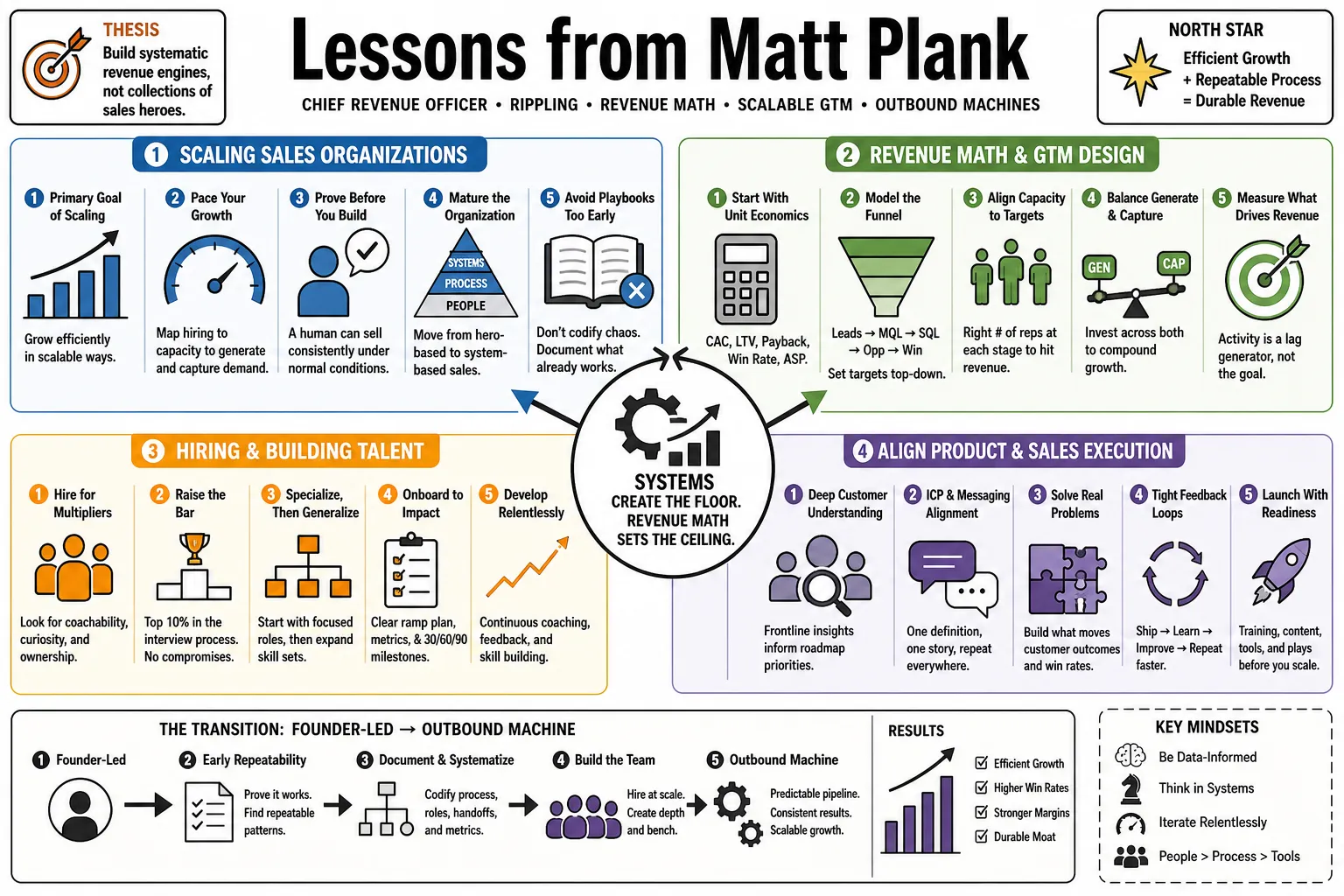
Part 1: Scaling Sales Organizations
- On the primary goal of scaling: "Instead of celebrating headcount, focus on growing efficiently in scalable ways." — Source: [SaaStr]
- On pacing your growth: "You have to map your hiring directly to your capacity to generate and capture demand, rather than hiring first and hoping demand catches up." — Source: [20VC]
- On early sales processes: "Before you can build a repeatable machine, you have to prove that a human being can sell your product consistently under normal conditions." — Source: [The Startup Podcast]
- On organizational maturity: "Scaling means moving from hero-based sales, where a few star reps carry the load, to system-based sales, where the process guarantees the floor." — Source: [Stage 2 Capital]
- On avoiding playbooks too early: "Founders should not create rigid sales playbooks too early; the process needs room to breathe and adapt as the initial market feedback rolls in." — Source: [20VC]
- On measuring success: "Your win rate is a lagging indicator. You need to focus on the leading indicators of pipeline generation and conversion velocity." — Source: [SaaStr]
- On managing expectations: "When you double the size of your sales team, expect temporary dips in overall efficiency as onboarding and ramp times take effect." — Source: [Revhacks]
- On segmenting the market: "Don't treat all tiers of the market with the same motion. SMB requires high velocity, while enterprise requires patience and multi-threading." — Source: [The Startup Podcast]
- On the role of leadership: "As a sales leader in hyper-growth, your job shifts from closing deals to recruiting, coaching, and removing friction from the system." — Source: [20VC]
- On adapting to change: "The go-to-market strategy that got you to $10 million ARR will rarely be the exact same strategy that gets you to $100 million." — Source: [Stage 2 Capital]
Part 2: The Math of Revenue Growth
- On baseline metrics: "You cannot build a predictable business if you do not understand your baseline conversion rates across every stage of the funnel." — Source: [The Science of Scaling]
- On capacity planning: "Revenue math dictates that you reverse-engineer your targets: figure out the required pipeline, calculate the activity needed to generate it, and staff accordingly." — Source: [Stage 2 Capital]
- On quota attainment: "If everyone is hitting quota, your quotas are too low. If no one is hitting quota, your model is broken. Aim for a healthy distribution." — Source: [SaaStr]
- On the cost of acquisition: "Keep a strict eye on payback periods. Growth is only valuable if the unit economics eventually make sense." — Source: [20VC]
- On pipeline hygiene: "A pipeline inflated with stale deals destroys your ability to forecast accurately. Enforce strict criteria for what stays in the funnel." — Source: [The Science of Scaling]
- On sales velocity: "Speed matters. The faster you can move a qualified prospect from first touch to closed-won, the more efficient your entire operation becomes." — Source: [Revhacks]
- On discounting: "Discounting to accelerate a deal often costs more in lifetime value than the short-term cash flow is worth. Protect your pricing power." — Source: [SaaStr]
- On compensation plans: "Your comp plan is your strategy translated into math. Ensure it heavily incentivizes the exact behaviors that drive sustainable growth." — Source: [Stage 2 Capital]
- On forecasting accuracy: "Good forecasting relies on historical data and rigorous qualification, not the subjective optimism of individual account executives." — Source: [The Science of Scaling]
Part 3: Transitioning from Founder-Led Sales
- On the first sales hire: "The first true sales hire shouldn't be a coin-operated rep; it needs to be someone who can operate in ambiguity and help codify the process." — Source: [The Startup Podcast]
- On founder involvement: "Founders shouldn't completely step away from sales once a team is built; they just need to shift their focus to the most strategic, high-leverage deals." — Source: [20VC]
- On codifying knowledge: "You have to extract the founder's intuition and turn it into documented objections, value props, and qualification criteria." — Source: [Revhacks]
- On letting go: "Founders often struggle to let reps lose deals, but reps need to fail occasionally to learn and adapt without the founder's safety net." — Source: [SaaStr]
- On building trust: "The new sales team has to earn the founder's trust by showing they respect the product and deeply understand the ideal customer profile." — Source: [The Startup Podcast]
- On handling objections: "Founders handle objections with deep product vision. Reps need to handle them with tight, rehearsed, and proven talk tracks." — Source: [20VC]
- On early marketing support: "Founder-led sales often relies on network and charisma. Scaled sales requires proper collateral, case studies, and marketing air cover." — Source: [Stage 2 Capital]
- On setting realistic quotas: "Don't base the first AE's quota on what the founder was able to close. The founder has an inherent authority that a new rep simply does not have." — Source: [SaaStr]
- On the transition timeline: "Moving away from founder-led sales is a phase, not a switch. Plan for a multi-quarter transition where the founder gradually fades into the background." — Source: [The Startup Podcast]
Part 4: Building the Outbound Machine
- On cold outreach: "Outbound cannot be an afterthought. It requires dedicated resources, precise targeting, and relentless execution to yield consistent results." — Source: [20VC]
- On personalization at scale: "The best outbound strikes a balance between broad automation and targeted, highly relevant personalization for high-value accounts." — Source: [SaaStr]
- On SDR metrics: "Measure SDRs not just on the volume of meetings booked, but on the quality of the opportunities that actually convert to closed revenue." — Source: [Revhacks]
- On list building: "Your outbound motion is only as good as your data. Spend the time to build accurate, well-segmented lists before you start dialing." — Source: [The Startup Podcast]
- On messaging cadence: "A successful outbound sequence requires multiple touches across multiple channels. Do not give up after two unanswered emails." — Source: [20VC]
- On handling rejection: "Outbound is an exercise in resilience. The team must be trained to view rejection as data rather than a personal failure." — Source: [SaaStr]
- On the SDR to AE relationship: "The handover between an SDR and an AE must be seamless. Friction here kills the momentum of an outbound deal." — Source: [Stage 2 Capital]
- On testing and iteration: "Treat your outbound scripts like software code. Constantly A/B test subject lines, calls to action, and value propositions." — Source: [Revhacks]
- On maintaining morale: "Outbound is a grind. You have to actively manage team morale, celebrate small wins, and create a competitive but supportive culture." — Source: [20VC]
Part 5: Hiring and Assessing Talent
- On the hiring profile: "Look for coachability and raw intellect over just a rolodex. The market changes fast, and you need people who can learn." — Source: [SaaStr]
- On structured interviews: "Consistency in hiring requires a structured interview process where every candidate is evaluated against the same objective criteria." — Source: [The Startup Podcast]
- On role-playing: "Never hire a sales rep without making them role-play. It reveals how they handle pressure, think on their feet, and take feedback." — Source: [20VC]
- On past performance: "Dig into the context of their past wins. Did they succeed because they had a great territory, or because they actually drove the business?" — Source: [Revhacks]
- On cultural alignment: "A top performer who destroys team culture is a net negative. Protect the environment by hiring for alignment with your core values." — Source: [Stage 2 Capital]
- On the cost of mis-hires: "Hiring the wrong person in sales is incredibly expensive, not just in salary, but in burned leads, lost time, and damaged morale." — Source: [SaaStr]
- On onboarding speed: "Your onboarding program should be designed to get a rep to their first closed deal as quickly as possible without skipping foundational knowledge." — Source: [The Science of Scaling]
- On promoting from within: "Building a strong SDR bench that you can promote to AE roles creates a predictable talent pipeline and boosts overall team retention." — Source: [20VC]
- On reference checks: "Take reference checks seriously. Ask specific, behavioral questions rather than just confirming employment dates." — Source: [Revhacks]
- On managing out: "When it is clear someone is not going to make it, address it quickly. Lingering low performance drags down the standard for everyone else." — Source: [The Startup Podcast]
Part 6: Sales and Product Alignment
- On masking product gaps: "When you put humans around a manual process, you tend to mask over the real product deficiencies instead of fixing them." — Source: [Revhacks]
- On the feedback loop: "Sales is the frontline of product feedback. There must be a formalized system for feeding customer objections directly back to engineering." — Source: [SaaStr]
- On selling roadmaps: "Train your team to sell the product you have today, not the roadmap. Relying on future features to close deals is a recipe for churn." — Source: [20VC]
- On mutual respect: "Engineering needs to understand that sales pays the bills, and sales needs to respect that engineering builds the value they are selling." — Source: [The Startup Podcast]
- On competitive intelligence: "Sales reps gather the best competitive intelligence. Capture that data rigorously to inform how the product needs to evolve." — Source: [Stage 2 Capital]
- On handling feature requests: "Not every lost deal due to a missing feature means you should build it. Align feature requests with the broader company strategy." — Source: [Revhacks]
- On beta programs: "Involve top sales reps in beta programs so they understand the nuances of new features before they have to pitch them to the market." — Source: [SaaStr]
- On technical sales: "For complex products, ensure your account executives have access to sales engineers who can translate technical depth into business value." — Source: [20VC]
- On product-led growth: "Even in a PLG motion, enterprise deals eventually require a human touch to navigate procurement, security, and complex stakeholder maps." — Source: [The Science of Scaling]
Part 7: Structuring Go-To-Market Teams
- On territory design: "Territories should be designed to give every rep an equal opportunity to hit quota, based on data and total addressable market, not tenure." — Source: [SaaStr]
- On the role of RevOps: "Revenue Operations is not just an administrative function; it is the central nervous system that aligns sales, marketing, and customer success." — Source: [The Startup Podcast]
- On specialization: "As you grow, specialize your roles. An AE who is forced to prospect, close, and manage renewals will eventually do all three poorly." — Source: [20VC]
- On marketing alignment: "Sales and marketing must operate from the same set of definitions for what constitutes a qualified lead and an active opportunity." — Source: [Stage 2 Capital]
- On managing the funnel: "Assign clear ownership to every stage of the funnel so that nothing falls through the cracks during handoffs." — Source: [Revhacks]
- On global expansion: "When expanding internationally, don't just copy-paste your US strategy. Adapt your messaging and structure to local market dynamics." — Source: [The Startup Podcast]
- On customer success: "Customer Success shouldn't just be a support function; they are a revenue function responsible for retention and identifying expansion opportunities." — Source: [SaaStr]
- On data hygiene: "Your CRM is the source of truth. If the data going into it is garbage, the strategic decisions coming out of it will also be garbage." — Source: [The Science of Scaling]
- On cross-functional communication: "Establish regular operating rhythms—like weekly pipeline reviews and monthly QBRs—to keep the entire go-to-market team aligned." — Source: [20VC]
Part 8: Managing Hyper-Growth and Culture
- On hiring velocity: "We were hiring so fast it was hard to find enough people to interview. You have to build recruiting engines that are as robust as your sales engines." — Source: [Revhacks]
- On maintaining culture: "Culture is not what you write on the wall; it is the behavior you reward and the behavior you tolerate when things get stressful." — Source: [SaaStr]
- On volatility: "Hyper-growth is inherently chaotic. You have to communicate clearly and frequently to keep the team focused despite the noise." — Source: [20VC]
- On scaling leadership: "The managers who get you from zero to ten are not always the directors who can get you from ten to one hundred. Evaluate leadership constantly." — Source: [The Startup Podcast]
- On burnout: "You cannot run a sales team at a full sprint indefinitely. Build in time for training, celebration, and rest to avoid burning out your top performers." — Source: [Stage 2 Capital]
- On transparency: "Be transparent about the metrics that matter. When the entire team understands how their work impacts the company's valuation, they take more ownership." — Source: [SaaStr]
- On adapting processes: "A process that works for fifty people will break when you hit a hundred. Anticipate these breaking points and redesign systems proactively." — Source: [20VC]
- On celebrating success: "Publicly recognize the behaviors that lead to closing deals, not just the closed deals themselves, to reinforce the right habits across the floor." — Source: [Revhacks]
- On handling mistakes: "In a fast-growing environment, mistakes are inevitable. Foster a culture where people learn from failures quickly rather than hiding them." — Source: [The Startup Podcast]
- On staying human-centric: "Despite all the automation and AI tools available, B2B sales fundamentally remains a human-centric endeavor based on trust and problem-solving." — Source: [SaaStr]