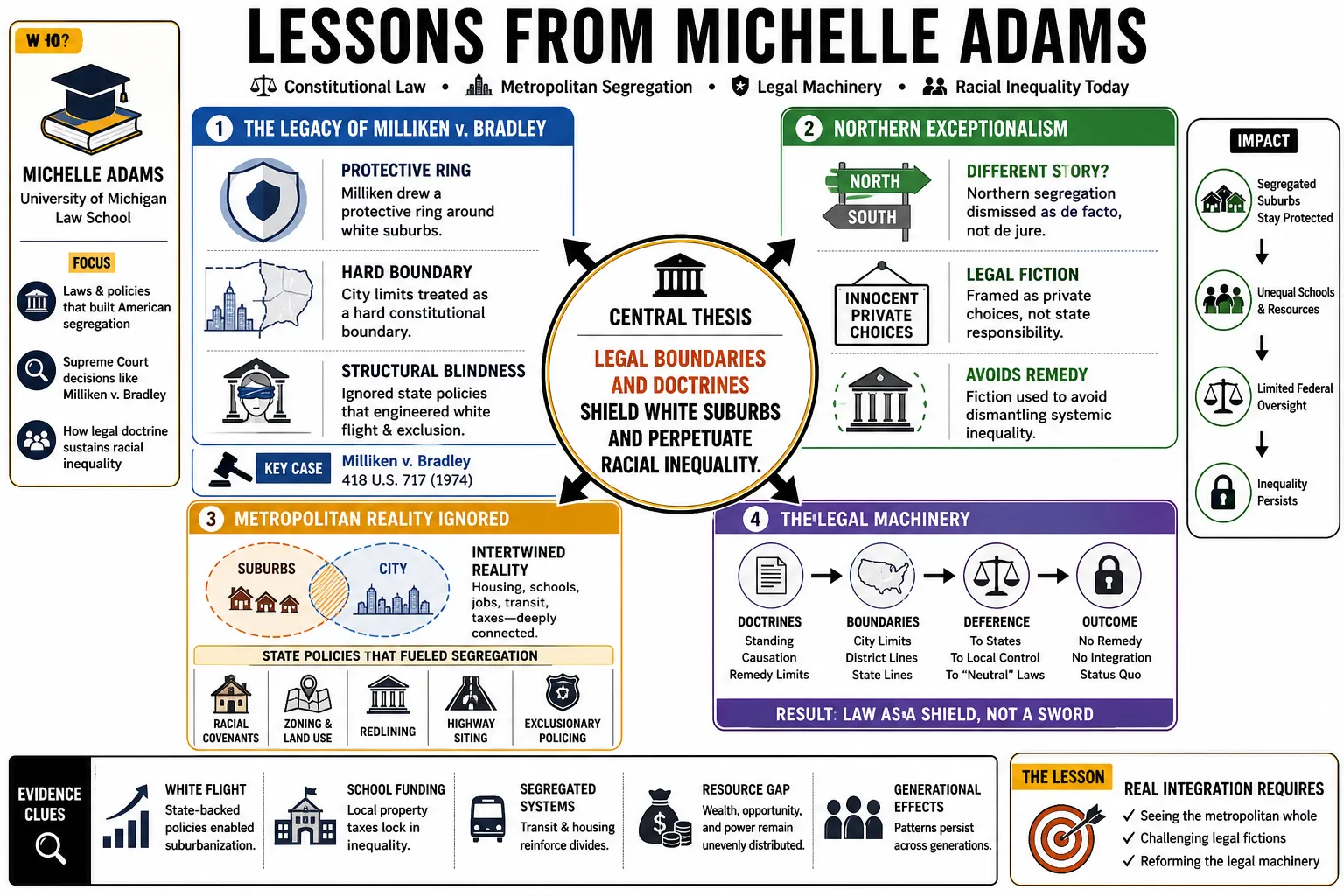
Lessons from Michelle Adams
University of Michigan Law School professor Michelle Adams studies the laws and policies that built American segregation. Her research focuses on how Supreme Court decisions like Milliken v. Bradley shielded Northern housing and education disparities from federal oversight. This collection outlines her work on constitutional law, the failure of metropolitan integration, and the legal machinery that sustains racial inequality today.
Part 1: The Legacy of Milliken v. Bradley
- On the boundary of Milliken: "The Court's decision in Milliken effectively drew a protective ring around white suburbs, making it constitutionally permissible to ignore the intertwined reality of metropolitan segregation." — Source: [The Containment]
- On structural blindness: "By treating the Detroit city limits as a hard constitutional boundary, the justices ignored the state policies that had explicitly engineered white flight and suburban exclusion." — Source: [The Containment]
- On Northern exceptionalism: "The narrative that Northern segregation was merely de facto, or a product of innocent private choices, was a legal fiction that the Supreme Court adopted to avoid dismantling systemic inequality outside the Jim Crow South." — Source: [The Containment]
- On the plaintiffs' burden: "Civil rights lawyers in Detroit had to prove not only that schools were segregated, but that the state itself engineered that segregation, a burden they met only to have the remedy denied." — Source: [LitHub Interview]
- On suburban complicity: "The suburbs were not innocent bystanders in the creation of inner-city poverty; they were active participants subsidized by federal and state policies that excluded Black families." — Source: [The Containment]
- On Thurgood Marshall's dissent: "Justice Marshall recognized immediately that Milliken was a devastating retreat from Brown, warning that it would guarantee a deeply divided and unequal society." — Source: [Amend: The Fight for America]
- On the limits of local control: "The Court used the concept of local control to protect white school districts, effectively elevating municipal boundaries above the Fourteenth Amendment's guarantee of equal protection." — Source: [The Containment]
- On the aftermath in Detroit: "Without a metropolitan remedy, Detroit's schools were left to shoulder the burden of integration alone, accelerating the exact demographic shifts the lawsuit sought to address." — Source: [The Nation]
- On legal containment: "The legal framework established by Milliken contained the demand for racial justice within dying urban cores, shielding wealthy suburbs from any obligation to integrate." — Source: [The Containment]
- On the precedent it set: "Milliken signaled to the rest of the country that the Supreme Court would not compel integration if it inconvenienced white suburbanites." — Source: [LitHub Interview]
Part 2: Housing, Segregation, and the Law
- On the illusion of choice: "Residential segregation is often framed as a matter of personal preference or market economics, masking the deeply entrenched federal and local laws that manufactured it." — Source: [The New Yorker]
- On the Fair Housing Act: "The Fair Housing Act was a monumental legislative achievement, but its enforcement mechanisms were compromised from the start, leaving much of its promise unfulfilled." — Source: [The New Yorker]
- On redlining's long tail: "We are still living in the geography dictated by mid-century redlining maps, where neighborhood demographics and property values were explicitly tied to race." — Source: [Amend: The Fight for America]
- On exclusionary zoning: "Zoning laws that ban multi-family housing or require large lot sizes function as a facially neutral mechanism to keep neighborhoods economically and racially exclusive." — Source: [Constitutional Commentary]
- On the racial wealth gap: "Because homeownership is the primary engine of wealth accumulation in America, state-sponsored housing segregation directly engineered the modern racial wealth gap." — Source: [The New Yorker]
- On disparate impact: "Challenging housing discrimination requires legal tools like disparate impact, which focus on the discriminatory results of a policy rather than the stated intent." — Source: [The New Yorker]
- On HUD's mandate: "The mandate to affirmatively further fair housing was largely ignored for decades, treating the law as merely a ban on explicit bigotry rather than a directive to integrate." — Source: [The New Yorker]
- On restrictive covenants: "Even after restrictive covenants became legally unenforceable, the racial geography they established was preserved through institutional practices and community resistance." — Source: [Constitutional Commentary]
- On housing and schools: "You cannot solve school segregation without addressing housing segregation; the two are inextricably linked by our reliance on neighborhood schools." — Source: [Integrated Schools Podcast]
- On reverse redlining: "The predatory lending practices that led to the 2008 housing crash targeted the exact same neighborhoods that had been starved of credit during the redlining era." — Source: [The New Yorker]
Part 3: The Supreme Court's Civil Rights Retreat
- On judicial retrenchment: "Following the Warren Court era, the Supreme Court systematically raised the bar for proving discrimination, making it nearly impossible to dismantle structural racism through the courts." — Source: [Constitutional Commentary]
- On the intent doctrine: "The requirement that plaintiffs prove explicit discriminatory intent, rather than discriminatory impact, severely crippled the ability of civil rights lawyers to challenge systemic inequality." — Source: [Iowa Law Review]
- On colorblind constitutionalism: "The Court’s turn toward colorblindness weaponized the Fourteenth Amendment against the very people it was designed to protect, treating efforts to integrate as constitutionally suspect." — Source: [Constitutional Commentary]
- On the rollback of remedies: "By limiting judicial remedies to only the specific victims of explicit bias, the Court ensured that broad, historical wrongs would remain unaddressed." — Source: [The Nation]
- On the Roberts Court: "The modern Court has shown a deep skepticism toward any race-conscious policy, effectively rewriting the history and purpose of the Equal Protection Clause." — Source: [LitHub Interview]
- On voluntary integration: "In striking down voluntary integration plans, the Court reached the perverse conclusion that school districts attempting to fulfill the promise of Brown were actually violating the Constitution." — Source: [Iowa Law Review]
- On federalism as a shield: "The invocation of states' rights and local control has historically served as a reliable judicial mechanism to block federal intervention in civil rights matters." — Source: [Constitutional Commentary]
- On the loss of institutional memory: "The courts often treat racial disparities as natural occurrences or the result of private choices, willfully ignoring the centuries of state action that created them." — Source: [Amend: The Fight for America]
- On legal formalism: "Strict adherence to legal formalism allows the Court to ignore the practical realities of racism, reducing civil rights to abstract theoretical debates." — Source: [Constitutional Commentary]
Part 4: Integration as a Constitutional Imperative
- On the purpose of integration: "Integration is not merely about moving bodies into the same building; it is a mechanism for disrupting the unequal distribution of resources and power." — Source: [Iowa Law Review]
- On integration versus assimilation: "True integration requires mutual adaptation and the sharing of institutional power, not simply demanding that marginalized students assimilate into dominant cultures." — Source: [Integrated Schools Podcast]
- On the democratic function of schools: "Public schools are the primary institutions where children learn what it means to be citizens in a multiracial democracy, and segregated schools teach them the opposite." — Source: [Equality of Opportunity and the Schoolhouse Gate]
- On the harm of isolation: "Racial isolation harms all students, but it disproportionately deprives Black and brown students of the political capital necessary to secure adequate school funding." — Source: [Integrated Schools Podcast]
- On local choice: "When the Court struck down voluntary integration plans, it essentially declared that local communities cannot democratically choose to correct their own racial imbalances." — Source: [Iowa Law Review]
- On the stigmatization of integration: "The legal framework has evolved to treat integration efforts as a form of discrimination, flipping the logic of the civil rights movement on its head." — Source: [Iowa Law Review]
- On shared fate: "Integration forces a shared fate upon communities. When white parents are invested in the same school buildings as Black parents, resources tend to follow." — Source: [Integrated Schools Podcast]
- On the definition of equality: "Equality cannot be achieved in a vacuum of separation. The fundamental lesson of Brown was that separation itself generates inequality." — Source: [Constitutional Commentary]
- On the burden of desegregation: "Historically, the logistical and emotional burdens of desegregation, from school closures to long bus rides, were placed almost entirely on Black communities." — Source: [Integrated Schools Podcast]
Part 5: Affirmative Action and Grutter v. Bollinger
- On the diversity rationale: "The diversity rationale in Grutter saved affirmative action, but it shifted the focus away from remedying historical injustice to the educational benefits for all students." — Source: [University of Toledo Law Review]
- On accessing higher education: "Just as Brown recognized the necessity of integration in K-12, Grutter recognized that higher education cannot fulfill its democratic mission if it remains racially exclusive." — Source: [University of Toledo Law Review]
- On the sunset clause: "Justice O'Connor's suggestion that affirmative action would no longer be necessary in twenty-five years vastly underestimated the durability of structural racism." — Source: [University of Toledo Law Review]
- On elite institutions: "Access to elite universities is access to the corridors of power. Affirmative action was a key mechanism for diversifying the nation's leadership class." — Source: [Amend: The Fight for America]
- On the limitations of diversity: "While diversity is a compelling educational interest, it is a weaker moral and legal foundation than the need to repair centuries of state-sponsored exclusion." — Source: [University of Toledo Law Review]
- On colorblind admissions: "Mandating colorblind admissions in a society that is fundamentally color-conscious inevitably reproduces the inequalities of the broader society." — Source: [University of Toledo Law Review]
- On holistic review: "Holistic review processes were designed to look at the whole applicant, acknowledging that race shapes a person's experiences and opportunities in America." — Source: [University of Toledo Law Review]
- On the backlash to affirmative action: "The persistent legal challenges to affirmative action reflect a broader societal resistance to sharing elite spaces and acknowledging systemic advantages." — Source: [Constitutional Commentary]
- On the future of higher education: "Without explicit consideration of race, universities will have to fundamentally alter how they evaluate applicants if they wish to maintain diverse student bodies." — Source: [University of Toledo Law Review]
Part 6: Education and the Architecture of Opportunity
- On property taxes and school funding: "Relying on local property taxes to fund public education ensures that the wealthiest communities will always have the best-resourced schools." — Source: [Equality of Opportunity and the Schoolhouse Gate]
- On San Antonio v. Rodriguez: "By deciding that education is not a fundamental right, the Supreme Court insulated the deeply unequal system of school funding from federal constitutional challenge." — Source: [Equality of Opportunity and the Schoolhouse Gate]
- On the opportunity gap: "What is often called an achievement gap is more accurately described as an opportunity gap, reflecting disparities in resources, experienced teachers, and advanced coursework." — Source: [Equality of Opportunity and the Schoolhouse Gate]
- On neighborhood schools: "The reverence for the neighborhood school often serves as a polite proxy for maintaining racial and economic exclusivity." — Source: [Integrated Schools Podcast]
- On tracking systems: "Even within integrated schools, tracking systems frequently recreate segregation within the building, steering Black and brown students away from advanced classes." — Source: [Integrated Schools Podcast]
- On the role of public education: "Public education is meant to be the great equalizer in American society, but it frequently operates as an engine of stratification." — Source: [Equality of Opportunity and the Schoolhouse Gate]
- On early childhood education: "The inequalities that manifest in high school often begin long before kindergarten, rooted in neighborhood deprivation and lack of early educational resources." — Source: [Equality of Opportunity and the Schoolhouse Gate]
- On school district secessions: "The modern trend of wealthy, white neighborhoods seceding to form their own school districts is a direct continuation of the containment strategies seen in Milliken." — Source: [The Nation]
- On teacher diversity: "The systemic dismantling of Black teaching staffs during the desegregation era removed a crucial layer of advocacy and representation for Black students." — Source: [Integrated Schools Podcast]
Part 7: Detroit and the Northern Strategy
- On the Detroit context: "Detroit was the perfect test case because it exposed the hypocrisy of the North, a region that condemned Southern racism while fiercely guarding its own segregated borders." — Source: [The Containment]
- On the construction of 8 Mile: "The 8 Mile border was fortified by federal housing policies, highway construction, and municipal hostility that physically separated Detroit from its suburbs." — Source: [The Containment]
- On Judge Roth's courage: "Judge Stephen Roth initially resisted the idea of a metropolitan remedy, but the overwhelming evidence of state-sponsored segregation forced him to follow the law where it led." — Source: [LitHub Interview]
- On the political backlash: "The political panic over busing in Detroit reached the highest levels of government, influencing presidential politics and judicial appointments." — Source: [The Containment]
- On the illusion of innocence: "Suburban districts claimed they had committed no constitutional violations, ignoring the reality that their very exclusivity was underwritten by state policies." — Source: [The Containment]
- On the role of highways: "The construction of the interstate highway system deliberately targeted Black neighborhoods in Detroit, destroying communities while facilitating white flight to the suburbs." — Source: [The Containment]
- On public housing placement: "Decisions about where to locate public housing were deliberately made to contain Black residents within the city limits and prevent suburban integration." — Source: [The Containment]
- On the economic toll: "The legal isolation of Detroit accelerated its economic decline, separating the city from the tax base and resources that had fled to the surrounding counties." — Source: [The Nation]
- On the missed opportunity: "Had the Supreme Court upheld the metropolitan remedy in Milliken, the demographic and economic trajectory of American cities over the last fifty years would look fundamentally different." — Source: [The Containment]
Part 8: The Ongoing Fight for the Fourteenth Amendment
- On original intent: "The Fourteenth Amendment was designed to bring newly freed slaves into full citizenship, a radical reconstructive purpose that has been diluted by decades of conservative jurisprudence." — Source: [Constitutional Commentary]
- On state action: "The doctrine of state action is often manipulated by courts to ignore how government policies shape purportedly private discrimination in housing and markets." — Source: [Constitutional Commentary]
- On formal equality: "The Constitution guarantees formal equality, but without substantive enforcement, the law merely protects the status quo of entrenched racial hierarchies." — Source: [Amend: The Fight for America]
- On the role of history: "Legal analysis cannot be divorced from history. To apply the Equal Protection Clause without acknowledging the history of racial subjugation is to render it meaningless." — Source: [Constitutional Commentary]
- On civil rights fatigue: "There is a persistent national desire to declare the work of civil rights finished, which enables the quiet dismantling of the mechanisms that actually enforce those rights." — Source: [LitHub Interview]
- On Supreme Court reform: "The conversations around reforming the Supreme Court are fundamentally about whether the institution can be trusted to protect democratic participation and equal rights." — Source: [Amend: The Fight for America]
- On structural remedies: "Individual lawsuits are insufficient to solve systemic problems. True equality requires structural, metropolitan-wide remedies that address housing, education, and economics simultaneously." — Source: [The Containment]
- On defining discrimination: "Discrimination entails the maintenance of systems that reliably produce racial disparities, rather than requiring the explicit presence of malice." — Source: [Iowa Law Review]
- On the limits of litigation: "While the courts are a necessary venue for civil rights, lasting change requires political mobilization and legislative action that courts cannot easily strike down." — Source: [The Nation]
- On the enduring promise: "Despite judicial setbacks, the language of the Equal Protection Clause remains a powerful tool and a constitutional promise that subsequent generations can still demand the nation fulfill." — Source: [Constitutional Commentary]