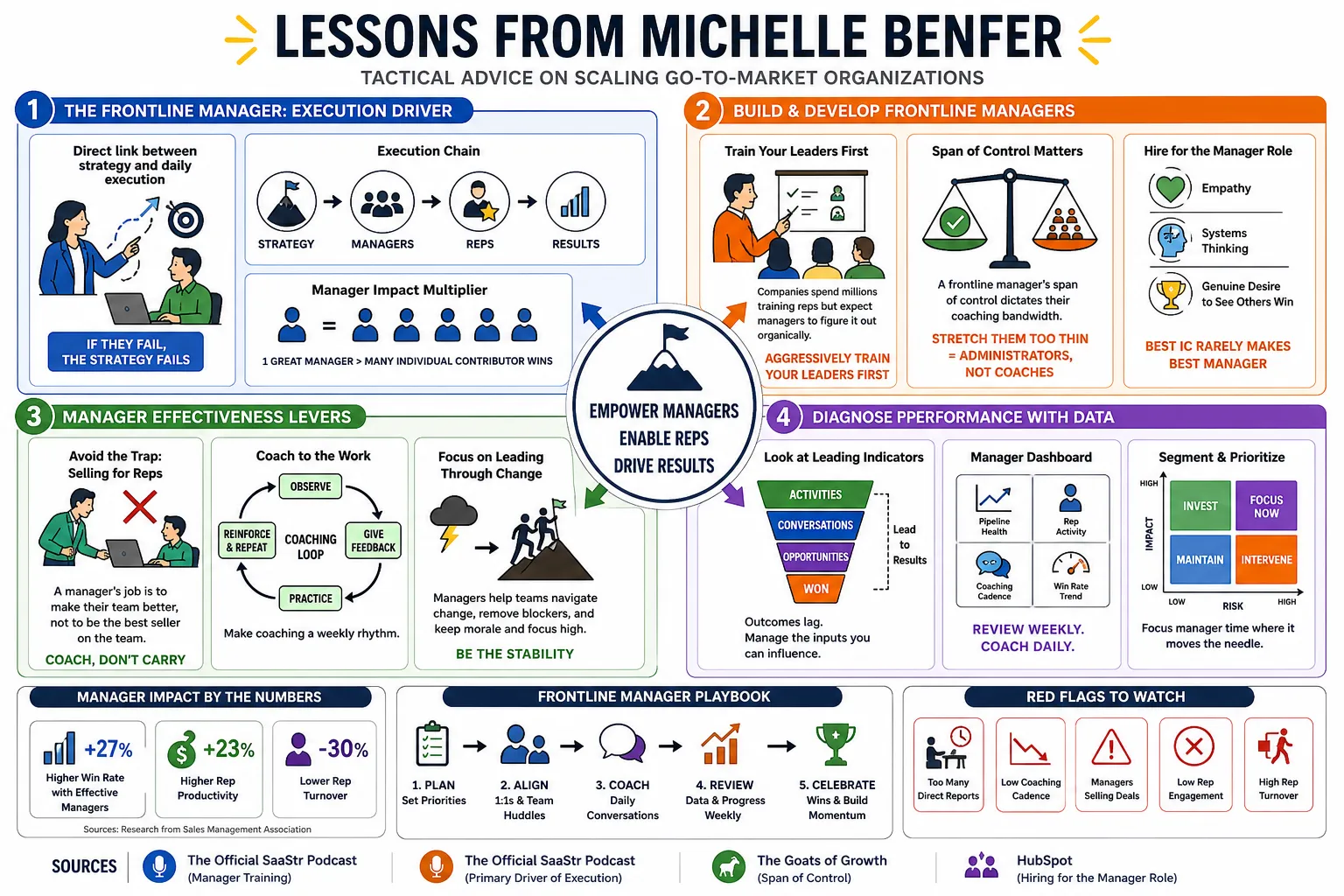
Lessons from Michelle Benfer
Michelle Benfer is a technology executive who has led sales and revenue teams at HubSpot, BILL, and Litmos. This profile collects her tactical advice on scaling go-to-market organizations, focusing on how to diagnose performance with data and help frontline managers navigate change.
Part 1: The Role of the Frontline Manager
- On the primary driver of execution: "Frontline sales managers are the direct link between high-level strategy and daily execution. If they fail, the strategy fails." — Source: The Official SaaStr Podcast
- On manager training: "Companies spend millions training reps but often expect managers to figure it out organically. You must aggressively train your leaders first." — Source: The Official SaaStr Podcast
- On span of control: "A frontline manager's span of control dictates their coaching bandwidth. Stretch them too thin and they become administrators instead of coaches." — Source: The Goats of Growth
- On hiring for the manager role: "The best individual contributor rarely makes the best manager by default. Look for empathy, systems thinking, and a genuine desire to see others win." — Source: HubSpot
- On the trap of selling for reps: "A manager's job is to build the rep's muscle to close the next ten deals independently, never to step in and close the deal for them." — Source: CoachEm
- On continuous feedback: "Feedback cannot wait for a quarterly review. It needs to be immediate, contextual, and tied directly to observed behaviors." — Source: The Official SaaStr Podcast
- On managing the middle: "Most revenue growth comes from moving your middle performers up a few percentage points. That requires dedicated focus from the frontline manager." — Source: Gong Reveal Podcast
- On protecting manager time: "If your managers are spending most of their time in spreadsheets, they are failing to manage. You have an operations problem." — Source: The Goats of Growth
- On leading with context: "Explain the business math behind the quota. Context creates ownership." — Source: The Official SaaStr Podcast
- On peer learning: "The fastest way to upskill a management layer is to facilitate structured peer-to-peer coaching among your frontline leaders." — Source: CoachEm
Part 2: Data-Driven Coaching and Performance
- On diagnosing performance: "Never diagnose a rep's performance based on gut feeling. Use conversational intelligence and activity metrics to isolate the exact breakdown in their process." — Source: Gong Reveal Podcast
- On the sink or swim fallacy: "The days of letting reps sink or swim are over. It is too expensive to replace a hire. Data allows us to throw a very specific lifeline." — Source: CoachEm
- On leading indicators: "By the time you see the lagging indicator of a missed quota, the quarter is lost. Coach strictly to meeting conversion rates and pipeline velocity." — Source: Gong Reveal Podcast
- On objective reality: "Data removes emotion from performance conversations. It shifts the dialogue from perceived effort to visible process bottlenecks." — Source: Sales Assembly
- On listening to calls: "A manager should be reviewing game tape every single week. If you avoid listening to calls, you are managing blind." — Source: Gong Reveal Podcast
- On focusing coaching efforts: "Pick one skill to coach at a time. If the data shows a rep struggles with discovery and negotiation, fix discovery first." — Source: CoachEm
- On pipeline hygiene: "Dirty data is a leadership failure. If you fail to enforce hygiene, you cannot forecast, and if you cannot forecast, you cannot lead." — Source: The Goats of Growth
- On the Rule of 40: "Balancing growth and profitability requires a deep understanding of unit economics. You have to engineer revenue instead of buying it." — Source: The Goats of Growth
- On standardizing excellence: "Use data to isolate what your top performers do differently, then build your enablement program around cloning those specific behaviors." — Source: HubSpot
- On tech stack bloat: "More tools do not equal more revenue. If software fails to increase active selling time or improve conversion, cut it entirely." — Source: Sales Assembly
Part 3: Building Inclusive Sales Cultures
- On expanding archetypes: "Sales has historically been dominated by a specific aggressive archetype. Expanding that profile is a business imperative to reach modern buyers." — Source: HubSpot
- On diverse hiring: In her HubSpot article on building a more inclusive sales floor, Benfer argues that leaders should search beyond their immediate networks, expand recruiting to non-traditional schools and programs, and make engaging diverse candidates an explicit priority. That supports the safer lesson that homogeneous hiring pipelines create market blind spots and need to be widened deliberately. — Reference: HubSpot article on investing in diverse candidates
- On psychological safety: "Reps will avoid taking the necessary risks to close complex deals if they feel one mistake will cost them their job." — Source: HubSpot
- On equitable promotion: The same HubSpot article says an inclusive team is one where people do not feel held back from success because of how they identify, and Benfer frames inclusion as an ongoing leadership responsibility shaped by honest feedback. That supports the narrower lesson that promotion and advancement systems should be examined for signs that some groups feel excluded or disadvantaged. — Reference: HubSpot article on inclusion and not feeling held back
- On mentorship versus sponsorship: In the CoreOS interview, Benfer says the best leaders combine belief in a person with concrete support for that person's development and growth. That supports the safer lesson that career progress depends on advocacy and practical backing from leaders, not just advice in the abstract. — Reference: CoreOS interview on leadership support and development
- On inclusive enablement: "Training needs to accommodate different learning styles. The loud extroverted role-play is rarely the only way to build a skill." — Source: HubSpot
- On defining cultural fit: "Stop hiring for culture fit and start hiring for culture add." — Source: Sales Assembly
- On celebrating wins: "How you celebrate dictates what you value. If you only reward the lone-wolf massive deal, you destroy collaboration." — Source: HubSpot
- On the manager's role in inclusion: In her HubSpot article, Benfer writes that part of her job as a leader is making her team feel welcome and safe and that leaders must keep the inclusion dialogue active instead of assuming it is solved. That supports the lesson that a frontline manager shapes inclusion through everyday team interactions and consistent follow-through. — Reference: HubSpot article on leaders making teams feel welcome and safe
Part 4: Leading Through Change and Adaptability
- On organizational agility: "The market will change faster than your annual plan. Your strategy must remain a living document rather than a rigid script." — Source: Litmos
- On pacing the team: "During periods of uncertainty, the leader must set the pace. The team will adopt your level of urgency and your level of calm." — Source: Francisco Partners
- On clear communication: "When things change, over-communicate. In the absence of information, sales teams will assume the absolute worst." — Source: The Official SaaStr Podcast
- On objective leadership: "You cannot manage change emotionally. Look at the macroeconomic realities and adjust the sails without panicking the crew." — Source: CoachEm
- On adjusting targets: "If the market shifts drastically, holding onto an impossible quota destroys morale. Adjust targets to remain challenging but rooted in reality." — Source: The Goats of Growth
- On intellectual curiosity: "The leaders who survive market downturns get intensely curious about why buyers hesitate, instead of demanding reps to dial more." — Source: The Sales Hacker Podcast
- On breaking down silos: "During a pivot, revenue operations, sales, and marketing must operate as a single organism. Friction between these departments is fatal." — Source: The Goats of Growth
- On managing burnout: "Change fatigue is real. You have to know when to push the team and when to force them to log off and reset." — Source: Litmos
- On the opportunity in chaos: "Market disruptions always create new buyer needs. The agile sales organization finds out what those needs are first." — Source: Francisco Partners
Part 5: Go-to-Market Strategy and Execution
- On aligning motions: "Your product complexity must match your sales motion. You cannot sell a cheap product with an enterprise field team." — Source: The Official SaaStr Podcast
- On buyer-centricity: "Your sales process should be mapped to how the buyer actually wants to buy, avoiding how you prefer to sell." — Source: HubSpot
- On the role of operations: "Revenue operations is the central nervous system of a modern go-to-market strategy. Treat it as a strategic partner." — Source: The Goats of Growth
- On sales efficiency: "If you want to be less reliant on adding raw headcount, obsess over conversion rates at every single stage of the funnel." — Source: The Goats of Growth
- On retention: "Net revenue retention is the lifeblood of software. Your strategy must prioritize post-sale expansion alongside initial logo acquisition." — Source: The Official SaaStr Podcast
- On market segmentation: "Diluting your focus across too many segments leads to mediocre win rates. Know exactly who your ideal customer profile is and ignore the rest." — Source: Stage 2 Capital
- On discounting: "A heavy discounting culture is a symptom of poor discovery. If you have to slash the price to close, you failed to establish the value." — Source: Gong Reveal Podcast
- On alignment: "The handover from marketing to sales should be invisible to the buyer. If the messaging changes entirely, you lose their trust." — Source: HubSpot
- On continuous iteration: "A go-to-market strategy is never finished. You run the play, measure the results, and iterate the playbook in a constant loop." — Source: Stage 2 Capital
Part 6: Personal Growth and Mindset in Sales
- On self-advocacy: CoachEm's episode summary quotes Benfer saying she is a goal-setter who writes her goals down and shares them loudly. That supports the safer lesson that career progress often requires stating ambitions clearly and making your goals visible instead of waiting passively to be noticed. — Reference: CoachEm episode page quoting Benfer on writing and sharing goals
- On handling rejection: "Resilience in sales means dissecting the 'no' to figure out what you can control next time." — Source: The Sales Hacker Podcast
- On lifelong learning: In the CoreOS interview, Benfer says leaders should be students of iteration, keep learning from peers at both larger and smaller organizations, and keep checking where they can improve. That supports the lesson that strong sales leaders treat growth as an ongoing practice rather than a skill set they have already finished building. — Reference: CoreOS interview on being a student of iteration and learning from peers
- On the transition to management: "Moving to management means your success detaches from personal production and anchors entirely to your team's output. It requires an ego reset." — Source: The Official SaaStr Podcast
- On seeking feedback: "Do not wait for a formal meeting. The best reps proactively pull game tape and ask their peers to tear it apart." — Source: The Sales Hacker Podcast
- On managing energy: Benfer's CoreOS interview describes protecting thinking time, taking micro-breaks, walking every morning, and shutting off in the evening so strategy work and recovery both have room. That supports the safer lesson that sales leadership is an endurance job that requires deliberate energy management instead of constant sprinting. — Reference: CoreOS interview on thinking time, breaks, and evening shutdowns
- On imposter syndrome: Gong's writeup of Benfer's Reveal episode says managers regularly bring her reps who doubt themselves, feel stuck, or struggle with imposter syndrome, and she argues for a psychologically safe environment where people can talk about stress and get support. That supports the lesson that imposter syndrome should be addressed through coaching and psychological safety rather than dismissed as a personal weakness. — Reference: Gong article on imposter syndrome and psychological safety
- On building a personal brand: "Your internal reputation is your most valuable asset. Be the person who solves problems instead of merely pointing them out." — Source: The Sales Hacker Podcast
- On lateral moves: "Taking a sideways step to learn a new product line or market segment pays massive dividends later in your career." — Source: HubSpot
- On maintaining perspective: "A bad month does not define your career trajectory. Keep the macro perspective while fixing the micro execution." — Source: The Sales Hacker Podcast
Part 7: Scaling Revenue Teams
- On the danger of premature scaling: "Do not pour headcount onto a broken process. If your conversion rates are terrible, adding more reps simply scales the inefficiency." — Source: The Goats of Growth
- On onboarding speed: "Time-to-ramp is a defining metric. Your onboarding process must turn a new hire into a productive rep in a highly predictable timeframe." — Source: Stage 2 Capital
- On maintaining culture at scale: "Culture breaks every time a company triples in size. You have to actively rebuild and reinforce your core values at every new growth stage." — Source: HubSpot
- On hiring profiles: "As you scale from startup to enterprise, the pioneer who found product-market fit is rarely the person who can execute a rigid playbook at scale." — Source: The Official SaaStr Podcast
- On managing global teams: "Scaling across regions requires localization, which goes beyond mere translation. What works in North America will fail in Europe if copied exactly." — Source: HubSpot
- On forecasting accuracy: "At scale, missing your forecast by twenty percent impacts the entire company's resource planning. Discipline in pipeline management becomes non-negotiable." — Source: The Goats of Growth
- On organizational design: "Design your sales architecture around the customer journey instead of internal politics. The structure should remove friction for the buyer." — Source: Stage 2 Capital
- On promoting from within: "A scalable organization must build a farm system. If you continually hire leaders externally, your internal development programs are failing." — Source: The Official SaaStr Podcast
- On enablement at scale: "Sales enablement must shift from ad-hoc training sessions to programmatic learning paths as the team grows." — Source: Litmos
Part 8: The Future of Sales Leadership
- On the integration of AI: "AI will not replace sales reps, but reps who use AI will replace those who refuse. Leaders must embed these tools into the daily workflow." — Source: Litmos
- On the evolving CRO role: "The modern revenue executive must be as fluent in product usage data and marketing attribution as they are in closing enterprise deals." — Source: The Goats of Growth
- On continuous education: "Corporate learning is no longer an onboarding event. It is a permanent requirement for retention and performance." — Source: Litmos
- On buyer independence: "Buyers do most of their research before talking to a rep. Our job is no longer providing raw information; it revolves around building context and consensus." — Source: Gong Reveal Podcast
- On the death of the lone wolf: "Complex sales are now entirely a team sport. The salesperson is the quarterback, but they need the sales engineer and customer success to win." — Source: HubSpot
- On remote management: "Leading a distributed team requires intentionality. You cannot rely on overhearing conversations on the sales floor; you have to manufacture coaching moments." — Source: The Official SaaStr Podcast
- On value over volume: "The era of the bulk outbound motion is over. Hyper-personalization and high-value outreach are the only ways to break through the noise." — Source: Sales Assembly
- On customer success alignment: "The line between sales and customer success is blurring. The revenue leader of the future manages the full customer lifecycle from first touch through renewal." — Source: Stage 2 Capital
- On leading with empathy: In the CoreOS interview, Benfer says empathy matters most when it is paired with visible support, especially during demanding periods like caregiving or parental leave. That supports the safer lesson that high-performance leadership works better when empathy is operationalized through concrete support instead of rhetoric alone. — Reference: CoreOS interview on empathy paired with support