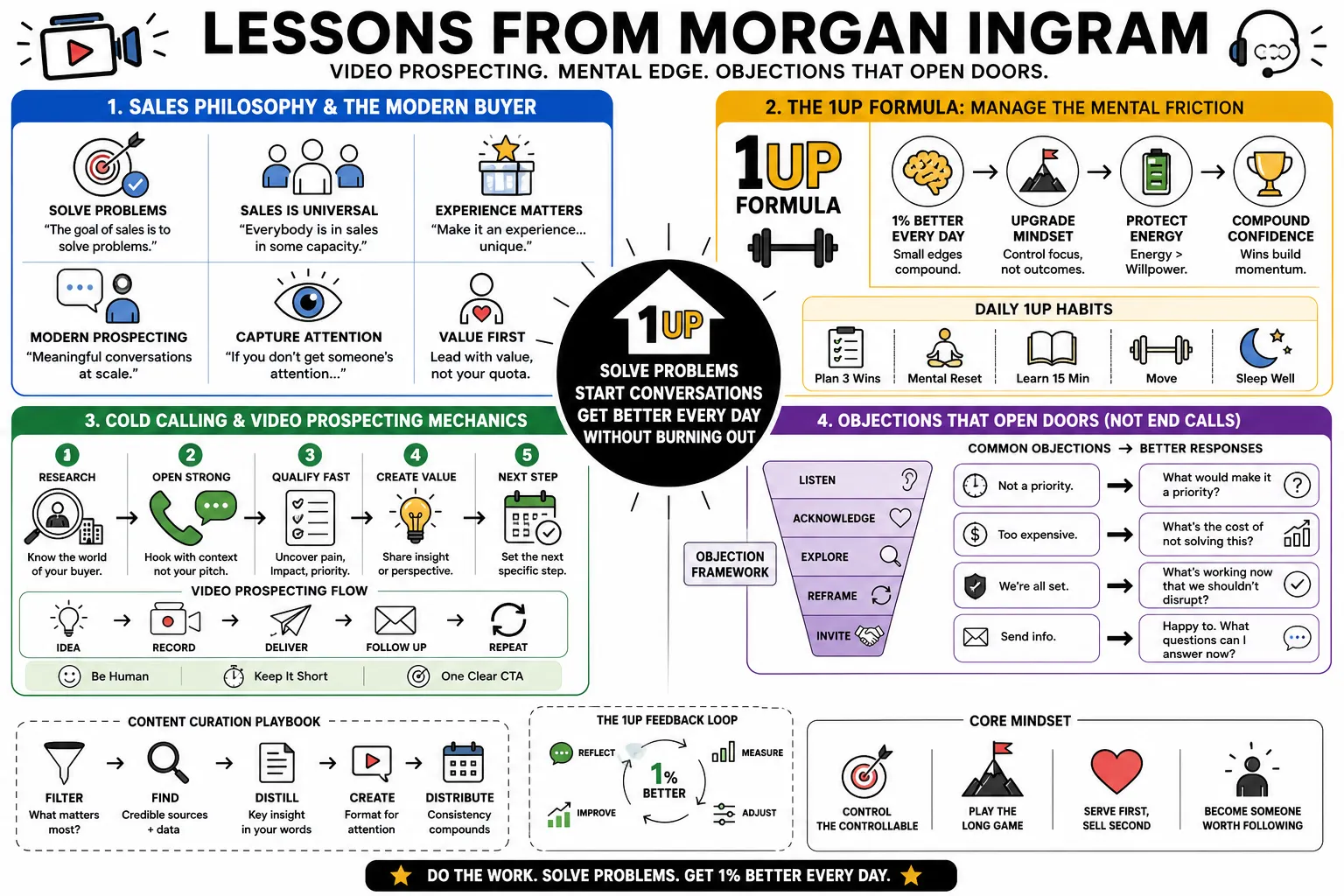
Lessons from Morgan Ingram
Morgan Ingram built his reputation in B2B sales by broadcasting his early career on YouTube and pushing the industry toward video prospecting. He later developed the 1UP Formula to help reps manage the mental friction of outbound work. This profile breaks down his mechanics for cold calling and content curation, along with his exact tactics for handling objections without burning out.
Part 1: Sales Philosophy and the Modern Buyer
- On the nature of sales: "The goal of sales is to solve problems, which means that it's something that we do every single day because every day we are solving some type of problem in our life." — Source: HubSpot Sales
- On universality: "I think everybody, no matter what career path they're in, is in sales in some capacity." — Source: HubSpot Sales
- On the buyer experience: "When you sell, you want people to feel like it's an experience... unique... a seller I want to work with wherever they go." — Source: HubSpot Sales
- On modern prospecting: "Sales prospecting is no longer about numbers alone. It's about crafting meaningful conversations at scale." — Source: HubSpot Sales
- On capturing attention: "If you don't get someone's attention in the first 5 to 10 seconds, they will not pay attention to you." — Source: HubSpot Sales
- On the power of attention: "If you can get attention, you can pretty much do anything." — Source: HubSpot Sales
- On the death of tactics: "Most people who say something is 'dead' like cold calling or email just aren't good at it." — Source: HubSpot Sales
- On standing out: "The way you stand out is the wins your customers have. And honestly, the bar isn't that high." — Source: HubSpot Sales
- On speaking the buyer's language: Obsess over your prospects' digital assets, listening to their podcast appearances to identify their specific words and lingo, then mirror that language in outreach. — Source: 30 Minutes to President's Club
Part 2: The Art of the Cold Call
- On the Fisherman’s Framework: The cold call operates in three stages: the waiting or introduction, the bite or pitch, and the fight or objection handling. — Source: 30 Minutes to President's Club
- On the PLA Opener: Use the Pleasant, Laugh, Arms Up method. Start by thanking them, include a genuine chuckle to create levity, and physically raise your arms to open your chest and soften your tone. — Source: 30 Minutes to President's Club
- On thanking the prospect: Start by saying, "Hi [Name], thanks for taking my call," because most people never get thanked simply for answering the phone. — Source: 30 Minutes to President's Club
- On the direct pattern interrupt: Tell them, "Hi [Name], you don't know me and I don't know you. The reason for my call is..." to immediately answer who you are and what you want. — Source: 30 Minutes to President's Club
- On asking for help: Use the phrase, "Hi [Name], can you help me?" because humans are biologically wired to want to help when asked directly. — Source: 30 Minutes to President's Club
- On the 30-second rule: Give them an out by asking, "Do you have 30 seconds for me to tell you why I called? If it’s not relevant, you can hang up on me. Does that sound fair?" — Source: 30 Minutes to President's Club
- On the "Typically" pivot: Use the word "typically" to sound like an expert guide, such as, "Typically, VPs of Sales I talk to are worried about X," implying you solve this for many others. — Source: 30 Minutes to President's Club
- On reviewing calls: Record your calls and specifically review the first 20 seconds every week to refine your tone, pacing, and approachability. — Source: 30 Minutes to President's Club
- On sounding human: Avoid Robot Mode by talking as if you are calling a colleague, not reading from a rigid script. — Source: 30 Minutes to President's Club
- On the 2-Minute Rule: Spend no more than two minutes researching a prospect on LinkedIn or company news to find one hook that makes the call feel personalized. — Source: 30 Minutes to President's Club
Part 3: Video Prospecting and Outreach
- On the movie trailer philosophy: Your video is the movie trailer, and the sales call is the actual movie; the objective is to sell the meeting, not the product. — Source: HubSpot Sales
- On the 10-30-10 framework: Structure videos with a 10-second hook on the reason for reaching out, 30 seconds of value connecting to their pain point, and a 10-second low-friction call to action. — Source: HubSpot Sales
- On the ideal video length: Keep video outreach between 45 and 60 seconds, as anything over 90 seconds is generally too long for a cold prospect to watch. — Source: HubSpot Sales
- On the first three seconds: Smile and wave at the start of your video to immediately appear approachable and human. — Source: HubSpot Sales
- On lighting and environment: Ensure you are well-lit by facing a window or using a ring light so the prospect can clearly see your face, avoiding dark or cave-like backgrounds. — Source: HubSpot Sales
- On the "Power 5" approach: Aim to send five highly personalized videos per day rather than blasting hundreds of generic messages. — Source: HubSpot Sales
- On native tools: An iPhone or native LinkedIn video is often the most effective format because it feels more authentic and less like a polished marketing asset. — Source: HubSpot Sales
- On personalizing the hook: State a specific reason for the video by mentioning a recent post they made, a podcast they appeared on, or a major company milestone. — Source: HubSpot Sales
- On low-friction CTAs: Instead of asking for a 30-minute meeting, end videos with, "Are you open to learning more?" or "Would you be opposed to a deeper dialogue?" — Source: HubSpot Sales
Part 4: Social Selling and the 5Cs Framework
- On Clarity: Get granular about your Ideal Customer Profile; do not just target marketers, target specific roles at specific company stages with specific pain points. — Source: All Dots Connected
- On Connection: Be intentional and mirror executive behavior by connecting early in the morning or late at night. — Source: All Dots Connected
- On the pitch slap: Avoid pitching immediately after connecting; move beyond immediate selling to intentional networking. — Source: All Dots Connected
- On Conversation: Wait a few days after connecting before sending a personalized message, often using video or voice notes as a pattern interrupt. — Source: All Dots Connected
- On Commenting: Use comments on prospects' posts as a primary way to build visibility and familiarity before ever reaching out via direct message. — Source: All Dots Connected
- On the comment framework: When commenting on a prospect's post, offer a specific insight and ask a follow-up question to drive engagement. — Source: All Dots Connected
- On Content: Position yourself as a curator rather than just a creator, sharing takeaways from industry resources to build authority. — Source: All Dots Connected
- On human-centric sales: In an era of AI-generated slop, sellers must focus on being more human through personalized outreach and authentic engagement. — Source: All Dots Connected
- On the past company filter: Use LinkedIn Sales Navigator to find people who used your product at their previous company and have now moved to a new target account. — Source: All Dots Connected
- On profile viewers: Regularly check who has viewed your LinkedIn profile and reach out by asking if there was anything specific they were looking for or needed help with. — Source: All Dots Connected
Part 5: Content Strategy and Curation
- On Edutainment: B2B content should live at the intersection of education and entertainment, moving away from boring corporate updates toward narrative-led growth. — Source: All Dots Connected
- On content curation: You do not need to create original content daily; you can win by curating and providing perspective on existing industry insights. — Source: All Dots Connected
- On the weekly curation habit: Take three lessons from a podcast, article, or industry report, make them your own, and share them once a week to stand out on LinkedIn. — Source: All Dots Connected
- On un-gating insights: Stop hiding your best insights behind densely worded PDFs and instead turn that value into short-form videos or casual LinkedIn posts. — Source: All Dots Connected
- On context: "Content is nothing without context." — Source: All Dots Connected
- On utilizing AI correctly: Use AI tools to transcribe internal sales calls and customer success meetings, then turn those transcripts into content based on real-world questions, rather than relying on generic AI prompts. — Source: All Dots Connected
- On Dearbound strategy: Modern outbound must tap into partner ecosystems and referrals; pure cold outbound is becoming less effective than being visible where buyers hang out. — Source: All Dots Connected
- On turning profiles into engines: Transform your static LinkedIn profile from a simple resume into a lead magnet that actively generates meetings and inbound interest. — Source: All Dots Connected
- On standing out from AI: As AI-generated content saturates digital channels, the real differentiator will be moving relationships from the URL to IRL through micro-events and dinners. — Source: All Dots Connected
Part 6: The B2B Creator Economy and Influencer Marketing
- On narrative-led growth: Brands must lead with stories and expert-driven content rather than depending strictly on cold outreach to generate pipeline. — Source: Demand Gen Report
- On activating internal experts: Help B2B organizations identify and activate their internal subject matter experts to turn employees into trusted creators. — Source: Demand Gen Report
- On Character in influencers: When selecting subject matter experts, evaluate their character to ensure they are likable and genuinely aligned with the brand’s story. — Source: Demand Gen Report
- On Credibility in influencers: Ensure that the internal experts leading a brand's content are speaking from actual, hands-on experience in the field. — Source: Demand Gen Report
- On Charisma in influencers: Internal experts must be captivating enough to hold an audience’s attention in video or writing formats. — Source: Demand Gen Report
- On B2B vs B2C influencers: Unlike B2C influencer marketing, which focuses on sheer reach, B2B influencer partnerships must prioritize credibility and the ability to actually influence buying decisions. — Source: Demand Gen Report
- On the value of attention: In a world of automated spam and noise, the ability to create authentic, video-first content that resonates with a specific audience is the most valuable skill set. — Source: Demand Gen Report
- On documenting the journey: B2B professionals can use personal branding and document their day-to-day journey, much like the SDR Chronicles, to accelerate their careers and drive business results. — Source: Demand Gen Report
- On Customer Success alignment: Sales reps should talk to their Customer Success team weekly to understand specific wins and ROI, using those real-world proof points in content and prospecting. — Source: 30 Minutes to President's Club
Part 7: Handling Objections and Pattern Interrupts
- On the PAQ Method: When a prospect throws an objection, use the PAQ framework: Pause, Acknowledge, and Question. — Source: Proposify
- On the power of pausing: Wait 1.5 to 2 seconds after an objection; this shows you aren't reactive and are genuinely thinking about what they said. — Source: Proposify
- On acknowledging objections: Validate their statement by saying, "I completely understand you're already using [Competitor]." — Source: Proposify
- On questioning to pivot: Ask a discovery question to pivot, such as, "Typically, when people use [Competitor], they are happy with X but struggle with Y. Is that what you're seeing?" — Source: Proposify
- On the brutally honest question: If a prospect says "Send me an email," ask: "Can I ask a brutally honest question? Usually, that's a polite way of telling me to get off the phone. Is this a priority, or should I just not send the email?" — Source: Proposify
- On the reverse voicemail: Instead of asking for a callback, tell them not to call back. State your reason for calling and say you will send an email with a specific subject line, asking them to reply there. — Source: Proposify
- On voice notes in DMs: Use LinkedIn or social media voice notes as a pattern interrupt; hearing a human voice in a direct message inbox feels more personal and difficult to ignore. — Source: All Dots Connected
- On inverse thinking: To improve your sales process, ask yourself what the absolute worst thing you could do on a call is, and by identifying those behaviors, you can more effectively avoid them. — Source: 30 Minutes to President's Club
- On not backing down: The "fight" stage of a cold call isn't about arguing; it's about standing your ground respectfully and turning an automatic "no" into an actual conversation. — Source: 30 Minutes to President's Club
Part 8: The 1UP Mindset and Personal Growth
- On experimentation: "You cannot lose if you do an experiment. It's near impossible. If you do something well, you're ahead. If you don't, you're in the same place." — Source: HubSpot Sales
- On patience: "Be patient and persistent—what doesn't work today might evolve into tomorrow's breakthrough." — Source: HubSpot Sales
- On seeing the light: "When you commit yourself to be persistent towards your sales goals, you will see the light at the end of the tunnel." — Source: HubSpot Sales
- On innate motivation: Ingram says skills can be taught to anyone, but the underlying drive and motivation that push someone to keep going has to come from within, from whatever originally sparked it for that person. — Source: Apple Podcasts
- On mental health in sales: "You can be great at sales but lose all the money and well-being and mental health from being great at sales." — Source: Apple Podcasts
- On the 1UP Formula: The show's own premise is that leading your best life means growing across three areas at once, professionally, creatively, and in your relationships, rather than treating career success as the only measure that counts. — Source: Apple Podcasts
- On total commitment: Ingram says he wasn't always 100% committed to sales, and believes that if you're going to do anything, you have to be fully committed to it, or you'll never really know whether it was right for you. — Source: Apple Podcasts
- On lacking regrets: Ingram says he carries no regrets, since even decisions that look bad in hindsight ended up teaching him something that fed later success. — Source: Apple Podcasts
- On faith: Asked what faith means to him, Ingram describes it as believing in something bigger than yourself, something hard to put into words but that you know is there. — Source: Apple Podcasts
- On continuous leveling up: The 1UP Formula's throughline is that leveling up is not a one-time career milestone, it is an ongoing effort spread across your professional life, your creative expression, and your relationships. — Source: Apple Podcasts