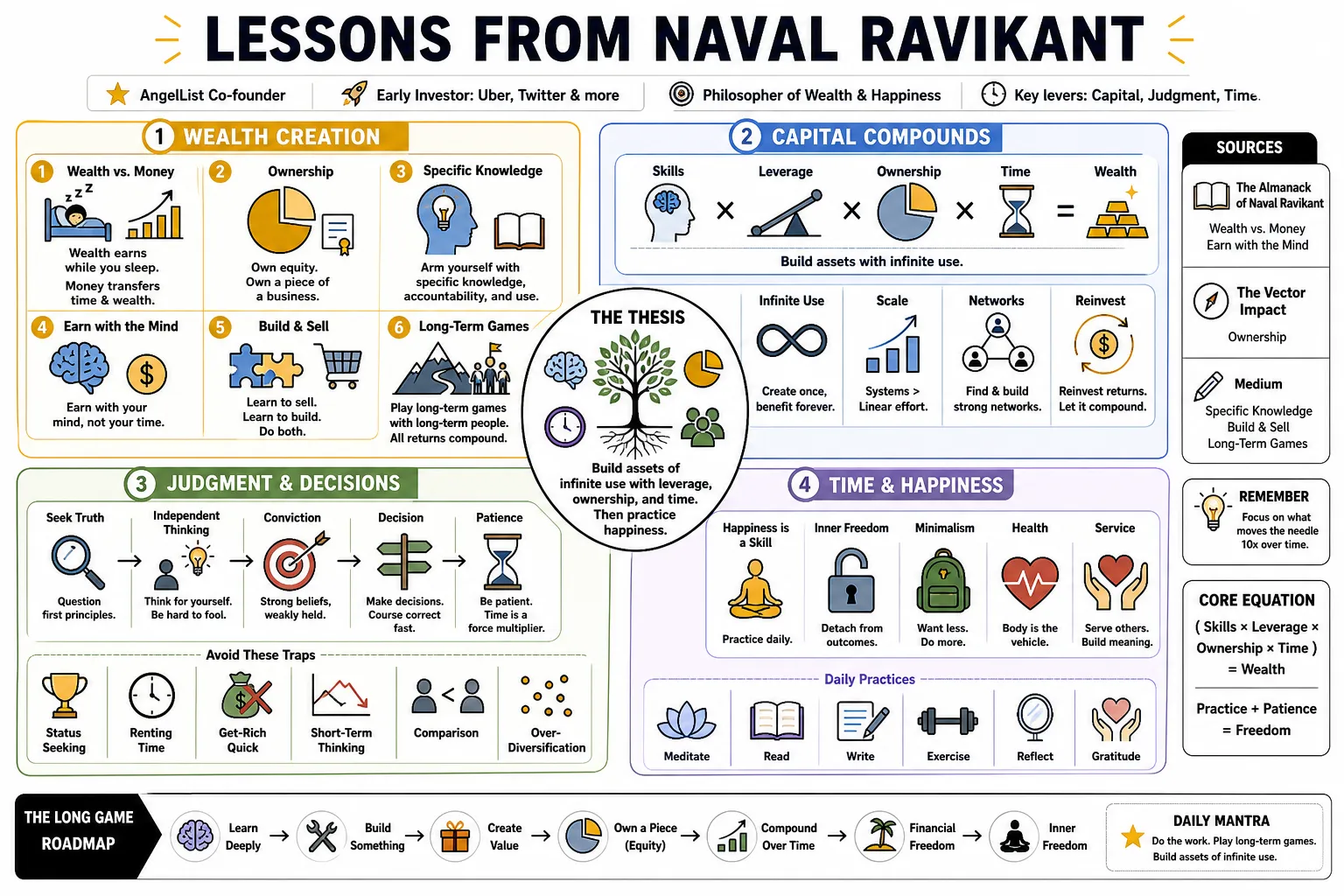
Lessons from Naval Ravikant
Naval Ravikant co-founded AngelList and invested early in startups like Uber and Twitter. He argues that wealth comes from building forms of leverage, and that happiness is simply a skill you practice. This collection organizes his arguments on capital, judgment, and time. — Naval: How to Get Rich.
Part 1: Wealth Creation
- On Wealth vs. Money: "Seek wealth, not money or status. Wealth is having assets that earn while you sleep. Money is how we transfer time and wealth." — Naval: How to Get Rich.
- On Ownership: "You’re not going to get rich renting out your time. You must own equity—a piece of a business—to gain your financial freedom." — Naval: How to Get Rich.
- On Specific Knowledge: "Arm yourself with specific knowledge, accountability, and leverage. Specific knowledge is knowledge that you cannot be trained for." — Naval: How to Get Rich.
- On Earning with the Mind: "Earn with your mind, not your time." — Naval: How to Get Rich.
- On Building and Selling: "Learn to sell. Learn to build. If you can do both, you will be unstoppable." — Naval: How to Get Rich.
- On Long-Term Games: "Pick an industry where you can play long-term games with long-term people. All returns in life come from compound interest." — Naval: How to Get Rich.
- On Solving Society's Needs: "Society will pay you for creating things it wants. But society doesn’t yet know how to create those things, because if it did, they wouldn’t need you." — Naval: How to Get Rich.
- On Authenticity as a Moat: "Escape competition through authenticity. Basically, when you’re competing with people, it’s because you’re copying them." — Naval: How to Get Rich.
- On the Skill of Wealth: "Getting rich is about knowing what to do, who to do it with, and when to do it. It is much more about understanding than purely hard work." — Naval: How to Get Rich.
- On Positive-Sum Games: "Wealth creation is an inherently positive-sum game. You are creating things that society wants but does not yet know how to get." — Naval: How to Get Rich.
Part 2: Leverage and Capital
- On the Types of leverage: "There are three broad classes of leverage: labor, capital, and products with no marginal cost of replication, like code and media." — Naval: How to Get Rich.
- On Permissionless leverage: "Code and media are permissionless leverage. They are the leverage behind the newly rich. You can create software and media that works for you while you sleep." — Naval: How to Get Rich.
- On the Force Multiplier: "Leverage is a force multiplier for your judgment." — Naval: How to Get Rich.
- On Infinite leverage: "In an age of infinite leverage, judgment is the most important skill." — Naval: How to Get Rich.
- On Labor as leverage: "Labor means people working for you. It's the oldest and most fought-over form of leverage. Avoid it if possible, as it requires managing others." — Naval: How to Get Rich.
- On Capital as leverage: "Money is a good form of leverage. It means every time you make a decision, you multiply it with money. But it requires permission from investors or banks." — Naval: How to Get Rich.
- On Ethics and leverage: "If you care about ethics in wealth creation, it is better to create your wealth using code and media as leverage because then those products are equally available to everybody." — Naval: How to Get Rich.
- On Archimedes and Business: "Give me a lever long enough and a place to stand, and I will move the earth." — Naval: How to Get Rich.
- On Democratized Tools: "The new generation's fortunes are made through code or media. You can sit on a computer and write code or record a podcast, and it scales infinitely without extra cost." — Naval: How to Get Rich.
- On Independence: "Leverage enables you to decouple your inputs from your outputs, destroying the traditional link between hours worked and money earned." — Naval: How to Get Rich.
Part 3: Happiness and Peace
- On Happiness as a Skill: "Happiness is a choice you make and a skill you develop." — Naval: Happiness.
- On Interpreting Events: "A happy person isn’t someone who’s happy all the time. It’s someone who effortlessly interprets events in such a way that they don’t lose their innate peace." — Naval: Happiness.
- On the Absence of Desire: "Happiness is what’s there when you remove the sense that something is missing in your life." — Naval: Happiness.
- On the Fundamental Delusion: "The fundamental delusion: There is something out there that will make me happy and fulfilled forever." — Naval: Happiness.
- On Peace vs. Happiness: "Peace is happiness at rest, and happiness is peace in motion." — Naval: Happiness.
- On Peace From Mind: "We say 'peace of mind,' but what we really want is peace from mind." — Naval: Happiness.
- On Managing Desires: "Desire is a contract that you make with yourself to be unhappy until you get what you want." — Naval: Happiness.
- On Internal Solutions: "The way we think you get peace is by resolving all your external problems... The only way to actually get peace is on the inside by giving up the idea of problems." — Naval: Happiness.
- On Reality: "Reality is neutral. Our reactions reflect back and create our world. Judge, and feel separate and lonely." — Naval: Happiness.
- On Choosing Your Battles: "Pick your one overwhelming desire. It’s okay to suffer over that one. But on all the others, you want to let them go so you can be calm and peaceful." — Naval: Happiness.
Part 4: Judgment and Decision Making
- On the Value of Accuracy: "Someone who makes decisions right 80% of the time instead of 70% of the time will be valued and compensated in the market hundreds of times more." — Naval: Happiness.
- On the Three Big Choices: "Most of your life's success comes from three choices: where you live, who you are with, and what you are doing." — Naval: Happiness.
- On Indecision: "If you can’t decide, the answer is no." — Naval: Happiness.
- On Short-Term Pain: "If you have two choices and they are relatively equal, take the path that is more difficult and painful in the short term." — Naval: Happiness.
- On Equanimity: "In times of interpersonal conflict, pick the choice which will leave you more equanimous in the long term." — Naval: Happiness.
- On First Principles: "Think clearly from the ground up. Understand and explain from first principles. Ignore society and politics." — Naval: Happiness.
- On Simplicity: "It’s the mark of a charlatan to try and explain simple things in complex ways; it’s the mark of a genius to explain complicated things in simple ways." — Naval: Happiness.
- On Truth Over Desire: "I want to see the world the way it is. Not through my filters. Not through my desires... And I want to accept it the way it is." — Naval: Happiness.
- On Internal Authority: "Clear thinkers appeal to their own authority. They don't rely on consensus or 'experts' but on their own understanding of the truth." — Naval: Happiness.
Part 5: Time and Freedom
- On Valuing Your Time: "Value your time at an hourly rate, and ruthlessly spend to save time at that rate." — Naval: How to Get Rich.
- On Priorities: "‘I don’t have time’ is just another way of saying ‘It’s not a priority.’" — Naval: Happiness.
- On the Purpose of the Game: "The reason to win the game is so that you can be free of it." — Naval: How to Get Rich.
- On Freedom from Upgrades: "People who live far below their means enjoy a freedom that people busy upgrading their lifestyles can’t fathom." — Naval: How to Get Rich.
- On 'Freedom From': "I’m more into 'freedom from' rather than 'freedom to.' Freedom from expectations, anger, and employment." — Naval: How to Get Rich.
- On Patience and Results: "Impatience with actions, patience with results." — Naval: How to Get Rich.
- On Creating Luck: "You make your own luck if you stay at it long enough." — Naval: How to Get Rich.
- On Cosmic Perspective: "Nothing you do is going to matter that much in the long run. Don’t take yourself so seriously." — Naval: Happiness.
Part 6: Health and Habits
- On Priority Hierarchies: "My number one priority in life, above my happiness, above my family, above my work, is my health. It starts with my physical health." — Naval: Happiness.
- On Personal Responsibility: "Doctors won’t make you healthy. Nutritionists won’t make you slim. Teachers won’t make you smart... Ultimately, you have to take responsibility. Save yourself." — Naval: Happiness.
- On Diet Focus: "Fit and healthy people focus way more on what they eat rather than how much they eat." — Naval: Happiness.
- On Hard Workouts: "The harder the workout, the easier the day." — Naval: Happiness.
- On Flexibility: "One month of consistent yoga and I feel 10 years younger. To stay flexible is to stay young." — Naval: Happiness.
- On Compounding Habits: "All the benefits in life come from compound interest—money, relationships, habits—anything of importance." — Naval: Happiness.
- On Breaking Habits: "Learning how to break habits is actually a very important meta-skill and can serve you in life almost better than anything else." — Naval: Happiness.
- On Identity and Environment: "At the end of the day, you are a combination of your habits and the people you spend the most time with." — Naval: Happiness.
- On Mental Fasting: "Meditation is intermittent fasting for the mind. It is turning off society and listening to yourself." — Naval: Happiness.
Part 7: Reading and Learning
- On Building the Habit: "Read what you love until you love to read." — Naval: Read What You Love Until You Love to Read.
- On Reading as a Meta-Skill: "Reading is the ultimate meta-skill that can be traded for anything else." — Naval: Read What You Love Until You Love to Read.
- On Quality Over Quantity: "I would rather read the best 100 books over and over again until I absorb them, rather than read every single book out there." — Naval: Read What You Love Until You Love to Read.
- On Reading Speed: "The smarter you get, the slower you read. True learning involves struggling with concepts and reflecting on them." — Naval: Read What You Love Until You Love to Read.
- On the Desire to Learn: "The tools for learning are abundant. It’s the desire to learn that’s scarce." — Naval: Read What You Love Until You Love to Read.
- On Knowledge Foundations: "Knowledge is a skyscraper. You can take a shortcut with a fragile foundation of memorization, or build slowly upon a steel frame of understanding." — Naval: Read What You Love Until You Love to Read.
- On Dropping Books: "Don't finish every book you start. If a book loses your interest or you've grasped the main idea, drop it immediately." — Naval: Read What You Love Until You Love to Read.
- On Concurrent Reading: "At any given time, I’m reading somewhere between ten and twenty books, flipping through based on my current mood and curiosity." — Naval: Read What You Love Until You Love to Read.
- On Selecting Books: "If they wrote it to make money, don't read it. Prefer foundational texts written by people who were trying to solve a problem or express a truth." — Naval: Read What You Love Until You Love to Read.
Part 8: Relationships and Status
- On Zero-Sum Games: "The problem is that to win at a status game, you have to put somebody else down. That’s why you should avoid status games in your life." — Naval: How to Get Rich.
- On Networking: "Networking is overrated. Become first and foremost a person of value and the network will be available whenever you need it." — Naval: Be Too Busy to “Do Coffee”.
- On the "Five-Year" Rule: "If you can’t see yourself working with someone for life, don’t work with them for a day." — Naval: Reject Most Advice.
- On Value Alignment: "Great relationships are easy because your value systems line up so perfectly they make you happy being who they are, and you make them happy being who you are." — The Almanack of Naval Ravikant: Relationships.
- On Power Struggles: "Deep down, a lot of bad relationships are power struggles. In a good relationship, each person does what they want and does not try to control the other person." — The Almanack of Naval Ravikant: Relationships.
- On the Value Filter: "The closer you want to get to me, the better your values have to be." — The Almanack of Naval Ravikant: Relationships.
- On Earned Assets: "A fit body, a calm mind, a house full of love. These things cannot be bought—they must be earned." — Naval: A Calm Mind, a Fit Body, a House Full of Love.