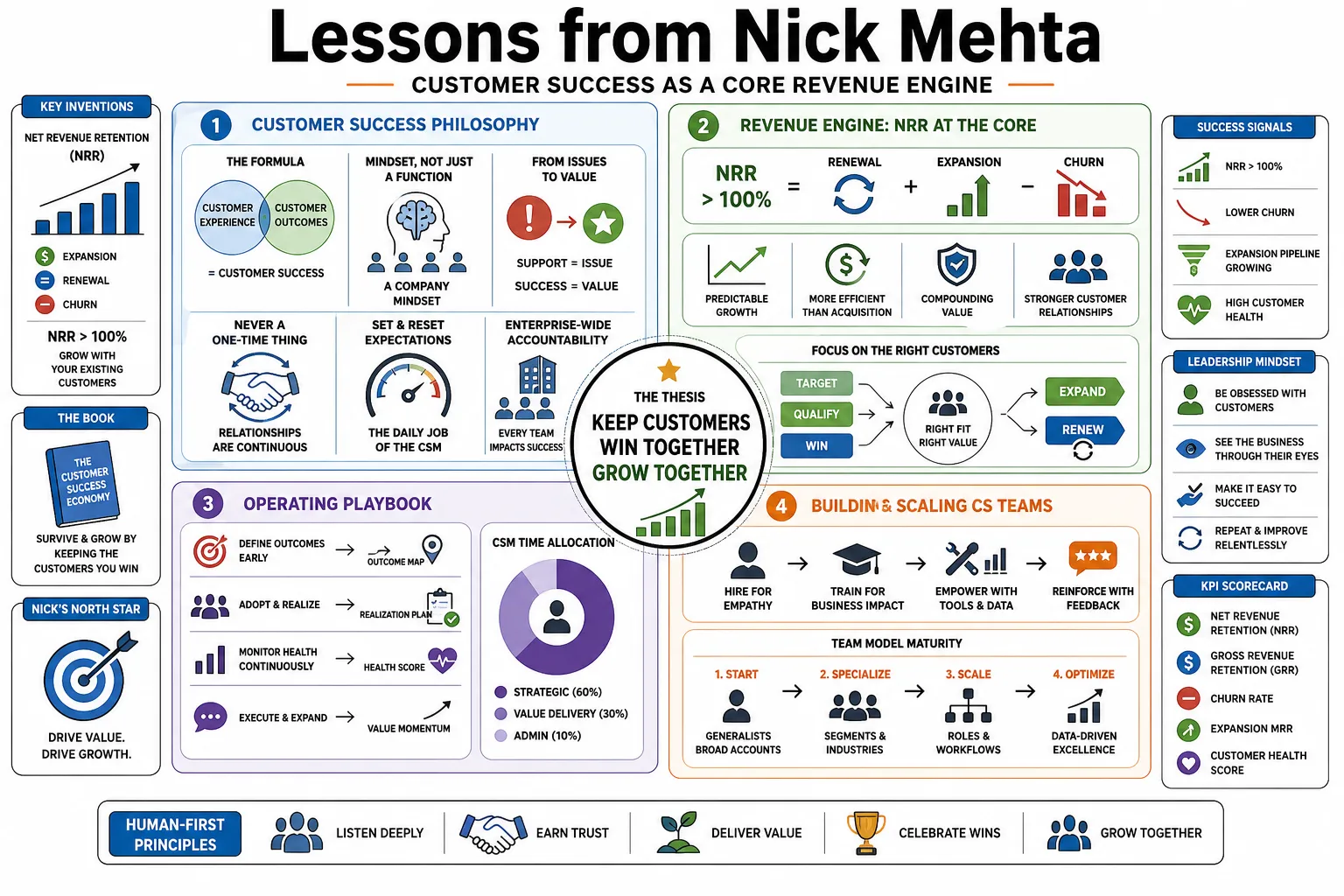
Lessons from Nick Mehta
As CEO of Gainsight, Nick Mehta is the leading voice for treating customer success as a core revenue engine rather than a back-office support function. He popularized Net Revenue Retention (NRR) and wrote the book on how subscription businesses survive by keeping the customers they win. This profile collects his direct operational advice on managing churn and scaling teams, all grounded in his human-first approach to enterprise software.
Part 1: Customer Success Philosophy
- On the formula: "Customer Success = Customer Experience + Customer Outcomes." — Source: Adrian Swinscoe
- On mindset vs. function: "Customer success is not just a function, it's a company mindset." — Source: Adrian Swinscoe
- On continuous relationships: "Unless you are a mortician or a funeral parlor, then your relationship with a customer is never a one-time thing." — Source: Adrian Swinscoe
- On expectation management: "The daily job of the CSM in a SaaS company has to do with setting and resetting customer expectations." — Source: Adrian Swinscoe
- On enterprise-wide alignment: "Customer Success 2.0 is about making CS an enterprise-wide priority. Every person in a company needs to be aligned around the customer." — Source: Adrian Swinscoe
- On the CEO's responsibility: "The biggest barrier to customer success is CEOs not making it an important part of the culture." — Source: Adrian Swinscoe
- On defining value: "A great customer success function has a well-defined measurement, and some consistent definition of value to the end customer." — Source: Adrian Swinscoe
- On demanding users: "Don't mistake demanding customers for unsuccessful ones. The most successful customers may seem unhappy because they're pushing boundaries." — Source: Adrian Swinscoe
- On defense vs. offense: "In the beginning, customer experience and customer success can feel a lot like defense. Moving to offense means focusing on keeping customers, helping them do more and get more value." — Source: Adrian Swinscoe
Part 2: Net Revenue Retention and Churn
- On the leaky funnel: "You can't pour enough business into the top of the funnel to sustain real growth if customers are leaking out the bottom at a high rate." — Source: Gainsight
- On future spend: "NRR tracks how much your existing customers want to spend with you next year as compared to this year." — Source: SaaStr Podcast 212
- On market multiples: "Each percentage point increase in NRR is associated with a ~0.7x change in a company’s revenue multiple." — Source: Gainsight
- On shifting power: "Everything changes when your customers have power. They aren't buying your technology for a point in time; they're buying it so you can constantly deliver more for them." — Source: Gainsight
- On lightning in a bottle: "Dollar-based net retention is one of those things that can tell you, 'Do you have lightning in a bottle or not?'" — Source: Gainsight
- On the priority of retention: "Retaining customers is the number one priority for CEOs right now." — Source: Gainsight
- On natural decay: "Customers and vendors tend to drift apart naturally. Only willful, proactive interaction on the part of one or both companies will overcome the natural drift caused by constant change." — Source: Gainsight
- On growth models: "We all know that going through existing customers is just so much more efficient, so companies with high, natural net retention are just going to grow more efficiently, and easily." — Source: Gainsight
Part 3: Human-First Leadership
- On prioritizing humanity: "We are human beings first, and business people second. We are human beings first, and customers second. We are human beings first and CEOs second." — Source: UserTesting Insights Unlocked
- On the goal of business: "To be living proof that you can win in business while being human-first." — Source: UserTesting Insights Unlocked
- On granting permission: "If the leader is willing to be human, there's more permission for others to be too. It creates a positive virtuous circle." — Source: UserTesting Insights Unlocked
- On balancing efficiency and connection: "Human-first doesn't mean human-less. True customer centricity means eliminating the low-value stuff, not the relationships." — Source: UserTesting Insights Unlocked
- On vulnerability: "If you're willing to be vulnerable, which takes some bravery, it can really pay off for your business, but also for you as a person." — Source: UserTesting Insights Unlocked
- On breaking down barriers: "We can integrate our home and work in ways we never could before. It's breaking this artificial wall between who we are at home and who we are at work." — Source: UserTesting Insights Unlocked
- On organizational capital: "You can build up a huge amount of organizational social capital if you help make somebody else successful." — Source: UserTesting Insights Unlocked
- On self-deprecation: "The world wants to see CEOs being pied in the face." — Source: UserTesting Insights Unlocked
- On normal routines: Using an icebreaker question at the start of every meeting builds personal connections before diving into business metrics. — Source: UserTesting Insights Unlocked
- On the definition of nice: True human-first leadership involves radical candor. Avoiding tough feedback is a disservice to the person; you must be honest to help others grow. — Source: UserTesting Insights Unlocked
Part 4: Scaling and Operational Discipline
- On repeating errors: "I never make the same mistake twice. I make it 5 or 6 times, just to be sure." — Source: SaaStr Annual
- On holding the line: "I need to hold our leaders at Gainsight to the highest possible standard. I learned, after years of procrastinating on tough moves for our leadership team, that the leaders' teams suffer greatly through that inaction." — Source: SaaStr Annual
- On hiring ahead: "Many times, I thought 'I need to hire for the role I'll need 4 years from now.' In reality, I needed to bet on the person who believed in Gainsight for the last four years." — Source: SaaStr Annual
- On early systems: "Be REALLY careful about custom deals and make sure they are worth it. Invest in back-office systems early." — Source: SaaStr Annual
- On throwing headcount at friction: Fix product and process issues first rather than just hiring more customer success managers as a band-aid. — Source: SaaStr Annual
- On timing scale: Scale only when the data and leading indicators prove the model is repeatable, not based on a gut feeling or a temporary market bump. — Source: SaaStr Annual
- On the tortoise and hare: Do not compare your 100% known internal mess to a competitor's 5% known public success. Persistence beats over-anxious comparison. — Source: SaaStr Annual
- On early operations: Once a company reaches 50 to 75 employees, you need a CS Operations person to define processes and track leading indicators of churn. — Source: SaaStr Annual
Part 5: The Post-Sales Funnel
- On pre-sales and post-sales: "In a recurring revenue business, there’s no such thing as post-sales. Every single activity is a pre-sales activity." — Source: Intercom Podcast
- On the second funnel: Companies must manage a second funnel for existing customers, focusing on delivering continuous outcomes so they become qualified leads for expansion. — Source: Intercom Podcast
- On the value of advocacy: "The second-order effect of advocacy is much bigger than the value of the individual customer." — Source: Intercom Podcast
- On creating advocates: "A big part of customer success entails engaging and motivating your advocates. I'm a firm believer that if you make a customer an advocate and engage them, they will be more successful and stay longer." — Source: Intercom Podcast
- On customer outcomes: "Customers don't buy your solution to use its features, they buy your solution because they want to achieve a business objective." — Source: Intercom Podcast
- On proactive service: "The reality is that in new business models, if you're not proactive with a customer after the sale, they're not going to stay with you." — Source: Intercom Podcast
- On scaling support: "The most impressive companies demonstrate a strategy for scaling customer success without linear headcount growth." — Source: Intercom Podcast
- On identifying risk: You must develop risk management programs centered around customer health-scoring frameworks that provide early-warning signals to avoid surprises. — Source: Intercom Podcast
- On metrics: "Drive customer success through hard metrics. Success should be measured by data, not gut feelings." — Source: Intercom Podcast
Part 6: Product Alignment and Tech Debt
- On sales and marketing: "Product is to customer success what marketing is to sales." — Source: Gainsight
- On product as a differentiator: "Product is your only scalable differentiator. A great product reduces the burden on the success team." — Source: Gainsight
- On time-to-value: "Obsessively improve time-to-value. The faster a customer sees results, the more likely they are to stay." — Source: Gainsight
- On human duct tape: Customer success managers should not be used as duct tape for a bad product. Product teams must be close partners to ensure the software itself drives adoption. — Source: SaaStr Podcast 212
- On custom pricing debt: Custom deals and complex pricing create technical debt in the back office that is nearly impossible to simplify later. — Source: Gainsight
- On prescriptive implementation: Customers want a methodology. Tell them the best way to use your product rather than letting them implement it however they want. — Source: Gainsight
- On efficient growth: The market has shifted from growth at all costs to durable growth driven by customer-led, product-led, and community-led strategies. — Source: Gainsight
- On automation: Use technology to automate low-value tasks so that human employees can focus on high-value emotional and relational work. — Source: UserTesting Insights Unlocked
- On product constraints: If a customer is not a good fit for the product, targeting them anyway leads to inevitable churn. — Source: Gainsight
- On fair pricing: "Unfair pricing is exhausting. It works, but it’s tiring. The easiest thing to remember is the truth." — Source: SaaStr Annual
Part 7: Hiring and Organizational Culture
- On universal grading: "I am on a passionate campaign to eliminate the term 'A-Players.' It implies people are magically graded on a universal system. It’s about getting the right person in the right situation." — Source: SaaStr Annual
- On management's job: "I think a lot of companies miss out on management's responsibility in making people great versus just finding great people." — Source: SaaStr Annual
- On parting ways: How you treat people when they leave defines your culture more than how you treat them when they join. — Source: SaaStr Annual
- On the golden rule: "One of our company values is the Golden Rule—treat people the way you'd want to be treated." — Source: SaaStr Annual
- On avoiding hierarchy: Encourage new hires to message the CEO on their first day to break down hierarchical barriers early. — Source: SaaStr Annual
- On external vs. internal talent: Founders often assume they need a big company external hire for every new stage, missing out on internal talent who already know the product and culture. — Source: SaaStr Annual
- On shared values: Every major disagreement in a company can usually be traced back to a value that isn't being lived or hasn't been articulated. — Source: SaaStr Annual
- On communication: The practice of sending a weekly Sunday night email to the entire company helps maintain transparency and human connection at scale. — Source: UserTesting Insights Unlocked
- On allocating time: "If you’re a high growth public company with a 97% GRR, you might take those incremental hours spent chasing the pesky few RED customers and instead double down on your successful ones to help them grow and expand." — Source: SaaStr Annual
Part 8: Executive Lessons and Authenticity
- On category creation: "People say Gainsight created the category, but I think it's more like we fan the flames. Everyone gets too much credit, including us." — Source: SaaStr Podcast 212
- On authenticity: After a speaking coach told him to stop being high energy and fast-talking, he gave his worst keynote ever. He now advises leaders to embrace their authentic selves. — Source: SaaStr Podcast 212
- On accepting advice: Learn and listen, but be your own CEO. Following every piece of advice from mentors or VCs leads to a monochromatic and ineffective leadership style. — Source: SaaStr Annual
- On beginner's mind: Approach every situation with a beginner's mind, actively seeking advice from younger employees to avoid expert blindness. — Source: SaaStr Podcast 212
- On responsiveness: Being ultra-responsive to emails and messages builds trust and removes bottlenecks faster than almost any other tactic. — Source: MehtaPhysical
- On finding your center: Leaders must find the intersection of what they are uniquely good at, what brings them energy, and what the company needs. — Source: SaaStr Annual
- On continuous networking: "The best time to network is always." — Source: SaaStr Podcast 212
- On understanding constraints: To understand your company's limits, you must deeply understand your investors' expectations and their fund's timeline. — Source: SaaStr Annual
- On the community moat: Word-of-mouth and community are the most impactful marketing tools, making your customers your best salespeople. — Source: SaaStr Podcast 212