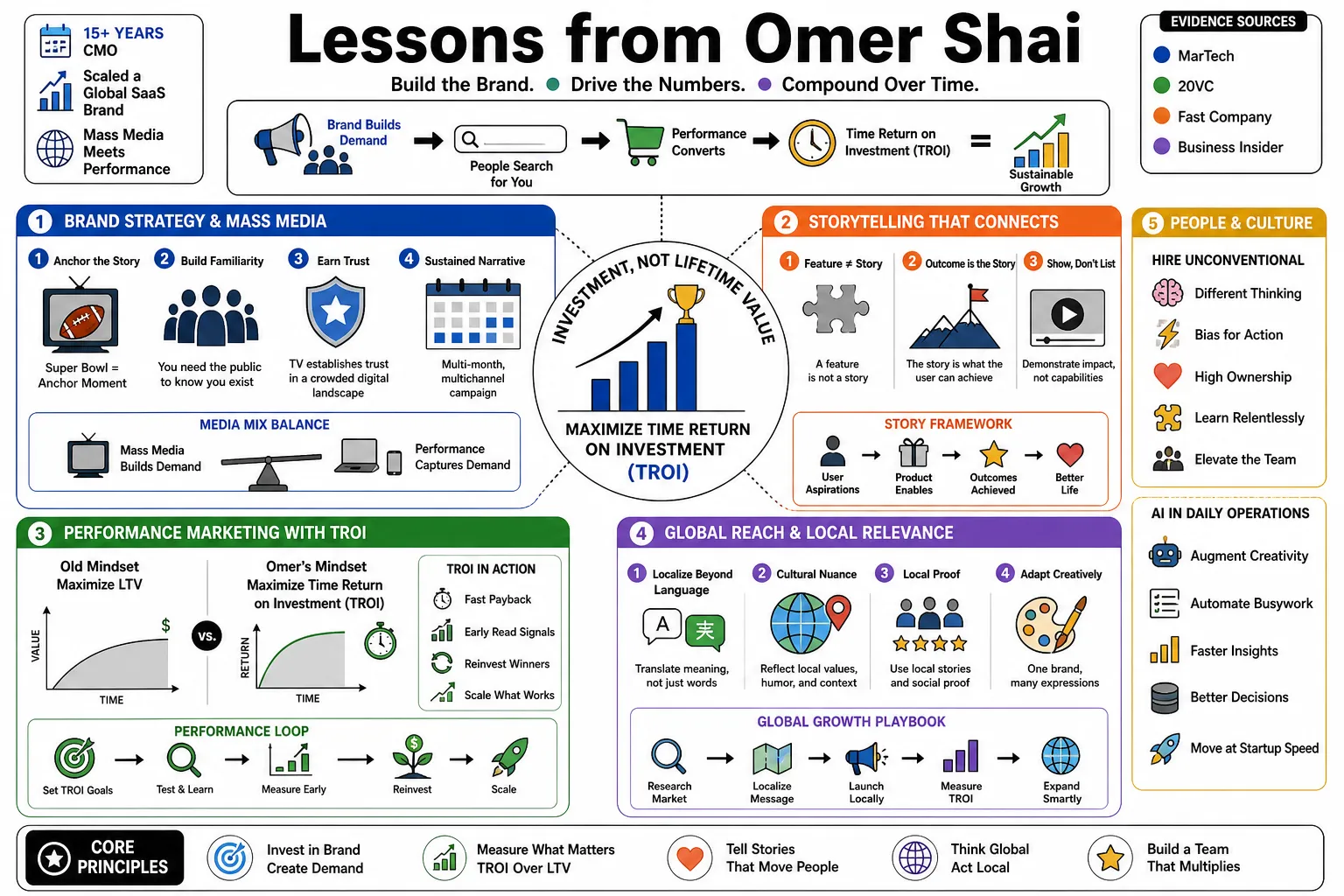
Lessons from Omer Shai
Omer Shai spent over 15 years as Wix.com’s CMO, building the company into a household name by pairing big brand swings like Super Bowl campaigns with strict, math-driven performance marketing tied to Time Return On Investment instead of traditional Lifetime Value. This profile breaks down his approach to scaling a software brand, hiring unconventional talent, and putting AI to work in daily operations.
Part 1: Brand Strategy and Mass Media
- On Super Bowl ads: "We don't view the Super Bowl as a single spot; it's the anchor for a multi-month, multichannel narrative." — Source: MarTech
- On brand awareness: In Wix's marketing retrospective, Shai says Super Bowl campaigns gave Wix a rare shared stage where people discussed the ads the next day, making brand education part of performance strategy. — Reference: Wix marketing retrospective with Omer Shai
- On storytelling: "A product feature is not a story; the story is what the user can achieve because the feature exists." — Source: Fast Company
- On global reach: "Expanding internationally requires localizing not just the language, but the cultural nuance of the marketing campaign." — Source: Business Insider
- On mass media: "Television still holds unique power to establish trust and authority in a crowded digital landscape." — Source: Wix Blog
- On campaign longevity: "A successful campaign should have legs that carry it across social, search, and PR for months after the initial launch." — Source: Elite Business Magazine
- On competing with giants: "When you are a challenger brand, you have to make noise; silence is the only strategy guaranteed to fail." — Source: Calcalistech
- On celebrity partnerships: "We use celebrities not just for their reach, but to demonstrate our product's ease of use in unexpected, highly visible ways." — Source: MarTech
- On consistent messaging: Shai argues that brands should keep content real and honest as they share knowledge publicly, because customer relationships start with open conversations rather than hidden playbooks. — Reference: Wix marketing retrospective with Omer Shai
- On measuring brand: "Brand marketing doesn't yield instant conversions, but it lowers your acquisition costs across every other channel over time." — Source: NFX
Part 2: Rethinking Metrics: TROI vs LTV
- On the flaw of LTV: 20VC frames Shai's argument around why lifetime value can mislead marketing decisions and why Wix prefers a time-to-return lens for budget allocation. — Reference: 20VC episode with Omer Shai
- On Time Return On Investment: "TROI forces a company to focus on when cash actually returns to the business, rather than theoretical future gains." — Source: Crypto Briefing
- On cash flow: Wix says Shai's team introduced TROI, or time to return on investment, to understand when free users became paid customers and when marketing dollars began paying back. — Reference: Wix marketing retrospective with Omer Shai
- On payback periods: "A marketing team should obsess over shortening the payback period of every dollar spent." — Source: Business Insider
- On predicting behavior: "User behavior changes too rapidly to trust five-year retention models; optimize for the next 12 to 18 months." — Source: NFX
- On marketing math: "The best marketers are as comfortable with financial modeling as they are with creative direction." — Source: Wix Blog
- On capital efficiency: Shai says TROI helped Wix manage budgets more aggressively, including a rapid budget increase once the team understood how quickly marketing investment returned. — Reference: Wix marketing retrospective with Omer Shai
- On aligning with finance: "Marketing and Finance must speak the same language, and that language is cash realization." — Source: Fast Company
- On short-term vs long-term: "TROI doesn't mean abandoning the long term; it means ensuring you survive the short term to get there." — Source: Calcalistech
Part 3: Performance Marketing and Growth
- On channel diversification: Shai warns that search and customer attention are fragmenting, so marketers need to test new channels without relying too heavily on any single platform. — Reference: Wix marketing retrospective with Omer Shai
- On data granularity: "You need to understand the performance of your campaigns down to the individual ad creative and audience segment." — Source: MarTech
- On testing: "We run thousands of variations; intuition gets the test built, but only the data decides what runs." — Source: Business Insider
- On search evolution: "The way people search is fragmenting, meaning performance marketers must master intent across multiple platforms." — Source: NFX
- On scaling spend: "You can only scale spend when your tracking infrastructure is flawless; otherwise, you are just burning cash." — Source: Wix Blog
- On localized acquisition: "A campaign that converts in the US might fail in Europe; performance marketing must be hyper-localized." — Source: Elite Business Magazine
- On attribution: Shai's lesson is to define a primary metric that fits the business, then use it to make practical decisions instead of copying a generic attribution framework. — Reference: Wix marketing retrospective with Omer Shai
- On the limits of optimization: "You cannot optimize a bad product into a success; marketing only accelerates what is already working." — Source: Fast Company
- On agility: "If a channel stops performing on Tuesday, the budget must be reallocated by Wednesday." — Source: Calcalistech
Part 4: Hiring Unconventionally
- On interviewing: "I care less about where you went to school and more about how you think through a problem you've never seen before." — Source: NFX
- On practical tests: "We test candidates aggressively because a resume tells you what they did, but a test shows you how they do it." — Source: Business Insider
- On raw intelligence: Shai values colleagues who can give brutally honest feedback, listen well, and challenge ideas without damaging the relationship that makes the debate productive. — Reference: Wix marketing retrospective with Omer Shai
- On internal mobility: "We frequently move people across different marketing disciplines to keep them challenged and cross-pollinate ideas." — Source: Wix Blog
- On the value of generalists: "Early on, you need people who can write copy, analyze data, and build a landing page; specialization comes later." — Source: Elite Business Magazine
- On culture fit: "Culture fit doesn't mean you want to have a beer with them; it means they share your intensity and standards." — Source: NFX
- On promoting from within: "When you hire smart people and train them your way, they often outgrow the need for external management hires." — Source: Fast Company
- On spotting talent: "Some of our best marketers came from entirely unrelated fields like physics or music." — Source: Business Insider
- On fast correction: Shai says he likes to move quickly after reading the data, either accelerating what works or stopping things quickly when the trend is wrong. — Reference: Wix marketing retrospective with Omer Shai
Part 5: Building a Startup Culture at Scale
- On fighting bureaucracy: "Even at thousands of employees, you have to fight every day to keep the entrepreneurial attitude alive." — Source: Elite Business Magazine
- On speed: "The biggest risk of scale is that decisions that used to take an hour suddenly take three weeks." — Source: NFX
- On ownership: Shai advises leaders to keep challenging their metrics and stay flexible enough to change their mind when the evidence changes. — Reference: Wix marketing retrospective with Omer Shai
- On failure: "We celebrate well-reasoned risks that fail, because fear of failure kills innovation faster than bad strategy." — Source: Wix Blog
- On communication: "As you grow, you cannot rely on casual conversations; you need rigorous, documented communication rhythms." — Source: Fast Company
- On staying close to the user: "No matter your title, you should regularly listen to customer support calls or read user feedback." — Source: Business Insider
- On organizational structure: "We organize in small, cross-functional pods to ensure marketing, product, and engineering stay aligned." — Source: MarTech
- On meetings: "A meeting without a clear decision at the end is a waste of everyone's time." — Source: Calcalistech
- On momentum: "Startups win on momentum; the moment you feel comfortable is the moment you start losing it." — Source: NFX
Part 6: Artificial Intelligence in Marketing
- On AI adoption: "AI is not a threat to marketers; it is a threat to marketers who refuse to use AI." — Source: Business Insider
- On AI operating habits: Shai says AI has already affected almost every function of his marketing team, while also warning that the largest changes are still ahead. — Reference: Wix marketing retrospective with Omer Shai
- On creative scaling: "AI allows us to generate variations of copy and design at a scale that was previously impossible for a human team." — Source: Wix Blog
- On automation: "We integrate AI to handle repetitive tasks so our team can focus strictly on strategy and high-level creative." — Source: Fast Company
- On personalization: "AI models enable us to deliver hyper-personalized user experiences without requiring massive engineering overhead." — Source: MarTech
- On data analysis: "Machine learning is essential for spotting trends in vast datasets that human analysts would easily miss." — Source: Business Insider
- On the limits of AI: "AI can generate the content, but it still requires human judgment to decide if the content resonates emotionally." — Source: NFX
- On AI in marketing systems: 20VC introduces the episode around the AI agent revolution and how AI is reshaping marketing, making automation a core operating question rather than a side experiment. — Reference: 20VC episode with Omer Shai
- On staying updated: "The AI landscape changes weekly; your team must have dedicated time just to experiment with new tools." — Source: Wix Blog
- On the future of work: "The marketing department of the future will be smaller in headcount but drastically larger in output." — Source: Calcalistech
Part 7: Product-Led Marketing
- On the product as marketing: 20VC highlights Shai's view that marketers should stop selling only the why and put the product at the center of the story. — Reference: 20VC episode with Omer Shai
- On onboarding: "The first five minutes a user spends in your product is the most critical marketing touchpoint you have." — Source: NFX
- On freemium models: "Freemium only works if the free version is genuinely useful; it builds the trust required for the eventual upgrade." — Source: Business Insider
- On virality: "Build features that naturally encourage users to share their work; your customers should be your best acquisition channel." — Source: Fast Company
- On listening to users: "Marketing's job is not just to sell the product, but to bring market feedback back to the product team." — Source: Wix Blog
- On friction: "Every extra click required to sign up reduces your conversion rate; marketing must fight for a frictionless experience." — Source: MarTech
- On feature launches: "Don't just launch a feature; explain the specific pain point it solves for a specific type of user." — Source: Elite Business Magazine
- On sustained marketing: Shai compares marketing to a long sports season: the work is about repeated preparation and improvement, not one instant result. — Reference: Wix marketing retrospective with Omer Shai
- On alignment: "When marketing and product have different goals, the user experiences a disjointed, frustrating journey." — Source: Calcalistech
Part 8: Leadership and Adaptability
- On self-awareness: "A good leader knows their weaknesses and hires people who are significantly better than them in those areas." — Source: NFX
- On ego: "Check your ego at the door; data wins arguments, not titles." — Source: Business Insider
- On pivoting: Shai's ego lesson is to stay flexible enough to say something different today than you advocated two days ago when the market or metrics change. — Reference: Wix marketing retrospective with Omer Shai
- On continuous learning: "The marketing playbook that worked three years ago is obsolete today; you have to stay curious." — Source: Wix Blog
- On managing stress: "In hyper-growth, things are always breaking; leadership is about maintaining calm and focusing the team on the fix." — Source: Fast Company
- On vision: "Your team needs to know not just what they are doing today, but where the company is trying to be in three years." — Source: Elite Business Magazine
- On trust: "You build trust by being transparent about failures, not just parading successes." — Source: MarTech
- On decision making: "Gather 80% of the information and make the call; waiting for 100% certainty means you moved too late." — Source: NFX
- On leadership relationships: Shai says strong working relationships let people argue productively, offer blunt feedback, and then keep trust intact after the debate. — Reference: Wix marketing retrospective with Omer Shai
- On the journey: "Building a company is a marathon run at a sprint pace; you have to learn to enjoy the intensity." — Source: Calcalistech