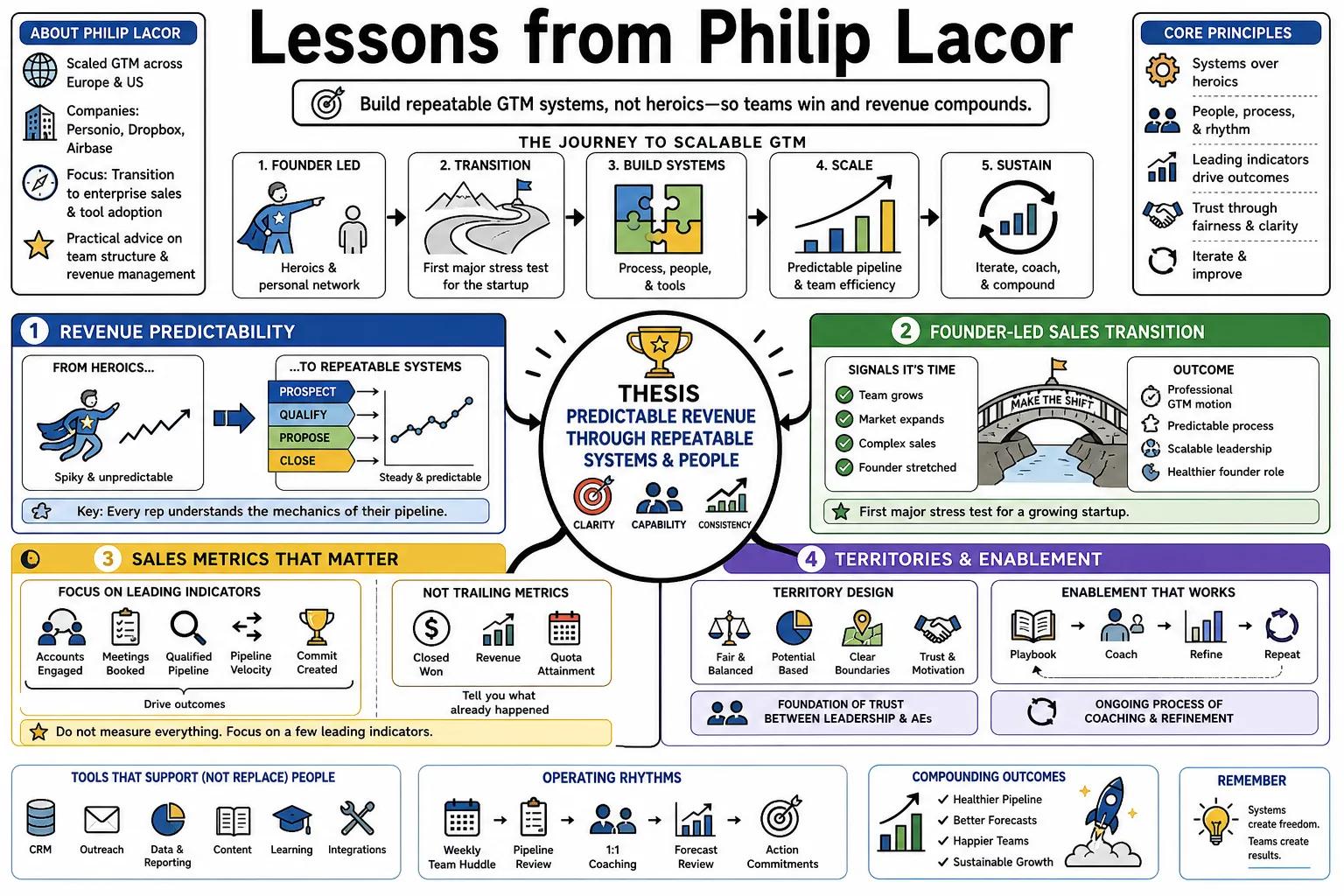
Lessons from Philip Lacor
Philip Lacor has scaled go-to-market operations across Europe and the US for companies like Personio, Dropbox, and Airbase. He focuses on how organizations transition to enterprise sales and get teams to actually use new tools. These notes collect his practical advice on team structure and revenue management.
Part 1: Scaling Go-to-Market Teams
- On Revenue Predictability: "Scaling a sales organization requires moving from heroics to repeatable systems where every rep understands the mechanics of their pipeline." — Source: [Smart Venture Pod]
- On Founder-Led Sales Transition: "The shift from founder-led sales to a professional GTM motion is often the first major stress test for a growing startup." — Source: [Unqork Press Release]
- On Sales Metrics: "Do not measure everything. Focus on a few leading indicators that actually influence outcomes rather than trailing metrics that only tell you what already happened." — Source: [Playing the Infinite Game]
- On Territory Design: "Fair and balanced territories are the foundation of trust between sales leadership and account executives." — Source: [SaaStr London]
- On Enablement: "You cannot hand a rep a playbook and expect results; enablement is an ongoing process of coaching and refinement." — Source: [Smart Venture Pod]
- On Compensation Plans: "Comp plans should be simple enough that a rep can calculate their commission on a napkin. If it requires a spreadsheet, it is too complex." — Source: [Airbase Press Release]
- On Pipeline Hygiene: "A bloated pipeline is worse than a thin one because it creates a false sense of security and hides underlying conversion issues." — Source: [SaaStr London]
- On Deal Reviews: "The purpose of a deal review is to uncover blind spots and align resources to help them win, rather than to interrogate the rep." — Source: [Playing the Infinite Game]
- On Tooling: "Adding more software to the sales stack rarely solves underlying process problems. Fix the process first, then automate it." — Source: [Smart Venture Pod]
- On Forecasting: "Accurate forecasting relies on intellectual honesty. Reps must feel safe admitting when a deal is at risk." — Source: [Personio Press Release]
Part 2: Operationalizing AI in Sales
- On AI Strategy: "Effective AI transformation requires a balance of top-down directives and bottom-up experimentation from the reps actually doing the work." — Source: [SaaStr London]
- On Use Cases: "Map AI tools to specific jobs to be done within the customer journey rather than deploying tech for the sake of it." — Source: [SaaStr London]
- On AI Productivity: "The goal of AI in a GTM team is to automate the administrative burden so sellers can spend more time in front of customers." — Source: [SaaStr London]
- On Data Quality: "AI models are only as good as the CRM data feeding them. Clean data is a prerequisite for any meaningful AI initiative." — Source: [Personio Press Release]
- On Personalization: "Using AI to generate generic outreach at scale will only damage your brand. Use it to synthesize research and enable highly specific messaging." — Source: [Smart Venture Pod]
- On Coaching Tools: "Conversational intelligence tools change the game for managers, allowing them to coach based on actual call transcripts rather than selective memory." — Source: [Playing the Infinite Game]
- On AI Adoption: "You have to show the sales team exactly how a new AI tool will help them hit their quota. If they do not see the personal benefit, they will ignore it." — Source: [SaaStr London]
- On Predictive Analytics: "Predictive scoring models are useful, but they should inform human judgment rather than replace it entirely." — Source: [Unqork Press Release]
- On Change Management: "Rolling out AI tools is primarily a change management exercise. Focus on the human element and workflow integration." — Source: [SaaStr London]
- On Future Skills: "The most successful sellers of tomorrow will be those who know how to prompt AI effectively to uncover account insights faster than their competitors." — Source: [Smart Venture Pod]
Part 3: Cross-Functional Alignment
- On Sales and Marketing Alignment: "Marketing and sales must share the same revenue goals. If marketing is measured on MQLs and sales on closed-won, friction is inevitable." — Source: [Airbase Press Release]
- On Product Feedback: "The sales team is the front line for product feedback. Establish a structured loop so product managers hear directly what is causing deals to stall." — Source: [Unqork Press Release]
- On Customer Success Handoffs: "The moment a deal closes is the most vulnerable point in the customer journey. The handoff to Customer Success must be seamless." — Source: [Playing the Infinite Game]
- On Shared Metrics: "Create a single source of truth for data. When departments argue over whose dashboard is correct, momentum stops." — Source: [Smart Venture Pod]
- On RevOps: "Revenue Operations is the glue that holds the GTM engine together. It should sit above sales, marketing, and CS to maintain neutrality." — Source: [SaaStr London]
- On Communication: "Over-communicate across departments during periods of high growth. Silos form quickly when people are moving fast." — Source: [Personio Press Release]
- On Executive Alignment: "If the CRO and CMO are not fully aligned, the entire go-to-market motion will suffer from mixed messaging and wasted spend." — Source: [Playing the Infinite Game]
- On Pricing Changes: "Adjusting pricing requires coordination across every department. You have to train sales, update marketing, and prepare CS for the fallout." — Source: [Airbase Press Release]
- On Competing Priorities: "When product and sales disagree on what to build next, look at the lost reason data in the CRM. Let the market decide." — Source: [Smart Venture Pod]
- On Unified Leadership: "A true revenue leader thinks about the entire funnel, from the first marketing touch to the renewal contract three years later." — Source: [SaaStr London]
Part 4: Global Expansion and Localization
- On Market Entry: "You cannot simply copy and paste a US playbook into Europe. Each country has different buying behaviors and compliance requirements." — Source: [Personio Press Release]
- On Local Leadership: "Hire local leaders who understand the cultural nuances of their specific market rather than trying to manage everything remotely." — Source: [Vodafone Germany Profiles]
- On Language: "Language skills in business go beyond translation. They demonstrate respect and a willingness to meet the customer where they are." — Source: [Playing the Infinite Game]
- On Phased Expansion: "Do not try to open five countries at once. Prove the model in one new region, learn from the mistakes, and then scale." — Source: [Smart Venture Pod]
- On Remote Workforces: "Managing global teams requires discipline in asynchronous communication and regular touchpoints to ensure remote employees feel connected." — Source: [Envoy Press Release]
- On Cultural Nuance: "A direct sales approach might work well in one country but be perceived as overly aggressive in another. Adapt the pitch." — Source: [Vodafone Germany Profiles]
- On Global Operations: "Standardize your core systems globally, but allow for local variations in the execution layer." — Source: [SaaStr London]
- On Talent Acquisition: "When expanding internationally, your first few hires set the tone for the entire regional office. Prioritize cultural fit alongside experience." — Source: [Playing the Infinite Game]
- On Time Zones: "Share the pain of time zones. Avoid always making the European or Asian teams take the late-night calls." — Source: [Smart Venture Pod]
Part 5: Customer Success and Retention
- On Churn Prevention: "Churn is usually decided in the first 90 days. If the onboarding experience is poor, the customer is already looking for alternatives." — Source: [Playing the Infinite Game]
- On Value Realization: "It is insufficient to sell a product; you have to ensure the customer actually deploys it and sees the ROI they were promised." — Source: [Unqork Press Release]
- On Account Management: "Separate the hunting from the farming. The skill set required to close a new enterprise deal differs from the one needed to expand an existing account." — Source: [Airbase Press Release]
- On Customer Support: "Support serves as a revenue protection engine rather than a mere cost center." — Source: [Personio Press Release]
- On Renewals: "A renewal conversation should never be a surprise. It should be the natural conclusion of a year-long partnership." — Source: [SaaStr London]
- On Net Revenue Retention: "NRR is the ultimate measure of product-market fit. If your customers stay and buy more, you have a healthy business." — Source: [Smart Venture Pod]
- On Executive Sponsors: "If your only contact at a customer leaves the company, your deal is at risk. Always build multi-threaded relationships." — Source: [Playing the Infinite Game]
- On User Communities: "Building a community among your power users creates a moat that competitors will find very difficult to cross." — Source: [Envoy Press Release]
- On Feedback Loops: "When a customer churns, conduct a rigorous post-mortem. The lessons learned from a lost account are invaluable." — Source: [Unqork Press Release]
Part 6: Building Diverse and High-Performing Teams
- On Hiring Criteria: "Look for curiosity and resilience over a perfect resume. You can teach product knowledge, but you cannot teach drive." — Source: [Playing the Infinite Game]
- On Diversity: "A diverse sales team is a commercial advantage. Customers want to buy from teams that reflect their own organizations." — Source: [Playing the Infinite Game]
- On Psychological Safety: "Reps need to feel safe bringing bad news to their managers. If they hide problems, you cannot help fix them." — Source: [Smart Venture Pod]
- On Internal Promotion: "Promoting from within builds loyalty and outlines a career path, while outside hires bring in fresh perspectives." — Source: [Personio Press Release]
- On Interviewing: "Ask candidates to walk you through a deal they lost. How they analyze their own failures tells you everything about their coachability." — Source: [SaaStr London]
- On Onboarding: "A strong onboarding program shortens ramp time. Avoid handing a new hire a laptop and wishing them luck." — Source: [Airbase Press Release]
- On Performance Management: "Address underperformance early. Letting a struggling rep miss quota month after month is unfair to them and to the rest of the team." — Source: [Smart Venture Pod]
- On Team Culture: "Culture is not what you write on the wall; it is the behavior you tolerate from your top performers." — Source: [Playing the Infinite Game]
- On Leadership Development: "Invest in your front-line managers. They have the biggest impact on rep retention and quota attainment." — Source: [Vodafone Germany Profiles]
Part 7: Navigating Enterprise Sales
- On Enterprise Deals: "Enterprise sales is about navigating consensus. You are rarely selling to one person; you are selling to a buying committee." — Source: [Unqork Press Release]
- On Deal Velocity: "Time kills all deals. Identify the bottlenecks in your sales cycle and engineer them out of the process." — Source: [Airbase Press Release]
- On Procurement: "Treat procurement as a partner rather than an adversary. Understand their metrics and help them check their boxes." — Source: [SaaStr London]
- On Proof of Concepts: "A POC should have clearly defined success criteria agreed upon before it starts. Otherwise, it turns into an endless free trial." — Source: [Unqork Press Release]
- On Discounting: "Discounts should always be traded for something of value, like faster payment terms or a public case study. Never drop the price simply to win the deal." — Source: [Smart Venture Pod]
- On Executive Sponsoring: "Bring in your own executives to meet with their executives. Peer-to-peer relationships can unlock stuck deals." — Source: [Playing the Infinite Game]
- On Discovery: "Thorough discovery separates average reps from top performers. You have to uncover the business pain, rather than only the technical requirements." — Source: [Envoy Press Release]
- On Competitive Positioning: "Never speak poorly of a competitor. Focus on your own differentiation and the specific outcomes you can deliver." — Source: [Personio Press Release]
- On Sales Process: "A defined methodology ensures that reps ask the hard questions early in the cycle." — Source: [SaaStr London]
Part 8: The Role of the Modern CRO
- On Scope: "The modern CRO is more than a VP of Sales. They own the entire customer lifecycle and revenue engine." — Source: [SaaStr London]
- On Data Literacy: "A CRO must be comfortable deep in the data. You cannot run a global organization on gut feeling." — Source: [Personio Press Release]
- On Board Communication: "When presenting to the board, focus on the narrative behind the numbers. Be transparent about risks and clear about mitigation plans." — Source: [Smart Venture Pod]
- On Adaptability: "The market changes constantly. A successful CRO must be willing to tear down and rebuild their own GTM structure when it no longer fits the environment." — Source: [Airbase Press Release]
- On Tech Stack Management: "Evaluate the revenue tech stack regularly to ensure tools actually drive efficiency rather than adding administrative overhead." — Source: [Unqork Press Release]
- On Cross-Border Leadership: "Operating globally requires a CRO to balance standard corporate policy with necessary local adaptations." — Source: [Vodafone Germany Profiles]
- On Mentorship: "Part of the job is building the next generation of sales leaders. Take the time to mentor your directors and VPs." — Source: [Playing the Infinite Game]
- On Customer Centricity: "The CRO should spend at least a quarter of their time speaking directly with customers. You cannot lead from a spreadsheet." — Source: [Envoy Press Release]
- On Long-Term Vision: "Quarterly targets matter, but you must also build the foundation for where the company needs to be in three years." — Source: [SaaStr London]