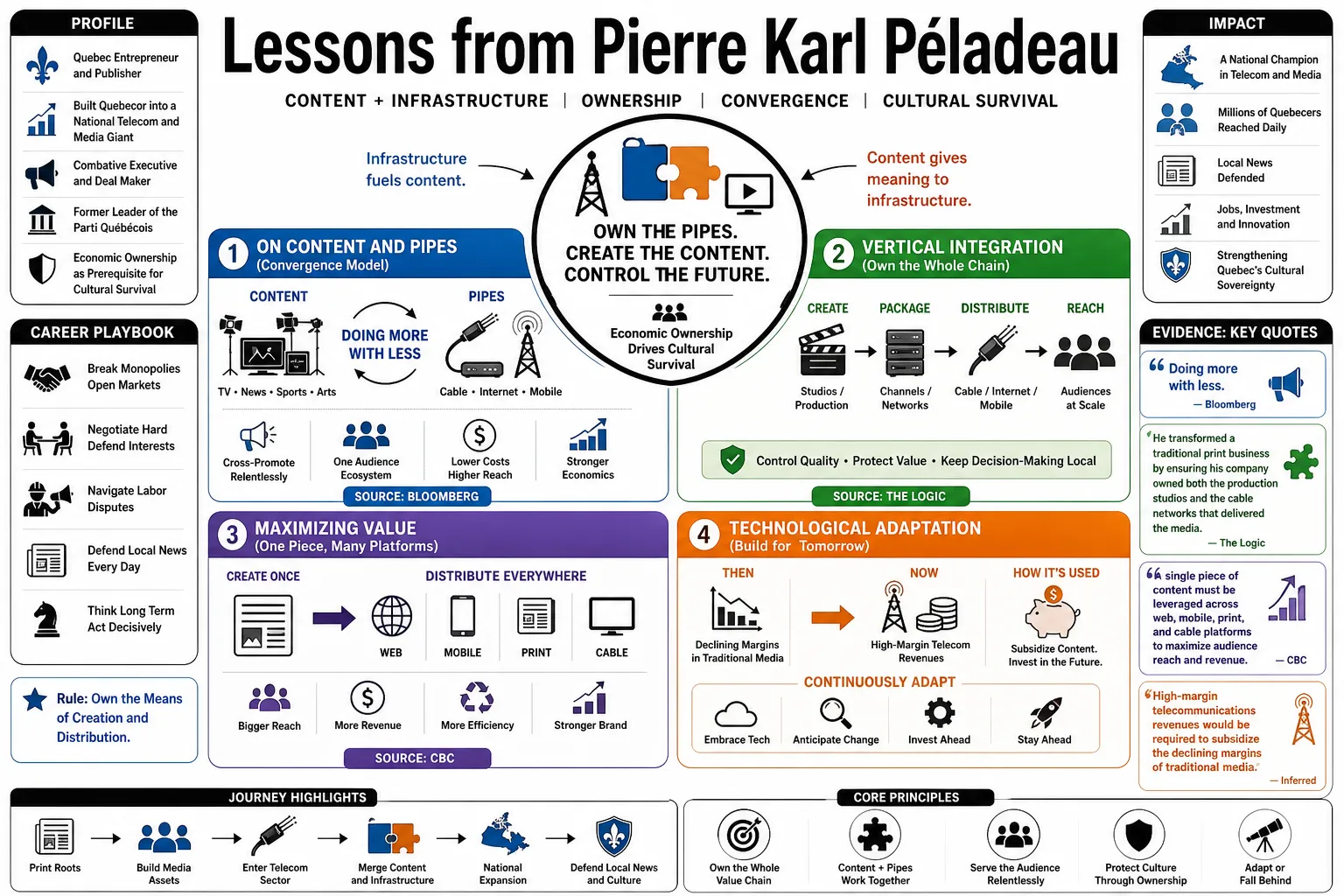
Lessons from Pierre Karl Péladeau
Pierre Karl Péladeau built Quebecor into a national telecom and media giant by aggressively merging content with the infrastructure that delivers it. A notoriously combative executive who briefly led the Parti Québécois, he views economic ownership as the strict prerequisite for cultural survival. These gathered statements track his career of breaking telecom monopolies, navigating labor disputes, and defending local news.
Part 1: Strategy and The Convergence Model
- On Content and Pipes: "Doing more with less." (Describing the convergence strategy of cross-promoting content across Vidéotron and TVA.) — Source: Bloomberg
- On Vertical Integration: He transformed a traditional print business by ensuring his company owned both the production studios and the cable networks that delivered the media. — Source: The Logic
- On Maximizing Value: A single piece of content must be leveraged across web, mobile, print, and cable platforms to maximize audience reach and revenue. — Source: CBC
- On Technological Adaptation: He recognized early that the high-margin revenues from telecommunications would be required to subsidize the declining margins of traditional media. — Source: Quebecor
- On Cross-Promotion: The success of his model relies on using one platform to drive traffic to another, such as heavily covering a reality show in his newspapers while airing it on his networks. — Source: Maclean's
- On Digital Evolution: He shifted the convergence model toward digital ecosystems like QUB, moving away from a reliance on linear television and print. — Source: Quebecor
- On Content as a Differentiator: High-quality, local content is the primary mechanism to distinguish a domestic company from global streaming giants. — Source: Quebecor
- On Competitive Moats: He views cultural alignment and a deep understanding of local identity as a business moat that foreign competitors cannot easily replicate. — Source: Strategy Online
- On the Media Business Plan: "The Journal de Montréal has no interest in reducing the quality of information in its publication in an increasingly competitive environment where content is king." — Source: Le Journal de Montréal
- On Building Ecosystems: He built a system where television celebrities are documented in company magazines, their music is sold through company retailers, and their performances are delivered via company cables. — Source: CBC
Part 2: Financial Discipline and Balance Sheets
- On Financial Reality: "The proof of the pudding is the eating... what we're showing in the balance sheet to the marketplace is one of the best." — Source: Bloomberg
- On Debt Reduction: He prioritizes maintaining a low debt-to-EBITDA ratio, viewing it as a clear advantage over more leveraged rivals. — Source: Quebecor
- On Prudent Management: "Our Corporation's solid foundations, and our prudent management of our operations and balance sheet, have kept us on track to our objectives." — Source: Quebecor
- On Operational Efficiency: His management style relies on a lean corporate structure and aggressive cost-cutting in declining sectors to fund growth in technology. — Source: Strategy Online
- On High-Stakes Acquisitions: He believes in making massive, transformative financial bets, executing the $5.4 billion acquisition of Vidéotron and the $2.85 billion acquisition of Freedom Mobile. — Source: CBC
- On Delivering Value: "We need to make sure that we will service our customers better; we need to be a lower-cost operator." — Source: iPhone in Canada
- On Shareholder Returns: He consistently highlights his company's ability to increase dividends and buy back shares even during periods of heavy national expansion. — Source: Quebecor
- On Media Costs: He actively reduces heavy traditional TV productions in favor of agile, cost-effective digital content to survive falling ad revenues. — Source: Le Journal de Montréal
- On Sports Rights: "Did we pay too much for our NHL rights? Probably." — Source: The Logic
- On Capital Allocation: He views the funding of local cultural initiatives not as charity, but as a direct investment in the community that sustains his business. — Source: HEC Montréal
Part 3: Competition and Market Disruption
- On True Competition: "Unlike the parasitic resellers, which have invested nothing, Videotron has spent more than $1.5 billion to build out and upgrade its network." — Source: House of Commons
- On Breaking Oligopolies: "I really believe that Canadians are looking to have competition." — Source: Bloomberg
- On Customer Pricing: "It boils down to our clear, customer-centric approach, which is 'more choice and better value at the best price.' It’s that simple." — Source: Quebecor
- On Owning Infrastructure: "It’s always just more economically viable to operate on the network instead of being forced to rent... Being an owner is better." — Source: iPhone in Canada
- On Market Dynamics: "This wave of renewal has helped foster genuine competition in a market that was historically dominated by an oligopoly." — Source: Times Colonist
- On Trailblazing: "Freedom positioned itself as a trailblazer in international roaming with unprecedented plans that were quickly copied by the competition." — Source: Quebecor
- On Pricing Disruption: To secure national expansion, he committed to a pricing strategy ensuring plans are at least 20 percent more affordable than equivalent plans offered by incumbents. — Source: Quebecor
- On Foreign Tech Giants: He views domestic telecom competition as necessary to build companies strong enough to face unmitigated competition from global Web giants. — Source: Le Journal de Montréal
- On Facilities-Based Growth: He argues that the government must uphold rules that allow for healthy, facilities-based competition rather than subsidizing network resellers. — Source: House of Commons
Part 4: Confrontational Leadership and Labor
- On Necessary Conflict: "It's not an absurd conflict, not an inexplicable conflict, it was the only way to succeed in changing our business plan." — Source: Le Journal de Montréal
- On Shifting Culture: He emphasized shifting the internal culture of a newly acquired cable company from "servicing a subscriber" to "serving a customer." — Source: Strategy Online
- On Hardline Tactics: He oversaw numerous lockouts of unionized staff to modernize work rules and reduce costs, earning a reputation for never backing down. — Source: Maclean's
- On Unpopular Decisions: He argues that disruptive, sometimes unpopular decisions are a requirement of leadership to ensure a company's long-term survival in a changing economy. — Source: QUB Radio
- On the Challenger Mindset: He believes a confrontational stance is required for a challenger brand taking on entrenched national incumbents. — Source: Bloomberg
- On Direct Action: Rather than relying on institutional processes, he favors a hands-on, deeply involved approach to granular business operations. — Source: The Globe and Mail
- On Managing Relationships: He famously sent a "fax machine tirade" to a rival executive, demonstrating a willingness to engage in direct, public feuds. — Source: Maclean's
- On Structural Change: He views long-term labor disruptions as an acceptable cost for achieving permanent flexibility in labor expenses. — Source: CBC
- On Independence from Theories: Like his father, he prefers to rely on business instinct and street smarts over traditional academic management theories. — Source: HEC Montréal
Part 5: The Survival of Local Media
- On Global Pressures: "We are competing with the entire world." — Source: TVA News
- On Public Funding Advantages: "Advertising is the main source of revenue for private broadcasters: it should therefore be removed from all platforms of the state corporation." — Source: Le Journal de Montréal
- On Regulatory Inertia: "So there, governments, CRTC: wake-up call." — Source: Le Journal de Montréal
- On the Value of the Press: "One must never forget one thing, it's because we have a strong written press that we are able to ensure a solid democracy in the West." — Source: National Assembly of Quebec
- On Cultural Erosion: "If our television disappeared, what would remain of our common culture?" — Source: QUB Radio
- On Job Preservation: "Do we have the means to see thousands of jobs of all categories suppressed... that are active in TVA productions?" — Source: TVA News
- On AI and Journalism: "Journalists produce content that is foundational for any credible AI system or strategy... Technology companies and public policymakers must establish mechanisms that ensure fair compensation." — Source: Quebecor
- On Channel Dominance: "Contrary to what is written: LCN is here to stay. LCN is the most-watched specialty channel in Quebec." — Source: Le Journal de Montréal
- On Informing the Public: "If the population and citizens are not able to be correctly informed by the largest possible source... I think it's our democracy that will suffer." — Source: National Assembly of Quebec
Part 6: Cultural Sovereignty and Politics
- On His Primary Objective: "Sovereignty, yes. I think it's clear that I've committed to achieving Quebec sovereignty. It is my objective, my only objective." — Source: CBC
- On Making a Country: "My joining the Parti Québécois is an adhesion to my deepest and most cherished values, which is to make Quebec a country!" — Source: Maclean's
- On Economic Protection: "I am convinced that... Quebec, when it is a country, will always be able to better protect all its interests... obviously its economic interests but also its cultural interests." — Source: Radio-Canada
- On the Language of Business: "En français, s'il vous plaît!" (A public outburst asserting the necessity of conducting cultural life in French.) — Source: Montreal Gazette
- On the Urgency of Independence: "We don't have 25 years ahead of us to achieve it. With demographics, with immigration, we're definitely losing one riding each year." — Source: CBC
- On Stepping Down: "I had to make a heartbreaking choice between my family and my political project... I chose my family." — Source: CBC
- On the Future of the Province: "I am convinced that the future of Quebec and of all Quebecers requires that our nation become independent." — Source: National Post
- On National Affirmation: He continues to describe sovereignty as a great idea and the ultimate expression of national affirmation. — Source: Le Devoir
- On Generational Pride: "I wish to contribute to leaving them [my children] a country for which they will be proud." — Source: National Post
Part 7: Ownership and Skin in the Game
- On Financial Commitment: "I have a financial interest in seeing it perform well." — Source: BNN Bloomberg
- On the Owner-Operator Model: He fundamentally believes that leadership is most effective when the leader has a significant personal financial stake in the outcome. — Source: QUB Radio
- On Corporate Governance: He publicly criticizes current management of target companies for maintaining broken balance sheets, demanding board shakeups to protect local interests. — Source: Radio-Canada
- On Institutional Managers: "I am an entrepreneur... I manage companies directly." — Source: BNN Bloomberg
- On Protecting Local Assets: "Air Transat must remain Quebecois." — Source: TVA News
- On Investing in the Community: He frames his purchase of the Montreal Alouettes as a strategic move to invest in the wealth and pride of the local market. — Source: Montreal Alouettes
- On Self-Reliance: "I didn't want a goddamn cent from my father." — Source: Maclean's
- On Controlling Destiny: He views ownership of domestic infrastructure as the only way a community can assert control over its economic trajectory. — Source: University of Montreal
- On Sports Infrastructure: He champions the return of an NHL team to Quebec City, viewing the Videotron Centre as vital regional infrastructure. — Source: CBC
- On Direct Action Over Consensus: His tenure as a politician demonstrated that his top-down management clashed directly with the collaborative, consensus-based nature of public office. — Source: Maclean's
Part 8: Legacy and The Next Generation
- On the Visionaries of the Past: "It is visionaries like my father, and many others of his era, who gave us the collective means to assert ourselves." — Source: University of Montreal
- On Educational Investment: "The worst investment a community can make is its disinvestment in its education." — Source: Université du Québec
- On Setting an Example: "I must, for them [my children], remain a good example." — Source: CBC
- On Shared Success: Through university bursaries, he promotes the idea that success should be shared to build the economy of tomorrow. — Source: HEC Montréal
- On the Value of Simplicity: He continues to promote his father's principle of keeping things simple as a core tenet for young entrepreneurs. — Source: HEC Montréal
- On Adapting to Change: He urges the next generation of business leaders to recognize that the old business models are dead and agility is the only path to survival. — Source: Les Dérangeants
- On Physical and Mental Endurance: He connects physical health to the mental toughness required for high-level leadership. — Source: Grand Défi Pierre Lavoie
- On Listening: He reinforces the classic rule that to sell is to know how to listen, advising young leaders to shut up and listen to the market. — Source: HEC Montréal
- On Building for the Future: He structures his philanthropic efforts around the belief that corporate success is hollow unless it actively bolsters the social fabric of the community. — Source: Quebecor