Lessons from Sandy Diao
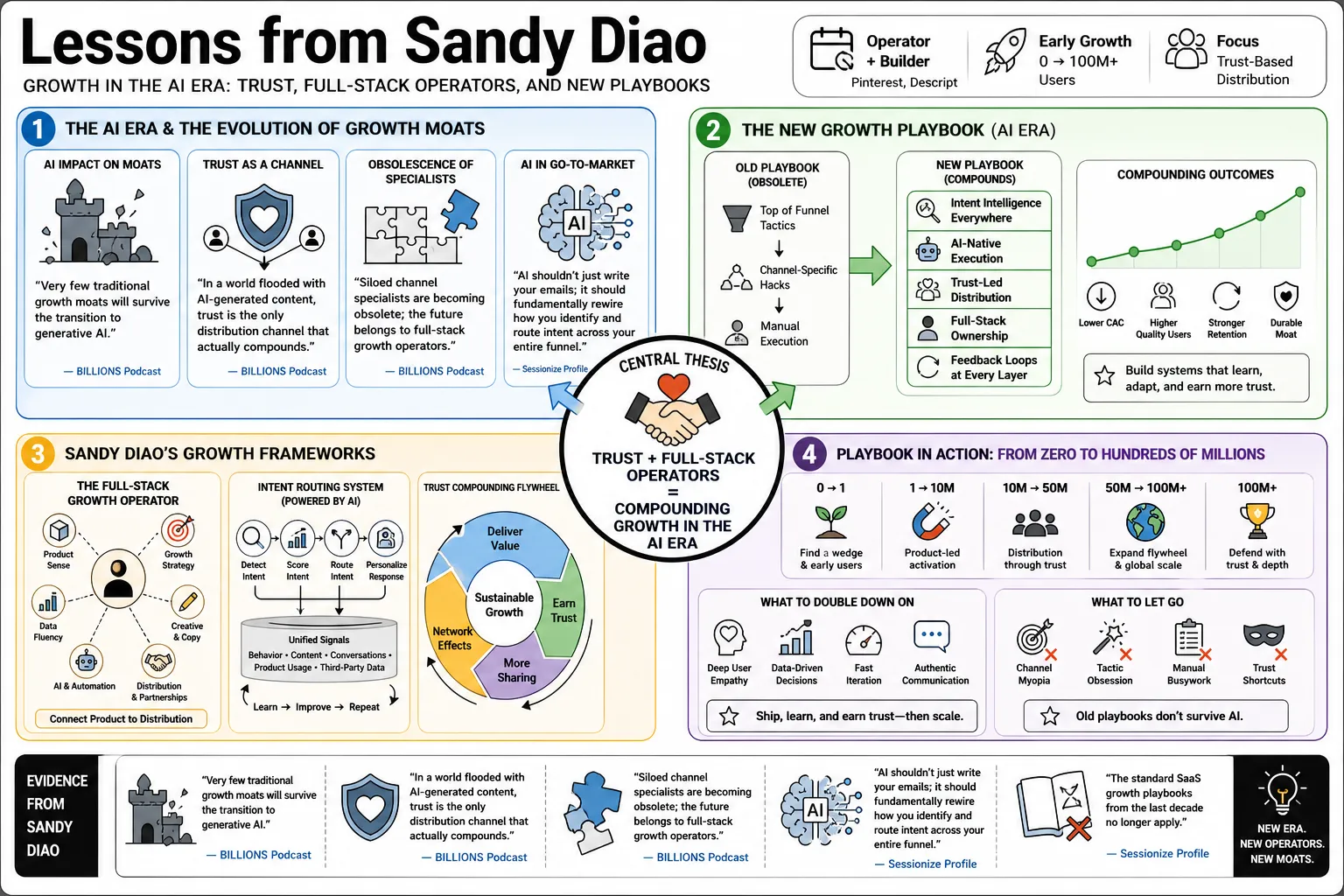
Sandy Diao led early user acquisition at Pinterest and built Descript's affiliate engine. She argues that channel-specific growth tactics are obsolete in the AI era, favoring full-stack operators and trust-based distribution instead. This profile breaks down her frameworks for scaling products from zero to hundreds of millions of users.
Part 1: The AI Era and the Evolution of Growth Moats
- On AI's impact on moats: Diao's AI-era growth warning is that many channel advantages decay once everyone can produce, test, and copy faster; the moat has to move closer to product, trust, and distribution design. — Reference: BILLIONS episode on why growth moats change in the AI era
- On trust as a channel: Diao treats trust as a growth engine because referrals and affiliates combine human credibility with measurable acquisition economics. — Reference: Diao essay on referrals, affiliates, and trust as a growth engine
- On the obsolescence of specialists: Diao's operating model favors full-stack growth people who can diagnose product, data, content, and distribution together instead of only optimizing one channel. — Reference: BILLIONS episode on siloed channel specialists and unified growth
- On generative AI in go-to-market: "AI shouldn't just write your emails; it should fundamentally rewire how you identify and route intent across your entire funnel." — Source: Sessionize Speaker Profile
- On the new growth playbook: "The standard SaaS growth playbooks from the last decade are dying because the cost of content creation has dropped to zero." — Source: Growth Notes Substack
- On automated growth: "When AI handles the execution of campaigns, the growth team's job shifts from pulling levers to designing the machine itself." — Source: Growth Notes Substack
- On content saturation: Diao argues that copied playbooks lose power; when a channel saturates, teams need sharper insight and better distribution design rather than simply publishing more. — Reference: Diao essay on saturated growth playbooks
- On the AI growth funnel: "The top of the funnel is moving away from search engines and toward AI chat interfaces, requiring a completely different approach to visibility." — Source: Growth Notes Substack
- On adapting to change: Diao's growth approach is diagnostic: when distribution shifts, the team has to audit the engine and find the broken constraint instead of staring at a static dashboard. — Reference: BILLIONS episode on auditing growth engines
- On technical marketing: "Marketing is becoming a highly technical discipline where prompt engineering and workflow automation are basic requirements." — Source: Sessionize Speaker Profile
Part 2: Paid Marketing, ROAS, and User-Generated Content
- On the reality of ROAS: "Return on Ad Spend is often a vanity metric if you aren't accounting for the natural decay of creative performance over time." — Source: The Twenty Minute VC
- On UGC vs. branded content: "User-generated content almost always outperforms highly polished branded creative because it matches the native language of social platforms." — Source: The Twenty Minute VC
- On building paid machines: "A successful paid marketing machine requires tightening the feedback loop between the ad creative and the specific in-product action you want the user to take." — Source: The Twenty Minute VC
- On channel fit: "You don't need to be on every channel; you just need to find the one channel where your product's core loop naturally fits the audience's intent." — Source: The Twenty Minute VC
- On testing creatives: "Test concepts, not just colors. Changing a button from red to blue won't save a fundamental mismatch in messaging." — Source: Growth Notes Substack
- On scaling ad spend: "The hardest part of scaling paid acquisition isn't finding the first profitable campaign, but maintaining unit economics as you exhaust your core audience." — Source: The Twenty Minute VC
- On attribution modeling: "Last-click attribution will lead you to over-invest in bottom-of-funnel capture while starving the channels that actually create demand." — Source: The Twenty Minute VC
- On authentic ad creative: "The best performing ads don't look like ads. They look like a recommendation from a smart friend." — Source: Growth Notes Substack
- On campaign decay: "Every growth channel has a half-life. You have to be building your next acquisition engine while your current one is peaking." — Source: The Twenty Minute VC
- On paid as an accelerant: "Paid marketing cannot fix a broken product experience. It only amplifies what is already working organically." — Source: The Twenty Minute VC
Part 3: Organic Growth and Generative Engine Optimization (GEO)
- On the shift from SEO to GEO: "Traditional SEO focused on keywords; Generative Engine Optimization requires optimizing for entity relationships and context." — Source: Growth Notes Substack
- On search intent: "As AI summarization takes over search results, you only get traffic if your content provides an original opinion or primary research that the AI cannot simply extract." — Source: Growth Notes Substack
- On organic moats: Diao sees stronger organic growth in systems where users, creators, or partners have a reason to distribute the product to people like themselves. — Reference: Diao essay on structured referrals and high-intent acquisition
- On content quality: "When the marginal cost of producing words hits zero, the premium on human experience and verifiable facts skyrockets." — Source: Growth Notes Substack
- On capturing AI traffic: "To surface in AI answers, your brand needs to be consistently cited by high-authority sources in relation to a specific problem." — Source: Growth Notes Substack
- On community as SEO: "Active communities are becoming the new SEO. People trust indexed Reddit threads more than heavily optimized corporate blogs." — Source: Growth Notes Substack
- On algorithmic changes: Diao's channel-lifecycle view makes chasing each new algorithm less durable than understanding why users respond and where market pull is moving. — Reference: Diao essay on growth channel lifecycle and saturation
- On zero-click searches: "Prepare for a world of zero-click searches where your brand's value must be communicated entirely within the search engine's interface." — Source: Growth Notes Substack
- On information architecture: "Structuring your site data clearly is no longer just for web crawlers; it is how you train language models to understand your product." — Source: Growth Notes Substack
Part 4: Architecting Growth at Descript and Pinterest
- On early Pinterest growth: Diao's Pinterest experience put her close to activation and onboarding work at massive scale, where small changes to the user path could compound across millions of people. — Reference: BILLIONS episode on Diao's early Pinterest growth work
- On being the first growth hire: Diao's Descript role shows the early growth hire as a systems builder, connecting measurement, acquisition loops, and product usage rather than only buying traffic. — Reference: Descript author bio on Diao's growth background
- On Descript's self-serve engine: Diao's Descript work tied creator-led acquisition to a self-serve motion, making growth less dependent on manual sales or headcount. — Reference: BILLIONS episode on Descript's self-serve affiliate engine
- On generative AI features: "Features like Overdub at Descript were powerful acquisition hooks because they solved a painful problem with a solution that felt like magic." — Source: Sessionize Speaker Profile
- On scaling to millions: "Scaling from zero to hundreds of millions requires shifting your focus from acquiring individual users to optimizing systemic loops." — Source: Reforge Faculty Notes
- On Pinterest's activation: "We realized early on that a user who pinned an item in their first session was exponentially more likely to retain long-term." — Source: The Twenty Minute VC
- On onboarding friction: Diao's onboarding lesson is to learn from actual user friction, including support tickets, then align product and engineering around the changes that improve activation. — Reference: BILLIONS episode on Pinterest onboarding and growth experiments
- On identifying core actions: Diao looks for the action that predicts retained use, then designs growth experiments around moving users toward that behavior faster. — Reference: BILLIONS episode on growth diagnostics and activation
- On cross-functional alignment: "Growth at early Pinterest worked because product, engineering, and marketing were completely aligned on the same user activation metric." — Source: The Twenty Minute VC
Part 5: Affiliate Models and Viral Loops
- On automated affiliates: Diao's Descript affiliate system turned creator-driven word of mouth into a measurable self-serve acquisition loop. — Reference: BILLIONS episode on Descript's automated affiliate model
- On creator incentives: Diao treats creator incentives as product design: the program has to make the right behavior economically clear, trackable, and worth repeating. — Reference: Diao essay on affiliate incentives and attribution
- On building viral loops: "A true viral loop only works if sharing the product makes the product better for the person doing the sharing." — Source: Reforge Faculty Notes
- On affiliate program design: Diao's affiliate-design lesson is to engineer the economics, attribution, and incentives so the channel can be managed with the same rigor as paid acquisition. — Reference: Diao essay on referrals and affiliates as performance channels
- On network effects: "Content creation tools inherently have weak network effects unless you specifically design collaboration features that pull in secondary users." — Source: Reforge Faculty Notes
- On predictable acquisition: Diao sees referrals and affiliates as a way to make word of mouth more measurable, turning trust into an acquisition system rather than hoping virality appears. — Reference: Diao essay on replacing vague virality with structured referrals
- On user psychology in sharing: "People don't share your product to do you a favor; they share it to look smart or helpful to their own audience." — Source: Reforge Faculty Notes
- On scaling partnerships: Diao's partnership logic is operational: reduce ambiguity, make incentives obvious, and give partners a trackable reason to keep sending the right users. — Reference: Diao essay on structured affiliate economics
- On the creator economy: "Software tools that empower the creator economy must recognize that their users are businesses themselves, and market to them accordingly." — Source: Sessionize Speaker Profile
Part 6: Building and Scaling Growth Teams
- On hiring for growth: "When hiring for an early growth team, index heavily on curiosity and analytical rigor rather than deep experience in one specific ad platform." — Source: The Twenty Minute VC
- On when to hire: "Don't hire a growth leader until you have clear product-market fit. Growth teams cannot manufacture demand that does not exist." — Source: The Twenty Minute VC
- On growth vs. marketing: "Marketing often focuses on the story; growth focuses on the system that delivers that story at scale." — Source: Reforge Faculty Notes
- On team structure: "A modern growth team should operate like a product squad, complete with dedicated engineering and design resources." — Source: The Twenty Minute VC
- On evaluating growth talent: "The best growth operators are comfortable breaking things and are never satisfied with the first version of an experiment." — Source: The Twenty Minute VC
- On defining hypotheses: "A bad growth hypothesis is stating that changing a button will increase conversions. A good hypothesis is based on a specific behavioral insight about the user." — Source: The Twenty Minute VC
- On failing fast: "If your growth team isn't failing on at least half of their experiments, they aren't testing aggressively enough." — Source: Reforge Faculty Notes
- On common growth mistakes: "The most common mistake startups make is trying to optimize the bottom of the funnel before they have a reliable top-of-funnel engine." — Source: The Twenty Minute VC
- On data literacy: "Everyone on a growth team, regardless of their specific role, must be able to write basic queries and pull their own data." — Source: Reforge Faculty Notes
Part 7: Product-Led Growth and User Activation
- On defining PLG: "Product-Led Growth isn't just offering a free trial; it's designing the product so that usage naturally drives acquisition and expansion." — Source: Growth Notes Substack
- On the first five minutes: "The battle for a user is won or lost in the first five minutes after they create an account. You must deliver value immediately." — Source: Reforge Faculty Notes
- On activation metrics: Diao treats activation as a retention signal, not a vanity event; the metric should reveal whether users are reaching the behavior that predicts durable use. — Reference: BILLIONS episode on growth diagnostics and onboarding
- On self-serve limitations: "Even the best self-serve PLG motions eventually need a sales-assist team to close enterprise deals and navigate procurement." — Source: Growth Notes Substack
- On pricing strategy: "Pricing is a growth lever. A complex pricing tier structure creates friction that will actively suppress your product-led motion." — Source: Growth Notes Substack
- On continuous onboarding: "Onboarding doesn't stop after the first day. You need contextual triggers to introduce advanced features as the user matures." — Source: Reforge Faculty Notes
- On qualitative feedback: "Quantitative data tells you where users are dropping off; qualitative feedback from support tickets tells you why." — Source: Growth Notes Substack
- On time-to-value: Diao's growth lens pushes teams to shorten the path from signup to meaningful outcome, because every extra step weakens the activation loop. — Reference: BILLIONS episode on high-velocity growth engines and onboarding
- On freemium models: "A freemium model only works if the free tier is useful enough to build a habit, but limited enough to create a clear reason to upgrade." — Source: Reforge Faculty Notes
Part 8: Early Career Lessons and Hardware Crowdfunding
- On hardware startups: "Hardware startups face a unique growth challenge because they have to fundraise and build an audience simultaneously before having a physical product." — Source: The Hardware Entrepreneur
- On crowdfunding success: "A successful Indiegogo campaign is won weeks before it launches through meticulous email list building and community engagement." — Source: The Hardware Entrepreneur
- On early community building: "In the early days of a project, doing things that don't scale, like personally calling your first hundred backers, builds the foundation for later growth." — Source: The Hardware Entrepreneur
- On storytelling in crowdfunding: "People don't back a hardware project just for the specs; they back the story of the founder and the vision of the future they are building." — Source: The Hardware Entrepreneur
- On the momentum of a launch: "In crowdfunding, momentum is everything. Hitting your funding goal in the first 48 hours triggers algorithmic visibility that drives the rest of the campaign." — Source: The Hardware Entrepreneur
- On hardware margins: "Many early hardware entrepreneurs fail because they underestimate the cost of customer acquisition when calculating their final retail margins." — Source: The Hardware Entrepreneur
- On managing expectations: "Over-communicating delays and manufacturing hurdles builds more trust with early backers than delivering false promises." — Source: The Hardware Entrepreneur
- On transition to software: Diao's career moved from Indiegogo-style launch mechanics into software growth, where faster iteration and richer product data let teams tune the acquisition engine continuously. — Reference: Descript author bio on Diao's Indiegogo, Pinterest, and Descript background
- On the value of early stage chaos: "Working in high-growth, chaotic environments early in your career forces you to learn how to prioritize ruthlessly." — Source: The Twenty Minute VC
- On foundational growth principles: "Whether you are selling a physical gadget on Indiegogo or a SaaS tool to an enterprise, the core principle remains finding where your audience lives and speaking their language." — Source: The Hardware Entrepreneur