Lessons from Sarah Patterson
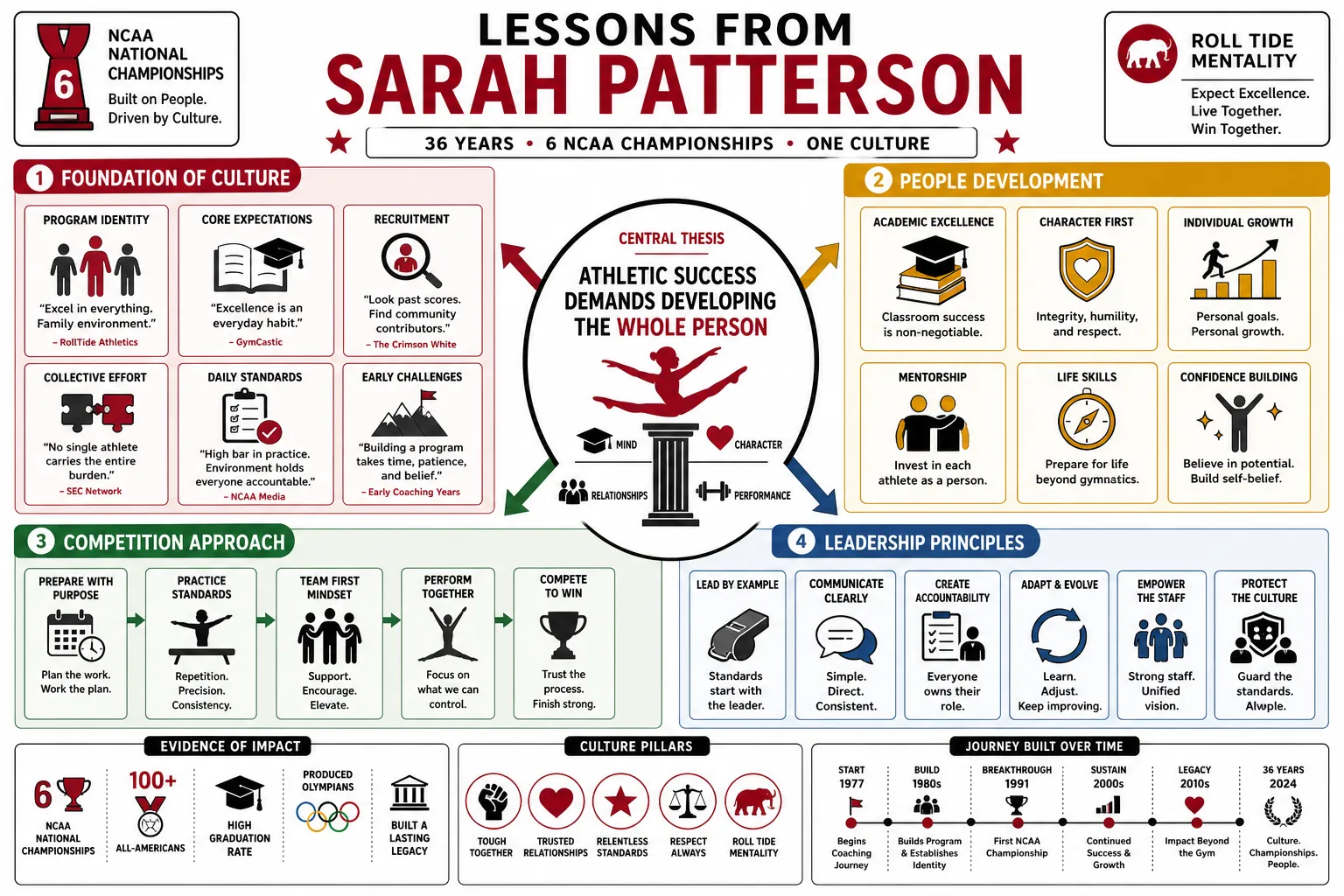
Sarah Patterson spent 36 years as head gymnastics coach at the University of Alabama, leading the program to six NCAA national championships. She built her teams on the straightforward belief that athletic success requires developing the whole person. This profile catalogs her specific approaches to management and competition.
Part 1: The Foundation of Culture
- On Program Identity: "We look for those that want to excel in everything they do, who want to be part of a family environment." — Source: RollTide Athletics
- On Core Expectations: "Excellence is an everyday habit that applies to the classroom exactly as it applies to the training facility." — Source: GymCastic
- On Recruitment: "Identifying talent means looking past raw scores to find individuals who genuinely want to contribute to the community." — Source: The Crimson White
- On Collective Effort: "The strength of a championship team lies in the understanding that no single athlete carries the entire burden." — Source: SEC Network
- On Daily Standards: "Setting a high bar in practice ensures that the environment itself holds everyone accountable." — Source: NCAA Media
- On Early Challenges: "Building a program from the ground up requires patience and an absolute refusal to compromise on fundamental values." — Source: Tuscaloosa News
- On Sisterhood: "Creating a bond among athletes means they will fight harder for each other on the competition floor than they would for themselves." — Source: RollTide Athletics
- On Defining Success: "True achievement is measured by how an athlete matures and approaches life after graduation." — Source: Gymnastics Now
- On Internal Competition: In Alabama Gymnastics' season interview, Patterson says the staff had a game plan and the team took the year one week at a time after replacing a large share of its championship routines. That supports the safer lesson that internal competition should sharpen preparation inside a shared plan, not fracture the group. — Reference: Alabama Gymnastics season interview on the game plan and taking the year week by week
- On Setting Roots: "A strong culture is one where alumni continually return because they feel a lifelong connection to the program." — Source: SEC Sports
Part 2: Coaching the Complete Person
- On Human Development: "Our philosophy has always been that if you develop the whole person, the scores will take care of themselves." — Source: RollTide Athletics
- On Academic Excellence: "Demanding high performance in the classroom sets a standard of discipline that translates directly to the gym." — Source: GymCastic
- On Life Skills: "Coaching is an opportunity to teach personal responsibility before athletes enter the professional world." — Source: NCAA Media
- On Empathy: "Understanding what an athlete is going through in their personal life is required to unlock their potential in competition." — Source: The Crimson White
- On Post-Graduate Success: "The most rewarding moments are seeing former athletes thrive in their chosen careers and families." — Source: Tuscaloosa News
- On Individualization: "You cannot coach every athlete exactly the same way; you must learn what motivates each specific individual." — Source: SEC Network
- On Building Confidence: "Belief in an athlete often has to precede their own self-belief." — Source: NCAA Media
- On Emotional Support: Roll Tide's coaching bio says Patterson's philosophy is to develop the whole person, not just the gymnast, and to build a family environment around the program. That supports the safer lesson that strong coaching has to account for the athlete as a person, not only as a scorer. — Reference: Roll Tide bio on developing the whole person and building a family environment
- On Rest and Recovery: "Recognizing when to pull an athlete back from training is equally important as knowing when to push them forward." — Source: Gymnastics Now
- On Perspective: "Reminding athletes that gymnastics is what they do, rather than who they are, protects their long-term mental well-being." — Source: RollTide Athletics
Part 3: Competition and Pressure
- On Managing Nerves: "The pressure felt during a major collegiate meet often rivals the intensity of the Olympic stage." — Source: SEC Network
- On Championship Mindset: "Although we have made it 23 consecutive times, it never gets to be old. I am excited about it this year just like I was my first year." — Source: UCLA Bruins Athletics
- On Consistency: "Winning a title is the byproduct of hitting routines day after day in an empty gym." — Source: GymCastic
- On Elite Experience: "Collegiate competition demands a different type of mental endurance because you are competing for the team every single weekend." — Source: The Crimson White
- On Embracing the Moment: "Athletes perform best when they view high-stakes environments as opportunities rather than threats." — Source: NCAA Media
- On Reframing Mistakes: "A fall on the first event must be instantly compartmentalized so the rest of the team can move forward." — Source: Tuscaloosa News
- On Crowd Energy: "Teaching athletes to channel the noise of a packed arena into physical power changes the trajectory of a meet." — Source: RollTide Athletics
- On Preparation: "Confidence on the floor is directly tied to the knowledge that no shortcuts were taken in practice." — Source: Gymnastics Now
- On the Final Routine: In the same season interview, Patterson says younger gymnasts need real experience with both away crowds and home crowds. That supports the narrower lesson that late-lineup routines belong with athletes who have shown they can stay poised when the environment gets loud and the pressure rises. — Reference: Alabama Gymnastics season interview on crowd experience and poise
- On Defending a Title: "Returning as champions introduces a new level of expectation that requires resetting the team's internal focus entirely." — Source: SEC Sports
Part 4: Rivalries and Motivation
- On the Auburn Rivalry: "I quickly learned what it means to compete against Auburn and be successful." — Source: The Crimson White
- On Sustaining Streaks: "Maintaining a long winning streak against a rival is a point of pride that connects generations of athletes." — Source: SEC Network
- On Respecting Opponents: "A fierce rivalry forces a program to constantly elevate its own standards." — Source: Tuscaloosa News
- On Home Meets: "Defending your home floor against a major rival creates an atmosphere that athletes remember for the rest of their lives." — Source: RollTide Athletics
- On Road Environments: "Learning to block out a hostile crowd is a necessary skill for any team with championship aspirations." — Source: GymCastic
- On Keeping Perspective: "While rivalry meets carry intense emotion, they count exactly the same as any other competition in the standings." — Source: NCAA Media
- On Using History: "Educating freshmen about the history of a rivalry helps them understand the weight of the leotard they are wearing." — Source: NCAA Media
- On Post-Meet Reflection: Patterson says the team needed meet experience in different environments and benefited from taking the season one week at a time. That supports the safer lesson that high-emotion meets should be treated as diagnostic moments that show what a team still needs before postseason pressure peaks. — Reference: Alabama Gymnastics season interview on experience gaps and week-by-week adjustment
- On Shared Excellence: "The Southeastern Conference's dominance is built on rivalries that refuse to let any single team become complacent." — Source: Gymnastics Now
Part 5: Evolution of the Sport
- On Growing Parity: "I feel like my peers have done a tremendous job over the past few years. And that's why we have the parity that we have." — Source: Huskers Athletics
- On Administrative Support: "The rise in competition level is directly linked to universities providing better resources and facilities." — Source: SEC Sports
- On New Contenders: "Seeing new programs emerge on the national stage is necessary for the long-term health of collegiate gymnastics." — Source: The Crimson White
- On Recruiting Changes: "The process of identifying talent requires evaluating an athlete's potential for growth rather than their current skills." — Source: RollTide Athletics
- On Rule Shifts: "Adapting quickly to changes in the scoring code is a hallmark of a well-coached program." — Source: GymCastic
- On Television Exposure: "The increase in broadcast coverage has transformed athletes into recognizable ambassadors for the university." — Source: Tuscaloosa News
- On Athletic Longevity: "Smarter training protocols have allowed gymnasts to extend their careers and compete at a high level throughout all four years of college." — Source: Gymnastics Now
- On Specialization: "The modern era often requires utilizing event specialists to maximize team scoring potential." — Source: NCAA Media
- On Coaching Standards: In the season interview, Patterson says competition had become so tight because many programs now have excellent talent and facilities. That supports the lesson that rising coaching standards come from a deeper national field, not from any program being able to coast on reputation. — Reference: Alabama Gymnastics season interview on tighter national competition and stronger programs
Part 6: Mentorship and Leadership
- On Supporting Peers: "I always tried to encourage others through notes, quotes and just being at any event I could." — Source: The Crimson White
- On Female Leadership: "Navigating an environment with few female head coaches meant actively creating networks of support." — Source: SEC Network
- On Sharing Knowledge: "Mentoring younger coaches ultimately benefits the athletes they will eventually lead." — Source: NCAA Media
- On Leading by Example: "A coach must demonstrate the same work ethic and discipline they demand from their team." — Source: RollTide Athletics
- On Handling Adversity: "Reaching out to a peer whose program is struggling is a quiet but necessary act of leadership." — Source: GymCastic
- On Staff Cohesion: "Surrounding yourself with assistant coaches who challenge your ideas prevents a program from becoming stagnant." — Source: Tuscaloosa News
- On Delegation: "Trusting your staff to execute their specific roles allows the head coach to focus on the overarching vision." — Source: Gymnastics Now
- On Authentic Connections: Roll Tide's bio says Patterson looks for athletes who want to excel in everything they do, be part of a family environment, and stay involved in the community. That supports the safer lesson that trust is stronger when the coach-athlete relationship extends beyond routines and rankings. — Reference: Roll Tide bio on family environment, broad excellence, and community
- On Continual Learning: "The best leaders never assume they have everything figured out, regardless of how many titles they have won." — Source: NCAA Media
Part 7: Community and Cause
- On The Power of Pink: "Using the platform of collegiate athletics to raise breast cancer awareness turned a single meet into a national movement." — Source: Tide 100.9
- On Personal Motivation: In the Crimson Flame Power of Pink interview, Patterson says her own mammogram scare made her realize how many women could not afford screening. That supports the safer lesson that public initiatives often become much more durable when they are rooted in firsthand experience and a concrete problem to solve. — Reference: Crimson Flame Power of Pink interview on her mammogram scare and unmet screening needs
- On Fan Engagement: "Involving the community in a cause creates a bond with fans that extends far beyond wins and losses." — Source: RollTide Athletics
- On Athlete Participation: "Having gymnasts actively participate in community service instills a sense of civic responsibility." — Source: SEC Sports
- On Visible Support: "A sold-out arena wearing pink sends a powerful message of solidarity to those fighting the disease." — Source: The Crimson White
- On Broadening Impact: "The true success of an awareness campaign is measured by the other programs that adopt the same initiative." — Source: GymCastic
- On Civic Duty: "A university athletic department has an obligation to use its visibility to improve the surrounding community." — Source: Tuscaloosa News
- On Creating Traditions: "Events with a charitable focus become the most anticipated nights on the schedule for both athletes and fans." — Source: NCAA Media
- On Long-term Value: In the same interview, Patterson says she looked at Alabama gymnastics' following and asked how to use what the program had built to make a difference in other people's lives. That supports the lesson that community initiatives can outlast wins when a program converts attention into practical help. — Reference: Crimson Flame Power of Pink interview on using the program's platform to help others
Part 8: Building a Legacy
- On Initial Hiring: "Taking over a program at age 22 required an intense drive to prove that the sport belonged on the national map." — Source: SEC Network
- On Enduring Excellence: "Winning across four different decades requires a willingness to constantly evolve your methods while keeping your core values intact." — Source: Gymnastics Now
- On Passing the Torch: "The ultimate sign of a healthy program is the ability to hand it over to a successor who understands its foundation." — Source: RollTide Athletics
- On Alumni Impact: "A legacy is carried forward by the former athletes who return to mentor the current generation." — Source: The Crimson White
- On Shaping the University: "Elevating a women's sports program changes the entire culture of an athletic department." — Source: Tuscaloosa News
- On Reflecting on Titles: "National championships are memorable, but the daily interactions in the gym are what stay with a coach forever." — Source: GymCastic
- On Setting Precedents: "Doing things right from the beginning ensures that future coaches have a solid foundation to build upon." — Source: NCAA Media
- On Fan Loyalty: In Alabama Gymnastics' season interview, Patterson thanks the 15,000 fans who supported the team in Coleman Coliseum and the fans who traveled to championship meets. That supports the safer lesson that lasting fan loyalty is built through years of performance, gratitude, and shared identity around the program. — Reference: Alabama Gymnastics season interview on sustained fan support at home and postseason meets
- On Final Thoughts: "The ultimate measure of a coaching career is whether the athletes leave the program as stronger, more capable people." — Source: SEC Sports