Lessons from Scott Pugh
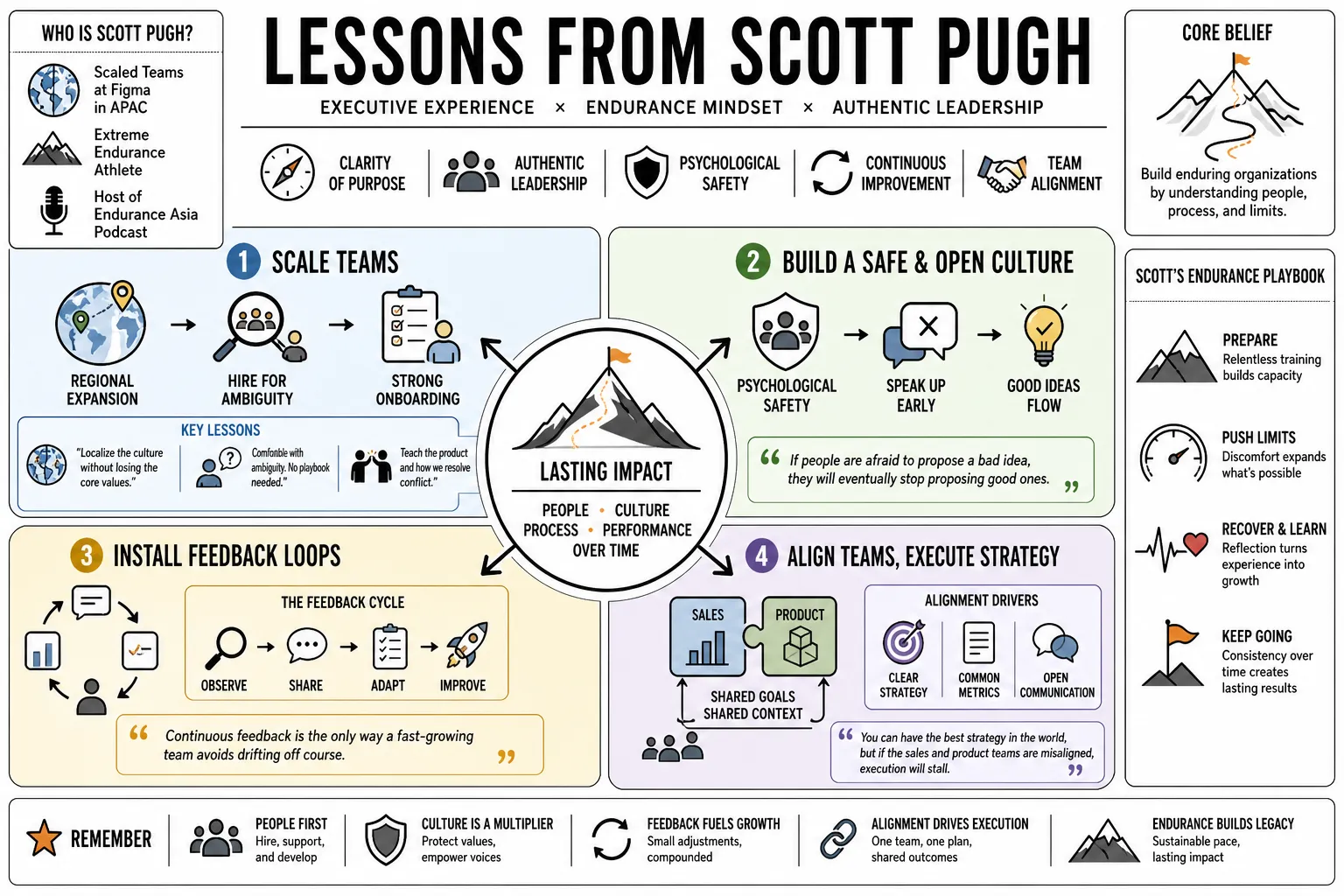
Scott Pugh pairs executive experience scaling Figma in APAC with a background in extreme endurance athletics. Through his writing on authentic leadership and his work hosting the Endurance Asia Podcast, he examines the mechanics of building lasting organizations and the physical limits of human performance.
Part 1: Scaling Teams and Culture
- On Regional Expansion: "When moving into a new territory, you have to localize the culture without losing the core values that made the company successful in the first place." — Source: [SaaStr Interview]
- On Hiring: "The best early hires are those who are comfortable with ambiguity and don't need a playbook to figure out what to do next." — Source: [Tech in Asia Conference]
- On Onboarding: "A strong onboarding process teaches the product and demonstrates how the team resolves conflict." — Source: [Figma Leadership Blog]
- On Psychological Safety: "If people are afraid to propose a bad idea, they will eventually stop proposing good ones." — Source: [LinkedIn Posts]
- On Feedback Loops: "Continuous feedback is the only way a fast-growing team avoids drifting off course." — Source: [SaaStr Interview]
- On Team Alignment: "You can have the best strategy in the world, but if the sales and product teams are misaligned, execution will stall." — Source: [Tech in Asia Conference]
- On Managing Change: "Scaling means breaking things that used to work. You have to be okay with dismantling old systems to build better ones." — Source: [Figma Leadership Blog]
- On Autonomy: "Hire capable people and give them the boundaries they need to run fast, rather than telling them exactly how to run." — Source: [LinkedIn Posts]
- On Talent Retention: "People stay when they feel they are growing faster inside the company than they could anywhere else." — Source: [SaaStr Interview]
- On Cross-Cultural Communication: "Assuming everyone understands your context is the fastest way to derail an international project." — Source: [Tech in Asia Conference]
Part 2: Endurance and Mental Toughness
- On Pacing: "In a hundred-mile race, running too fast in the first ten miles guarantees you will suffer in the last twenty." — Source: [Endurance Asia Podcast]
- On Hitting the Wall: "The wall isn't a physical barrier; it is your brain trying to protect you from fatigue. You have to negotiate with it." — Source: [EXECS WHO RUN Podcast]
- On Consistency: "Training isn't about the one epic workout. It is about waking up and putting the shoes on when you'd rather stay in bed." — Source: [Endurance Asia Podcast]
- On Suffering: "You have to make peace with discomfort early on, otherwise it will consume all your mental energy." — Source: [EXECS WHO RUN Podcast]
- On Preparation: "The race is just the victory lap. The actual work was done in the dark, cold mornings months prior." — Source: [Endurance Asia Podcast]
- On Managing Pain: "Pain is inevitable in long efforts. Suffering is a choice about how you react to that pain." — Source: [EXECS WHO RUN Podcast]
- On Small Milestones: "When you can't imagine running another fifty miles, just focus on running to the next aid station." — Source: [Endurance Asia Podcast]
- On Recovery: "Your fitness improves when you rest, not when you are actively tearing your muscles apart." — Source: [EXECS WHO RUN Podcast]
- On Mental Framing: "Instead of asking why it hurts so much, ask yourself what the pain is teaching you about your current limits." — Source: [Endurance Asia Podcast]
- On Commitment: "Motivation fades when the weather turns bad. Discipline is what gets you to the starting line." — Source: [EXECS WHO RUN Podcast]
Part 3: Leadership and Decision Making
- On Delegation: "If you are the bottleneck for every decision, you have built a dictatorship, rather than a scalable business." — Source: [SaaStr Interview]
- On Clarity: "A leader's primary job is to remove ambiguity so the team can focus entirely on execution." — Source: [Figma Leadership Blog]
- On Decisiveness: "A good decision made today is better than a perfect decision made next month." — Source: [LinkedIn Posts]
- On Empathy: "Understanding what drives your employees outside of work makes you a much more effective manager at work." — Source: [Tech in Asia Conference]
- On Ownership: "When something goes wrong, the leader absorbs the blame. When something goes right, the leader distributes the credit." — Source: [SaaStr Interview]
- On Leading by Example: "Your team pays attention to what you tolerate, not what you write in the company handbook." — Source: [Figma Leadership Blog]
- On Adapting to Markets: "The strategies that secured your first million in revenue are rarely the ones that will secure the next ten." — Source: [Tech in Asia Conference]
- On Listening: "The quietest person in the meeting often has the most observation-based insight. You have to invite them to speak." — Source: [LinkedIn Posts]
- On Strategic Vision: "You need to know what the company will look like in three years to make the right hiring decisions today." — Source: [SaaStr Interview]
- On Accountability: "Setting targets is easy; maintaining the discipline to measure against them weekly is where most teams fail." — Source: [Tech in Asia Conference]
Part 4: Building Community and Connection
- On Shared Purpose: "A community forms when individuals realize their collective goal is larger than their personal ambition." — Source: [Children Matter Book]
- On Vulnerability: "People connect with your struggles far more deeply than they connect with your successes." — Source: [Velocity Church Sermons]
- On Inclusivity: "True community requires making space for people who disagree with you, avoiding an echo chamber of agreement." — Source: [My New Church Book]
- On Active Engagement: "You cannot build a community passively. It requires constant, intentional outreach and maintenance." — Source: [Children Matter Book]
- On Generational Shifts: "We have to build institutions that respect the wisdom of the older generation while adopting the tools of the newer one." — Source: [Velocity Church Sermons]
- On Authentic Networking: "Transactions build databases. Relationships build networks." — Source: [My New Church Book]
- On Mentorship: "A good mentor doesn't give you the map; they teach you how to read the compass." — Source: [Children Matter Book]
- On Sustaining Energy: "Communities burn out when the leaders forget to celebrate small, ordinary wins." — Source: [Velocity Church Sermons]
- On Conflict Resolution: "Addressing tension immediately prevents small misunderstandings from becoming permanent divisions." — Source: [My New Church Book]
Part 5: Sales and Growth Strategy
- On Customer Value: "Sales requires diagnosing a customer's problem and offering a clear solution, rather than convincing them to buy." — Source: [SaaStr Interview]
- On Product-Led Growth: "Your product should be doing the heavy lifting. If the sales team has to explain basic utility, the user experience is broken." — Source: [Figma Leadership Blog]
- On Go-To-Market: "Speed to market matters, but going to market with the wrong message will cost you a year of momentum." — Source: [Tech in Asia Conference]
- On Forecasting: "Hope is not a revenue strategy. You need metrics that tell the truth, even when it is uncomfortable." — Source: [SaaStr Interview]
- On Rejection: "Every 'no' gives you data. Collect enough data and you will eventually build the perfect pitch." — Source: [LinkedIn Posts]
- On Building Pipelines: "The deals you close today are the result of the outreach you did six months ago." — Source: [Figma Leadership Blog]
- On Client Relationships: "The sale actually begins after the contract is signed. That is when you prove your value." — Source: [SaaStr Interview]
- On Scaling Revenue: "You cannot brute-force your way to scale. You have to build systems that generate leads while you sleep." — Source: [Tech in Asia Conference]
- On Competitive Advantage: "Your biggest advantage against an incumbent is your ability to listen to the customer and ship a fix in hours, not months." — Source: [LinkedIn Posts]
Part 6: Overcoming Adversity
- On Setbacks: "A failure is only permanent if you refuse to extract a lesson from it." — Source: [Endurance Asia Podcast]
- On Reframing Failure: "Losing a major deal or dropping out of a race feels like the end, but it is usually the catalyst for your next major leap." — Source: [EXECS WHO RUN Podcast]
- On External Pressure: "You cannot control the market conditions, but you can control your daily operational rigor." — Source: [SaaStr Interview]
- On Resilience: "Resilience is built in the mundane, boring moments when you choose to keep working instead of giving up." — Source: [Tech in Asia Conference]
- On Patience: "We overestimate what we can fix in a week and underestimate what we can rebuild in a year." — Source: [Figma Leadership Blog]
- On Market Downturns: "A recession forces you to strip away the vanity metrics and focus on what actually keeps the business alive." — Source: [LinkedIn Posts]
- On Personal Crisis: "When everything falls apart, narrow your focus to the single next step you need to take." — Source: [Endurance Asia Podcast]
- On Emotional Control: "Reacting in anger destroys trust instantly. Walk away, process the information, and return with a strategy." — Source: [SaaStr Interview]
- On Adaptability: "The organizations that survive are those willing to throw out a failing strategy without letting ego get in the way." — Source: [Tech in Asia Conference]
Part 7: Productivity and Focus
- On Prioritization: "If you have more than three main priorities for the quarter, you effectively have none." — Source: [Form & Function Newsletter]
- On Deep Work: "You cannot solve complex structural problems in the fifteen minutes between Zoom meetings." — Source: [LinkedIn Posts]
- On Eliminating Distractions: "Turn off your notifications. The world will not end if you wait an hour to check your email." — Source: [Form & Function Newsletter]
- On Daily Habits: "Your morning routine sets the baseline for how much stress you can handle the rest of the day." — Source: [Endurance Asia Podcast]
- On Time Blocking: "Schedule your most difficult tasks for the hours when your energy naturally peaks, rather than whenever your calendar happens to be free." — Source: [Form & Function Newsletter]
- On Energy Management: "Time management is useless if you are too exhausted to do the work. Protect your sleep first." — Source: [EXECS WHO RUN Podcast]
- On Technology Use: "Software should remove friction from your day. If you spend more time managing the tool than doing the work, drop the tool." — Source: [Form & Function Newsletter]
- On Delegation: "Delegate the tasks that someone else can do mostly as well as you can, so you can focus on what only you can do." — Source: [SaaStr Interview]
- On Saying No: "Every time you say yes to a minor request, you are implicitly saying no to your primary goals." — Source: [LinkedIn Posts]
Part 8: The Long Game
- On Infinite Mindset: "Business is not a game you win or lose; it is a game you play to stay in the game as long as possible." — Source: [Tech in Asia Conference]
- On Legacy: "Your legacy will be the careers of the people you trained, rather than the revenue numbers you hit." — Source: [SaaStr Interview]
- On Compound Interest: "Small, consistent improvements applied daily yield completely unrecognizable results over a decade." — Source: [Endurance Asia Podcast]
- On Sustainable Growth: "Scaling too fast burns out your best people. You have to grow at a pace the team can metabolize." — Source: [Figma Leadership Blog]
- On Evolving Goals: "The goal you start with is rarely the goal you cross the finish line with, and that is completely fine." — Source: [EXECS WHO RUN Podcast]
- On Mentoring the Next Generation: "The highest return on investment you will ever make is spending an hour answering a junior employee's questions." — Source: [LinkedIn Posts]
- On Leaving a Mark: "Build something that outlasts your tenure. If everything falls apart when you leave, you failed." — Source: [SaaStr Interview]
- On Reflection: "You must schedule time to look back at what you accomplished, otherwise you will always feel like you are falling behind." — Source: [Form & Function Newsletter]
- On Lifelong Learning: "The moment you believe you have mastered your industry is the moment you begin to become obsolete." — Source: [Tech in Asia Conference]