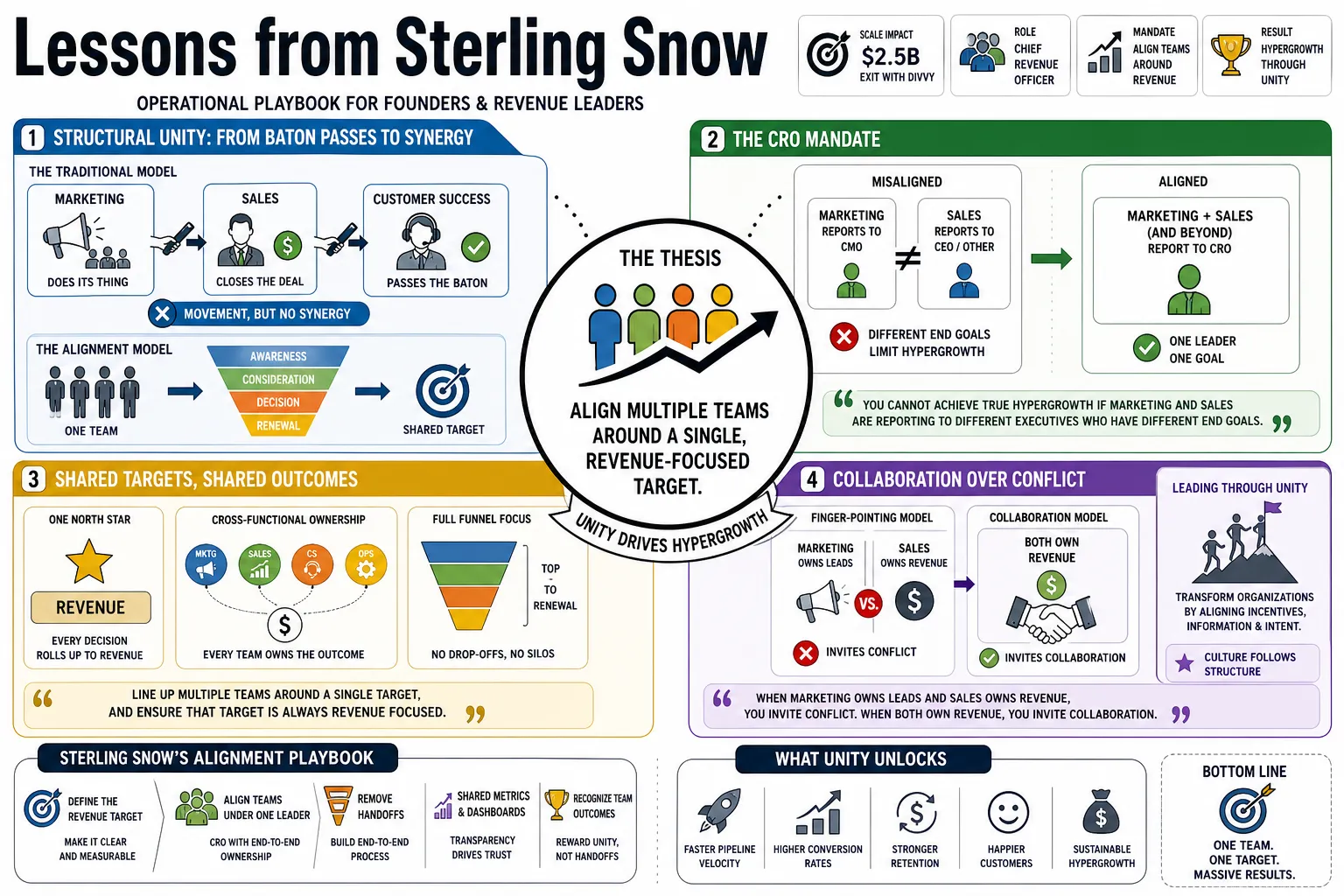
Lessons from Sterling Snow
As Chief Revenue Officer at Divvy, Sterling Snow helped scale the company to a $2.5 billion exit by consolidating sales, marketing, and customer success into a single team. He eliminated traditional departmental handoffs in favor of shared targets across the entire funnel. This compilation outlines his operational playbook for founders and revenue leaders.
Part 1: Revenue Alignment
- On structural unity: "Traditionally, alignment between teams looked like this: Marketing did its thing then threw the baton to sales, who then closed the deal and passed the baton again to customer success. There was movement, but no synergy." — Source: [The Sales Engagement Podcast]
- On the CRO mandate: "You cannot achieve true hypergrowth if marketing and sales are reporting to different executives who have different end goals." — Source: [SaaStr Podcast #628]
- On cross-functional targets: "Line up multiple teams around a single target, and ensure that target is always revenue focused." — Source: [The Sales Engagement Podcast]
- On eliminating finger-pointing: "When marketing owns leads and sales owns revenue, you invite conflict. When both own revenue, you invite collaboration." — Source: [SaaStr Podcast #628]
- On leading through unity: "The most effective way to transform an organization is to lead the conversation towards unity." — Source: [The Customer Experience Podcast]
- On shared language: "If marketing speaks 'MQLs' and sales speaks 'ARR', they are fundamentally operating in different companies." — Source: [SaaStr Podcast #672]
- On budget allocation: "A unified revenue org allows you to move budget fluidly from marketing to sales enablement depending on what the funnel actually needs that week." — Source: [The Investor + Operator Podcast]
- On compensation: "If you want teams to act like one team, you have to compensate them based on the success of the whole machine, not just their isolated cog." — Source: [SaaStr Podcast #628]
- On reporting structures: "The org chart shouldn't reflect internal political boundaries; it should mirror the journey the customer takes." — Source: [The Customer Experience Podcast]
- On defining alignment: "Alignment isn't a weekly meeting between department heads. It is a shared scoreboard." — Source: [Marketing Today Podcast]
Part 2: Go-To-Market Strategy
- On GTM agility: "Your go-to-market motion cannot be static. It has to evolve every time the market shifts or your product reaches a new tier of maturity." — Source: [SaaStr Podcast #672]
- On proprietary channels: "Find lead sources that your competitors can't simply outbid you on. Secure those early." — Source: [Marketing Today Podcast]
- On positioning against incumbents: "Don't attack the competitor's product features; attack the outdated philosophy their product forces the user into." — Source: [CRO Confidential]
- On market feedback: "A tight feedback loop is essential to bring sales and marketing together to serve prospects in the most effective way." — Source: [The Customer Experience Podcast]
- On rapid iteration: "The teams that win are the ones that run the most experiments in the shortest amount of time, not the ones with the most elaborate initial plans." — Source: [SaaStr Podcast #672]
- On segmenting audiences: "You cannot sell to an enterprise CFO the same way you sell to a mid-market controller. The GTM motion must adapt to the buyer's internal friction." — Source: [The Investor + Operator Podcast]
- On product-led vs sales-led: "It's rarely a binary choice. The best GTM strategies use product as a wedge and sales as the accelerator." — Source: [SaaStr Podcast #628]
- On early traction: "In the early days, you don't need a scalable strategy. You need a strategy that gets the first hundred people to care intensely." — Source: [The Investor + Operator Podcast]
- On messaging saturation: "If your messaging feels repetitive to you, it's probably just starting to register with your target audience." — Source: [Marketing Today Podcast]
- On competitive intelligence: "The best competitive intelligence comes from your own lost deals, not from reading the other company's website." — Source: [CRO Confidential]
Part 3: Marketing & Demand Generation
- On rapid ad testing: "We would write numerous ads daily to determine the best approach. You let the market tell you what works, not your internal intuition." — Source: [TofuHQ Interview]
- On newsletter sponsorships: "Locking down sponsorships in niche newsletters early provided a proprietary lead flow that competitors couldn't easily replicate." — Source: [TofuHQ Interview]
- On marketing accountability: "Marketing should be held accountable for closed-won business, not just generating top-of-funnel leads." — Source: [SaaStr Podcast #628]
- On brand vs performance: "Brand makes performance marketing cheaper. They aren't opposing forces; one is the foundation for the other." — Source: [Marketing Today Podcast]
- On content creation: "Don't create content to check a box. Create content that directly answers the objections your sales team hears on the floor every day." — Source: [The Sales Engagement Podcast]
- On event ROI: "If you can't trace an event back to pipeline generation within two quarters, it was a party, not a marketing strategy." — Source: [The Investor + Operator Podcast]
- On lead scoring: "A lead score is useless if sales doesn't trust the criteria behind it. Build the scoring model together." — Source: [SaaStr Podcast #672]
- On website conversion: "Treat your website like your top-performing sales rep. If it's not closing meetings, figure out where it's dropping the ball." — Source: [Marketing Today Podcast]
- On category creation: "You can't create a category with a press release. You create it by forcing the market to acknowledge a problem they were previously ignoring." — Source: [CRO Confidential]
- On marketing budgets: "Spend aggressively on channels where unit economics make sense, but hold back 10 percent for unproven, high-risk experiments." — Source: [TofuHQ Interview]
Part 4: Sales Execution & Operations
- On pipeline hygiene: "A bloated pipeline is worse than an empty one, because a bloated pipeline lies to you about the health of the business." — Source: [The Sales Engagement Podcast]
- On the discovery process: "Discovery shouldn't feel like an interrogation. It should feel like a consultation where both sides determine if there's a fit." — Source: [SaaStr Podcast #628]
- On sales urgency: "Time kills all deals. If you aren't establishing a compelling reason to act now, the default answer is always 'maybe later'." — Source: [SaaStr Podcast #672]
- On discounting: "When you discount early, you communicate that your initial price was a lie. Defend the value before you drop the price." — Source: [CRO Confidential]
- On multi-threading deals: "If your deal relies on a single champion, you are one resignation letter away from losing the account." — Source: [The Sales Engagement Podcast]
- On sales enablement: "Enablement isn't a one-time training session. It is the continuous process of removing friction from the rep's day." — Source: [The Investor + Operator Podcast]
- On objection handling: "Don't wait for the prospect to raise the obvious objection. Address the elephant in the room before they have the chance." — Source: [CRO Confidential]
- On closing techniques: "The best close is simply the logical conclusion of a well-executed discovery and evaluation process." — Source: [The Sales Engagement Podcast]
- On forecasting accuracy: "Forecasting isn't about guessing the future; it's about understanding the historical conversion rates of your current pipeline stages." — Source: [SaaStr Podcast #672]
- On territory planning: "Design territories based on addressable opportunity, not geographical convenience, to ensure reps have equal chances to succeed." — Source: [The Investor + Operator Podcast]
Part 5: Customer Success & Experience
- On the cost of disjointedness: "When internal alignment is not achieved, companies risk a disjointed customer experience that damages the brand." — Source: [The Customer Experience Podcast]
- On seamless handoffs: "The customer shouldn't have to repeat their pain points to a success manager after explaining them to a sales rep for three months." — Source: [The Customer Experience Podcast]
- On retention ownership: "Customer success secures the renewal, but marketing and sales set the expectations. Churn is often a symptom of bad selling." — Source: [SaaStr Podcast #628]
- On proactive support: "If you only talk to the customer when they have a problem or when it's time to renew, you are a vendor, not a partner." — Source: [The Customer Experience Podcast]
- On measuring success: "NPS tells you how they feel. Product usage tells you what they actually do. You need both to gauge account health." — Source: [The Investor + Operator Podcast]
- On expansion revenue: "Upsells should feel like a natural progression of value, not a forced transaction to meet an internal quota." — Source: [SaaStr Podcast #672]
- On managing churn: "Treat churn as a systemic failure to investigate, not just a lost contract to replace." — Source: [The Customer Experience Podcast]
- On customer feedback: "The most valuable product roadmap is written by listening to the frustrations of your most active users." — Source: [Marketing Today Podcast]
- On defining the experience: "A remarkable customer experience is the natural byproduct of a unified internal culture." — Source: [The Customer Experience Podcast]
Part 6: Hiring & Team Culture
- On interview tactics: "I ask candidates to map out a 30-60-90 day plan, and then I ask them to condense it. It shows me how they prioritize when time is scarce." — Source: [TofuHQ Interview]
- On cultural fit: "Hire for a high-performance culture fit. Brilliance is useless if it creates toxicity in the revenue org." — Source: [TofuHQ Interview]
- On onboarding: "The first two weeks dictate a rep's trajectory for the next year. Do not shortcut the onboarding process." — Source: [The Investor + Operator Podcast]
- On internal mobility: "Your best future managers are often your current top performers who show an instinct for teaching others." — Source: [SaaStr Podcast #628]
- On letting people go: "If someone isn't meeting the bar after being given every resource to succeed, keeping them hurts the morale of the people who are carrying the weight." — Source: [The Sales Engagement Podcast]
- On diversity of thought: "You don't want a team of people who solve problems exactly the way you do. You want a team that covers your blind spots." — Source: [The Investor + Operator Podcast]
- On remote work culture: "Culture isn't the ping-pong table in the office. It's how people communicate in Slack when things go wrong." — Source: [Marketing Today Podcast]
- On promoting from within: "Creating a clear path for advancement is the easiest way to retain top talent in a competitive market." — Source: [SaaStr Podcast #672]
- On team resilience: "A resilient team doesn't panic when they miss a target; they dissect the failure and adjust the inputs." — Source: [The Sales Engagement Podcast]
Part 7: Leadership & Management
- On transparent leadership: "Share the ugly numbers along with the good ones. The team can't help fix a problem they don't know exists." — Source: [The Investor + Operator Podcast]
- On managing managers: "Your job shifts from managing the work to managing the environment in which the work gets done." — Source: [SaaStr Podcast #628]
- On decision making: "Make decisions quickly based on 80 percent of the information. Waiting for absolute certainty will paralyze the organization." — Source: [CRO Confidential]
- On ego in leadership: "Leave your ego at the door. The best idea wins, regardless of whose title is highest on the org chart." — Source: [The Sales Engagement Podcast]
- On cross-departmental friction: "When friction arises, address the process, not the personalities. Usually, it's a structural flaw causing the conflict." — Source: [The Customer Experience Podcast]
- On setting the pace: "The speed of the team is dictated by the speed of the leader. If you drag your feet, they will too." — Source: [The Investor + Operator Podcast]
- On radical candor: "Feedback is a gift, but only if it's delivered with the genuine intent of helping the person improve." — Source: [Marketing Today Podcast]
- On resource allocation: "Don't spread your best people across ten mediocre projects. Put them all on the one initiative that could double the business." — Source: [SaaStr Podcast #672]
- On maintaining focus: "The hardest part of leadership is saying no to good ideas so you have the bandwidth to execute on great ones." — Source: [The Sales Engagement Podcast]
Part 8: Metrics, Data & Accountability
- On funnel accountability: "Every department should be accountable for KPIs at least one stage deeper in the sales funnel than their immediate function." — Source: [SaaStr Podcast #628]
- On actionable metrics: "If a metric goes up or down and you don't know what behavioral change caused it, it's a vanity metric." — Source: [The Investor + Operator Podcast]
- On data silos: "When marketing has their data set and sales has theirs, the customer truth gets lost in the middle." — Source: [The Customer Experience Podcast]
- On measuring velocity: "Deal velocity is the most underrated metric. The faster a deal moves through the pipeline, the more predictable your revenue becomes." — Source: [SaaStr Podcast #672]
- On tracking conversions: "Don't just look at the overall conversion rate. Measure the conversion rate between every individual micro-step of the buyer journey." — Source: [Marketing Today Podcast]
- On the limits of data: "Data tells you what happened, but human intuition is required to figure out why it happened." — Source: [The Investor + Operator Podcast]
- On revenue predictability: "Predictability is the ultimate goal. If you hit your number but you don't know how you did it, you are in danger." — Source: [The Sales Engagement Podcast]
- On individual accountability: "Set clear inputs. If a rep hits their activity inputs but misses the target, it's a process failure. If they miss the inputs, it's an accountability failure." — Source: [TofuHQ Interview]