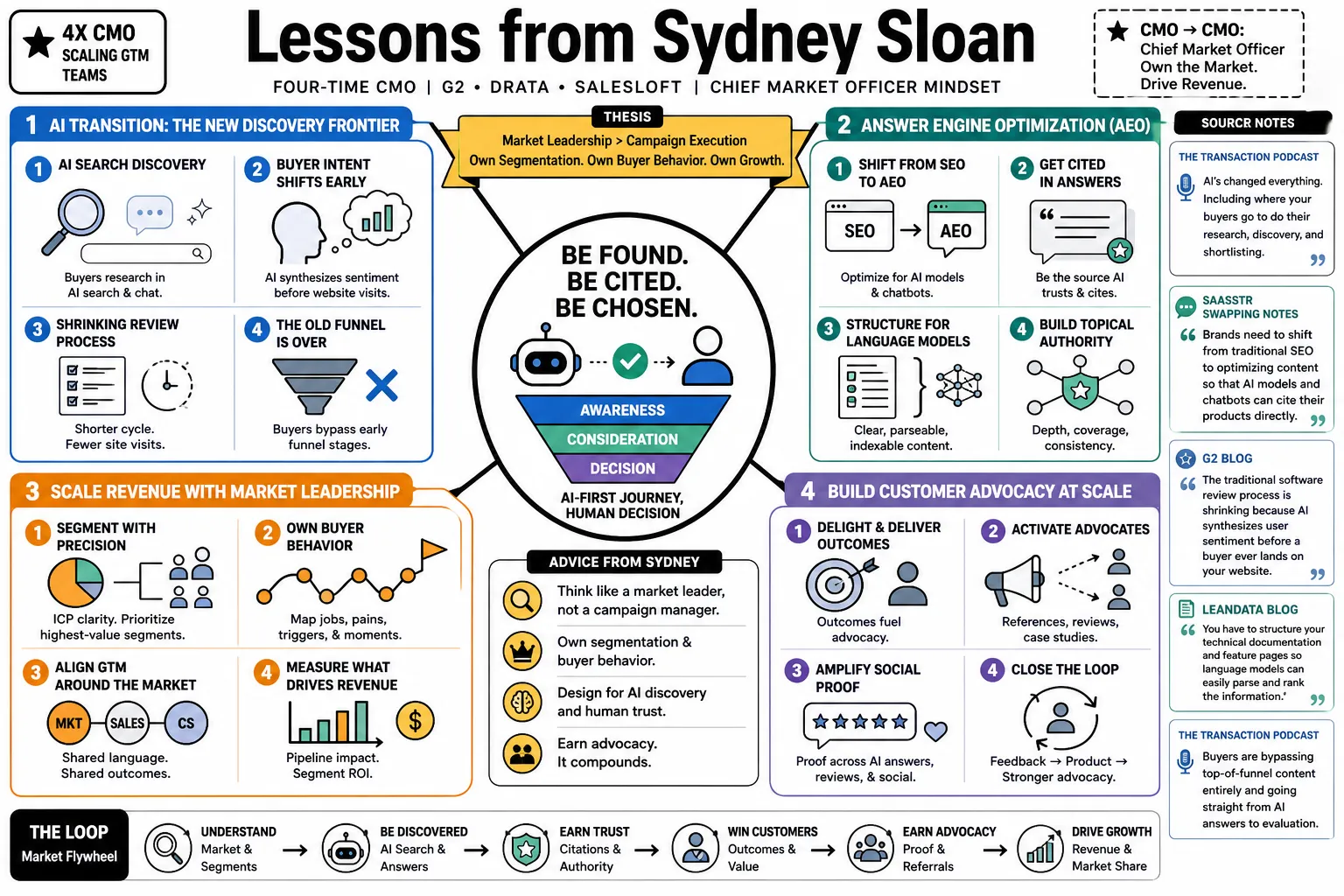
Lessons from Sydney Sloan
Sydney Sloan is a four-time CMO who has led go-to-market teams at G2, Drata, and Salesloft. She argues that marketing leaders should act as "Chief Market Officers" who own segmentation and buyer behavior rather than just running campaigns. This profile collects her advice on scaling revenue, building customer advocacy, and adapting to AI-driven discovery.
Part 1: The AI Transition and Answer Engine Optimization
- On AI Search Discovery: "AI's changed everything. Including where your buyers go to do their research, discovery and shortlisting." — Source: The Transaction transcript for Sloan on AI changing buyer research, discovery, and shortlisting
- On Answer Engine Optimization: "Brands need to shift from traditional SEO to optimizing content so that AI models and chatbots can cite their products directly." — Source: SaaStr Swapping Notes
- On Buyer Intent: "The traditional software review process is shrinking because AI synthesizes user sentiment before a buyer ever lands on your website." — Source: G2 Blog
- On Content Formatting: "You have to structure your technical documentation and feature pages so language models can easily parse and rank the information." — Source: LeanData Blog
- On The End of the Old Funnel: "Buyers are bypassing standard lead-capture forms by using AI to ask highly specific, multi-variable questions about vendor capabilities." — Source: MarTech Series
- On Adapting GTM for AI: "Marketing teams must start measuring how frequently they appear in AI-generated answers, replacing the old metric of organic search clicks." — Source: SaaStr Annual
- On Trust in the AI Era: "When AI generates the initial shortlist, authenticated customer reviews become the primary currency of trust that separates real software from vaporware." — Source: G2 Resources
- On AI and Competitor Research: Sloan argues that AI-driven buyer research makes comparison content, pricing detail, pro/con lists, and prompt-shaped answers more important because buyers are forming shortlists and evaluating options before they reach a vendor. — Reference: The Transaction transcript for Sloan on comparison content, pricing, pro/con lists, and AI shortlists
- On Content Volume vs. Quality: "The generative AI boom means content volume is no longer a differentiator. Original data and proprietary customer insights are the only things AI cannot instantly hallucinate or replicate." — Source: G2 Blog
- On Future-Proofing Marketing: "A modern CMO has to understand the underlying mechanics of how large language models ingest brand data, because that is the new top of the funnel." — Source: SaaStr Swapping Notes
Part 2: The Chief Market Officer Paradigm
- On Redefining the CMO Role: "The role should be less about tactical marketing activations and more about knowing and owning the market." — Source: PanBlast PR
- On Strategic Segmentation: "A Chief Market Officer spends more time defining exact ideal customer profiles than they do reviewing ad copy." — Source: Stage 2 Capital
- On Moving Beyond Tactics: "If you only focus on lead generation, you are running campaigns. If you focus on market dynamics and buyer behavior, you are running a business." — Source: SaaStr Annual
- On Knowing the Buyer: "You cannot effectively own the market if you rely on second-hand information from sales to understand what your customers actually want." — Source: Women in Revenue
- On Market Definition: "Marketing leadership starts with a disciplined approach to defining the total addressable market and intentionally deciding which segments to ignore." — Source: MarTech Series
- On Alignment with Product: "The Chief Market Officer works in lockstep with product to ensure that what is being built actually maps to an urgent, funded market need." — Source: B2B Marketing Exchange
- On Growth Levers: "Understanding pricing, packaging, and competitive positioning are just as core to the marketing function as demand generation." — Source: Stage 2 Capital
- On Category Creation: "You don't create a category through branding alone; you create it by identifying a fundamental shift in how the market operates and building a solution for it." — Source: Salesloft Blog
- On Executive Presence: "When you present to the board as a Chief Market Officer, you talk about market share, win rates, and customer acquisition cost, avoiding superficial pipeline metrics." — Source: Scale Venture Partners
Part 3: Scaling High-Growth Go-to-Market
- On Early-Stage Focus: "In the early days of scaling, you have to nail one motion perfectly before trying to run an omnichannel enterprise playbook." — Source: SaaStr Podcast
- On Revenue Growth: "Scaling from $16M to $135M requires a completely different operational rigor than getting from zero to one." — Source: Salesloft Resources
- On Metric Discipline: "High-growth marketing is an exercise in math. You need to know the exact conversion rates at every stage of the funnel to predict revenue." — Source: Stage 2 Capital
- On Process Breakdown: "The systems that got you to your current revenue milestone will predictably break when you attempt to double it. You have to rebuild the engine while driving." — Source: Revenue Builders Podcast
- On Budget Allocation: "Do not spread your marketing budget thinly across ten experiments. Concentrate your spend on the three channels that actually drive closed-won deals." — Source: Scale Venture Partners
- On Messaging Evolution: "As the company scales, your messaging must evolve from selling a specific tool to selling a broader strategic transformation for the entire enterprise." — Source: G2 Blog
- On Going Upmarket: "Moving to enterprise sales means marketing has to shift from generating raw lead volume to orchestrating account-based buying committees." — Source: SaaStr Swapping Notes
- On Compliance and Risk: "In markets like compliance automation, speed to market is essential, but you must balance rapid growth with maintaining absolute trust." — Source: Drata Blog
- On International Expansion: "You cannot simply translate your website and expect to win in Europe. You need local market context and localized buyer understanding." — Source: B2B Marketing Exchange
- On Managing Expectations: "When scaling fast, the hardest part of marketing leadership is setting realistic expectations with the board on how long enterprise pipeline actually takes to mature." — Source: Revenue Builders Podcast
Part 4: Sales and Marketing Alignment
- On Structural Friction: "Everyone says marketing and sales should be aligned, but no CMO wants to report to sales." — Source: Captivate.fm Interviews
- On Shared Goals: "The only way to align sales and marketing is to put them on the exact same revenue quota. Shared metrics eliminate finger-pointing." — Source: SaaStr Annual
- On Pipeline Definitions: "You have to agree on the definition of a qualified lead. If marketing thinks a whitepaper download is a lead and sales thinks it's a booked meeting, the system is broken." — Source: Salesloft Blog
- On Sales Feedback: "Marketing teams need to listen to sales calls every week. That is where you hear the real objections and the actual words buyers use." — Source: Women in Revenue
- On Campaign Handoffs: "A campaign does not end when marketing generates the lead. It ends when sales effectively works the lead to a closed outcome." — Source: LeanData Blog
- On Cross-Functional Trust: "Trust between a CRO and a CMO is built through transparency in the data. Never hide a bad pipeline quarter behind vanity metrics." — Source: Revenue Builders Podcast
- On Enablement: "Marketing must arm sales with content that helps them navigate the middle of the funnel, ignoring flashy assets for the initial pitch." — Source: Salesloft Resources
- On Feedback Loops: "Create a formal, recurring meeting where sales can tell marketing exactly why deals are being lost. Use that to fix your positioning." — Source: B2B Marketing Exchange
- On Account-Based Strategy: "Account-based marketing is impossible without account-based selling. It has to be a joint organizational motion, rarely succeeding as a standalone marketing campaign." — Source: SaaStr Podcast
Part 5: Customer Marketing and Advocacy
- On First-Party Teams: "Establishing a dedicated customer marketing team is necessary for retention and expansion, yet it is often the last thing companies fund." — Source: Adobe Blog
- On Customer Voices: "Your best marketing material is simply getting out of the way and letting your successful customers talk directly to your prospects." — Source: G2 Resources
- On Post-Sale Engagement: "Marketing's job does not end at the signature. You have to market to your existing customers to drive adoption and prevent churn." — Source: Stage 2 Capital
- On Advocacy Programs: "A strong customer advocacy program turns your user base into a decentralized sales team." — Source: B2B Marketing Exchange
- On Review Platforms: "B2B buyers trust peer reviews over analyst reports. Managing your presence on software marketplaces is a primary growth channel." — Source: G2 Blog
- On Case Studies: "Nobody wants to read a dry corporate case study. Frame customer stories around the human struggle they faced before using your product." — Source: MarTech Series
- On Community Events: "Bringing customers together in a room builds an emotional connection to the brand that no digital campaign can replicate." — Source: Salesloft Blog
- On Customer Advisory Boards: "Use your customer advisory board to actually steer the product roadmap, instead of presenting finished features to them." — Source: Women in Revenue
- On Expansion Revenue: "Customer marketing is the most efficient driver of net revenue retention. Upselling an engaged user is always cheaper than acquiring a new one." — Source: Scale Venture Partners
- On Authenticity: "Buyers can spot a manufactured customer quote instantly. You have to let them speak with their own rough edges and honest feedback." — Source: SaaStr Annual
Part 6: Hiring, Talent, and Team Building
- On Interview Transparency: "Surface red flags when hiring and talk to the candidates about them; you can then have a development plan for them in place on day 1." — Source: Captivate.fm Interviews
- On Internal Promotion: "Look for emerging talent or people taking on special projects to join the team and get exposure. You don't always need to hire from the outside." — Source: Captivate.fm Interviews
- On Diverse Backgrounds: "The best marketing teams are built from people with non-linear career paths. A former sales rep or product manager often makes a brilliant marketer." — Source: Women in Revenue
- On Generalists vs. Specialists: "In the early days, you need generalists who can write copy and run operations. As you scale, you must transition to deep specialists." — Source: Stage 2 Capital
- On Cultural Add: "Do not hire for culture fit, which creates echo chambers. Hire for cultural add: people who bring a perspective your leadership team currently lacks." — Source: SaaStr Swapping Notes
- On Retaining Talent: "Top performers stay when they feel they are doing the best work of their careers and have clear visibility into how their work impacts the company's bottom line." — Source: Revenue Builders Podcast
- On Leadership Delegation: "A CMO's job is to build a team of directors and VPs who are smarter than them in specific domains, and then get out of their way." — Source: B2B Marketing Exchange
- On Firing Quickly: "If someone is a brilliant performer but toxic to the team culture, you have to remove them. The damage they do to the rest of the organization always outweighs their output." — Source: Scale Venture Partners
- On Continuous Learning: "Marketing moves too fast. If your team is not actively dedicating time to learning new tools and market shifts, their skills will be obsolete in two years." — Source: MarTech Series
Part 7: Community and Ecosystems
- On Partner Marketing: "You scale faster by tapping into the audiences of complimentary software vendors than you do by trying to build an audience from scratch." — Source: G2 Resources
- On Open Source: "In open-source business models, the community is your product. Marketing has to protect and nurture that community alongside monetizing it." — Source: Alfresco Blog
- On Ecosystem Strategy: "Modern B2B purchasing is ecosystem-driven. Buyers want to know how your tool integrates with the stack they already own." — Source: LeanData Blog
- On Building Trust: "You build community by providing value with zero expectation of an immediate return. It requires patience that most quarterly-driven boards struggle with." — Source: SaaStr Annual
- On Event Strategy: "Don't host a user conference purely to generate pipeline. Host it to make your users feel like they belong to a movement." — Source: Salesloft Resources
- On Thought Leadership: "True thought leadership is giving away your best frameworks for free so that the market adopts your way of thinking." — Source: Stage 2 Capital
- On Influencer Marketing in B2B: "B2B influencers are not celebrities; they are trusted practitioners. Partner with the people your buyers actually go to for technical advice." — Source: B2B Marketing Exchange
- On Developer Communities: "When marketing to developers or technical buyers, drop the corporate jargon. They respect transparency, documentation, and open code." — Source: Alfresco Blog
- On Category Networks: "The companies that win a category are the ones that successfully build a network of implementation partners, consultants, and power users around their product." — Source: Scale Venture Partners
Part 8: Leadership and Execution
- On Ruthless Prioritization: "There will always be fifty good ideas. Leadership is having the discipline to say no to forty-seven of them and executing the remaining three flawlessly." — Source: Revenue Builders Podcast
- On Board Communication: "Never walk into a board meeting with a marketing deck full of qualitative achievements. Bring a financial model that shows how marketing spend drove enterprise value." — Source: SaaStr Swapping Notes
- On Agility: "The market dictates your strategy, not your internal annual plan. If the environment shifts, you have to rewrite your playbook that same week." — Source: G2 Blog
- On Taking Risks: "Safe marketing is invisible marketing. You have to be willing to run bold campaigns that might fail, as long as you learn from the data." — Source: Women in Revenue
- On Measuring Success: "Stop reporting on clicks and impressions. If you cannot draw a straight line from a marketing initiative to closed revenue or retention, stop doing it." — Source: Stage 2 Capital
- On Executive Burnout: "You cannot lead a high-growth team if you are running on empty. Setting boundaries is a requirement for sustained executive performance." — Source: Captivate.fm Interviews
- On Founder Relationships: "A CMO must act as a strategic partner to the founder, translating their original vision into a scalable, repeatable market narrative." — Source: Scale Venture Partners
- On Owning Mistakes: "When a campaign fails or a quarter is missed, own it immediately. Post-mortems should be blameless exercises in finding the operational flaw." — Source: MarTech Series
- On The Long Game: "Building a durable brand takes years of consistent execution. Do not let the pressure for short-term leads compromise your long-term market position." — Source: SaaStr Annual