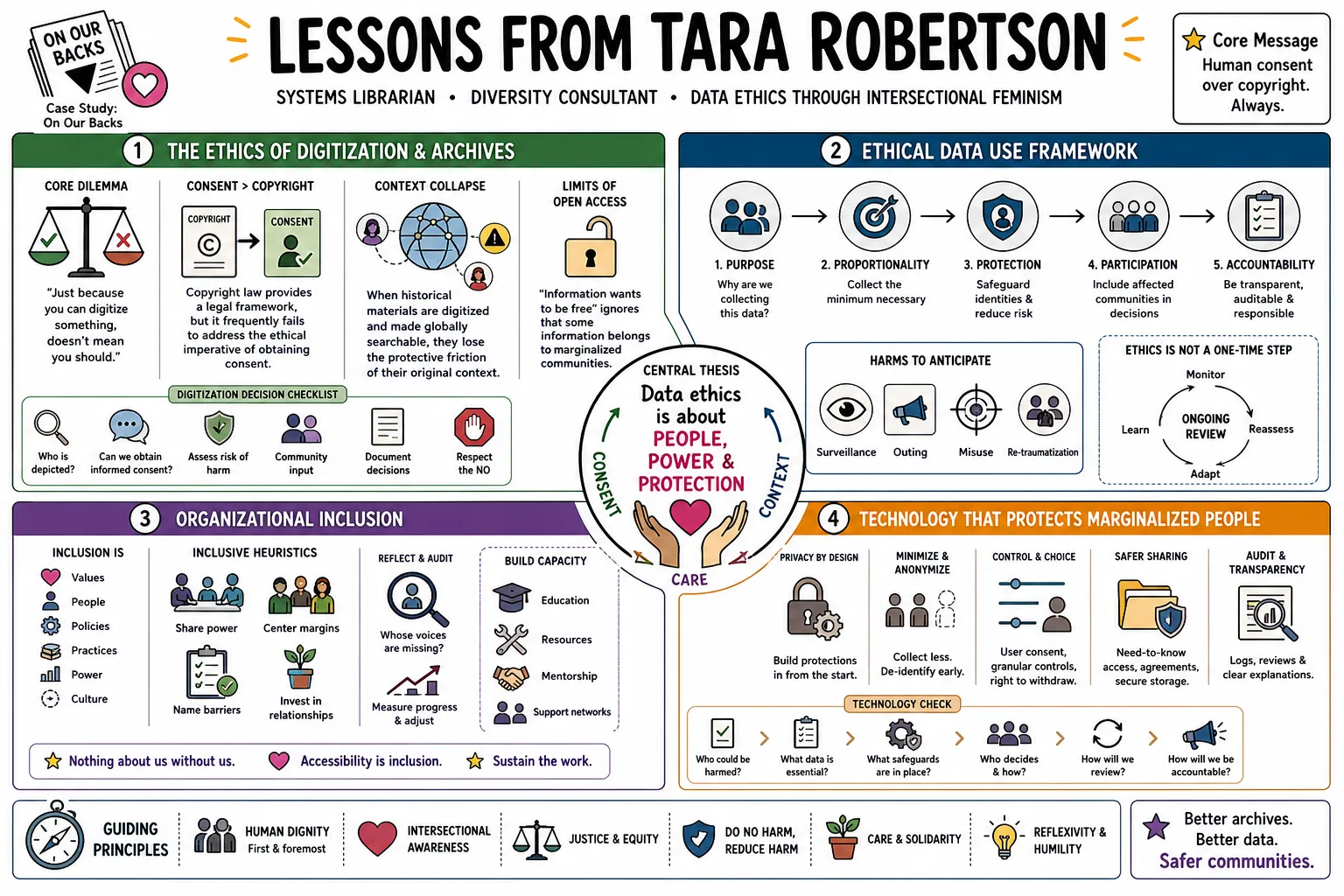
Lessons from Tara Robertson
Tara Robertson is a systems librarian and diversity consultant whose approach to data ethics is rooted in intersectional feminism. Her case study on the digitization of the lesbian magazine On Our Backs challenged institutions to prioritize human consent over copyright. This profile outlines her frameworks for ethical data use, organizational inclusion, and building technology that protects marginalized people.
Part 1: The Ethics of Digitization and Archives
- On the core dilemma of digitization: "Just because you can digitize something, doesn't mean you should." — Source: [Tara Robertson Consulting]
- On copyright versus consent: "Copyright law provides a legal framework for digitization, but it frequently fails to address the ethical imperative of obtaining consent from the subjects depicted." — Source: [Not All Information Wants to be Free]
- On context collapse in archives: "When historical materials are digitized and made globally searchable, they lose the protective friction of their original context, exposing vulnerable individuals to new harms." — Source: [Code4Lib Keynote]
- On the limitations of open access: "The rallying cry that 'information wants to be free' ignores the reality that some information belongs to marginalized communities who never intended it to be universally accessible." — Source: [Applying Library Values to Emerging Technology]
- On the right to be forgotten: "Libraries and archives must reckon with the right to be forgotten, especially when digitizing materials that could out individuals or jeopardize their employment and safety." — Source: [Tara Robertson Consulting]
- On retroactive exposure: "Contributors who consented to a limited-run print publication in the 1980s did not consent to having their images and names searchable on the open internet decades later." — Source: [Not All Information Wants to be Free]
- On ethical stewardship: "Librarians must shift from viewing themselves merely as custodians of information to acting as ethical stewards who prioritize the well-being of the communities documented in their collections." — Source: [Circulating Ideas Podcast]
- On balancing access and respect: "There is an inherent tension between providing broad public access to historical records and maintaining a deep respect for the privacy of the individuals living within those records." — Source: [Tara Robertson Consulting]
- On the neutrality myth in archiving: "The decision of what to digitize is never neutral; it is an exercise of power that often disproportionately impacts those who already have the least agency over their own narratives." — Source: [Rebus Community]
- On halting harmful projects: "Institutional pride should never prevent an organization from pausing or pulling down a digital collection when real human harm is identified." — Source: [Code4Lib Keynote]
Part 2: Consent and Vulnerability in Tech
- On ethical consent models: "True consent in technological and archival spaces must be informed, ongoing, and revocable, rather than a one-time unchecked box." — Source: [Tara Robertson Consulting]
- On the permanence of digital data: "The internet's inability to forget forces us to design systems that intentionally build in mechanisms for removal and privacy." — Source: [Learn to Improve It]
- On vulnerable populations and tech: "Systems are frequently designed by those with the most societal privilege, resulting in platforms that are uniquely dangerous for marginalized users." — Source: [Open Source Summit]
- On the ethics of care: "Technology and archiving must adopt an ethics of care, placing human safety above the theoretical ideals of absolute information freedom." — Source: [Code4Lib Keynote]
- On corporate responsibility: "Companies that build digital repositories have a fundamental responsibility to assess the downstream consequences of their platforms on vulnerable populations." — Source: [Harvard Business Review]
- On the speed of innovation: "Moving fast and breaking things is an unacceptable philosophy when the things being broken are the lives and privacy of real people." — Source: [Substack Newsletter]
- On opting out: "The burden of opting out of harmful data systems should not rest on the individuals who are most likely to be victimized by those systems." — Source: [Not All Information Wants to be Free]
- On redefining open data: "Open data initiatives must mature beyond a blanket release of information to include specific threat modeling for the communities involved." — Source: [Rebus Community]
- On institutional listening: "When marginalized people tell an institution that a project is causing harm, the ethical response is to listen, stop, and reassess, rather than defend the project's intent." — Source: [Tara Robertson Consulting]
Part 3: Intersectional Feminism in Practice
- On applied intersectionality: "Intersectionality is a practical lens required to understand how compounding forms of discrimination operate within organizations." — Source: [Forbes]
- On one-dimensional feminism: "Feminist initiatives in the workplace that fail to account for race, class, and ability end up advancing the interests of white, neurotypical women." — Source: [Tara Robertson Consulting]
- On structural inequities: "Individual resilience is frequently praised to avoid addressing the structural inequities that demand such resilience in the first place." — Source: [Learn to Improve It]
- On feminist leadership: "Feminist leadership requires abandoning the illusion of complete objectivity and acknowledging how our own positionality shapes our decisions." — Source: [Substack Newsletter]
- On the limitations of empathy: "Empathy is a starting point, but it must be followed by resource redistribution and shifts in power to create meaningful intersectional change." — Source: [Harvard Business Review]
- On the myth of pipeline problems: "Blaming a lack of diversity on a pipeline problem ignores the toxic environments that push marginalized people out of the industry entirely." — Source: [Mozilla Diversity & Inclusion]
- On centering the margins: "When we design policies and systems for those who are most marginalized, the resulting environment becomes more supportive for everyone." — Source: [Code4Lib Keynote]
- On invisible labor: "Organizations must recognize, quantify, and compensate the invisible emotional labor that marginalized employees perform to sustain the company culture." — Source: [Tara Robertson Consulting]
- On solidarity over charity: "True inclusion work is rooted in solidarity and shared struggle, avoiding paternalistic charity toward underrepresented groups." — Source: [Rebus Community]
Part 4: Accessibility as a Systemic Baseline
- On systemic failure: "When a disabled user cannot access a service, it is a profound failure of the system's design rather than a failure of the individual." — Source: [Circulating Ideas Podcast]
- On accessibility as an afterthought: "Tacking on accessibility features at the end of a project guarantees a subpar experience; inclusion must be embedded from the initial design phase." — Source: [Tara Robertson Consulting]
- On compliance versus usability: "Meeting legal accessibility compliance standards is the absolute floor of design, never the ceiling for an inclusive user experience." — Source: [Open Source Summit]
- On the social model of disability: "The social model of disability teaches us that people are disabled by barriers in society, giving designers the power to remove those barriers." — Source: [Applying Library Values to Emerging Technology]
- On invisible disabilities: "A comprehensive approach to accessibility must proactively support neurodivergence and invisible disabilities alongside obvious physical accommodations." — Source: [Mozilla Diversity & Inclusion]
- On auditing systems: "Regular accessibility audits should be conducted by people who actually rely on assistive technologies, and they must be paid fairly for their expertise." — Source: [Code4Lib Keynote]
- On universal design: "Universal design principles recognize that environments created to be accessible to people with disabilities inherently benefit the entire user base." — Source: [Learn to Improve It]
- On resource allocation: "An organization's commitment to accessibility is measured by its budget allocations for inclusive design, never by its diversity statements." — Source: [Tara Robertson Consulting]
- On the cost of exclusion: "The cost of building accessible systems is frequently debated, while the massive social and economic costs of excluding disabled people are ignored." — Source: [Substack Newsletter]
Part 5: Diversity and Inclusion Strategy
- On performative diversity: "Hiring marginalized individuals without changing the underlying corporate culture is an exercise in public relations." — Source: [Harvard Business Review]
- On retaining diverse talent: "You cannot recruit your way out of a retention problem; if the environment is hostile, diverse talent will eventually leave." — Source: [Mozilla Diversity & Inclusion]
- On metric-driven DEI: "Diversity and inclusion goals must be tracked with the same rigor, resourcing, and accountability as revenue or product launch metrics." — Source: [Forbes]
- On trans inclusion: "Trans inclusion requires comprehensive healthcare coverage, psychological safety, and clear anti-harassment enforcement." — Source: [Tara Robertson Consulting]
- On moving beyond training: "Unconscious bias training must be coupled with structural changes to how performance is evaluated and who gets promoted." — Source: [Learn to Improve It]
- On leadership buy-in: "DEI initiatives led solely by grassroots employee groups will inevitably burn out unless they have explicit, material support from executive leadership." — Source: [Substack Newsletter]
- On systemic friction: "Creating an inclusive culture requires intentionally introducing friction into biased legacy processes, such as hiring pipelines and performance reviews." — Source: [Rebus Community]
- On defining equity: "Equity is providing individuals with the specific resources they need to succeed, avoiding treating everyone exactly the same." — Source: [Tara Robertson Consulting]
- On cultural fit: "Evaluating candidates for 'cultural fit' often serves as a coded mechanism to enforce homogeneity; organizations should look for 'cultural add.'" — Source: [Open Source Summit]
- On sustained commitment: "Equity work is an ongoing practice that requires daily maintenance, resisting the urge to view it as a project with a definitive end date." — Source: [Code4Lib Keynote]
Part 6: Navigating Open Source Culture
- On the myth of meritocracy: "The concept of meritocracy in open source often masks deep-seated systemic biases, rewarding those who already possess the time and privilege to contribute." — Source: [Mozilla Diversity & Inclusion]
- On interdependence: "The open source community must transition away from the toxic narrative of the 'lone genius' and embrace the reality of interdependence." — Source: [Code4Lib Keynote]
- On codes of conduct: "A code of conduct is a meaningless document unless there is a clear, transparent, and consistently enforced mechanism for handling violations." — Source: [Open Source Summit]
- On community health: "The health of an open source project is determined by how it treats its most vulnerable contributors, rather than its code quality alone." — Source: [Tara Robertson Consulting]
- On gatekeeping: "Technical jargon and obscure contribution processes often serve as intentional gatekeeping mechanisms that keep underrepresented groups out of tech spaces." — Source: [Rebus Community]
- On rewarding non-code contributions: "Open source projects must value and formally recognize non-code contributions like documentation, community management, and design." — Source: [Substack Newsletter]
- On the burden of education: "Marginalized contributors in tech should never bear the unpaid burden of educating their privileged peers on basic inclusion principles." — Source: [Learn to Improve It]
- On conflict resolution: "Healthy tech communities do not avoid conflict; they build equitable frameworks to resolve disagreements without resorting to harassment." — Source: [Mozilla Diversity & Inclusion]
- On dismantling elitism: "We must actively dismantle the intellectual elitism in tech that equates technical prowess with moral superiority." — Source: [Code4Lib Keynote]
Part 7: Leadership and Accountability
- On taking responsibility: "Effective leadership requires taking public accountability for organizational failures, especially when those failures cause harm to marginalized communities." — Source: [Forbes]
- On the courage to change: "Transformational leadership is less about having all the answers and more about having the courage to abandon legacy systems that no longer serve equity." — Source: [Tara Robertson Consulting]
- On coaching for inclusion: "Coaching leaders on DEI requires helping them move past their own fragility and defensiveness so they can focus on their systemic impact." — Source: [Substack Newsletter]
- On delegating equity work: "Executives cannot outsource DEI to human resources; it must be a core competency of every senior leader in the organization." — Source: [Harvard Business Review]
- On measuring success: "Leadership success should be evaluated by the psychological safety and retention rates of underrepresented employees, alongside financial metrics." — Source: [Learn to Improve It]
- On transparent communication: "When organizations make mistakes regarding inclusion, transparent communication about the remediation process is essential to rebuilding trust." — Source: [Tara Robertson Consulting]
- On power dynamics: "Leaders must be intimately aware of their own power dynamics and how their positional authority can silence necessary dissent within their teams." — Source: [Open Source Summit]
- On sponsoring vs. mentoring: "Underrepresented talent is frequently over-mentored and under-sponsored; leaders must use their political capital to advocate for their advancement." — Source: [Forbes]
- On ethical courage: "Institutional change often requires leaders to risk their own comfort and popularity to enforce policies that protect the vulnerable." — Source: [Code4Lib Keynote]
Part 8: Data Collection and Representation
- On demographic data: "Collecting demographic data is useless if the organization has no concrete plan to use that data to dismantle inequities." — Source: [Mozilla Diversity & Inclusion]
- On the qualitative context: "Quantitative data shows where a problem exists, while qualitative data is required to understand why the problem is happening and how to fix it." — Source: [Substack Newsletter]
- On data privacy as a right: "Data privacy is a fundamental human right that must be centered in every phase of product and survey design." — Source: [Rebus Community]
- On reducing humans to metrics: "We must resist the urge to flatten complex human experiences and intersecting identities into overly simplistic, neat data points." — Source: [Tara Robertson Consulting]
- On ethical surveying: "Before asking marginalized employees to share their traumatic experiences in a survey, organizations must prove they are ready to act on the findings." — Source: [Learn to Improve It]
- On intersectional data analysis: "Analyzing diversity data without an intersectional lens obscures the unique barriers faced by individuals who live at the crossroads of multiple marginalized identities." — Source: [Harvard Business Review]
- On data sovereignty: "Communities should have sovereignty over how their data is collected, interpreted, and weaponized against them by external institutions." — Source: [Code4Lib Keynote]
- On transparency in metrics: "Organizations should publish their diversity metrics transparently as a public commitment to continuous improvement, rather than a marketing exercise." — Source: [Mozilla Diversity & Inclusion]
- On algorithmic bias: "Data models trained on historically biased datasets will inevitably reproduce and scale those biases unless they are actively interrogated and corrected." — Source: [Open Source Summit]
- On the ultimate goal of data: "The purpose of collecting inclusion data is to build an environment where everyone can thrive, avoiding the trap of simply creating a perfectly diverse dashboard." — Source: [Tara Robertson Consulting]