Lessons from Tom Freston
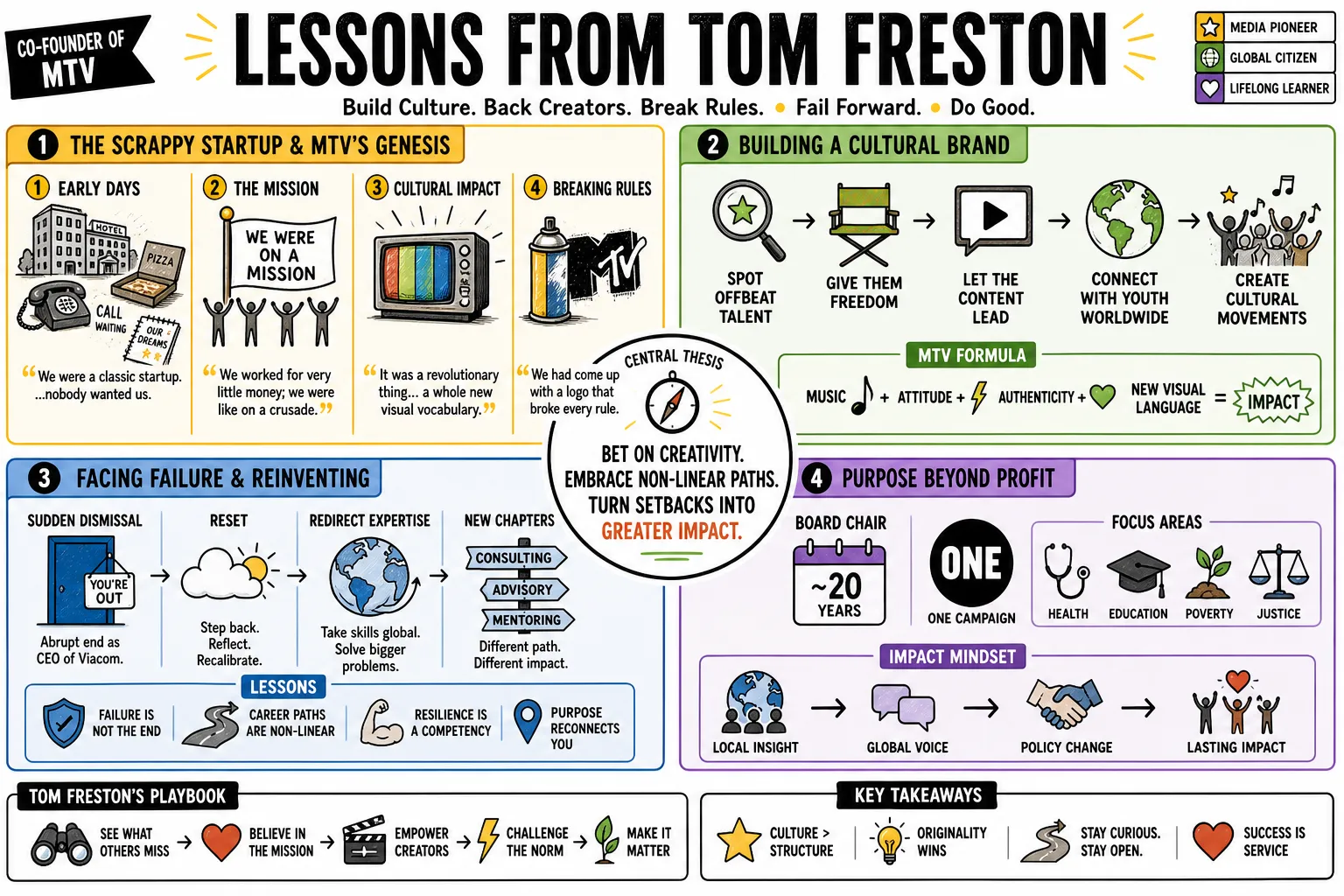
Tom Freston co-founded MTV, building a niche cable channel into a global cultural brand by championing offbeat creative talent over traditional corporate management. After an abrupt dismissal from his role as CEO of Viacom, he redirected his media expertise toward international consulting and philanthropy, spending nearly two decades as the board chair of the ONE Campaign. This collection synthesizes his views on managing creative teams, navigating corporate failure, and the value of a non-linear career path.
Part 1: The Scrappy Startup & MTV's Genesis
- On Early Days: "We were a classic startup. We were like a child of a joint venture. Our parents barely knew we existed. We were shuttled off to some hotel room. We had call waiting, ate pizza, had our dreams. But nobody wanted us." — Source: [Tufts Daily]
- On The Mission: "We were on a mission—I mean everyone who worked there. And we worked for very little money; we were like on a crusade." — Source: [Tufts Daily]
- On Cultural Impact: "It was a revolutionary thing when it first came out. It made quite a splash... It was like a whole new visual vocabulary we were throwing at people." — Source: [Tufts Daily]
- On Breaking Rules: "We had come up with a logo for $1,000... [The agency] said, 'You can't use this; it breaks every rule of corporate identity.' We fired the agency." — Source: [Inc]
- On The Pitch: "We wanted to sweep the nation with this new musical invention that we thought was irresistible." — Source: [Tufts Daily]
- On Early Belief: "We were doing something that algorithms or focus groups would have hated, but we trusted our instincts over data." — Source: [YourTango]
- On Building a Brand: "MTV was born at the start of a revolution, the cable revolution... And now it's happening again with digital-enabled television." — Source: [Forbes]
- On Getting Started: "I hit the timing. And you know I had always had a great passion for music. And I was willing to take risks. I could just say, 'You know, what the hell. I'll jump into this.'" — Source: [Business Insider]
- On The MTV Vibe: "It was an eccentric—we were not a traditional media company. We would thrive on offbeat leading-edge talent and gradually bring them into the mainstream." — Source: [Television Academy Interview - Tom Freston]
- On Audience Evolution: "When you're focused on that youth audience, people pass through you in a few years, and generally the next batch of people have different sensibilities than the ones before." — Source: [Forbes]
Part 2: Managing Creative "Aberrant" Talent
- On Insulating Creatives: "I tried the best I could to always insulate the people at MTV Networks from the corporate overlords." — Source: [Inc]
- On Hiring Misfits: "I often quote Judy McGrath’s advice to hire 'aberrant' people—those who might have sat in the back of the class or didn't respect the system. They bring the most success." — Source: [PBS - MTV Creator Tom Freston on His Iconic Career and the Future of Creativity]
- On The Value of Troublemakers: "These 'troublemakers' were the ones who would bring the most success and cultural currency to the company." — Source: [AP News - Tom Freston hopes to show young people multiple paths to success]
- On Corporate Dress Codes: "They were not corporate people. They were basically untraditional creatives: the worst-dressed group of people going to any Manhattan office building." — Source: [Inc]
- On Creative Leadership: "I wanted all the employees to know that our main aptitude was creativity and taking risks... So I would put creative people in charge of these networks." — Source: [Los Angeles Times - Paramount Gets Its MTV]
- On Identifying Talent: "As you get older, you might lose your ear for what 20-year-olds want, so you hire 'talent pickers' who are closer to the action and empower them." — Source: [PBS - MTV Creator Tom Freston on His Iconic Career and the Future of Creativity]
- On Work Environment: "You have to create a 'hothouse' for talent where risk-taking is encouraged, failure is tolerated, and work is genuinely fun." — Source: [Inc]
- On Internal Independence: "None of the people who worked at this division really came to work for Viacom... We didn't like the new people who bought us. They weren't in agreement with our image." — Source: [Forbes]
- On SpongeBob's Appeal: "It was weird and not traditional. Some people looked at the first tape and said, 'Maybe some people laugh, it's certainly never going to sell any products.'" — Source: [The Future Organization]
- On Trusting Odd Ideas: "We allowed our creatives to be shielded from the business side, focusing on taking chances and shedding skin for every new generation." — Source: [Business Insider]
Part 3: The Hindu Kush Era & The Value of Travel
- On Leaving the Corporate Path: "Did I, Tom Freston, look like a toilet paper man? Stepping off the conveyor belt of conformity felt necessary." — Source: [LitHub]
- On Early Globalization: "Luck had landed me on the far side of the world in the early days of globalization." — Source: [LitHub]
- On Improvised Business: "It was like a bebop lifestyle, hitting notes instead of having a long, set classical structure." — Source: [LitHub]
- On Dealing with Chaos: "I learned the dust of Kabul and the audacity of running a logistics empire out of a suitcase. The law was often just a suggestion." — Source: [LitHub]
- On the Collapse of Hindu Kush: "It vaporized like Ozymandias in Shelley’s poem. I was thirty-three, deep in debt, and back in New York City." — Source: [LitHub]
- On Unconventional Resumes: "When I interviewed with Bob Pittman, my time in Afghanistan made him suspect I was a hashish smuggler—which ironically helped me get hired because it fit the edgy image they wanted." — Source: [LitHub]
- On The Best Education: "Travel is the best and probably cheapest graduate school you can buy." — Source: [AllWomenStalk]
- On Living Abroad: "Travel early and travel often. Live abroad, if you can. Understand cultures other than your own." — Source: [Goodreads]
- On Cultural Understanding: "As your understanding of other cultures increases, your understanding of yourself and your own culture will increase exponentially." — Source: [QuoteFancy]
- On Improvised Ingenuity: "Surviving the business challenges of 1970s Kabul required an improvised ingenuity that translated perfectly to building a startup cable network." — Source: [LitHub]
Part 4: Getting Fired & Bouncing Back
- On Sudden Endings: "I had delivered to him 17 years' worth of quarters, always up double digits. Getting fired didn't seem to be part of the plan." — Source: [Forbes]
- On The Ouster: "When that call came, that was the first time he [Sumner Redstone] ever yelled at me. I was humiliated and depressed. I was leaving this thing that I loved, and we were just getting going." — Source: [CBS News]
- On Blessings in Disguise: "People often say that a bad event is a 'blessing in disguise.' Trust me, experience will teach you that some are unbelievably well disguised." — Source: [AllWomenStalk]
- On Inevitable Setbacks: "Everyone gets fired, or decides to make a radical change at some point. Everyone suffers setbacks." — Source: [AllWomenStalk]
- On Redstone's Obsession: "He thought that firing Tom Cruise would be enough of a success to move the stock, which he was always maniacally obsessed with." — Source: [Forbes]
- On Managing Relationships: "I was gone soon thereafter because I didn't know how I was going to really repair the relationship after yelling and screaming at my boss." — Source: [Forbes]
- On The Silver Lining: "As I look back on it, I got fired at the apex of the legacy media business. The skills you acquire can always be effectively redeployed." — Source: [AllWomenStalk]
- On Recognizing Patterns: "I'd seen him fire both Mel Karmazin and Frank Biondi for doing their jobs. They were making smart moves, and they were getting credit, which was dangerous." — Source: [CBS News]
- On Reinvention: "Generally, just when you're feeling as successful as you could be, that's probably when you should be thinking about how to reinvent yourself." — Source: [Forbes]
Part 5: Navigating Corporate Politics & "Overlords"
- On Narrowcasting: "Our strategy was narrowcasting. We focused on one genre and one audience segment, and aimed to do it better than anyone else." — Source: [Inc]
- On Brand as Destination: "We wanted viewers to watch our networks as a destination, rather than just tuning in for a specific show. It built deep brand loyalty." — Source: [Inc]
- On Cost vs Value: "The corporate people were very cost-oriented. Not that we had a lot of costs to compress—there were hardly any costs at the time at all." — Source: [Forbes]
- On Missing the Digital Wave: "While we were criticized for being too slow on digital acquisitions like MySpace, missing some 'disruptive' trends can sometimes save you from inheriting Frankenstein monsters." — Source: [Forbes - Tom Freston on MTV Networks, Viacom and Afghanistan]
- On Building IP: "Owning our own intellectual property, like SpongeBob or The Real World, created long-term value far beyond simple broadcasting." — Source: [My First Million Summary - The insane true story behind MTV]
- On Human Curation: "Even as algorithms dominate, there is a permanent space for human curation. People want to be surprised and delighted by a human, hand-programmed experience." — Source: [Inc]
- On Staying Plugged In: "Read, listen to and watch everything you can. Explore the corners of popular culture... otherwise you're toast." — Source: [AZ Quotes]
- On Innovation Mechanics: "Innovation is taking two things that already exist and putting them together in a new way." — Source: [Goodreads]
- On Localization: "The more local you are, the better off you are. You want to be in the local language, you want to connect with the local person, or your business doesn't have any chance." — Source: [CultureBy]
Part 6: Mentorship & The "Gandalf" Role
- On Advising Vice: "They're inventing new things every day. It reminds me of MTV in the early days." — Source: [The Guardian]
- On Shane Smith: "Shane was complicated… a punk, a showman, a shaman, a sweetheart, a blowhard, an intellectual of weird shit, and a family man." — Source: [Redef]
- On Pacing: "He calms me down a lot. I'll get excited wanting to do a big deal, and he'll be like, 'Take it easy. Rome wasn't built in a day. Do a deal that's good for you.'" — Source: [Forbes]
- On Vice's Scale: "I look at Tom, who built MTV, and essentially, we're doing the same thing, just cheaper." — Source: [QuoteFancy]
- On Being the Gandalf: "He's our Gandalf, guiding us through the mines of Moria or whatever." — Source: [Forbes]
- On Lifestyle Envy: "I want to be like Tom Freston. Tom just flies around everywhere, gets to make movies, gets to start TV shows, hang out with cool people and do whatever he wants." — Source: [QuoteFancy]
- On The Chaotic Growth: "I was drawn to Vice's 'sky's the limit' culture, even as I witnessed its eventual struggles with overspending." — Source: [Forbes - Tom Freston on MTV Networks, Viacom and Afghanistan]
- On Vitality at 66: "The guy's on a plane to Afghanistan and Mali, and he drinks me under the table... you can say he's got it wired." — Source: [Fortune/CNN Money - The most wanted man on the planet]
- On The New Media Era: "The transition to streaming meant that when you could get music videos on demand on YouTube, it was obvious this was a better application than a linear network." — Source: [Inc]
Part 7: Philanthropy & The ONE Campaign
- On The Bono Pitch: "Bono grabbed a karaoke microphone at 5:00 AM in a Riviera disco, sang a U2 song to a lone waitress, and told me I was joining the ONE Campaign." — Source: [Independent]
- On Timing: "Bono rang me right away after I was fired. They had started ONE when I was head of Viacom. It made sense to support it." — Source: [ChrissyIley]
- On Finding Satisfaction: "I’ve been working with Bono as the board chair of the ONE campaign... I find that very satisfying work. It gives me a chance to really explore Africa a bit more." — Source: [ChrissyIley]
- On Bono's Support: "'Fuck him [Redstone]. This is your great, great part of your life's about to start,' Bono told me after I got the call." — Source: [AP News]
- On Optimism: "His decades as scribe and editor had not made him cynical; rather he saw himself as an evidence-based optimist." — Source: [Bootle History]
- On Living History: "This is really history in the present... I like history in the present, living history, making history, writing history." — Source: [MediaVillage - Former Viacom CEO Tom Freston: Wisdom from a Legend for All Ages]
- On Communicating the Cause: "As the leader of ONE, he communicated with ease just how doable the transformation of the lives of the poorest was." — Source: [Bootle History]
- On The Next Chapter: "You will look back on setbacks and be grateful for the catalyst that came not a moment too soon, opening the door to humanitarian work." — Source: [AllWomenStalk]
- On Redeploying Skills: "The skills you acquire in corporate media can always be effectively redeployed to lobby Washington and the G8 for extreme poverty relief." — Source: [Forbes]
Part 8: Business Strategy, Brand Building & The Future
- On The Career Path: "A career path is rarely a path at all. A more interesting life is usually a more crooked, winding path of missteps, luck and vigorous work." — Source: [Goodreads]
- On Life's Balance: "It is almost always a clumsy balance between the things you try to make happen and the things that happen to you." — Source: [Goodreads]
- On The True Fuel: "Only true love can fuel the hard work that awaits you." — Source: [Goodreads]
- On The New American Dream: "The new American Dream is about having an interesting life, not making a lot of money." — Source: [Goodreads]
- On Speed: "If you make the wrong move, then quickly change it until you get it right. Whatever you're going to do, do it quicker." — Source: [The Age of Ideas]
- On Being Wrong: "If you get it right 50 percent of the time, you're close to a genius. So you've got to be prepared to be wrong many times." — Source: [The Age of Ideas]
- On New Leadership: "The legacy media industry needs new leadership that prioritizes content creation over stock buybacks and managing decline." — Source: [Puck - Did Hollywood Ever Have a Chance Against YouTube?]
- On Nostalgia: "I look back on the MTV years with immense fondness, but I also know you can't go backwards. The audience moves on, and so must you." — Source: [HappyScribe]
- On The Full Circle: "My career went from selling drawstring pants in pre-war Kabul to running Viacom, and back to advising Afghan television. The unpredictable path is the only one worth taking." — Source: [LitHub]