Lessons from Toni Hohlbein
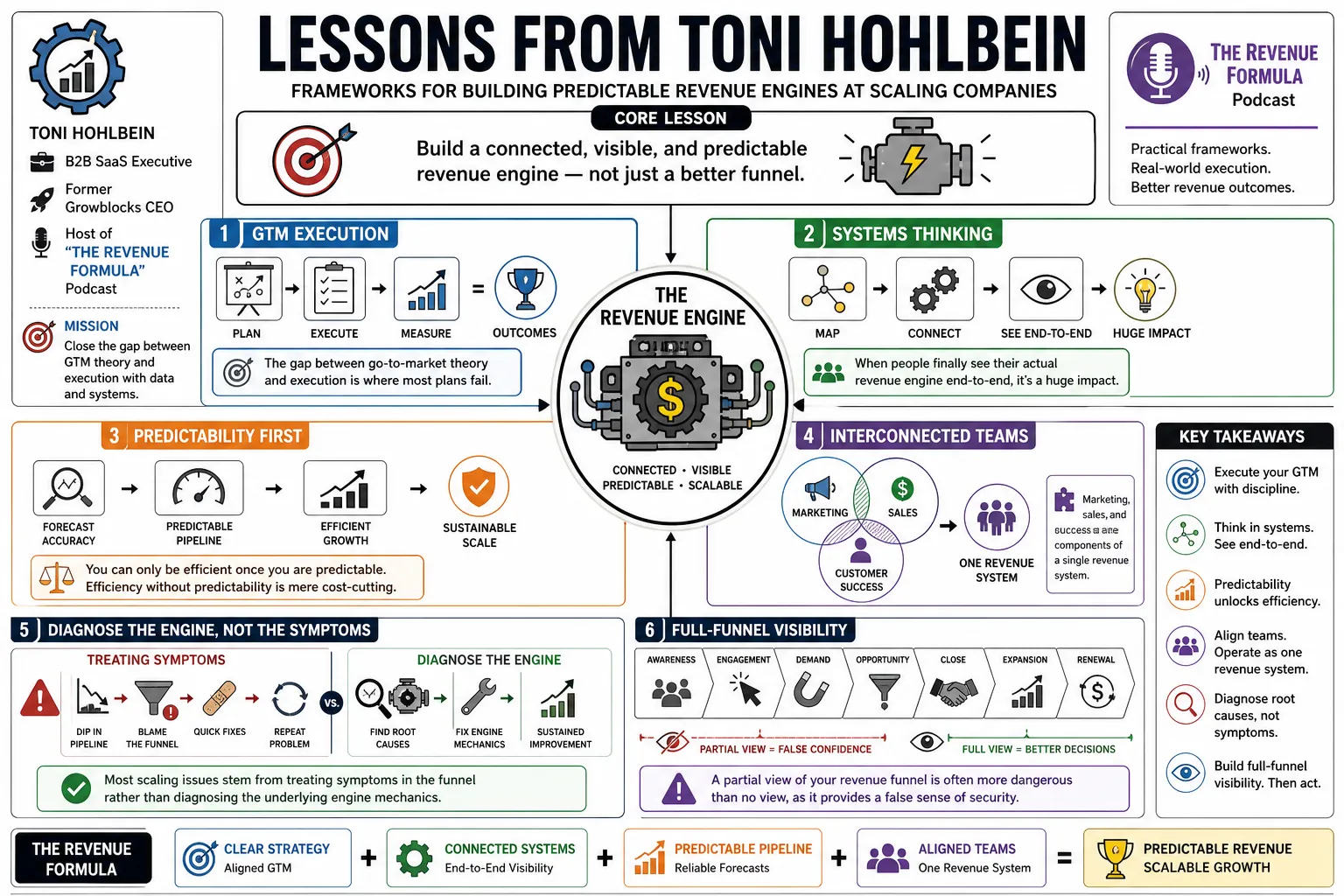
Toni Hohlbein is a B2B SaaS executive, former Growblocks CEO, and host of "The Revenue Formula" podcast. His work in Revenue Operations relies on data analysis to close the gap between high-level go-to-market theory and actual execution. This profile collects his frameworks for building predictable revenue engines at scaling companies.
Part 1: The Revenue Engine
- On GTM Execution: "The gap between go-to-market theory and execution is where most revenue plans fall apart." — Source: [The Revenue Letter]
- On Systems Thinking: "When people finally see their actual revenue engine end-to-end for the first time, it's a huge impact." — Source: [RevOps FM]
- On Predictability: "You can only be efficient once you are predictable. Efficiency without predictability is mere cost-cutting." — Source: [The Revenue Formula]
- On Interconnected Teams: "Marketing, sales, and customer success are components of a single revenue system." — Source: [The Revenue Formula]
- On the Core Problem: "Most scaling issues stem from treating symptoms in the funnel rather than diagnosing the underlying engine mechanics." — Source: [Growblocks Content]
- On Full-Funnel Visibility: "A partial view of your revenue funnel is often more dangerous than no view, as it provides a false sense of security." — Source: [The Revenue Letter]
- On Tooling Overload: "We don't need more tools in the revenue stack; we need better synthesis of the data those existing tools collect." — Source: [The Revenue Formula]
- On Growth Mechanics: "Sustainable growth is mathematical before it is creative. You have to understand the equation." — Source: [Growblocks Content]
- On Cross-Functional Reality: "The revenue engine breaks precisely at the handoffs between marketing, sales, and success." — Source: [The Revenue Letter]
- On Early-Stage Mistakes: "Founders often delay building a systematic revenue engine because they rely too long on founder-led sales." — Source: [The Revenue Formula]
Part 2: Predictability Over Heroics
- On Sales Culture: "A sustainable revenue engine should not rely on salespeople who can routinely pull rabbits from hats." — Source: [RevOps FM]
- On End-of-Quarter Stress: "If your quarter is consistently saved in the final two weeks, you have a predictability problem, not a hero problem." — Source: [The Revenue Formula]
- On Process Dependence: "Build systems that average performers can use to succeed, rather than systems that only top performers can survive." — Source: [The Revenue Letter]
- On Unpredictable Success: "A lucky quarter is worse than a bad quarter if you don't understand the mechanics of why you won." — Source: [The Revenue Formula]
- On Forecasting Maturity: "Mature organizations forecast the process alongside the individual deals. Immature organizations forecast hope." — Source: [Growblocks Content]
- On Scaling Quotas: "You cannot scale a business by simply giving your best reps higher quotas; the system must scale independently of the individual." — Source: [The Revenue Letter]
- On Managing Variability: "The goal of RevOps is to reduce the standard deviation in your sales team's performance." — Source: [The Revenue Formula]
- On Burnout: "Hero-based sales cultures inevitably lead to burnout and high turnover. Predictability is a retention strategy." — Source: [The Revenue Letter]
- On Institutional Knowledge: "When your success relies on a few heroes, your revenue engine walks out the door when they leave." — Source: [Growblocks Content]
Part 3: Metrics and Measurement
- On Data Rigor: "We need rigor in analyzing historical data to understand pipeline sources rather than relying on massaged spreadsheets." — Source: [RevOps FM]
- On Vanity Metrics: "Tracking activity without tracking the conversion of that activity into revenue is a waste of dashboard space." — Source: [The Revenue Formula]
- On Leading Indicators: "Most boards look at lagging indicators. Operations teams must live and breathe leading indicators." — Source: [The Revenue Letter]
- On Conversion Rates: "A drop in top-of-funnel volume can be masked by a temporary spike in conversion rates. Always look at both." — Source: [Growblocks Content]
- On Pipeline Coverage: "Standard 3x or 4x pipeline coverage rules are arbitrary; your coverage ratio should be derived from your specific historical win rates." — Source: [The Revenue Formula]
- On Metric Definition: "Before you argue about the numbers, ensure everyone in the room has the exact same definition of what a qualified lead actually is." — Source: [The Revenue Letter]
- On Time Metrics: "Sales cycle length is often the most ignored mechanism for increasing revenue efficiency." — Source: [Growblocks Content]
- On Blended CAC: "Looking at blended customer acquisition costs hides the inefficiencies of your worst channels and penalizes your best." — Source: [The Revenue Formula]
- On Data Quality: "Bad data leads to confident bad decisions. Always audit the CRM inputs before trusting the outputs." — Source: [The Revenue Letter]
- On Dashboard Fatigue: "If a metric doesn't trigger a specific business decision, it shouldn't be on your primary dashboard." — Source: [The Revenue Formula]
Part 4: Alignment in Go-To-Market
- On Integrated Planning: "Marketing and sales planning must be viewed as a single, integrated system." — Source: [The Revenue Formula]
- On Silos: "When marketing is measured on leads and sales is measured on revenue, misalignment is guaranteed." — Source: [The Revenue Letter]
- On Shared Goals: "True GTM alignment means marketing feels the pain of a missed sales quarter just as acutely as the sales team." — Source: [Growblocks Content]
- On Handoffs: "The quality of the handoff from marketing to the development rep, and then to the account executive, dictates the health of your pipeline." — Source: [The Revenue Formula]
- On Feedback Loops: "Sales must provide qualitative feedback to marketing on why deals are lost, rather than simply updating a dropdown in Salesforce." — Source: [The Revenue Letter]
- On Target Audiences: "Alignment starts with an uncompromising agreement between all departments on exactly who the ideal customer profile is." — Source: [Growblocks Content]
- On Budget Allocation: "Alignment is tested when you have to shift budget from a performing sales team to a struggling marketing channel to fix the top of the funnel." — Source: [The Revenue Formula]
- On Meeting Cadence: "Weekly revenue meetings should be joint problem-solving sessions between sales and marketing leaders." — Source: [The Revenue Letter]
- On Terminology: "A unified motion requires a unified dictionary. A lead must mean the same thing to every executive." — Source: [The Revenue Formula]
Part 5: Pipeline Generation and Management
- On Pipeline Architecture: "Pipeline generation is not a phase of the quarter; it is a continuous, daily operational requirement." — Source: [The Revenue Letter]
- On Pipeline Hygiene: "A bloated pipeline is worse than a thin pipeline because a bloated pipeline lies to you about your future." — Source: [Growblocks Content]
- On Source Attribution: "Stop fighting over whether marketing or sales sourced a deal. Focus on the combined touchpoints that pushed it forward." — Source: [The Revenue Formula]
- On Outbound vs Inbound: "Inbound pipeline gives you efficiency, but outbound pipeline gives you control." — Source: [Breaking B2B Podcast]
- On Aging Opportunities: "Deals that sit in the same stage for longer than your average sales cycle have a win rate approaching zero. Flush them." — Source: [The Revenue Letter]
- On Next Steps: "An opportunity without a scheduled next step on the calendar is not a pipeline opportunity; it is a hope." — Source: [The Revenue Formula]
- On Funnel Leakage: "Before spending more on top-of-funnel acquisition, plug the leaks in your middle-of-funnel conversion stages." — Source: [Growblocks Content]
- On Training Roles: "The development rep function is the most important bridge in your pipeline architecture, yet often the most neglected in terms of training." — Source: [The Revenue Letter]
- On Pipeline Reviews: "Pipeline reviews should look forward at what needs to happen to win, avoiding backward glances at why things stalled." — Source: [The Revenue Formula]
- On the Time Window: "The pipeline you build today is the revenue you close next quarter. You cannot fix today's revenue problem today." — Source: [The Revenue Letter]
Part 6: RevOps as a Strategic Function
- On the RevOps Mandate: "RevOps must be closely tied to the revenue-generating process to be effective, distinguishing it from traditional financial planning." — Source: [RevOps FM]
- On Strategic Value: "If your RevOps team functions solely to build Salesforce reports and provision software seats, you are wasting a strategic asset." — Source: [The Revenue Formula]
- On Truth Telling: "The primary job of RevOps is to be the objective truth-teller in the room when sales and marketing present conflicting narratives." — Source: [The Revenue Letter]
- On Operations as a Product: "Treat your internal revenue process as a product, and your sales and marketing teams as the users." — Source: [Growblocks Content]
- On the CRO Relationship: "RevOps is the co-pilot to the chief revenue officer. The CRO sets the destination, RevOps builds the navigation system." — Source: [The Revenue Formula]
- On Process Design: "Good RevOps designs processes that naturally force good data hygiene, rather than nagging reps to update fields." — Source: [The Revenue Letter]
- On System Architecture: "Your CRM architecture will eventually dictate your organizational chart. Design it carefully." — Source: [Growblocks Content]
- On Talent Profiles: "The best RevOps professionals think like engineers, communicate like salespeople, and analyze like financiers." — Source: [The Revenue Formula]
- On Proactive Problem Solving: "A mature RevOps function identifies pipeline gaps before the sales managers even know they exist." — Source: [The Revenue Letter]
Part 7: Financial Planning vs. Execution
- On Top-Down Models: "Top-down financial targets are useless if they aren't met with a bottom-up execution plan that proves the math is possible." — Source: [The Revenue Formula]
- On FP&A vs RevOps: "Finance manages the spreadsheet of what needs to happen; RevOps manages the reality of how it actually happens on the floor." — Source: [RevOps FM]
- On Target Setting: "Assigning a revenue target without reverse-engineering the exact funnel math required to hit it is managerial negligence." — Source: [The Revenue Letter]
- On Budgeting Reality: "You can't arbitrarily cut the marketing budget by a fifth and expect sales to hit the exact same targets three months later." — Source: [Growblocks Content]
- On the Board Meeting: "Board slides often tell a simplified story that obscures the complex realities of the actual operating engine." — Source: [The Revenue Formula]
- On Scenario Planning: "Revenue leaders must plan for downside scenarios operationally alongside their financial modeling." — Source: [The Revenue Letter]
- On Compensation: "Compensation plans are the most direct mechanism a company has to align financial goals with field execution behavior." — Source: [Growblocks Content]
- On Growth Constraints: "Understanding whether your growth is constrained by budget, headcount, or total addressable market changes your entire operating plan." — Source: [The Revenue Formula]
- On Mid-Year Pivots: "The ability to re-allocate resources dynamically mid-quarter is the hallmark of a resilient revenue system." — Source: [The Revenue Letter]
Part 8: Adapting to Modern B2B SaaS
- On the SaaS Downturn: "The days of growing at all costs with cheap capital are gone; we are back to the era of sustainable, efficient growth." — Source: [The Revenue Formula]
- On AI in Teams: "AI will rarely replace teams, but teams that adopt AI for data synthesis will outpace those that refuse." — Source: [Breaking B2B Podcast]
- On Buyer Behavior: "B2B buyers are completing more of the evaluation journey before ever speaking to a rep; your motion must adapt to this reality." — Source: [The Revenue Letter]
- On Product-Led Growth: "Product-led growth is an efficient top-of-funnel acquisition channel for a sales engine." — Source: [Growblocks Content]
- On Customer Retention: "In modern software, net revenue retention is a more powerful growth mechanism than net new acquisition." — Source: [The Revenue Formula]
- On Tech Stack Consolidation: "The current trend is moving away from a disjointed stack of point solutions toward unified data models." — Source: [RevOps FM]
- On Market Maturation: "As a software category matures, win rates inherently drop. Your model must account for increased competitive friction." — Source: [The Revenue Letter]
- On Agile Operations: "Annual planning is too slow for modern companies. Revenue operations must adopt a quarterly or even monthly agile planning rhythm." — Source: [Growblocks Content]
- On the Founder's Role: "Founders must transition from being the best salesperson to being the chief architect of the revenue system." — Source: [The Revenue Formula]