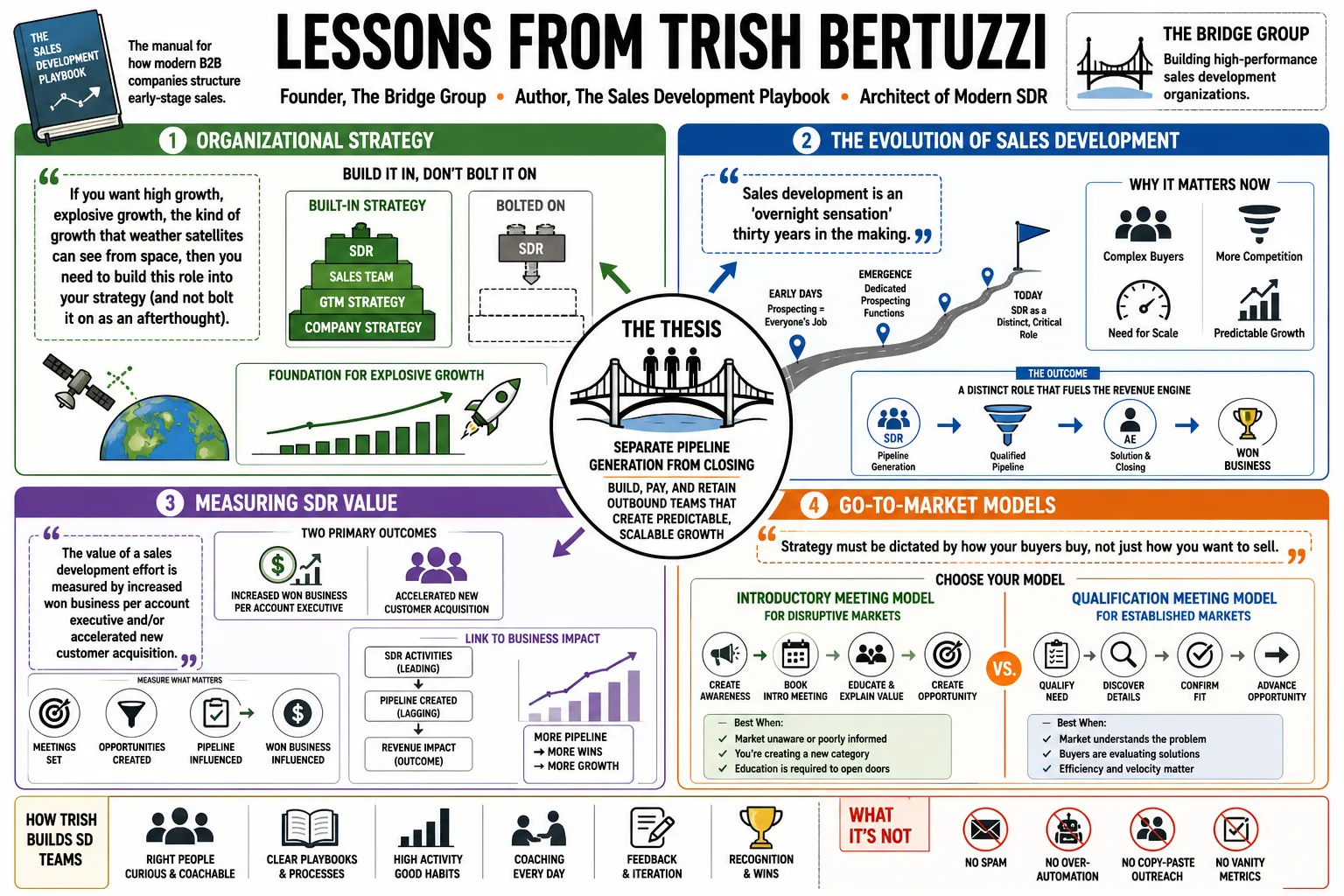
Lessons from Trish Bertuzzi
Trish Bertuzzi founded The Bridge Group and wrote The Sales Development Playbook, the manual for how modern B2B companies structure early-stage sales. She turned the Sales Development Representative (SDR) into a distinct role by separating pipeline generation from closing. This profile covers her approach to building, paying, and retaining outbound sales teams that don't rely on spam or over-automation.
Part 1: The Core Philosophy of Sales Development
- On Organizational Strategy: "If you want high growth, explosive growth, the kind of growth that weather satellites can see from space, then you need to build this role into your strategy (and not bolt it on as an afterthought)." — Source: [The Bridge Group]
- On the Evolution of the Role: "Sales development is an 'overnight sensation' thirty years in the making." — Source: [The Bridge Group]
- On Measuring SDR Value: "The value of a sales development effort is measured by increased won business per account executive and/or accelerated new customer acquisition." — Source: [Goodreads]
- On Go-to-Market Models: "Strategy must be dictated by how your buyers buy, not just how you want to sell. Choose an Introductory Meeting model for disruptive markets and a Qualified Opportunity model for mature ones." — Source: [Shortform]
- On Meaningful Execution: "Vision without execution is hallucination." — Source: [QuoteFancy]
- On Arousing Curiosity: "The goal of outreach isn't to sell the product, but to sell the meeting." — Source: [YouTube]
- On the Death of BANT: "Putting budget first is like asking for W2 forms on the first date! In terms of qualification for introductory meetings, you can’t get much beyond right profile, right person, and right high-level pain." — Source: [Women in Action]
- On Authentic Selling: "In our rush to revenue... I think sometimes we forget to step back and say, ‘Am I adding value here, or am I executing a process as a check-the-box strategy?’" — Source: [QuoteFancy]
- On Asking the Right Questions: "People get hung up on the wrong questions around sales development: templates, tools, and tricks. You need to ask and answer the right questions." — Source: [The Bridge Group]
- On Driving Momentum: "An organization that isn't in motion is much harder to move than one that has already realized the consequences of inaction." — Source: [Goodreads]
Part 2: Hiring and Building the Team
- On the Hiring Hierarchy: "Hire and promote first on the basis of integrity; second, motivation; third, capacity; fourth, understanding; fifth, knowledge; and last and least, experience." — Source: [Goodreads]
- On the Danger of Raw Motivation: "Without integrity, motivation is dangerous; without motivation, capacity is impotent; without capacity, understanding is limited; without understanding, knowledge is meaningless; without knowledge, experience is blind." — Source: [Goodreads]
- On Hiring Top Talent: "If you always hire people who are smaller than you are, we shall become a company of dwarfs. If, on the other hand, you always hire people who are bigger than you are, we shall become a company of giants." — Source: [Goodreads]
- On Remote Evaluation: "When it comes to hiring SDRs, phone interviews are as (if not more) important than in-person." — Source: [Goodreads]
- On Interview Preparation: "In my experience, candidates who don't prepare for this conversation [the interview] won't prepare for future conversations with prospects." — Source: [Goodreads]
- On Teaching Experience: "Experience is easy to provide and quickly put to good use by people with all the other qualities like Integrity, Motivation, and Capacity." — Source: [Goodreads]
- On the Real Currency of Employment: "For early-career professionals, adding skills to their resume is a primary motivator. A learning culture is the new currency." — Source: [Quora]
- On Candidate Research: "A candidate who hasn't researched the hiring manager or the company prior to the interview is an immediate 'no'." — Source: [Shortform]
- On Internal Upward Mobility: "The moral of the story: promote only those you would hire. Put your SDRs through the same hiring and evaluation process you would for external candidates." — Source: [QuoteFancy]
- On Setting Up for Failure: "No one benefits—not you, your company, sales leadership, or the SDRs themselves—when a promotion sets reps up to fail." — Source: [Goodreads]
Part 3: The Micro-Promotion and Retention Playbook
- On the SDR Productivity Window: "The average SDR tenure is 12–18 months. With a 3–4 month ramp time, you only get 8–14 months of peak productivity." — Source: [InsideSales]
- On Combating Burnout: "To combat burnout, use 'micro-promotions' with small pay bumps and new responsibilities to keep reps engaged without moving them to AE roles prematurely." — Source: [Cascade Insights]
- On Promotion Cadence: "Micro-promotions should ideally occur on a 5- to 9-month cadence, ensuring reps constantly feel a sense of forward momentum." — Source: [Cascade Insights]
- On Tiered Responsibility: "Instead of a single SDR role, create a tiered system where an SDR 1 focuses on prospecting, and an SDR 2 begins participating in discovery calls." — Source: [Cascade Insights]
- On the AE Transition: "The jump from prospecting to closing is too large for most reps to make in one leap. Micro-promotions serve as a bridge to develop discovery and deal management skills." — Source: [Medium]
- On Career Visibility: "By sharing the progression path during the recruiting process, candidates see a clear, documented future with the company from day one." — Source: [Cascade Insights]
- On the Productivity Gap: "If you subtract a ramp time from a short tenure, the productivity gap means companies lose money on SDRs who leave before they truly perform." — Source: [StudyLib]
- On Rewarding Skill Over Tenure: "Micro-promotions reward specific skill acquisition, preventing the entitlement trap where SDRs expect to be promoted simply because they've put in their time." — Source: [Quora]
- On Off-Ramping: "The micro-promotion path also allows SDRs to 'off-ramp' into other essential sales functions like customer success or marketing if closing isn't their true calling." — Source: [Medium]
Part 4: Coaching and Management
- On the Role of the Manager: "Coaching is not a component within the sales manager role; managing is now a component of the new coaching role." — Source: [SalesMEDDIC]
- On the Buttons Managers Push: "Bad sales managers push two buttons: 'more' and 'panic.' Great sales managers have one more button to push: the 'how'." — Source: [Skynamo]
- On Managing the Status Quo: "If you don't have a defined process that moves your people forward, so they can achieve greater results, then what is it you are managing? You're managing the status quo." — Source: [Skynamo]
- On Coaching Prioritization: "Coaching—everyone knows how critical it is and it falls to the bottom of the list every time." — Source: [YouTube]
- On the Cost of Training: "The CFO asks the CEO, 'What happens if we invest in developing our people and they leave us?' The CEO responds, 'What happens if we don't, and they stay?'" — Source: [QuoteFancy]
- On Cultivating Grit: "Great SDRs, great AEs, and great leaders have grit. Cultivating grit requires embracing tension, encountering pushback, and experiencing confrontation." — Source: [The Bridge Group]
- On the Rush to Demo: "Leaders must prevent SDRs from pushing for a demo too early before establishing value or fit." — Source: [Shortform]
- On Knowing Your Reps: "Management knows all about the individual's sales quota... but they know hardly anything about what this person hopes to accomplish in life. This is essential information." — Source: [Kylas]
- On Defining Process over Effort: "Treating sales development as a disciplined, repeatable system is far superior to relying on a series of heroic individual efforts." — Source: [Shortform]
Part 5: Navigating Inbound vs. Outbound
- On the Allbound Approach: "It’s not either/or, it’s ‘and.’ Merge the best of inbound and outbound for superior results in an Allbound model." — Source: [Sidekick Strategies]
- On the Value of Inbound: "An inbound opportunity is roughly twice as valuable as one generated through outbound effort." — Source: [Goodreads]
- On the Limitation of Inbound: "The challenge with inbound—and it’s a big one—is that there are exponentially more small companies than big ones. You cannot rely on inbound alone for enterprise scale." — Source: [Goodreads]
- On the True Definition of Outbound: "Outbound is about making sure we’re all targeting our perfect ideal customer profile, that our story is in alignment, and that our marketing message backs it up." — Source: [CoSchedule]
- On Dead Tactics: "It is the cold that is dead – not the calling. I agree that no one should be ‘cold’ calling anymore – meaning having a name and number, but lacking a compelling reason to call." — Source: [Salesloft]
- On Buyer Fatigue: "Getting to engagement is now the hardest part of the sales process... because our buyers are done with us. We’re inundating them." — Source: [CoSchedule]
- On Specialization: "Mixing inbound and outbound roles often leads to momentum killers as reps naturally gravitate toward the easier inbound leads." — Source: [Shortform]
- On Inbound Lead Volume: "One inbound SDR can typically handle about two hundred to three hundred leads a month when fully ramped." — Source: [Goodreads]
- On Prepared Responsiveness: "The race doesn’t go to the swift. It goes to the responsive. But I define responsiveness as a prepared response. You want to be fast, but only if you’re prepared." — Source: [Women in Action]
Part 6: Account-Based Revenue (ABR)
- On the Evolution of ABM: "Account-Based Revenue is an all-encompassing organizational strategy, whereas Account-Based Marketing often stays siloed within the marketing department." — Source: [Sales Pop]
- On Orchestration: "The Account Executive must act as the quarterback or maestro, orchestrating the efforts of SDRs, marketing, and executives to penetrate target accounts." — Source: [Sales Pop]
- On Choosing ABR: "ABR is not for everyone. It is most effective for companies selling high-ticket items to enterprise-level organizations where a decision committee is involved." — Source: [Sales Pop]
- On Modern Whale Hunting: "While the names have changed from 'whale hunting' to 'target account sales' to 'ABR', the core goal remains the same: winning and growing the opportunities that matter most." — Source: [The Bridge Group]
- On Shared Philosophy: "Account-Based should be a company-wide philosophy rather than just a departmental tactic used to generate top-of-funnel activity." — Source: [Sales Pop]
- On Aligning the Narrative: "For an account-based strategy to work, all of our content must be part of the overall story being delivered across every touchpoint." — Source: [CoSchedule]
- On Building Repeatable Pipeline: "Building a repeatable pipeline within named accounts requires moving past 'spray and pray' into deeply researched, customized outreach." — Source: [Brad Harker]
- On the Hard Work of Account Selection: "The very first step is determining if your revenue goals and target market actually justify the intense, hard work required by an account-based approach." — Source: [Sales Pop]
- On SDR Integration in ABR: "Sales development reps are the tactical tip of the spear in an ABR motion, translating marketing intelligence into actual human conversations." — Source: [The Bridge Group]
Part 7: Technology and the Human Element
- On the Ultimate Truth in Sales: "People still buy from people at the end of the day. And one of the things you can’t automate is Excellence." — Source: [YouTube]
- On the Dangers of Over-Automation: "We are starting to over-automate the sales process. We're starting to take the people out of the process, and I think in doing that we're shooting ourselves in the foot." — Source: [The Bridge Group]
- On Tech as a Barrier: "I love technology, but at some point, when you start putting up this barrier between you and your buyer, you lose the engagement." — Source: [Women in Action]
- On Categorizing Software: "Sales technology should be evaluated into three categories: True Accelerators, Burdens, and Toys." — Source: [Shortform]
- On Evaluating Tech Stack Needs: "True Accelerators markedly improve efficiency. Burdens consume time without adding value. Toys are trendy but useless for productivity." — Source: [Shortform]
- On Multi-Channel Outreach: "Effective execution requires a multi-channel cadence. You must use a calibrated mix of phone, email, and social touches." — Source: [YouTube]
- On Spamming Prospects: "We’re spamming them with email. We’re leaving robo-voicemails. We have to return to authentic outreach to break through the noise." — Source: [CoSchedule]
- On Scale vs. Personalization: "Move away from 'spray and pray.' Use research to identify specific pain points so the prospect feels understood at scale." — Source: [YouTube]
- On the Right Questions to Ask: "Is technology putting a barrier between you and your prospects? If the answer is yes, you are optimizing for your own comfort, not your buyer's experience." — Source: [The Bridge Group]
- On Reclaiming the Human Touch: "The future of sales development isn't fully automated bot outreach; it's using AI and tools to handle the administrative burden so humans can have better human conversations." — Source: [The Bridge Group]
Part 8: Leadership, Quotas, and Compensation
- On Compensation Simplicity: "Net new reps who clearly understand their comp plans are three times more likely to be Promoters than those who don't. Getting comp right and making it easy to understand are crucially important." — Source: [Kylas]
- On Prioritizing Compensation Plans: "If you only have time to stick the landing on one thing, it's always better to nail comp, because you only have to design a good comp plan once." — Source: [Kylas]
- On the Coin-Operated Myth: "Many Executives will describe salespeople as 'coin-operated'. That's what the spiff model is all about: establish a goal, run a spiff, comp the winner, shame the losers. It's an outdated model." — Source: [Kylas]
- On the Next Quarter Pillar: "Your reps should never have to guess. They should be able to ask, 'What will I earn next quarter?' and find that you've made the compensation plan clear and direct." — Source: [Kylas]
- On Metric Quality: "Don't just track activity like dials and emails; track meaningful metrics like actual conversations and conversions." — Source: [Shortform]
- On Digging for Pain: "You need to dig for the implications of not acting. Their biggest issue is fear that the cure will hurt worse than the illness." — Source: [SalesMEDDIC]
- On Aligning Quota with Capacity: "Setting quotas must be grounded in the mathematical reality of lead velocity, ramp times, and the proven conversion rates of your specific market." — Source: [Goodreads]
- On Managing the Rollercoaster: "Role clarity and specialization prevent the 'rollercoaster' of inconsistent revenue, where AEs stop prospecting to close deals, leading to empty pipelines the following quarter." — Source: [Shortform]
- On the Launch Pad: "Telemarketing has evolved into Sales Development. No longer the red-headed stepchild, it's now the launch pad for outstanding companies and amazing careers." — Source: [The Bridge Group]