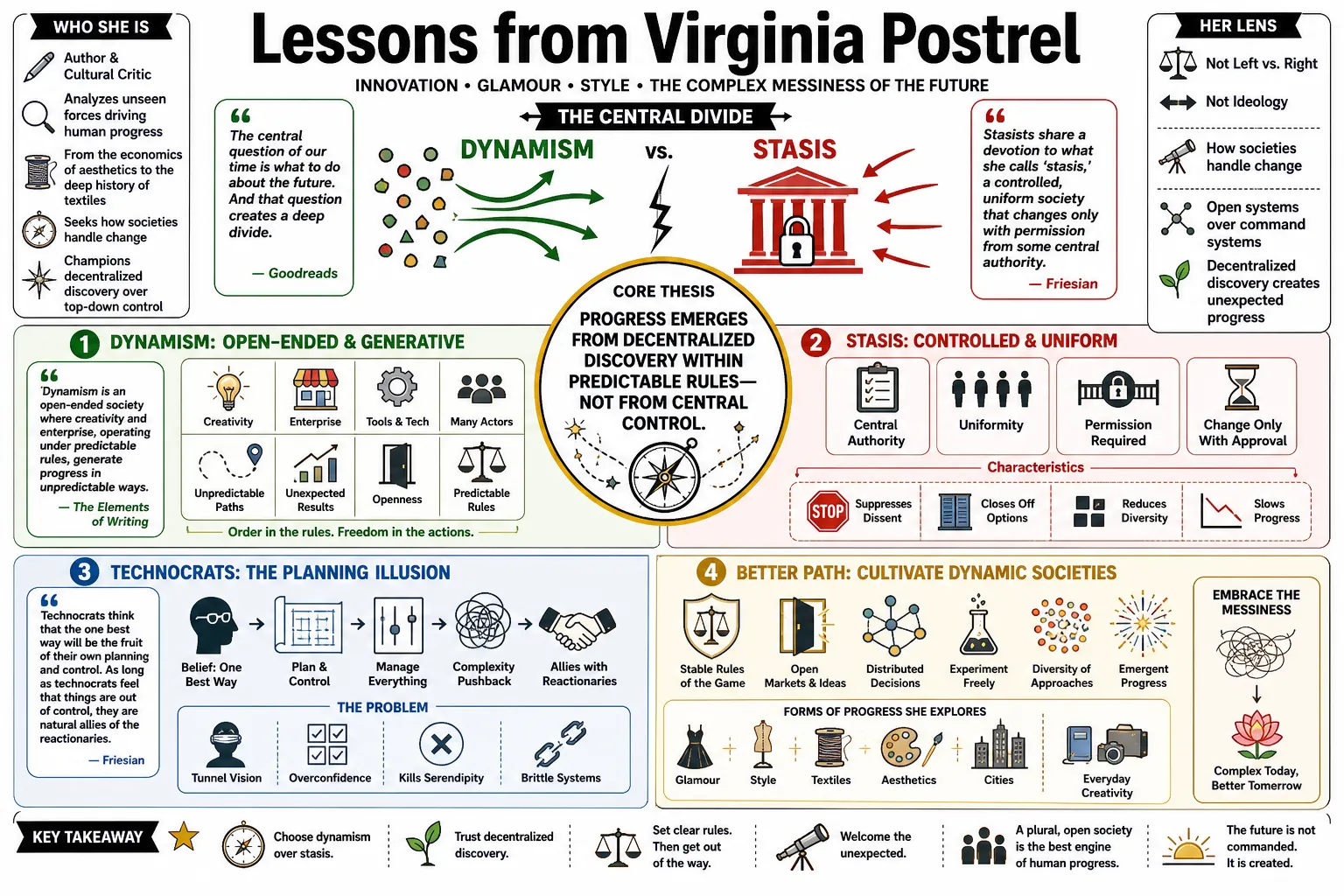
Virginia Postrel is an author and cultural critic who analyzes the unseen forces driving human progress, from the economics of aesthetics to the deep history of textiles. Her work replaces conventional political divides with a framework of how societies handle change, championing decentralized discovery over top-down control. This profile distills her core arguments on innovation, glamour, style, and the complex messiness of the future.
Part 1: Dynamism vs. Stasis
- On The Central Divide: "The central question of our time is what to do about the future. And that question creates a deep divide." — Goodreads
- On Dynamism: "Dynamism is an open-ended society where creativity and enterprise, operating under predictable rules, generate progress in unpredictable ways." — The Elements of Writing
- On Stasis: "Stasists share a devotion to what she calls 'stasis,' a controlled, uniform society that changes only with permission from some central authority." — Friesian
- On Technocrats: "Technocrats think that the one best way will be the fruit of their own planning and control. As long as technocrats feel that things are out of control, they are natural allies of the reactionaries." — Friesian
- On Reactionaries: "Reactionaries tend to think that 'the one best way' is already known from the present or the past, valuing stability above all else." — Friesian
- On The Tree of Knowledge: "To dynamists, knowledge is like a spreading elm tree in full leaf... For stasists, by contrast, the tree is a royal palm... one long, spindly trunk topped with a few fronds." — Virginia Postrel's Website
- On Spontaneous Order: "The future we face is emergent, complex messiness. Its messiness lies not in disorder, but in an order that is unpredictable, spontaneous, and ever shifting." — Goodreads
- On The Party of Life: "Dynamism represents the party of life, the party that favors free growth and spontaneous evolution." — FEE
- On Rulemaking: "Stasists want their detailed rules to apply to everyone; dynamists prefer competing, next rule sets." — The Daily Economy
- On The Enemies of the Future: "The true enemies of humanity's future are those who insist on prescribing outcomes in advance, circumventing the process of competition and experiment." — FEE
Part 2: The Illusion and Power of Glamour
- On Defining Glamour: "Glamour is a form of nonverbal rhetoric, which moves and persuades not through words but through images, concepts, and totems." — PCMA
- On Subjective Experience: "Glamour is not something you possess but something you perceive, not something you have but something you feel." — Virginia Postrel's Website
- On Translucence: "Glamour is translucent—not transparent, not opaque. It invites us into the world but it doesn’t give us a completely clear picture." — AZ Quotes
- On Grace: "You have to hide the things that would pull people out of the moment, so you have to hide costs, distractions, flaws, difficulties. Glamour appears effortless." — Manassa Loi
- On Mystery: "Mystery both enhances the grace by hiding things and it enhances projection because it’s intriguing... You have to leave room for the audience’s imagination." — PCMA
- On Projection: "Glamour creates that pleasurable pang of desire—the feeling of 'if only': If only I could wear those clothes, belong to that group... be that person." — Virginia Postrel's Website
- On Glamour vs. Charisma: "A place, an idea, even an object can be glamorous, but only a person can be charismatic. Charisma demands a shared vision; glamour invites personal projection." — Manassa Loi
- On Hope and Hardship: "By tendering the promise of escape and transformation, glamour feeds on both hope and hardship." — Substrate Wars
- On Dissatisfaction: "Glamour fuels dissatisfaction with the here and now, even as it makes present difficulties easier to endure by suggesting the existence of better alternatives." — Substrate Wars
- On Timelessness: "Glamour provides a lucid glimpse of desire fulfilled. It captures moments, not stories. It seems timeless." — Manassa Loi
Part 3: The Economic Substance of Style
- On The Aesthetic Imperative: "Aesthetics has become too important to be left to the aesthetes." — Boxes and Arrows
- On The Shift in Design: "'Form follows emotion' has supplanted 'form follows function' in the modern consumer economy." — Boxes and Arrows
- On Pervasive Beauty: "We live in an age of aesthetics, wherein the way things look, feel, and smell have come to matter—not just among the upper-middle classes but among all consumers." — Ghost.io
- On Function as a Baseline: "Give us a way to be smart and pretty, and we'll take it. When most products work well, aesthetics become the primary way we distinguish ourselves." — Goodreads
- On Cognitive Benefits: "Attractive things work better. Positive affect produced by aesthetics improves creative thinking and problem-solving." — Boxes and Arrows
- On Superficiality: "Aesthetics are not 'superficial': they have substance, bring us pleasure, and assist us in crafting public personas." — Ghost.io
- On True Design: "Design is not style. It's not about giving shape to the shell and not giving a damn about the guts. Good design produces something the world didn't know it was missing." — Goodreads
- On The Style Police: "Your ugly house bothers your neighbors; your ugly sofa does not. As design democratizes, it becomes a source of public conflict." — Boxes and Arrows
- On Human Desire: "There is something fundamentally human about wanting nice things and nice surroundings." — ResearchGate
Part 4: Textile History as Human History
- On Textile Amnesia: "To reverse Arthur C. Clarke’s famous adage about magic, any sufficiently familiar technology is indistinguishable from nature." — Goodreads
- On Invisible Technologies: "The most profound technologies are those that disappear. They weave themselves into the fabric of everyday life until they are indistinguishable from it." — Nebraska.gov
- On The Labor of Spinning: "Producing enough yarn to make cloth was so time-consuming that most preindustrial women spent their lives spinning." — Human Progress
- On The Preindustrial Bottleneck: "Without this constant labor of spinning thread, there could be no cloth, making thread production the fundamental bottleneck of civilization." — Bookey
- On Weaving and the Mind: "Spinning trains the hands, but weaving challenges the mind." — Goodreads
- On Binary Logic: "Weaving is the original binary system, at least twenty-four thousand years old, long predating modern computing." — Bookey
- On The Etymology of Making: "Fabric and fabricate share a common Latin root: fabrica, something skillfully made." — Goodreads
- On Cultural Authenticity: "The cultural authenticity of cloth arises not from the purity of its origins but from the ways in which individuals and groups turn textiles to their own purposes." — Bookey
- On Assigning Value: "Consumers, not producers, determine the meaning and value of textiles as they are traded across borders." — Goodreads
- On Thread and Civilization: "Making thread plentiful changed the world, enabling the division of labor that leads to variety and abundance." — Bookey
Part 5: The Mechanics of Progress
- On Trial and Error: "Progress through trial and error depends not only on making trials, but on recognizing errors." — AZ Quotes
- On Agency: "Innovation often comes from individuals saying, 'I'm dissatisfied with this,' and taking the agency to fix it. If you assume it's someone else's job to solve your problem, you give up your agency." — QuoteFancy
- On Technological Ecosystems: "Technological takeovers are rarely instant. They require a whole ecosystem of changes—new plant breeds, new field layouts, new skills—to succeed." — Substack
- On Rejecting The One Best Way: "The old modernist ideal was indeed too sterile for most tastes. Real people don't want to live in generic high-rise apartments and walk their dogs on treadmills." — DDNS
- On Evolved Solutions: "Dynamists trust in evolved solutions to complex problems, relying on feedback rather than foresight." — Quebecois Libre
- On The Messiness of Progress: "The pattern of progress is created by millions of uncoordinated, independent decisions rather than a central blueprint." — Goodreads
- On Continuous Discovery: "The pursuit of happiness must be trusted to go in many different, and many unexpected, directions." — Virginia Postrel's Website
- On Spontaneous Evolution: "An open-ended future relies on spontaneous evolution, where small adjustments compile into massive leaps." — FEE
- On Recognizing Failure: "A society that cannot acknowledge its errors is a society that cannot evolve; failure is the necessary cost of discovery." — AZ Quotes
Part 6: Knowledge, Control, and Freedom
- On Dispersed Knowledge: "Power must be dispersed because knowledge is dispersed. The most important dispersal of knowledge is the knowledge of what each of us wants." — Friesian
- On Centralized Planning: "Everything that is important to know cannot be easily grasped by those at the top; centralized knowledge is a dangerous illusion." — Virginia Postrel's Website
- On Individual Choice: "In a dynamic, decentralized system of individual choice and responsibility, people do not have to trust any authority but their own." — AZ Quotes
- On The Limit of Human Felicity: "The debate between dynamism and stasis is a struggle between those who believe they already know the limit of human felicity, and those who trust in unscripted exploration." — Virginia Postrel's Website
- On Limiting Rules: "Dynamists want to limit universal rulemaking to broadly applicable and rarely changed principles, within which people can create and test countless combinations." — The Daily Economy
- On Cultural Danger: "It is a conflict between those who believe culture is too dangerous to be left alone and those who believe it is too precious to be controlled." — Virginia Postrel's Website
- On The Plenitude of Life: "Like the present, the future is not a single, uniform state but an ongoing process that reflects the plenitude of human life." — DDNS
- On Dispersing Power: "When power is centralized, the cost of a single error is catastrophic. When power is dispersed, errors are localized and easily corrected." — Reason Magazine
- On Trusting Authority: "The modern era requires us to build systems where individuals can navigate complexity without relying on omniscient central authorities." — AZ Quotes
Part 7: The Aesthetics of Identity
- On Aesthetic Identity: "That sense of aesthetic identity prevails when 'I like that' merges into 'I'm like that.'" — Boxes and Arrows
- On Sensory Communication: "Aesthetics is the way we communicate through the senses." — Boxes and Arrows
- On Signaling Values: "The substance of style consists of its ability to signal identity and to remind ourselves and the world of what we think is important." — Boxes and Arrows
- On Form and Content: "Form has its own power and worth, but it does not inevitably trump content." — Boxes and Arrows
- On The Desire for Nice Things: "Aesthetics are not a luxury; they are a fundamental part of the human experience that brings meaning to everyday objects." — Ghost.io
- On Crafting the Self: "We use the look and feel of our surroundings as tools to construct our internal narratives and external personas." — Ghost.io
- On The Italian Solution: "The best response to the style police is what we might call the Italian solution—to look the other way from the stuff we don't like." — Boxes and Arrows
- On Emotion and Design: "Because humans are emotional creatures, a design that ignores how a user feels is functionally incomplete." — Goodreads
- On The Value of the Superficial: "What critics dismiss as superficial is often the very mechanism through which human beings find joy and articulate their individuality." — ResearchGate
Part 8: Culture, Curiosity, and the Future
- On Curiosity: "At the simplest level, only people who know they do not know everything will be curious enough to find things out." — Goodreads
- On The Future as a Process: "The future is alive. Outside Disneyland's walls, too, the future is an ongoing process." — DDNS
- On Microfutures: "There is in fact no single future; 'the' future encompasses the many microfutures of individuals and their associations." — DDNS
- On Optimism: "An embrace of dynamism is fundamentally an optimistic stance—a belief that humans can solve problems faster than they create them." — Virginia Postrel's Website
- On Embracing the Evolving World: "How we feel about the evolving future tells us who we are as individuals and as a civilization." — Goodreads
- On The Search for Happiness: "Progress is not about reaching a static utopia, but about preserving the freedom to continually search for better ways to live." — Virginia Postrel's Website
- On Acknowledging Ignorance: "The foundation of all discovery is the humility to admit that our current knowledge is incomplete." — Goodreads
- On The Danger of Nostalgia: "Yearning for a simpler past often blinds us to the immense technological and social achievements that define the present." — Friesian
- On The Unknown: "A dynamic society does not fear the unknown; it views the unpredictable future as a landscape of unmined potential." — The Elements of Writing