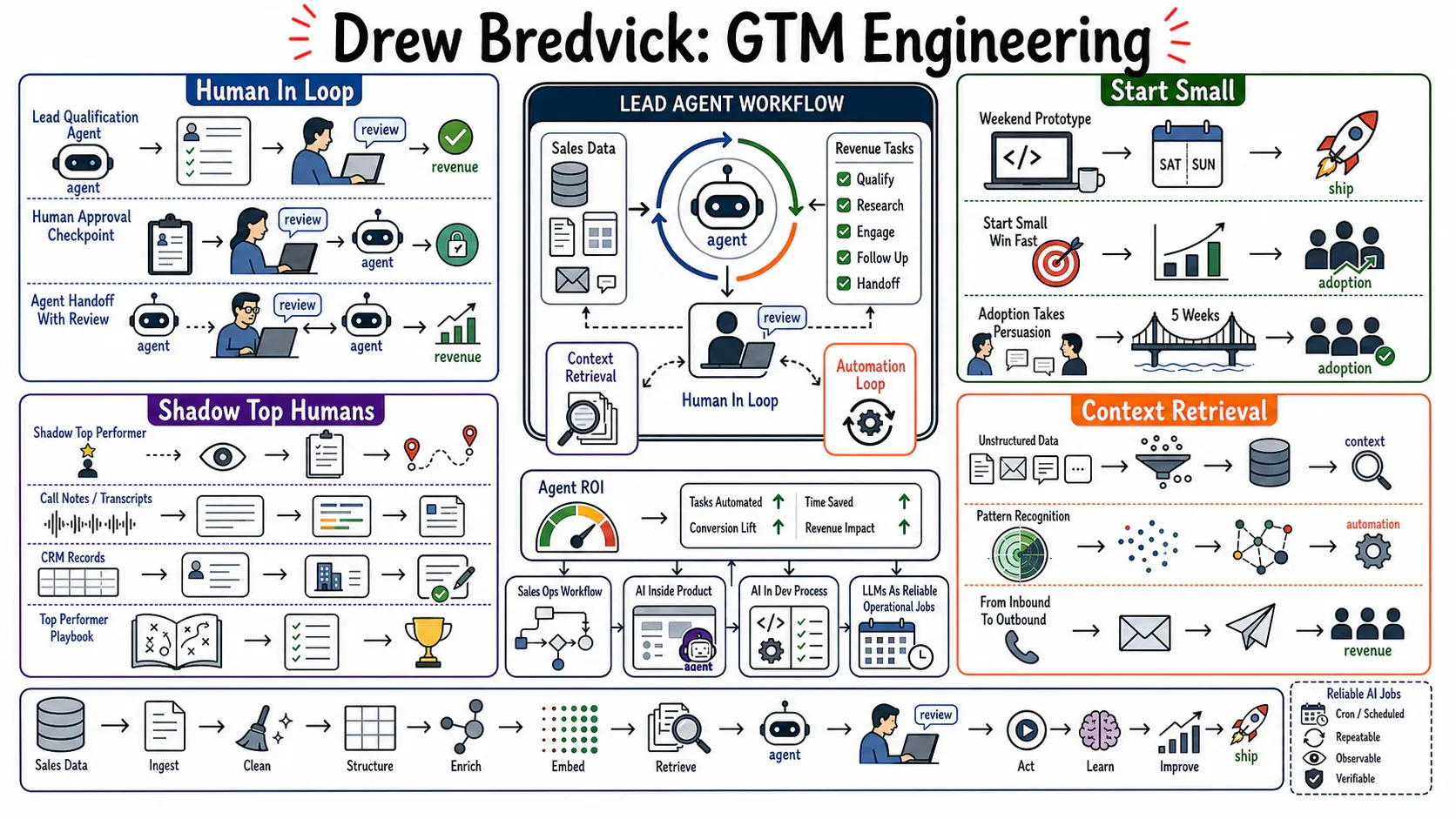
Drew Bredvick is a software engineer and the Director of GTM Engineering at Vercel, where he builds internal AI agents to automate and scale sales operations. He is known for popularizing the concept of GTM engineering, documenting his "Bootstrap 1000" challenge to build profitable side projects, and sharing practical frameworks for shipping code consistently. This profile collects his advice on applied AI, developer productivity, and the intersection of engineering and revenue.
## Part 1: On Building Agentic Systems
- On Human-in-the-Loop AI: "If you're building an efficiency agent, keep humans in the loop. It is built for human-in-the-loop... should agents should fire by default." — Source: [drew.tech]
- On Getting Started: "Lead agents started small... it was just an idea I had in a shower that I sat down and coded over a weekend." — Source: [Alex Lieberman Interview]
- On AI Adoption Timelines: "The actual engineering took a week. Then I spent five weeks convincing people it was actually good." — Source: [a16z Growth Engineer Fellow Interview]
- On Shadowing the Killers: "The best AI agents are built by shadowing top-performing humans to identify the high-impact tasks that actually drive revenue." — Source: [drew.tech]
- On the Two Waves of AI: "There are two waves: AI inside the product, and AI inside the development process. You need to master both." — Source: [drew.tech]
- On Agent ROI: "A weekend prototype generated over $2 million in incremental revenue by automating lead qualification." — Source: [Vercel GTM Talk]
- On Scaling Sales Teams: "By deploying a lead agent, we shifted from 20 inbound SDRs down to 2, allowing human talent to focus on higher-leverage outbound work." — Source: [Vercel Case Study]
- On Context Retrieval: "The real power of a GTM agent is hooking it into your existing data—like Gong transcripts and Salesforce records—so it has more context than any new hire." — Source: [turbopuffer blog]
- On Workflow Automation: "GTM engineering isn't just writing scripts; it's pattern recognition turned into automation." — Source: [drew.tech]
- On Using LLMs as Cron Jobs: "Running Claude Code as a cron job is a simple way to reliably turn unstructured data streams into structured insight." — Source: [drew.tech]
## Part 2: On Go-To-Market (GTM) Engineering
- On a New Discipline: "The field of GTM Engineering is so new that effort beats pedigree." — Source: [drew.tech]
- On Defining GTM Engineering: "It sits right at the intersection of software engineering, sales, and marketing—where you use code to solve revenue bottlenecks." — Source: [drew.tech]
- On The Developer Gap: "Most GTM teams don't have developers, which means they solve data problems with manual labor instead of software." — Source: [Gauntlet AI Talk]
- On Building Excellence Agents: "Our goal in GTM engineering is building excellence agents that close the gap between your top performers and the rest of the organization." — Source: [drew.tech]
- On the Lead Routing Bottleneck: "Automating the flow of form submission to Slack approval is the highest leverage engineering you can do for a sales team." — Source: [drew.tech]
- On Career Rocket Ships: "GTM engineering provides a rocket ship opportunity for career growth because you directly impact revenue." — Source: [a16z.news]
- On Picking Problems: "If you want your internal tools to succeed, find the problem the business already cares the most about." — Source: [drew.tech]
- On Working With Sales: "Engineers should learn how sales works. The crossover of skills is incredibly rare and valuable." — Source: [drew.tech]
- On Using Modern Stacks: "Applying modern web frameworks like Next.js and tools like turbopuffer to internal sales processes is an unfair advantage." — Source: [drew.tech]
## Part 3: On The Intersection of Engineering and Sales
- On Selling to Developers: "The best type of selling is educating, and that holds true with developers." — Source: [drew.tech]
- On Demos vs. Memos: "Ship demos, not memos. Prioritize functional prototypes over theoretical documents." — Source: [drew.tech]
- On Empathy for the User: "When an engineer learns how to talk to customers by joining a GTM team, they write entirely different code." — Source: [Twitter/X]
- On The SDR Persona: "I spent time acting as a Sales Development Rep just to understand exactly what was broken in the pipeline." — Source: [Vercel GTM Talk]
- On Value over Tech: "Customers don't buy your stack. They buy the solution to their headache. Engineers often forget this." — Source: [Cashed.dev Podcast]
- On Validating Early: "Don't fear the boats burning. Reaching out to customers before the product is perfect is the only way to know if you are building the right thing." — Source: [What's Stopping You?]
- On Asking for Money: "You have to get comfortable with the psychological hurdle of asking people to pay for what you built." — Source: [What's Stopping You?]
- On Sales Integrity: "Sales isn't sleazy when you are genuinely just trying to match your software to someone's acute problem." — Source: [drew.tech]
- On Building for the Buyer: "Write code that specifically removes friction for the person signing the check." — Source: [drew.tech]
## Part 4: On Bootstrapping and Indie Hacking
- On the Bootstrap 1000 Challenge: "My goal is to replicate my full-time salary through bootstrapped products using 1,000 days of effort." — Source: [drew.tech]
- On the Long Game: "Building a profitable business is a long-term game with no overnight success." — Source: [drew.tech]
- On The Stair-Step Method: "Start with small, simple products to build your skills and cash flow before moving on to complex SaaS." — Source: [Indie Hackers]
- On Prioritizing Excitement: "When bootstrapping on nights and weekends, you have to prioritize excitement to avoid burnout." — Source: [drew.tech]
- On Early Projects: "Projects like Share-a-podcast taught me how to ship and market, even if they made less than $1,000." — Source: [drew.tech]
- On Repetitions: "The goal of early side projects is reps. You want reps on building, launching, and ideally selling them, no matter the size." — Source: [Cashed.dev Podcast]
- On Funding vs. Bootstrapping: "Bootstrapping forces you to focus entirely on whether the customer finds value, not whether the VC finds value." — Source: [Cashed.dev Podcast]
- On Dedicated Focus: "I took a week-long vacation just to build and launch an MVP in public. Dedicated focus wins." — Source: [Indie Hackers]
- On Launching Vitals.guide: "Building Core Web Vitals tools taught me how to handle real data streams, which was more valuable than the initial MRR." — Source: [drew.tech]
- On Building in Public: "Documenting your journey publicly keeps you accountable and builds your initial audience." — Source: [Indie Hackers]
## Part 5: On Habits and the Systems Over Goals Philosophy
- On Systems vs. Goals: "With goals, you're unhappy every day until you reach that goal. With systems, each time I apply my system, it's a win." — Source: [drew.tech]
- On the Two-Day Rule: "Never miss two days in a row. It prioritizes consistency over perfection." — Source: [Bootstrap 1000 Talk]
- On Bouncing Back: "If life gets in the way and you miss one day of working on your project, the rule mandates that you must show up the next day." — Source: [drew.tech]
- On Lowering Activation Energy: "Make habits so small they are too easy to fail. Don't aim for an intense routine, just aim to show up." — Source: [drew.tech]
- On Daily Coding: "When I sit down to code, my goal is to push one commit. That’s it." — Source: [drew.tech]
- On Compound Interest: "The compounding effect of continuously improving your daily inputs is staggering over a thousand days." — Source: [drew.tech]
- On Forgiving Systems: "You need a habit system that accounts for human imperfection. A single slip-up shouldn't be a permanent stop." — Source: [drew.tech]
- On Showing Up: "The magic is in the reps. It’s not about the quality of the single day, it’s about stringing the days together." — Source: [Cashed.dev Podcast]
- On Sustainable Growth: "Burnout happens when your goals outpace your systems. Fix the system." — Source: [drew.tech]
## Part 6: On Learning in Public and Career Growth
- On Increasing Clarity: "I blog to increase the clarity of my thoughts and to show my work." — Source: [drew.tech]
- On Consistency in Writing: "Pick a tech stack and platform that will help you write consistently. The trick is getting posts out there and staying in the game." — Source: [drew.tech]
- On Joining Rocket Ships: "There's a rocket ship, just get on, don't ask questions. Joining Vercel early was about getting on the ship." — Source: [a16z Growth Engineer Fellow Interview]
- On Sharing Knowledge: "Writing down what you learn transforms individual knowledge into organizational leverage." — Source: [drew.tech]
- On the Power of Archiving: "Keep an archive of your side projects. They serve as a public portfolio of your progression as an engineer." — Source: [drew.tech]
- On Imposter Syndrome: "Everyone feels it. The way through is just to publish the post, push the code, and realize the sky doesn't fall." — Source: [Indie Hackers]
- On Open Source Contributions: "Publishing OSS templates, like the Lead Agent, forces you to clean up your code and helps the entire community elevate." — Source: [Vercel Blog]
- On Networking: "Your blog is your ultimate networking tool. It acts as a magnet for people interested in the same obscure things as you." — Source: [Cashed.dev Podcast]
- On Building a Personal Brand: "A personal brand isn't about marketing fluff; it's just the exhaust of doing good work publicly over a long period." — Source: [drew.tech]
## Part 7: On Shipping, Prototyping, and Fast Feedback
- On Bias to Action: "A weekend prototype is worth more than a month of planning meetings." — Source: [YouTube Interview]
- On Fast Iteration: "The faster you can get a functional prototype in front of the sales team, the faster you know if it's garbage or gold." — Source: [drew.tech]
- On Scoping MVPs: "Cut the scope until it hurts, then cut it a little more. You need to ship this weekend." — Source: [Indie Hackers]
- On Tooling for Speed: "Use tools like v0 and the Vercel AI SDK not because they are trendy, but because they drastically reduce time to first value." — Source: [drew.tech]
- On Feedback Loops: "The tighter the feedback loop between the engineer and the end user, the better the product." — Source: [drew.tech]
- On the Craft of Shipping: "Shipping is a distinct skill from coding. You have to practice crossing the finish line." — Source: [drew.tech]
- On Perfectionism: "Perfect code that never ships has a revenue impact of exactly zero." — Source: [Cashed.dev Podcast]
- On Getting to Revenue: "Don't build infrastructure before you have a customer willing to pay for the output." — Source: [What's Stopping You?]
- On Validating with Constraints: "Forcing a 1,000-day constraint makes you evaluate whether a project is actually viable or just a fun technical distraction." — Source: [drew.tech]
- On Killing Projects: "Be ruthless about shutting down side projects that drain energy and don't provide value. Move on to the next stair-step." — Source: [Cashed.dev Podcast]
## Part 8: On Observing Real User Behavior
- On Stated Preference: "Stated preference gives you the dream. It's what people say they want when you ask them." — Source: [drew.tech]
- On Revealed Preference: "Revealed preference shows you what to ship. It's what you learn by watching their actual behavior." — Source: [drew.tech]
- On Shadowing Users: "Shadowing reveals what actually matters. Don't ask a salesperson how they work; watch them do it." — Source: [drew.tech]
- On Building the Right Agent: "If you build an AI agent based on stated preference, it will sit unused. Build it based on revealed preference, and it becomes indispensable." — Source: [Gauntlet AI Talk]
- On Analytics: "User behavior data is the ultimate source of truth. Everything else is just a guess." — Source: [drew.tech]
- On Friction Logs: "Keep friction logs of where users get stuck. Those are the exact spots where an AI workflow can provide the most leverage." — Source: [drew.tech]
- On the Reality of Workflows: "People think their workflow is highly complex, but when you shadow them, it's often just copying and pasting between three tabs." — Source: [Cashed.dev Podcast]
- On Empathy via Observation: "You develop real empathy for your internal users not by taking their tickets, but by sitting next to them while they do their jobs." — Source: [drew.tech]
- On Iterating on Reality: "Launch the dumbest version of the automation first, watch how they break it, and then build the real system." — Source: [drew.tech]