Mishti Sharma is a product marketer and writer who brought editorial storytelling to B2B software and popularized "Go-To-Market Engineering" as an early employee at Clay. Drawing on her background in philosophy and cultural journalism, she applies the same writer's sensibility to scaling a data platform as she does to exploring the immigrant experience in her newsletter, maildrop by mishti.
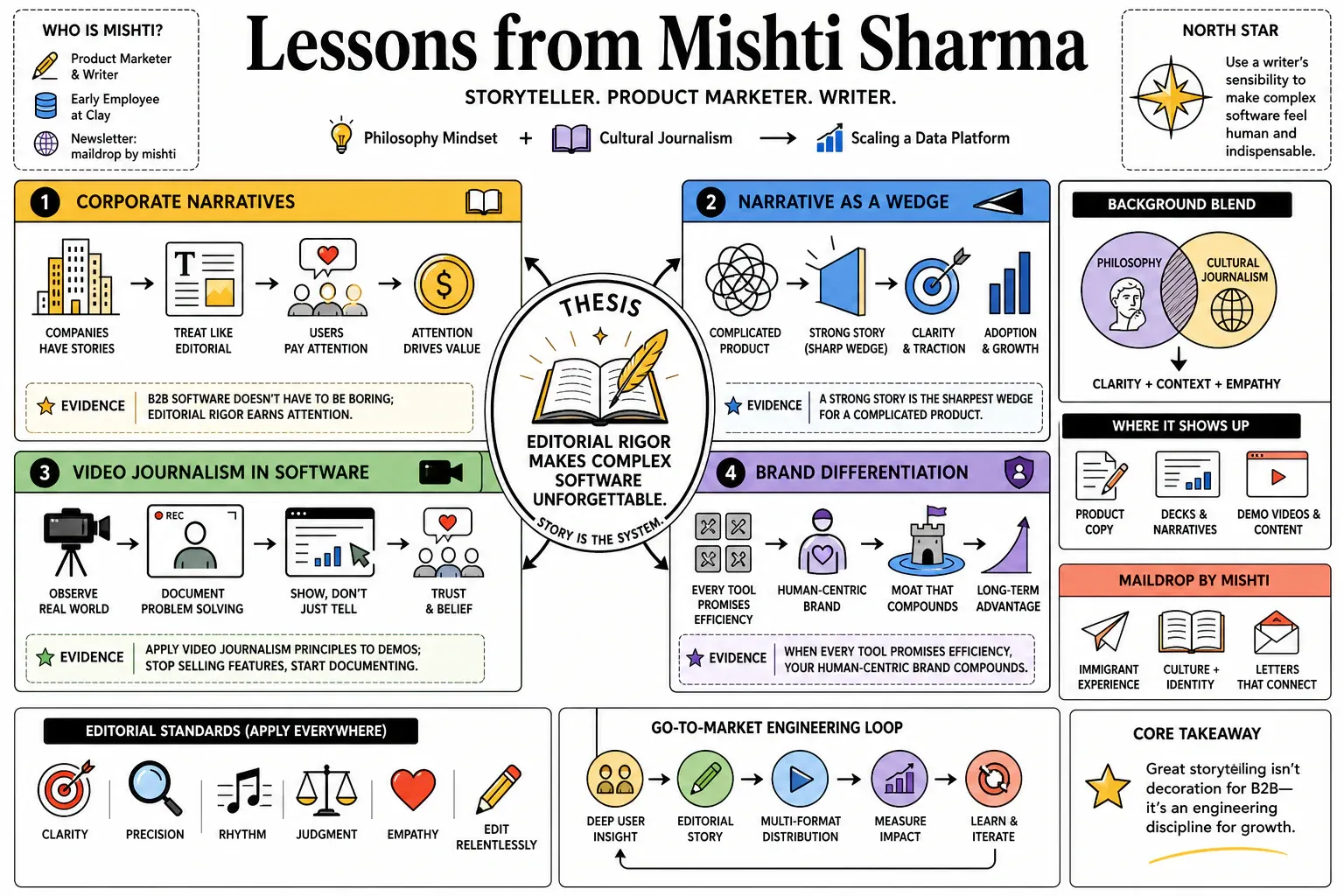
Part 1: The Art of B2B Storytelling
- On Corporate Narratives: "B2B software doesn't have to be boring; if you treat data platforms with the same editorial rigor as a magazine, users will actually pay attention." — Source: [First Round Review]
- On Narrative as a Wedge: "A strong story is the sharpest wedge for a complicated product." — Source: [Clay Blog]
- On Video Journalism in Software: "By applying the principles of video journalism to software demos, you stop selling features and start documenting real-world problem solving." — Source: [First Round Review]
- On Brand Differentiation: "When every tool promises efficiency, your distinct human-centric brand is the only moat that compounds over time." — Source: [MKT1 Newsletter]
- On Editorial Standards: "Hold your product copy to the standard of a literary essay. Precision and rhythm matter just as much in software as they do in print." — Source: [First Round Review]
- On Humanizing Data: "Our goal was never just to process rows and columns, but to give go-to-market teams a narrative framework for who they are reaching out to and why." — Source: [Clay Blog]
- On Removing Jargon: "The fastest way to lose trust is to speak in corporate acronyms. Speak to operators like they are intelligent peers." — Source: [First Round Review]
- On Content Durability: "We wanted to build content that someone would want to read even if they never bought our software." — Source: [Clay Blog]
- On Storytelling Mechanics: "Good storytelling in tech isn't about grand visions; it's about making the daily, unglamorous workflows feel urgent and solvable." — Source: [First Round Review]
Part 2: Go-To-Market Engineering
- On the GTM Engineer: "Go-to-market is no longer just sales and marketing; it is a development environment where technical operators build and iterate on workflows." — Source: [The GTM Engineer]
- On Technical Marketing: "The best marketers today are technical enough to pull their own data and build their own automations without waiting on engineering." — Source: [First Round Review]
- On Blurring Lines: "We are seeing the rapid collapse of boundaries between sales ops, marketing ops, and growth engineering." — Source: [The GTM Engineer]
- On Treating Campaigns like Code: "If you treat your outreach campaigns like a codebase, you can debug, fork, and scale them with predictable results." — Source: [Clay Blog]
- On Tooling as Leverage: "A GTM Engineer with the right data platform can do the work of a ten-person outbound team from five years ago." — Source: [MKT1 Newsletter]
- On Systematic Growth: "Growth is not a series of clever hacks; it is the rigorous application of data to business logic." — Source: [The GTM Engineer]
- On the Automation Mindset: "Before you hire another SDR, ask if you have properly engineered the data pipeline to give them a fighting chance." — Source: [Clay Blog]
- On Iterative Outreach: "You should be A/B testing your data sources just as rigorously as you test your subject lines." — Source: [First Round Review]
- On Ops as Strategy: "Operations is no longer a back-office function. When done right, it is the spearhead of the company's strategy." — Source: [The GTM Engineer]
- On Skill Convergence: "The most valuable person in the room is often the one who understands both the customer's emotional pain point and the API needed to solve it." — Source: [MKT1 Newsletter]
Part 3: Ecosystem & Community-Led Growth
- On Enabling Creators: "Your product grows fastest when you make external creators and agencies the heroes of the story." — Source: [First Round Review]
- On Word-of-Mouth: "You cannot manufacture word-of-mouth through ads; you have to build a product that makes people look smart when they share it." — Source: [Clay Blog]
- On LinkedIn Evangelism: "When users start posting their own workflows to LinkedIn, you have crossed the threshold from a tool to a movement." — Source: [MKT1 Newsletter]
- On Agency Partnerships: "Agencies are not just channel partners; they are the most rigorous stress-testers of your platform." — Source: [First Round Review]
- On Building in Public: "Sharing our internal templates and playbooks openly created more goodwill than any paid campaign could have." — Source: [Clay Blog]
- On Customer Success: "The best community management is just exceptionally fast, transparent, and helpful customer support." — Source: [MKT1 Newsletter]
- On Ecosystem Economics: "When other businesses are built entirely on top of your platform, your retention problem solves itself." — Source: [First Round Review]
- On User Feedback: "A noisy community is a blessing. It means they care enough to complain about what's broken." — Source: [Clay Blog]
- On Empowering Champions: "Give your power users the exact assets they need to pitch your tool to their own executive teams." — Source: [MKT1 Newsletter]
- On Authentic Growth: "Community-led growth fails the moment it feels like a top-down corporate mandate rather than a peer-to-peer exchange." — Source: [First Round Review]
Part 4: Leaning Into Your Spikes
- On Career Playbooks: "Do not try to force yourself into a traditional playbook if your background is non-traditional. Build a role around your unique spikes." — Source: [First Round Review]
- On the Reluctant Marketer: "I was a reluctant marketing hire because I viewed myself as a writer, but I learned that the best marketing is simply clear, empathetic writing." — Source: [First Round Review]
- On Generalists vs. Specialists: "Startups don't need perfect generalists early on; they need people with extreme superpowers in one or two areas who can figure the rest out." — Source: [MKT1 Newsletter]
- On Transferable Skills: "The editorial judgment required to shape a documentary film is the exact same judgment needed to shape a product launch." — Source: [First Round Review]
- On Imposter Syndrome: "When you switch from cognitive science to tech marketing, you realize everyone is making it up as they go. Your distinct perspective is an asset, not a deficit." — Source: [Clay Blog]
- On Defining Your Value: "Don't ask what the standard job description is; ask what the company urgently needs that you are uniquely equipped to provide." — Source: [First Round Review]
- On Scaling with a Company: "To grow from the first ten employees to a massive valuation, you have to continually fire yourself from your old jobs and invent new ones." — Source: [Clay Blog]
- On Hiring: "When interviewing, look for candidates who light up when talking about their specific craft, regardless of whether it perfectly matches the title." — Source: [First Round Review]
- On Creative Confidence: "It takes courage to say, 'I don't know how the standard B2B playbook works, but here is how a storyteller would solve this problem.'" — Source: [MKT1 Newsletter]
Part 5: Product Marketing & The "Reverse Demo"
- On the Reverse Demo: "We stopped showing people what our software did and started asking them to share their screen and build their dream workflow in front of us." — Source: [First Round Review]
- On Uncovering Pain Points: "The most valuable insights don't come from structured surveys; they come from watching a user struggle with a spreadsheet for five minutes." — Source: [Clay Blog]
- On Positioning: "Positioning is not what you say your product does; it is the exact words your best customers use when explaining it to their peers." — Source: [First Round Review]
- On Product-Led Education: "If your product is complex, your marketing must serve as a free, highly pragmatic university for your users." — Source: [MKT1 Newsletter]
- On Demo Calls: "A demo should never be a monologue. It is a collaborative whiteboard session." — Source: [First Round Review]
- On Messaging Cadence: "You have to repeat your core message so many times you get sick of it, because that is the exact moment the market is finally hearing it." — Source: [Clay Blog]
- On Feature Launches: "Nobody cares that you shipped a new integration. They care about what tedious task they never have to do again because of it." — Source: [First Round Review]
- On Building Trust: "Show the product's limitations openly. Users trust you more when you admit what the tool cannot do." — Source: [MKT1 Newsletter]
- On GTM Alignment: "Product marketing is the translation layer between the code that was written and the reality the sales team faces." — Source: [Clay Blog]
Part 6: Cultural Collision & Diaspora
- On Immigrant Memory: "The diaspora experience is often an exercise in holding two contradictory places in your mind and trying to make them feel like one home." — Source: [maildrop by mishti]
- On Allahabad to New York: "The transition from the deeply rooted traditions of India to the anonymity of the American suburbs forces you to become an acute observer of cultural norms." — Source: [Mishti Sharma Online]
- On Code-Switching: "We all perform different versions of ourselves depending on the room we are in; for immigrants, this performance is a matter of survival." — Source: [maildrop by mishti]
- On Nostalgia: "Nostalgia in diaspora communities is rarely about a physical place; it is a longing for the people and the texture of a time that no longer exists." — Source: [maildrop by mishti]
- On Culinary Memory: "Food is the most durable artifact of a culture. It survives migration long after language and customs begin to fade." — Source: [maildrop by mishti]
- On the Idea of Home: "Home is not a coordinate on a map. It is the specific frequency at which you are understood without having to explain yourself." — Source: [Mishti Sharma Online]
- On Intergenerational Translation: "Children of immigrants spend their lives translating not just language, but emotional contexts, between their parents and the world." — Source: [maildrop by mishti]
- On Cultural Juxtaposition: "There is immense beauty in the friction of living between cultures; it keeps you awake to the strangeness of everyday life." — Source: [maildrop by mishti]
- On Belonging: "You stop waiting to be granted permission to belong when you realize you can construct your own community from scratch." — Source: [maildrop by mishti]
- On Global Citizenship: "To understand a global diaspora is to understand that identity is porous, constantly rewriting itself." — Source: [Mishti Sharma Online]
Part 7: Philosophy & The Texture of Daily Life
- On Cognitive Science: "Studying how the brain constructs reality forces you to realize how fragile our shared assumptions about the world actually are." — Source: [Princeton Reflections]
- On the Value of Philosophy: "Philosophy is not an abstract academic exercise; it is the most rigorous framework for diagnosing why people behave the way they do." — Source: [Mishti Sharma Online]
- On Turning Thirty: "Milestones are arbitrary markers, but they are useful forcing functions for us to reconcile the person we thought we would be with the person we have become." — Source: [maildrop by mishti]
- On Attention: "What you pay attention to becomes your life. In an era of infinite distraction, directed attention is the ultimate moral act." — Source: [maildrop by mishti]
- On Education Systems: "My time working on the National Education Policy in India taught me that systemic change requires balancing idealism with the stubborn realities of local implementation." — Source: [Fulbright Fellowship Field Notes]
- On Modern Loneliness: "We have engineered friction out of our daily lives, and in doing so, we accidentally engineered out the random encounters that cure loneliness." — Source: [maildrop by mishti]
- On Meaning-Making: "Humans are narrative engines. We will stitch together completely unrelated events if it gives our lives a sense of plot." — Source: [maildrop by mishti]
- On Curiosity: "The highest form of respect you can offer someone is genuine, unhurried curiosity about their worldview." — Source: [Mishti Sharma Online]
- On Uncertainty: "A philosophy background trains you to sit comfortably in the unresolved. It is a necessary skill for both writing and building startups." — Source: [maildrop by mishti]
Part 8: Creative Nonfiction & Human Portraits
- On Interviewing: "The best interviews happen after the formal questions end and you just let the silence hang until they fill it with the truth." — Source: [Mishti Sharma Online]
- On Documenting Lives: "Projects like 'The Doorman's Door' taught me that the most profound stories are usually hiding behind the most invisible jobs." — Source: [maildrop by mishti]
- On The Detail: "A portrait essay succeeds or fails on the specificity of its details. A scratched watch tells you more about a person than a three-page biography." — Source: [maildrop by mishti]
- On Empathy in Writing: "You have to love your subjects enough to observe them honestly, flaws and all." — Source: [Mishti Sharma Online]
- On the Creative Process: "Writing is rarely a flash of inspiration; it is usually the grueling work of trying to make a messy thought legible." — Source: [maildrop by mishti]
- On Small Businesses: "Ethnic small businesses in New York are not just stores; they are living embassies for people who have lost their home country." — Source: [maildrop by mishti]
- On Finding the Angle: "If a story feels flat, you haven't looked at it from close enough. Proximity forces empathy." — Source: [Mishti Sharma Online]
- On Writing for Yourself: "The paradox of a newsletter is that the more intensely personal and hyper-specific you make it, the more universally it resonates." — Source: [maildrop by mishti]
- On the Power of Archives: "We must write things down not just to be read today, but to leave a reliable archive for the people we will eventually become." — Source: [maildrop by mishti]