The physical and psychological realities of athletic dedication
Across 39 sports & athletics profiles and 2,120 lessons, 7 patterns recur often enough to matter. They are not universal rules; recurrence indicates breadth within this collection, not agreement across an entire field.
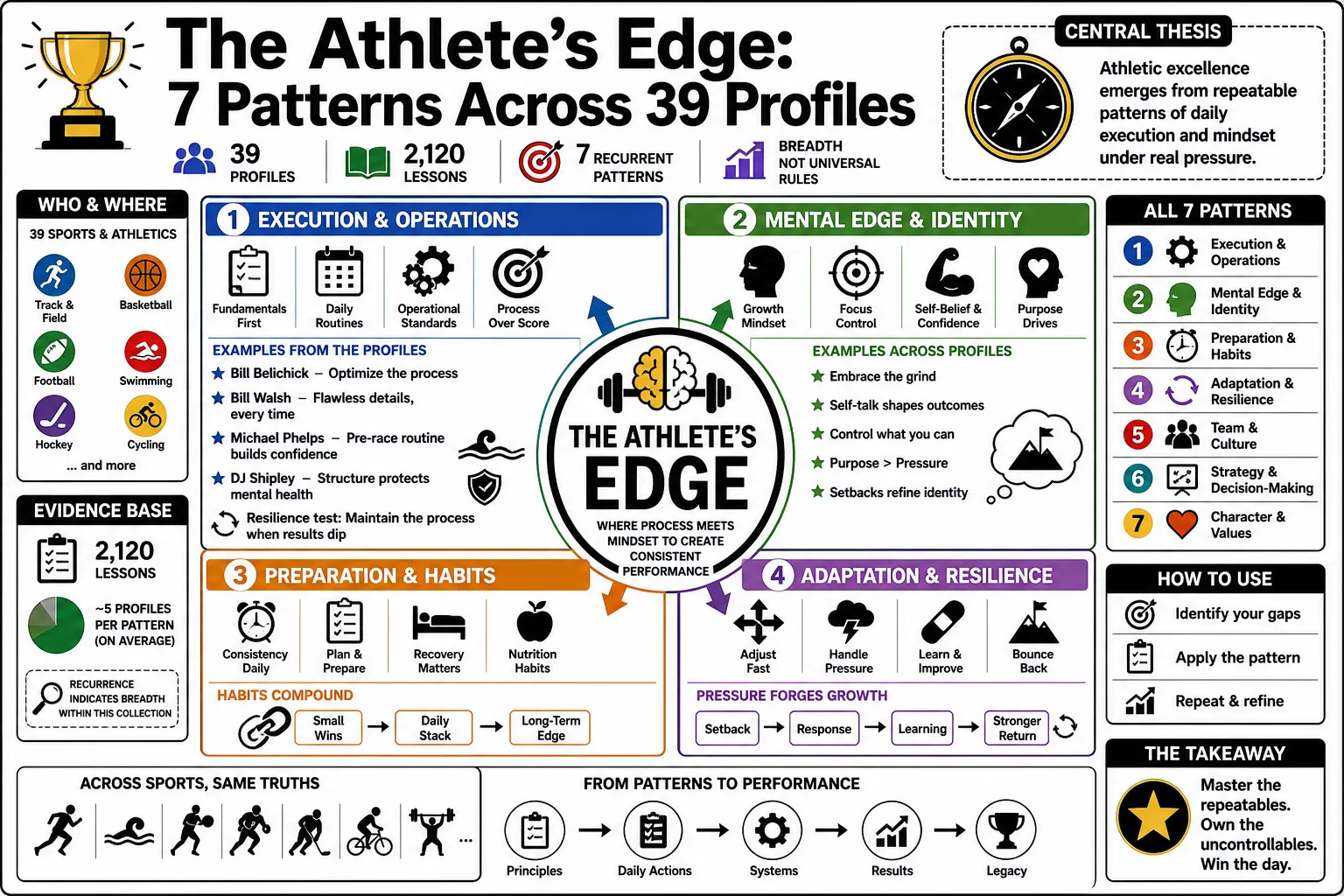
1. Execution and Operations
The relentless daily commitment to fundamentals, routine perfection, and rigorous operational standards that translate vision into objective outcomes. · recurs across ~5 profiles
The translation of grand vision into objective outcomes requires an uncompromising dedication to execution and operations. This distinction separates abstract goal-setting from the daily grind of process mastery. Rather than fixating on the final scoreboard, Bill Belichick emphasizes that success stems from optimizing the underlying process, which naturally fosters the daily habits required for victory. Similarly, Bill Walsh emphasized a non-negotiable standard of performance, demanding that every organizational detail—no matter how small—be executed with flawless precision.
This relentless adherence to routine serves multiple operational functions beyond mere physical preparation. For Michael Phelps, an unwavering sequence of pre-race actions functioned as a psychological anchor, generating the profound confidence necessary to neutralize competitive anxiety before stepping onto the starting block. However, the motivation for such strict compliance is not always positive reinforcement. DJ Shipley frames his rigorous daily regimen not as a product of fleeting motivation, but as a critical safeguard against the severe mental health consequences of abandoning established structure.
The ultimate test of operational resilience occurs during periods of failure. When results temporarily falter, external critics often demand immediate systemic changes. Daryl Morey notes that true organizational discipline means trusting your foundational models and mathematics, resisting the temptation to abandon a proven framework just because it encounters temporary friction. Ultimately, execution is the unwavering commitment to operational standards, ensuring that daily habits continuously align with long-term objectives regardless of emotional fluctuations or external pressures.
2. Interpersonal Cohesion and Culture
Deliberately constructing team harmony, managing conflicting super-star egos, and fostering an environment of radical honesty and shared purpose. · recurs across ~4 profiles
Individual brilliance often captures the public’s imagination, yet sustained organizational supremacy often depends on deliberate interpersonal cohesion and culture. This distinction is critical: talent provides a competitive baseline, but true leverage emerges from intentionally constructing an environment defined by shared purpose and radical honesty. The leadership challenge is not merely assembling exceptional athletes or executives, but rather systematically aligning fiercely competitive and driven egos toward a singular, unified objective, as Scott O’Neil suggests. This requires a transition from individual ambition to collective execution.
Even generational talents like Michael Jordan recognized that isolated dominance cannot secure enduring championship success. He maintained an uncompromising standard for collective effort, operating on the principle that absolute team triumph necessitates every single member executing their distinct role flawlessly. This intensity of accountability forms the bedrock of team harmony—not through passive agreement, but through rigorous, shared commitment.
Furthermore, this cultural alignment extends beyond the locker room into the boardroom and ownership level. Pat Riley has built his legacy on the necessity of cultivating an ecosystem grounded entirely in unified visions and collective thinking. The implications of this shared philosophy are profound; it dictates critical organizational maneuvers. For instance, Michael Andlauer demonstrated that cultural fit supersedes purely financial considerations, insisting that any strategic partnership must be deeply anchored in an identical, non-negotiable dedication to core values and service quality. Ultimately, fostering this culture demands constant vigilance, ensuring that ego is consistently subordinated to the team’s overarching mission.
3. Holistic Somatic Awareness
Treating physical movement as a comprehensive practice that integrates emotion, perception, and bodily health to shape personal identity over time. · recurs across ~6 profiles
Viewing the body as our primary interface with reality challenges the reductionist perspective of physical training as a mere mechanical chore. Rather than focusing exclusively on athletic metrics or isolated muscle development, this paradigm emphasizes physical mastery as an ongoing dialogue with our environment.
Ido Portal highlights this by distinguishing authentic movement from conventional exercise. He frames it as an all-encompassing behavior requiring deep attention, which elevates training into a dynamic expression of existence. Because such movement is intrinsic to human design, its physiological benefits transcend basic fitness. For instance, Bill Bowerman championed consistent, accessible practices like jogging, noting that these foundational habits often stall the physical decline of aging more effectively than medical treatments.
The cultivation of a capable physical form also serves as a tangible reflection of internal character. Mike Mentzer maintained that building bodily strength is a direct manifestation of a resilient and self-respecting identity. Yet, sustaining this physical fortitude demands vigilant maintenance of the organism’s underlying systems. Realizing physical success requires an equilibrium of hydration, nutrition, and mental fitness—elements that Tom Brady stresses are equal in necessity to the active training itself.
Neglecting these holistic needs often leads to profound physical struggles, a vulnerability mirrored in the late-career efforts of Maria Sharapova to return her body to an injury-free state. Therefore, true mastery requires a deep respect for our physiological limits. As Usain Bolt demonstrates, maximizing high-intensity capacity is impossible without prioritizing comprehensive rest and recovery, which ultimately gives the body the space it needs to safely adapt.
4. Physical Sacrifice and Pain Tolerance
The hidden bodily costs, severe physical suffering, and enduring pain required to achieve world-class competitive milestones. · recurs across ~6 profiles
The pursuit of elite athletic dominance transforms the human body into a highly taxed instrument of competition. For many champions, enduring extreme discomfort is not merely a side effect of training, but the very mechanism through which greatness is forged. The precise moment of excruciating physical agony—when the body practically begs to stop—is often the exact threshold where true physiological growth occurs. Athletes such as Usain Bolt and Serena Williams embody this reality, demonstrating that securing monumental victories hinges on the capacity to push forcefully beyond profound physical and emotional distress.
This relentless extraction of physical capital carries severe, hidden bodily costs. The sport’s brutal demands can necessitate absolute physical and mental sacrifice to reach unprecedented competitive heights—an expectation central to the organizational culture of Bill Walsh and vividly experienced as bodily deterioration by Andre Agassi, who ultimately viewed himself as a failing physical vessel. However, there are conflicting perspectives on the methodology of pain. Bill Bowerman argued that subjecting athletes to complete exhaustion on a daily basis does not drive physiological improvement, but rather guarantees inevitable injury. Ultimately, navigating this extreme physical sacrifice requires more than just brute strength. Enduring the immense bodily toll of grueling, agonizingly repetitive routines relies heavily on deep mental stamina, an endurance fundamental to competitors like Maria Sharapova.
5. Psychological Resilience Under Pressure
The ability to manage immense tension, maintain composure, and constructively bounce back from high-stakes failures or defeats. · recurs across ~6 profiles
Navigating intense psychological demands involves more than simply ignoring stress; it requires deliberate strategies for handling both internal anxiety and external scrutiny. For physical performers like Usain Bolt, resilience means actively preventing mental pressure from manifesting as physical rigidity, as physical tension fundamentally undermines peak velocity. Conversely, cognitive competitors such as Garry Kasparov must cultivate the capacity to tolerate prolonged mental friction, resisting the psychological urge to alleviate discomfort by making premature, suboptimal decisions. This highlights a crucial distinction: maximum physical output often demands releasing tension, while deep strategic calculation demands enduring it.
When pressure overwhelms a competitor, the resulting collapse—often a failure of focus driven by unmanaged anxiety—can be devastating. Mitigating this risk sometimes requires structural interventions rather than relying solely on individual fortitude. For instance, Larry Tanenbaum demonstrates how organizational leaders can foster collective resilience by intentionally absorbing public and media scrutiny. By acting as a buffer, executives can insulate their teams, allowing them to execute long-term strategies without the compounding panic of external expectations.
Ultimately, true resilience implies an active acceptance of adversity. As Bill Walsh understood, failure is an inevitable component of competing at the highest levels. The most formidable competitors recognize that a season is a marathon of setbacks, where progress is rarely linear. Resilience is therefore measured not by an undefeated record, but by the relentless capacity to absorb defeats and constructively return to the arena. The individual or team that refuses to stay down transforms failure from a terminal endpoint into a definitive competitive advantage.
6. Continuous Learning
The ongoing pursuit of self-investigation, experiential knowledge, and systemic improvement to continually adapt and evolve beyond current limits. · recurs across ~4 profiles
Continuous learning in the athletic realm is not merely about accumulating new techniques; it is a rigorous, lifelong dedication to expanding one’s understanding and steadily refining every aspect of performance. This requires distinguishing between temporary achievement and the enduring process of refinement. For instance, Bill Walsh embodied this commitment by treating his coaching methodology as a constantly evolving discipline. He recognized that resting on past achievements inevitably stifles future growth, demonstrating that sustained success demands remaining intensely focused on finding the most effective methods rather than clinging to personal preferences.
This drive for constant growth often originates from external demands before internalizing into a personal standard, as seen in Maria Sharapova, who adopted her father’s rigorous expectations as her own baseline for continuous improvement. Furthermore, this relentless evolution extends beyond individual athletes to shape broader systemic philosophies. Pep Guardiola epitomizes this through his focus on tactical evolution and constant adaptation, preferring to measure his legacy by the quality and innovation of his teams’ play rather than simply tallying trophies. Crucially, continuous learning also entails questioning established norms through empirical self-investigation. Mike Mentzer demonstrated this by pushing back against prevailing nutritional dogma, recognizing through biological facts that excessive protein consumption would not artificially force muscle growth. Ultimately, the essence of continuous learning lies in this unending journey of intellectual and physical adaptation, ensuring one is always evolving.
7. Legacy and Civic Impact
Leaving a lasting mark by building sustainable models, shifting cultural conversations, fostering educational endowments, and giving back to society. · recurs across ~5 profiles
Athletic achievements often transcend the confines of a playing field, culminating in profound civic influence. For many elite competitors, this transition from personal victory to societal betterment involves creating frameworks that uplift communities and reshape broader narratives. Andre Agassi illustrates this shift perfectly; recognizing that athletic records inevitably fall, he focused his post-career efforts on establishing educational endowments that empower countless children, demonstrating that institutional philanthropy outlasts sporting fame. Similarly, John Wooden created a pedagogical and moral framework at UCLA that continues to influence coaching and leadership philosophies across the globe. His legacy is less about championships than the enduring pedagogical model he left behind. The impact of civic engagement is also evident in the work of Rick Hansen, who leveraged his athletic endeavors to build global communities focused on inclusivity and teamwork.
Beyond structural philanthropy, leaving a mark often involves shifting cultural conversations. Simone Biles has explicitly sought to transcend her gymnastic achievements by prioritizing self-advocacy and mental health, fundamentally altering how athletes navigate the pressures of elite competition. Even in deeply intellectual pursuits like chess, recognizing long-term contributions remains vital. Garry Kasparov has praised the enduring theoretical and epoch-defining contributions of his rivals, acknowledging the lasting knowledge they contribute to the discipline. Together, these figures demonstrate how a lasting legacy can be built by leveraging individual success to foster education, advocate for well-being, and drive sustainable societal progress.