The Psychological Realities of Ambition and Execution
Across 123 personal development & psychology profiles and 5,722 lessons, 19 patterns recur often enough to matter. They are not universal rules; recurrence indicates breadth within this collection, not agreement across an entire field.
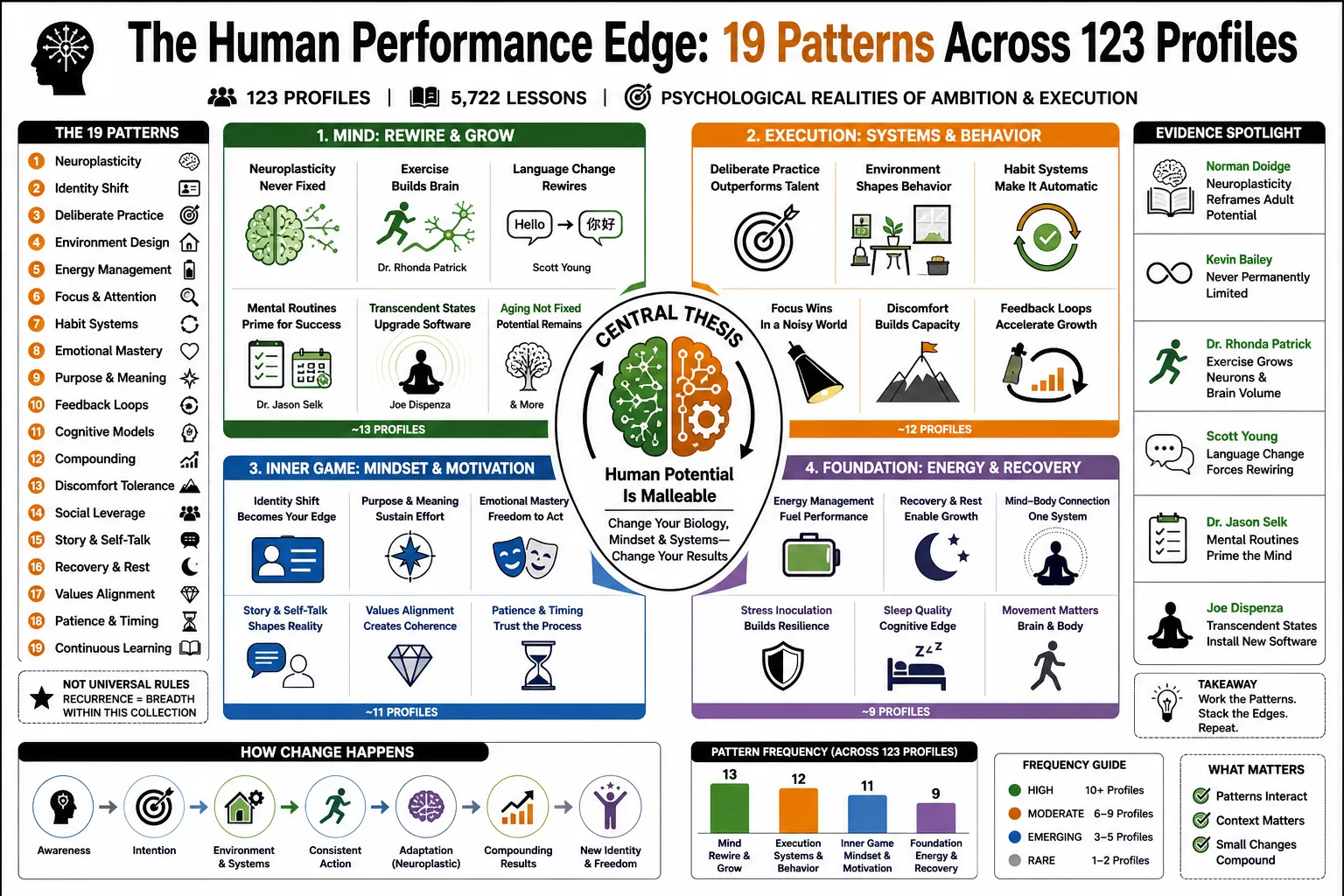
1. Neuroplasticity
The biological capacity of the brain to rewire its structure, forge new neural pathways, and adapt physically to repeated experiences and thoughts. · recurs across ~13 profiles
Neuroplasticity marks a radical shift from the outdated view of a fixed adult brain to one that is continually malleable. As Norman Doidge explores, this science offers extraordinary possibilities for healing and expanding human potential. Rather than being trapped with static cognitive abilities, adults maintain a remarkable capacity to adapt physically, meaning we are never permanently restricted to our current level of performance, a reality emphasized by Kevin Bailey of Dreamfuel.
This biological rewiring occurs through deliberate lifestyle choices and environmental pressures. For instance, Dr. Rhonda Patrick notes that physical exercise stimulates the generation of fresh neurons and expands brain volume. Cognitive strain also forces structural adaptation; Scott Young illustrates that fully abandoning one’s native language necessitates the brain to biologically rewire itself to accommodate new linguistic demands. Furthermore, consistent mental routines can reconfigure neural architecture, a strategy Dr. Jason Selk applies to prime the mind for success.
Profound internal shifts can also trigger structural changes. Joe Dispenza suggests that deep, transcendent states serve as biological upgrades, installing new mental software. Even fundamental aging might not be a permanent barrier to plasticity; David Sinclair points to research demonstrating that an aging brain can be biologically reversed to restore its capacity to learn. Ultimately, this structural flexibility allows us to delegate routine memory storage to external systems, empowering the organic brain to act as a strategic orchestrator rather than a mere filing cabinet, as advocated by Tiago Forte.
2. Nervous System Regulation
Techniques and biological processes for managing chronic physiological arousal, somatic stress, and the physical symptoms of emotional pain. · recurs across ~5 profiles
Regulating the nervous system requires shifting the body from a state of chronic physiological arousal—often characterized by somatic stress and the physical symptoms of emotional pain—into a restorative baseline. The core biological mechanism involves stimulating the vagus nerve to activate the parasympathetic nervous system, effectively neutralizing the fight-or-flight response.
Strategic respiration is universally highlighted as a primary lever for this transition. Patrick McKeown emphasizes that slow, gentle breathing, especially with prolonged exhalations, directly engages the vagus nerve to foster calm. Specific rhythmic breathing patterns provide concrete protocols for this biological reset. Kevin Bailey of Dreamfuel advocates for box breathing—equal four-second intervals of inhaling, holding, exhaling, and holding—as a manual override for acute stress mid-day. Similarly, Dr Michael Breus recommends the 4-7-8 method, noting that extending the exhalation to eight seconds forcibly decreases the heart rate and diminishes cortisol levels. Dr. Jason Selk also supports structured breathing as a foundational tool to mitigate physiological reactions to pressure.
Beyond respiration, broader lifestyle and environmental interventions play crucial roles. The work of Andrew Huberman highlights that mastering sleep consistency and utilizing deliberate cold exposure can systematically improve the resilience of the nervous system. Ultimately, managing somatic stress is not merely about psychological framing but involves active, mechanical interventions—like manipulating the breath and deliberately modulating environmental stressors—to alter the body’s neurochemistry and restore homeostatic balance.
3. Predictive Processing
The concept that the brain acts as a simulation engine, constantly predicting and constructing our subjective reality rather than just reacting to it. · recurs across ~8 profiles
Instead of acting as a passive camera, the human brain operates as an active simulation engine, continuously generating and projecting a model of reality. As Nick Chater explains, human perception functions through an ongoing process of unconscious inference, meaning our neurological systems are essentially placing bets on the most probable causes behind incoming sensory data. Consequently, our conscious experience is an internal construction rather than a direct reflection of the environment, a point underscored by Dan Gilbert. This subjective filtering means we are all living in entirely different mental universes. Ichiro Kishimi suggests that while objective facts remain fixed, the subjective meanings we assign them are our own creation, making it profoundly difficult to fully share our constructed world with anyone else.
This predictive machinery extends beyond physical perception into our emotional lives. Anthony De Mello noted that our cognitive processes often work backward: emotional centers preemptively dictate conclusions, then dispatch the intellect to build defensive reasoning. This aligns with Dr. Douglas J. Tataryn’s observation that deeply ingrained emotional beliefs can significantly distort our apprehension of reality. The resulting internal map, full of rigid demands about how the world should operate, is often mistaken for the territory itself, as Ken Wilber points out. Recognizing that our disturbances stem from these internal predictions and mental constructs, rather than external events, opens a pathway to liberation, shifting the locus of control from altering the world to managing our own meaning-making.
4. Cognitive Biases
Predictable flaws in human judgment and decision-making driven by evolutionary heuristics, loss aversion, and irrational emotional logic. · recurs across ~4 profiles
The human mind is a remarkable engine for survival, yet it is riddled with predictable flaws in judgment and decision-making when navigating the complexities of modern life. These cognitive biases are not random errors but systematic deviations driven by evolutionary heuristics, loss aversion, and irrational emotional logic. As Nick Chater points out, our probabilistic reasoning isn’t inherently defective; rather, we rely on mental shortcuts that were highly rational for the ancestral environments in which our brains evolved, even if they misfire today.
In contemporary settings, these heuristics often manifest as counterproductive tendencies that prioritize immediate comfort over optimal outcomes. For example, Dan Ariely notes our illogical hostility toward external solutions, demonstrating how we frequently reject superior ideas simply because they originated outside our own group. This tribal favoritism highlights how emotional logic consistently overrides objective evaluation. To effectively diagnose and mitigate these flaws, we must broaden our analytical framework. As Daniel Kahneman explains, “To understand error in judgment, we must understand both bias and noise.” [1]
While completely eradicating these ingrained psychological patterns is impossible, we are not entirely helpless. Dan Gilbert suggests that the first step toward clearer thinking is cultivating mindfulness about our specific vulnerabilities. By actively recognizing when we are prone to misjudgments—such as the tendency to be overly optimistic about the future or to rely too heavily on easily imagined scenarios—we can begin to correct for our evolutionary baggage and make more reasoned, deliberate choices.
5. Ego Detachment
Shifting from an ego-driven need to avoid failure and secure praise toward an objective orientation where errors are viewed dispassionately as data. · recurs across ~5 profiles
A pivotal shift in high performance is moving away from ego-driven validation toward objective mastery. Gio Valiante distinguishes between individuals motivated by a need for peer approval and those driven by a genuine love for their craft and a continuous desire to improve. When self-worth is entirely tethered to outcomes, setbacks are perceived as deeply threatening to the self. As Ryan Holiday points out, the ego instinctively generates excuses to protect itself after a failure, whereas cultivating humility allows a person to take responsibility and dispassionately extract lessons from the experience.
Achieving this level of objectivity often requires a psychological separation from one’s professional outputs. Dr Julie Gurner argues that individuals should view their work simply as an activity they perform rather than the core of who they are, noting that this emotional detachment facilitates much clearer decision-making. Yet, this detachment must be reconciled with the inherent human drive for purpose. As Dan Ariely emphasizes, human motivation in labor is rarely just about financial compensation; it is intricately bound up with elements like pride, meaning, and identity.
Ultimately, navigating ego detachment involves balancing the intrinsic human need for meaningful, identity-affirming work with the emotional distance required to process errors as mere data points rather than personal indictments.
6. Radical Acceptance
The psychological relief found in relinquishing the need for control, embracing reality as it is, and recognizing inherent self-worth independent of external outcomes. · recurs across ~6 profiles
The psychological relief of relinquishing control is profoundly illustrated through radical acceptance—a practice of embracing reality as it unfolds rather than resisting it. As Michael A. Singer explains, our distress typically stems from the internal drama we create, rather than external events themselves. By softening our resistance and remaining open during moments of discomfort, we can align with the natural flow of life rather than attempting to assert dominance over it. Similarly, Keith Johnstone points out that true flow requires a state of calm presence, entirely devoid of the ego’s urge to dictate circumstances.
This internal softening extends to how we process difficult emotions. As Russ Harris notes, “Basically, expansion means making room for our feelings. If we give unpleasant feelings enough space, they no longer stretch us or strain us.” [Source] Pioneered further by the teachings of Tara Brach, this compassionate allowance provides a pathway to profound internal peace. Furthermore, radical acceptance involves recognizing our fundamental value regardless of performance. Jenny Wallace emphasizes that we inherently matter simply by existing, a worth that remains entirely independent of our achievements or external validations.
However, acceptance is distinct from passivity. Just as Singer advocates engaging with life without attachment to specific outcomes, Spencer Johnson emphasizes the necessity of responsive action. When reality shifts, we must ultimately change our behavior and actively move in alignment with those new circumstances. Ultimately, radical acceptance is the foundation for meaningful action, anchored in an unwavering sense of inherent self-worth.
7. Personal Accountability
Taking total ownership of one’s choices, actions, and reactions, avoiding victimhood, and maintaining integrity. · recurs across ~11 profiles
Personal accountability requires an unwavering commitment to ownership over one’s internal landscape, regardless of external circumstances. As Mark Manson emphasizes, individuals cannot dictate every event that befalls them, but they retain ultimate responsibility for the meaning they assign to these events and their subsequent responses. This inner sovereignty is echoed by Ryan Holiday, who observes that while the world may restrict our physical freedom, it can never coerce our thoughts, beliefs, or reactions.
To embody this principle, one must actively reject victimhood. Dr. Kirstin Ferguson highlights that accountable leaders refuse to view themselves as casualties of circumstance; instead, they turn inward to examine their role in any situation. This introspection is critical because, as Michael A. Singer notes, external conflicts cannot be resolved until we own how those situations disturb us internally. Rather than relying on excuses—a trap Mike Michalowicz bluntly cautions against—true agency demands the proactivity and integrity that Dr. Cameron Sepah identifies as foundational to psychological strength.
The implications of this shift are profound. Manuel J. Smith warns that failing to claim responsibility for our psychological well-being makes us vulnerable to manipulation by those who would impose their problems upon us. Conversely, Dan Gilbert notes that maintaining a strong sense of agency is a fundamental pillar of mental health. Ultimately, personal accountability is liberating. By embracing the self-governance explored by Albert Bandura and Kerry Patterson, we stop outsourcing our happiness and proactively shape our existence.
8. Resilience
The psychological and structural capacity to endure failure, navigate setbacks, and recover stronger from adversity. · recurs across ~4 profiles
Resilience is not merely the passive weathering of adversity but an active, structural capacity to process failure and adapt. At its cognitive foundation, Martin Seligman argues that endurance stems from an optimistic explanatory style—a practiced ability to view setbacks as temporary and surmountable rather than permanent roadblocks. By actively challenging distorted negative beliefs and reframing the consequences of hardship, individuals can sustain the persistence required to overcome inevitable challenges.
In practice, Dr. Jason Selk posits that mental fortitude is fundamentally rooted in decisive action and finding immediate solutions. Complementing this active approach, Gio Valiante warns against the danger of continuous, unstructured striving, emphasizing that true mental endurance cannot be sustained without proactively embedding rest and psychological detachment into daily schedules. Waiting for burnout to force a necessary pause ultimately undermines long-term recovery.
Similarly, Jerry Colonna suggests that merely pushing forward with solutions can mask profound self-deception. He asserts that navigating failure effectively requires leaders to pause their constant striving and compassionately confront their internal contradictions. Rather than projecting invulnerability, resilient individuals must hold conflicting emotions and boldly examine how they might be complicit in creating the very circumstances they claim to want to escape. Ultimately, recovering stronger from adversity requires integrating the forward momentum of solution-seeking with the structural necessity of rest and the emotional courage to extract honest insight from defeat.
9. Meaning
The pursuit of purpose, intrinsic motivation, and legacy beyond material success or short-term achievement. · recurs across ~15 profiles
The search for meaning acts as the ultimate compass in personal development, demanding a shift from transient external achievements to a lasting internal legacy. As Mitch Albom observes, modern culture often mistakenly equates material status with success, whereas true fulfillment stems from contributing to the lives of others and nurturing profound relationships. This shift is echoed by Jim Loehr, who asserts that an enduring purpose requires moving one’s focus away from self-interest and toward serving a greater cause.
While the pursuit is universal, the experience of meaning takes different forms. Spencer Johnson emphasizes that purpose is rooted in being whole and fully engaged in the present moment. In a professional context, Jerry Colonna argues that true satisfaction requires aligning our daily work with our fundamental values through radical honesty. The absence of this alignment can be catastrophic; Dan Ariely notes that a lack of purpose, rather than difficult circumstances, is what truly makes life unbearable. Dr. John Vervaeke takes this further, describing the “zombie” as the embodiment of today’s meaning crisis—a state of consuming aimlessly without agency.
To combat this crisis, Martin Seligman distinguishes a merely pleasant life from a truly meaningful one, pointing out that authentic happiness is cultivated through practicing virtues. Seligman states, “Optimism is a tool with a certain clear set of benefits: it fights depression, it promotes achievement and produces better health.” [source] Ultimately, as Viktor Frankl demonstrated through unimaginable adversity, the search for purpose is a fundamental drive that endows us with the resilience to navigate suffering and leave a meaningful legacy.
10. Attention Management
Strategies for deliberately filtering out sensory overload and protecting cognitive bandwidth to maintain mental clarity in a hyper-connected world. · recurs across ~21 profiles
In a hyper-connected world, attention management is less about time and more about defending cognitive bandwidth against sensory overload. Mike James Ross stresses that true attention requires intentionality, while Gio Valiante frames the deliberate exclusion of external distractions as a vital competitive advantage. This filtering demands strict boundaries; David Rock argues we must aggressively curate what enters our mental workspace, ignoring non-urgent items to conserve energy.
Failing to protect our attention leads to severe cognitive consequences. Dan Ariely notes that stressful environments drain our cognitive bandwidth and impair clear reasoning, while Scott Young warns that chronic multitasking fractures the intense concentration required for meaningful skill acquisition. Furthermore, Mark Manson cautions that eradicating boredom through perpetual stimulation deprives us of the very discomfort needed to achieve personal clarity. To combat this fragmentation, Cal Newport champions a philosophy of digital minimalism, advising us to treat technology strictly as a supportive tool rather than allowing it to dictate our behavior.
Practical strategies for reclaiming focus range from physiological shifts to psychological reframing. Joe Dispenza points out that simply shutting our eyes blocks out the vast majority of environmental stimuli, allowing us to rapidly shift awareness inward. Once internal focus is established, Alex Korb and W. Timothy Gallwey both advocate for anchoring our awareness entirely in the present. Gallwey specifically observes that cultivating a relaxed, non-judgmental concentration naturally quiets the mind and neutralizes performance anxiety. Finally, optimizing when we engage is just as vital as how we engage; Dr Michael Breus suggests that scheduling complex, analytical work during our optimal biological windows ensures we fully leverage our cognitive clarity.
11. Learning
The continuous process of acquiring skills, integrating feedback, and adapting mental models to changing environments. · recurs across ~10 profiles
The journey of learning requires both acquiring new capacities and intentionally shedding old paradigms. At the foundation of this process lies the relentless refinement of basic skills, a principle championed by Tim Grover, who notes that even elite performers build greatness by endlessly drilling fundamentals. To ensure these abilities withstand intense pressure, Scott Young emphasizes the necessity of over-practicing slightly past the threshold of basic competence.
However, mechanical repetition alone is insufficient. True mastery demands active exploration. Gio Valiante and Guy Sengstock highlight how profound curiosity transforms tedious training into an engaging process of problem-solving. This cognitive flexibility can be systematically trained; Kevin Bailey of Dreamfuel points out that individuals can deliberately condition mental states like grit or calm, much like exercising a muscle.
Creating the environment for such deep practice requires radical prioritization. Eric Barker observes that prolonged, uninterrupted focus is the engine of skill acquisition. This is reinforced by Cal Newport, who argues that dedicating isolated time away from external noise is essential for meaningful reflection and high-quality output.
Furthermore, learning is a dynamic, social endeavor. Michael Bungay Stanier advocates using structured inquiry to turn routine interactions into informal coaching opportunities, while Paul Millerd relies on one-on-one dialogue to test and expand nascent concepts. Ultimately, cognitive growth is not solely about addition. As Nedra Glover Tawwab explains, genuine development frequently demands the difficult work of unlearning ingrained patterns so that our behaviors finally align with our authentic values.
12. Behavioral Design
Structuring environments and friction points to automatically guide actions and build sustainable, productive habits. · recurs across ~5 profiles
The spaces we occupy fundamentally dictate our daily actions, yet we often fail to recognize how heavily our physical and digital surroundings sculpt our routines. As Dan Ariely suggests, people consistently underestimate the profound influence that environmental design exerts on our everyday behavior. Rather than relying on sheer self-discipline, behavioral design shifts the focus toward engineering spaces that automatically foster positive outcomes. Mike James Ross observes that top performers strategically organize their surroundings to sustain their habits, thereby eliminating the exhaustion associated with constant willpower.
At the core of this approach is the strategic manipulation of friction. To cultivate productive routines, the goal is to make the ideal choice the path of least resistance. Shane Parrish emphasizes that establishing the desired behavior as the default action by removing obstacles is essential for doing the right thing consistently. This principle applies just as strongly to our virtual workspaces. Tiago Forte advises tailoring digital environments to eliminate distractions—such as disabling notifications and streamlining interfaces—to ensure seamless engagement with essential tools. Conversely, dismantling negative patterns requires the deliberate addition of barriers. Gio Valiante points out that interrupting destructive impulses, especially in high-pressure situations, necessitates injecting intentional friction between the initial urge and the harmful action. Ultimately, by systematically adjusting the ease or difficulty of specific actions, individuals can bypass the limitations of motivation and create sustainable, self-reinforcing systems that naturally guide them toward their goals.
13. Optimal Performance
Maximizing output and capability through the management of physiological energy, flow states, and purposeful recovery. · recurs across ~10 profiles
Achieving optimal performance requires treating the body and mind as an integrated system driven by energy management, deep focus, and strategic rest. At the physiological level, energy regulation begins with respiration and environment. Patrick McKeown cautions that habitual overbreathing restricts cerebral blood flow and induces fatigue. Conversely, Kelly Starrett explains that conditioning the body to tolerate carbon dioxide improves oxygen utilization, directly increasing available energy. Ray Peat highlights that external signals, such as light exposure, are equally critical for regulating our physiological baseline.
Once physiological energy is secured, output depends on cognitive flow and emotional non-resistance. Kevin Bailey recommends visualizing a seamless transition into deep work to prime the brain for the flow states famously defined by Mihaly Csikszentmihalyi. Maintaining this focus requires emotional regulation; Michael A. Singer argues that resisting reality causes us to contract and leak vital energy. By relaxing through discomfort rather than fighting it, we preserve our cognitive resources.
Finally, maximizing capability demands purposeful recovery. The brain requires downtime to accumulate energy and physically wire new pathways, a necessity emphasized by Norman Doidge. Practices like Yoga Nidra, advocated by Andrew Huberman, provide the profound rest needed for this neural consolidation, while Rob Burbea frames breathing as a way to actively infuse the body with restorative well-being. Ultimately, sustainable high performance is not about exhausting oneself. As both Shane Parrish and Starrett note, enduring progress stems from consistent, manageable habits rather than fleeting, heroic intensity.
14. Execution
The disciplined translation of strategy into reality through focused action, speed, and systematic processes. · recurs across ~18 profiles
Execution is not merely about exerting effort; it is a systematic approach to action where process takes precedence over outcome. Many experts emphasize evaluating daily behaviors based on the system used rather than the destination. W. Timothy Gallwey, Shane Parrish, and Katy Milkman argue that maintaining a focus on process fosters relaxed concentration and better decision-making. Similarly, Ichiro Kishimi and Dr. Jason Selk suggest that breaking ambitions down into present-moment daily actions prevents the anxiety that comes from fixating on distant futures.
Crucially, execution demands a relentless bias for action. Mike Michalowicz bluntly notes that conceptual ideas have no value without the immediate effort required to actually acquire a customer. This momentum relies on intentional speed and resilience, which Matthew McConaughey describes as a cultivated skill of navigating life’s signals with discipline and endurance.
Sustaining such high-velocity output requires deeply structured routines. Because the vast majority of human behavior is automatic, Jim Loehr advises developing rigorous rituals to consistently manage energy. Maintaining this forward motion also demands psychological flexibility; Russ Harris highlights the need to keep acting in alignment with personal values, while Gio Valiante identifies professional execution as the ability to swiftly extract lessons from mistakes without lingering emotional baggage. Finally, while Brad Stulberg recommends a patient, long-term perspective that tolerates failure, execution still requires immediate daily iteration, such as framing habits positively as suggested by Jeremy Dean, rapidly adapting routines like Dickie Bush, and quickly turning new insights into concrete commitments, as Marcia Reynolds outlines.
15. Communication
The clear, empathetic, and effective exchange of information, encompassing boundaries, listening, and conflict resolution. · recurs across ~6 profiles
Effective communication transcends mere vocabulary; it requires a foundational commitment to empathy, boundaries, and self-awareness. According to Jerry Colonna, authentic dialogue requires us to confront our self-deceptions, asking ourselves what essential truths we are ignoring and what unspoken messages need to be voiced. He notes that profound listening can heal emotional wounds, while emphasizing that guiding others often means asking questions rather than dispensing directives. Similarly, Brené Brown positions the courageous act of listening to our own shame as central to building resilience and fostering genuine connection.
Establishing these connections, however, also demands rigorous personal boundaries. Manuel J. Smith advocates for assertiveness over aggression or passivity, arguing that we protect our dignity when we clearly state our needs without feeling obligated to endlessly justify them. This clarity prevents others from manipulating our choices through guilt or anxiety.
When conflict inevitably surfaces, the focus must shift from surface-level disputes to underlying human drivers. Marshall B. Rosenberg teaches that universal needs—like safety and autonomy—rarely clash; rather, our conflicting strategies for meeting those needs create friction. By articulating our desires as concrete requests rather than demands, we build mutual understanding. This principle scales to high-stakes environments: Mike James Ross observes from Middle East peace negotiations that true resolution relies heavily on intentional empathy, while Michele Gelfand illustrates how structural conflicts, such as corporate mergers, break down when leaders fail to synthesize opposing demands like accountability and creative freedom. Ultimately, profound communication requires aligning our internal truths with clear, compassionate external expression.
16. Culture
The unwritten rules, shared values, and behavioral norms that define how a group operates and collaborates under pressure. · recurs across ~15 profiles
A group’s culture is fundamentally shaped by the continuous interplay between individual behavior and the surrounding environment, a dynamic Albert Bandura identifies as central to human development. Rather than relying on willpower, experts like James Clear, Gio Valiante, Scott Young, and Dr. Cameron Sepah argue that designing physical spaces and structural contexts is a more reliable method for reinforcing desired habits. However, this environmental determinism is challenged by Stephen R. Covey, who contends that individuals maintain the agency to proactively shape their lives rather than merely reacting to external conditions.
Beyond physical surroundings, behavioral norms dictate how teams collaborate under pressure. While Michele Gelfand notes that shared rules prevent societal chaos, Kevin Simler suggests a darker reality where individuals subtly violate these constraints for personal advantage. To counter defensive behaviors and hidden agendas, fostering a climate of trust is critical. Kerry Patterson and Marcia Reynolds emphasize that honest, non-judgmental dialogue only occurs when people feel secure, a sentiment echoed by Michael Bungay Stanier and Matthew Syed in their calls for blame-free workplaces. As Amy C. Edmonston observes, “When a work environment has reasonably high psychological safety, good things happen: mistakes are reported quickly so that prompt corrective action can be taken; seamless coordination across groups or departments is enabled, and potentially game-changing ideas for innovation are shared.” [Source] When leaders combine this safety with the respectful assertiveness championed by Robert Alberti and Michael Emmons and the unified emotional investment advocated by Mike Michalowicz, they create resilient cultures capable of navigating immense challenges.
17. Toxic Achievement Culture
The unintended damage caused by projecting economic anxiety and precariousness onto human development through relentless academic and social pressure. · recurs across ~6 profiles
The relentless pressure to excel academically and socially often stems from deep-seated economic anxiety, pushing individuals into a damaging cycle of artificial competition. Jenny Wallace points out that the fierce battles over marginal academic metrics, like tiny fractions of a grade point, are driven by manufactured scarcity rather than any true measure of a student’s preparation for adulthood. This environment forces young people and professionals alike to chase what Luke Burgis describes as superficial goals, trapping them in endless, zero-sum status comparisons that ultimately produce profound emptiness and exhaustion.
When we glorify relentless productivity and solitary success, we inadvertently lay the groundwork for severe burnout, as observed by Brad Stulberg. Many individuals mistakenly delay their own joy until they have reached externally imposed milestones, yet Jim Loehr stresses that the equation should be reversed: emotional fulfillment and strong character are the foundation of genuine achievement, not its byproduct. Furthermore, instead of deriving gratitude from having outcompeted others in a scarce environment, Mike James Ross advocates for finding appreciation in universally accessible human experiences.
To dismantle this toxic culture, we must fundamentally alter how we interact with pressure. Rather than seeking overnight fixes, Gio Valiante suggests that steadily shifting toward a process-oriented mindset through small, deliberate behavioral adjustments can slowly recalibrate our relationship with external expectations. By prioritizing character, intentional energy management, and a supportive inner dialogue over arbitrary benchmarks, we can reclaim our development from the anxieties of an overly competitive society.
18. Innovation
The generation of novel solutions through experimentation, embracing constraints, and challenging established paradigms. · recurs across ~5 profiles
Innovation isn’t just about having new ideas; it’s a dynamic process of experimentation that challenges established paradigms. To generate novel solutions, we must often embrace what seems counterintuitive. For instance, David Epstein argues that navigating wicked learning environments with an apparent lack of focus is actually a profound strength, fostering the mental flexibility required for true innovation. This broad, winding path allows us to connect disparate ideas rather than becoming trapped in narrow specialization.
Similarly, Keith Johnstone challenges the paradigm of self-editing, suggesting that our most potent creativity resides within the unpolished, uncensored parts of our psyche that we typically suppress. Unlocking innovation requires us to access this raw intuition. Bill Burnett reinforces this by distinguishing the design process from rigid, analytical planning; innovation flourishes when we prioritize intuitive exploration and iterative design over attempting to logic our way to a perfect answer.
However, unbridled creativity alone is insufficient to produce lasting impact. As Matthew Syed emphasizes, generating novel ideas must be coupled with rigorous testing and relentless feedback loops. Experimentation is only valuable if it produces measurable results. This delicate balance—between the unstructured flow of discovery highlighted by Mihaly Csikszentmihalyi and the structured refinement of testing—is the engine of innovation. The implication is clear: we must be wildly unconstrained in our ideation but ruthlessly empirical in our execution to bring meaningful solutions to life.
19. Solution fit
The alignment between a solution’s value proposition and the actual, validated needs of a specific problem. · recurs across ~7 profiles
Solution fit represents the crucial alignment between a solution’s value proposition and the actual, validated needs of a specific problem. Achieving this state requires moving beyond initial assumptions to confront market reality. James Beshara exemplifies this discipline; he spent two years actively soliciting critical feedback and secured hundreds of committed users before even finalizing his product’s name, demonstrating that confirmed demand must precede scaling.
This pursuit of alignment demands continuous refinement. As Matthew Syed notes, raw creativity remains insufficient unless disciplined by rigorous testing and external input. Similarly, Derek Sivers highlights that sustained success stems from repetitive execution that incorporates slight adjustments based on real-world responses rather than dramatic leaps. Building the capability to deliver these solutions also requires this feedback loop; Cal Newport indicates that pushing past comfort zones to seek honest critique is necessary for meaningful growth.