The Intellectual Foundations of Company Building
Across 63 philosophy & intellectuals profiles and 2,818 lessons, 20 patterns recur often enough to matter. They are not universal rules; recurrence indicates breadth within this collection, not agreement across an entire field.
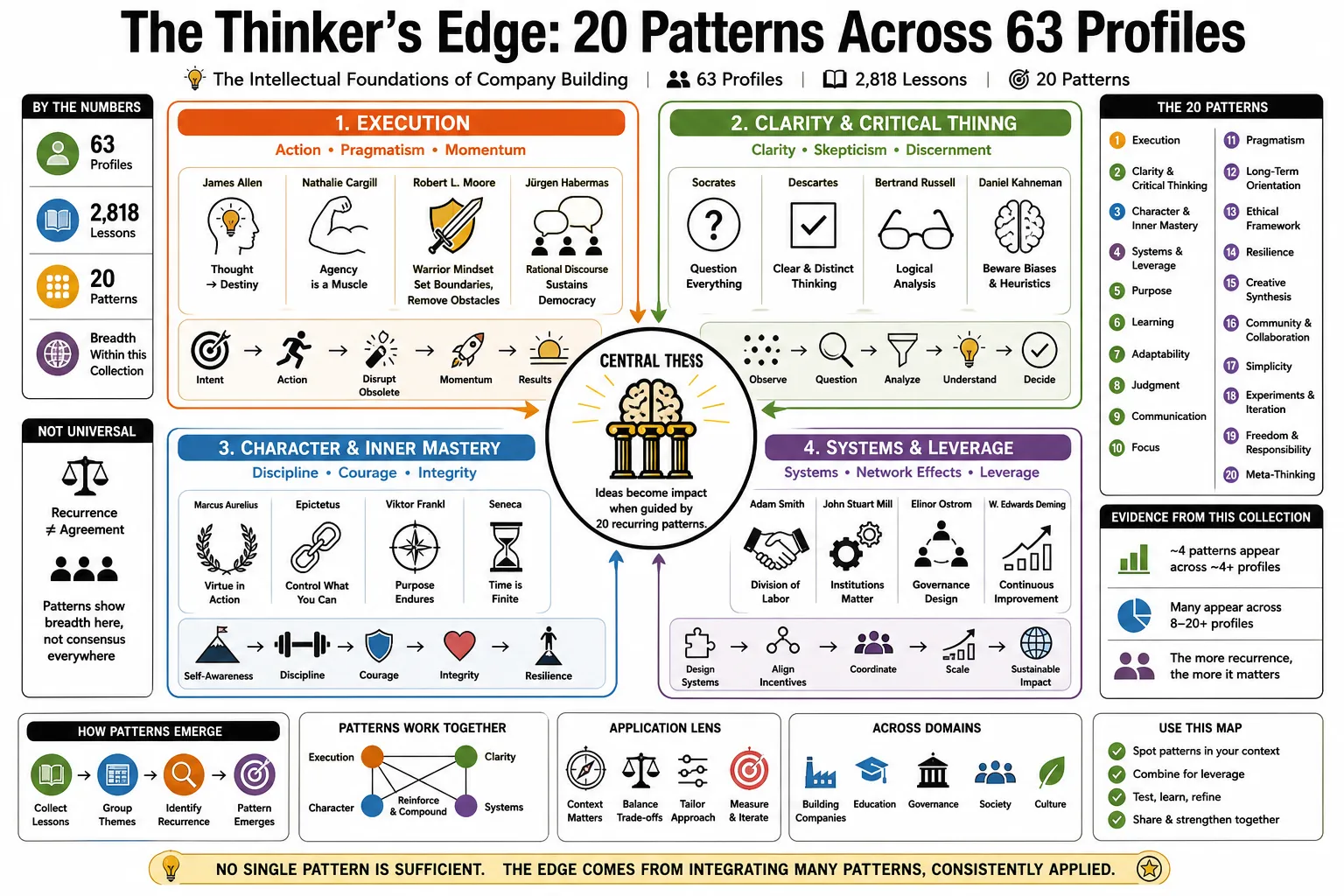
1. Execution
The primacy of action, pragmatism, and momentum in realizing ideas and solving concrete problems. · recurs across ~4 profiles
Execution distinguishes the mere theorist from the effective agent of change. Action is the mechanism through which internal visions become external realities. James Allen suggests that humans are not passive subjects of circumstance but the architects of their own destinies. For him, every material condition springs from a foundational thought, yet thoughts only gain traction when coupled with decisive, single-minded purpose. Action is the natural fruition of these focused intentions, determining whether one builds a life of strength or one of ruin.
Nathalie Cargill extends this principle to the broader world, defining agency as the active recognition that established systems can be reshaped. Instead of accepting the status quo, execution requires treating agency as a muscle that grows stronger through deliberate, repeated application. This pragmatic approach demands tearing down obsolete structures to make way for the new, a dynamic embodied in Robert L. Moore’s concept of the Warrior archetype. Moore describes a strategic mindset characterized by courage and self-discipline, where one establishes firm boundaries and decisively eliminates what impedes progress.
Even in the realm of collective governance, momentum is necessary. Jurgen Habermas emphasizes that a legitimate democracy relies on the continuous, active practice of rational discourse. Maintaining the public sphere against misinformation is an ongoing exercise in communicative action. Ultimately, realizing ideas requires bridging the gap between passive ideation and forceful intervention. Without the self-discipline to act and the courage to dismantle obstacles, potential remains dormant; it is only through sustained, purposeful momentum that concrete problems are solved and meaningful growth is achieved.
2. Distribution
The mechanics of attention, network effects, media, and audience building in a digital landscape. · recurs across ~8 profiles
In the digital landscape, the distribution of ideas depends profoundly on the mechanics of attention and the structural nature of media. George Mack observes that capturing attention is the central economic driver of our time, functioning as a vital resource harvested by modern platforms. To thrive in this environment, one must proactively shape their narrative rather than passively accepting given roles, a sentiment echoed by Robert Greene. The format of the medium itself dictates audience engagement. As Marshall McLuhan famously distinguished, high-definition media demand little from consumers, whereas low-definition media require active participation to fill in informational gaps.
Today’s platforms have evolved these dynamics into complex network effects. Niklas Luhmman conceptualized knowledge ecosystems as self-generating entities that sustain themselves through continuous internal communication. Within these digital ecosystems, Scott Alexander points out that nuanced ideas often stall, while emotionally charged, ambiguous concepts spread virally by exploiting tribal divides and hijacking our focus. Leveraging this ecosystem requires adaptation. David Perell suggests using social networks as real-time feedback loops, allowing creators to gauge audience reactions and refine their long-form writing accordingly.
Meanwhile, new formats are altering how information is internalized. While modern video content is often criticized for fragmenting focus, Samo Burja argues it uniquely enables the unprecedented, mass-scale transmission of tacit knowledge. Ultimately, achieving visibility requires an element of performance. As Harvey Mansfield notes regarding traditional masculine archetypes, a desire for attention often manifests through theatricality and drama, breaking through the friction of rational routine to successfully find its audience.
3. Storytelling
The fundamental role of narrative, myth, and fiction in shaping human perception and alignment. · recurs across ~5 profiles
Narrative acts not as a literal record of facts but as a vital framework for human alignment and perception, transforming how individuals interpret reality. James Carse creates a critical distinction between explanations and narratives: while explanations seek to definitively settle issues and halt further inquiry, stories intentionally raise new questions. By focusing on vision rather than conversion, storytellers invite continuous, horizonal thinking characteristic of infinite play. This expansive view of narrative resonates with Joseph Campbell, who viewed myths as public dreams that provide clues to our deepest spiritual potential. Campbell emphasized that religion and mythology should never be read as literal history, but rather as metaphors pointing toward the direct, transcendent experience of being alive.
Yet, fiction’s framing power also dictates structural realities. Slavoj Žižek illustrates how symbolic framing—even in the absence of a physical difference, like ordering coffee without cream instead of milk—alters the fundamental identity of an object, proving that the fictions we construct carry concrete, lived implications for how we navigate society. A tension emerges, however, in the practical application of these stories. While Carse and Campbell view storytelling as a means to organically expand awareness rather than force ideological conversion, Curtis Yarvin wields selective historical narratives precisely to dismantle modern systems and systematically construct alternative political frameworks. Ultimately, as Angus Fletcher observes regarding allegory, narrative often bypasses direct clarity in favor of cultivating deeper personal resilience, proving that human alignment relies less on rigid facts and more on the shared, dynamic myths we choose to inhabit.
4. Culture
The foundational norms, institutional behaviors, and shared contexts that govern societal and organizational life. · recurs across ~10 profiles
Culture acts as the operating system for human societies, shaping the foundational norms and institutional behaviors guiding collective life. A central tension within this framework is the mismatch between our evolved psychological predispositions and the shifting realities of modern environments, a challenge highlighted by Robert Wright and Bret Weinstein. Both argue that navigating this dissonance requires deliberate mindfulness, replacing outdated instinctual responses with conscious choices to better suit contemporary conditions.
The mechanisms driving culture are deeply rooted in institutional influence. Curtis Yarvin asserts that modern societal power is decentralized across an influential network of elite entities that naturally enforce social norms without any central direction. These structural entities are crucial for societal maintenance. As Samo Burja details, functional organizations act as essential blueprints: “These institutions are imperfectly imitated by the rest of society, multiplying their effect. The original versions outperform their imitators, and are responsible for the creation and renewal of society and all the good things that come with it—whether we think of technology, wealth, or the preservation of a society’s values.” [source]
Because cultural values vary widely, Kwame Anthony Appiah observes that we cannot adopt every valid moral framework. Addressing this, thinkers like Scott Alexander and Geoffrey Miller advocate for communities organized voluntarily around shared principles rather than immutable traits. Expanding on how we manage these differences, Venkatesh Rao notes that shared technologies enable a peaceful coexistence of wildly divergent lifestyles. Ultimately, Shiping Tang views these underlying rules and norms as the enduring forces that establish structural order across human history.
5. Leadership
The burden of responsibility, vision-setting, crisis management, and the stewardship of organizations. · recurs across ~5 profiles
In examining leadership, the profiles contrast traditional mechanics of power with the subtle art of ongoing stewardship. At the core of executive authority, Curtis Yarvin equates power directly with responsibility, suggesting that true authority cannot be divorced from the burden of its consequences. This functional view of control contrasts with Rene Girard’s sociological caution; Girard warns that human groups are prone to mimetic rivalries that easily escalate into destructive crises. When organizations face existential tension, leaders frequently rely on scapegoating to divert attention from structural flaws and restore temporary unity. However, Girard suggests that recognizing this scapegoat mechanism diminishes its effectiveness, forcing leaders to manage internal conflicts without the archaic safety valve of unified hostility.
Against the rigid constraints of finite power struggles, James Carse frames leadership as an infinite game of vision-setting. Rather than offering absolute truths to compel obedience, effective stewards act as storytellers who expand awareness and invite continuous adaptation. Carse likens this stewardship to gardening, a process focused on enduring cycles of renewal rather than definitive outcomes. Such ideals, however, must survive institutional realities. Jiang Xueqin highlights the tension between visionary educational reform and the entrenched, consumerist expectations of elite stakeholders, illustrating how structural incentives can easily compromise a leader’s foundational goals. Ultimately, navigating these pressures requires a synthesis of absolute accountability and adaptable foresight. As Maria Popova observes, leaders must navigate the unpredictable nature of chance while fully exercising the agency they possess, balancing the heavy demands of immediate crises with the perpetual stewardship of their communities.
6. Talent
The identification, cultivation, and management of human potential, genius, and professional competence. · recurs across ~4 profiles
The cultivation of human potential requires a careful navigation between standardization and organic, individualized growth. While Jane Jacobs focused her critique on the arrogance of top-down urban planning, her observation that rigidly imposed order sterilizes the natural habitat of new ideas applies equally to human development. Rigid systems crush organic potential. Henrik Karlsson illustrates this tension in education, arguing that while modern schooling effectively guarantees a universal baseline of competence, its standardized, mass-production model is fundamentally hostile to the bespoke, idiosyncratic environments that historically fostered exceptional genius.
If institutions struggle to produce exceptional talent, how is it cultivated? The thinkers present divergent, yet complementary, paths to excellence. For Jack Donovan, the realization of potential is rooted in mastery—a rigorous dedication to acquiring a high degree of specialized skill that provides concrete utility to one’s community. It is a highly focused pursuit of competence. Conversely, Craig Wright emphasizes the necessity of cognitive diversity in developing transcendent talent. While he agrees on the importance of deep, domain-specific expertise, Wright argues that true genius requires pairing this depth with a broad cultivation of varied interests. It is the unexpected cross-pollination of ideas across these diverse fields, rather than hyper-specialization alone, that sparks extraordinary intellectual breakthroughs. Ultimately, while standardized systems can reliably produce essential competence, the emergence of true genius and mastery relies on individual dedication, intellectual diversity, and the freedom to develop outside rigid, top-down structures.
7. Economics
The structures of debt, the fictional nature of money, and the systemic impacts of financial obligations on human societies. · recurs across ~11 profiles
Yuval Noah Harari describes money not as an objective reality but as humanity’s most successful shared fiction—an illusion maintained by powerful institutions to facilitate universal trust. Yet, this fiction operates as a profoundly coercive tool. Jiang Xueqin argues that poverty is an artificially maintained condition designed to compel labor, turning consumerism into a subtle enslavement where individuals willingly participate without recognizing their chains.
This economic coercion extracts a severe psychological and societal toll. David Graeber illustrates that debt predated money and has always been fundamentally intertwined with social control. He views the modern condition—where individuals are forced into meaningless labor to service endless financial obligations—as a form of spiritual violence. Echoing this alienation, Jack Donovan laments that civilization reduces humanity’s heroic potential to mere economic existence, pacifying people into craven competitors for artificial currency.
The impacts of this financial machinery extend into inescapable systemic traps. Scott Alexander invokes the concept of Moloch to describe an autonomous economic machine where systemic incentives trap participants in harmful equilibria despite their desires for better outcomes. While Jonathan Bi highlights how this dynamic increasingly centralizes power and wealth within insular technocratic enclaves, Agnes Callard notes that an insidious trade in social status underlies all of these monetary transactions. Ultimately, overcoming these obligations requires redefining prosperity itself; Nassim Taleb suggests that genuine wealth is found in the autonomy to reject financial incentives entirely, prioritizing the irreplaceable human assets of time and youth championed by Felix Dennis.
8. Founder-Investor Dynamics
The negotiation of control, equity, autonomy, and structural governance in business ventures. · recurs across ~4 profiles
In the high-stakes arena of founder-investor relations, negotiating control, equity, and autonomy is a delicate exercise in managing human nature and structural governance. Robert Wright highlights that these partnerships are fundamentally non-zero-sum games; participants either integrate to create value, or they devolve into destructive conflict. Reaching cooperative integration requires overcoming evolved psychological biases that inherently prioritize personal victory over objective truth.
Scott Alexander frames this governance challenge through the lens of game theory. Without robust mechanisms to align incentives, founders and investors easily slip into prisoner’s dilemmas, trapped by systemic forces where individually rational decisions lead to collective ruin. This underscores the necessity of structural solutions that mitigate principal-agent conflicts, rather than relying on shared goodwill.
Adding an interpersonal layer, Don Miguel Ruiz emphasizes that successful ventures require alignment in direction and values, cautioning against partnerships driven by control. Maintaining autonomy means refusing to internalize the projections of external capital and insisting on assumption-free communication. Meanwhile, Bret Weinstein warns of the institutional decay that occurs when those wielding financial power prioritize their own orthodoxy over the venture’s exploratory mission.
Ultimately, these thinkers suggest that preserving founder autonomy during equity negotiations demands not only ironclad legal frameworks to prevent systemic capture, but also a disciplined mindfulness of the innate human impulses that threaten cooperative enterprise.
9. Technology
The impact of tools, artificial intelligence, and digital platforms on human capability and societal structures. · recurs across ~9 profiles
The transition to advanced technology and artificial intelligence is reshaping not only human capability, but the very environment in which we operate. As Marshall McLuhan observed, humanity creates its instruments, but those instruments fundamentally recreate us in return. This dynamic accelerates toward what Nathalie Cargill considers history’s most critical and underprepared threshold: artificial general intelligence.
The nature of this capability divides intellectual perspectives. While Gwern attributes AI breakthroughs to the sheer scaling of computation and data, other thinkers identify fundamental limits. Angus Fletcher asserts that although machines master symbolic logic, they remain incapable of narrative deliberation. Furthermore, David Deutsch and Mortimer J. Adler dispute AI’s capacity for genuine thought. Deutsch contends that true intelligence demands creativity and the rebellious ability to formulate explanations, whereas Adler argues that because intellect is immaterial, machines merely simulate processes.
Even without achieving consciousness, the societal disruption of AI is profound. Yuval Noah Harari warns that advancing automation threatens to render large portions of the workforce permanently unemployable. The ultimate outcome of this shift reveals a stark disagreement. Bruno Maçães envisions AI not as a replacement for human cognition, but as a novel landscape that future human thought must navigate. In direct opposition, Nick Land projects a post-human endpoint where machine intelligence entirely overtakes its creators. As we navigate this paradigm, McLuhan’s insight remains a critical warning: we are transformed by the objects of our attention, constructing our instruments which then proceed to reshape us. [Source]
10. Agency
The navigation of individual autonomy, moral obligations, and the societal utility of honor and responsibility in daily life. · recurs across ~15 profiles
Agency requires navigating the tension between inherent choice and the forces that constrain it. Mortimer J. Adler defines natural freedom as the innate power of human will. However, this autonomy is frequently compromised. Robert Wright argues evolutionary programming overrides our conscious intentions, while René Girard reveals how mimetic desire causes us to unconsciously adopt others’ wants. Furthermore, Yuval Noah Harari warns that predictive algorithms now threaten free will by anticipating our choices.
Despite constraints, intellectuals stress the necessity of cultivating personal responsibility. James Allen insists individuals remain masters of their fate, forging character and circumstances through disciplined thought. Similarly, Don Miguel Ruiz advocates reclaiming our life’s narrative by refusing external judgments. The pursuit of liberation, however, provokes disagreement. Joseph Campbell frames self-actualization as a joyful alignment with one’s bliss. Conversely, Slavoj Žižek contends that genuine freedom is an inherently painful rupture from comforting illusions, arguing we resist liberation because our delusions are enjoyable.
Autonomy also demands moral obligations and societal courage. Jack Donovan criticizes modernity for pacifying individuals and dissolving the tribal bonds that fostered honor and strength. In navigating institutions, Bret Weinstein underscores the moral imperative to resist self-censorship, and Eric Weinstein suggests true innovation happens outside established structures. To apply these values, George Mack advises using regret minimization for decisions. Ultimately, as James Carse observes, those recognizing their absolute freedom play an infinite game, adapting boundaries to sustain future possibilities rather than seeking finite victories.
11. Epistemology
The philosophical pursuit of truth, error-correction, scientific reasoning, and the limits of knowledge. · recurs across ~12 profiles
Epistemology grapples with how we acquire knowledge and recognize its limits. David Deutsch and Kwame Anthony Appiah emphasize fallibilism: all knowledge is imperfect but advances through error correction and new evidence. This progress relies on rational inquiry, which Steven Pinker views as the engine of human flourishing. However, evidence conflicts on the supremacy of reason; Nassim Taleb contends that active tinkering and trial-and-error yield superior understanding compared to theoretical logic.
Our perception is also structurally biased. Robert Wright notes that evolutionary pressures designed minds for genetic survival, not objective reality, while Niklas Luhmman frames knowledge as an active, enclosed construction rather than a passive reflection of the world. Scott Alexander adds that false beliefs stem from complex mixtures of fact and cognitive bias. Socially, Rene Girard warns that imitative desires obscure authentic truth and fuel scapegoating, which requires collective ignorance.
To mitigate these vulnerabilities, Robert Anton Wilson advocates generalized agnosticism, maintaining healthy skepticism toward all reality models. James Carse suggests narratives expand awareness without forcing singular truths, offering vision over dogmatic conversion. Institutional rigidity also threatens inquiry, a risk Bret Weinstein observes when academic dogmatism stifles exploration. Ultimately, epistemology alone has limits. As Robert Caro observes, “Science, knowledge, logic and brilliance might be useful tools but they didn’t build highways or civil service systems. Power built highways and civil service systems.” [1]
12. Consciousness
The exploration of non-human sentience, evolutionary psychology, and the biological underpinnings of subjective experience. · recurs across ~12 profiles
The biological underpinnings of subjective experience reveal that our minds were not engineered for objective truth, but for genetic propagation. As Robert Wright explains through evolutionary psychology, natural selection equips the brain with perceptions that prioritize survival over clarity. This implies that the unified conscious self or central executive of the mind is an illusion; instead, consciousness operates as a receptor of passing thoughts and shifting emotional states designed to label the importance of environmental cues. From this perspective, psychological suffering often arises from a stark mismatch between our evolved impulses and our modern environment.
Addressing this mismatch requires examining how subjective experience extends beyond humanity. Nathalie Cargill argues that physiological evidence renders the species barrier morally obsolete. Because non-human entities also possess the capacity for pain, sentience itself—rather than human cognition—should be the baseline for moral consideration. The implications of these biological realities challenge our inherited concepts of reality. Alan Watts notes that our experience of the world is heavily distorted by linguistic and cultural conditioning. To alleviate the suffering caused by these conceptual distortions, Yuval Noah Harari suggests that training the mind to observe reality without craving is essential for true liberation. Furthermore, Geoffrey Miller illustrates that even our most complex cognitive traits, including creative expression, are likely rooted in sexual selection rather than pure intellect. Ultimately, recognizing the evolutionary machinery behind our consciousness allows us to adopt a mindful resistance to our primal impulses and extend cognitive empathy to all sentient beings.
13. Ethics
The moral frameworks, profound responsibilities, and subjective values that guide societal justice. · recurs across ~12 profiles
At the heart of ethics lies a tension between individual agency and systemic forces. James Allen argues that individuals are entirely the architects of their circumstances, suggesting a purified inner state naturally manifests outward harmony. However, Scott Alexander notes that personal intent is often insufficient; people frequently remain trapped in destructive societal equilibria requiring structural coordination rather than mere individual virtue.
The foundation of ethical principles is equally contested. Yuval Noah Harari contends that justice and human rights are not objective realities, but shared fictions invented to organize society. Building on this, Venkatesh Rao suggests justice principles often serve as comforting illusions masking an inherently unfair world. Conversely, Robert Wright perceives a tangible trajectory of moral progress through cultural evolution, pushing humanity toward objective moral truth.
Our ethical responsibilities further divide thinkers. While William Irvine utilizes philosophy to cultivate personal tranquility, Slavo Zizek rejects the pursuit of happiness, arguing philosophy must instead ruthlessly expose the severity of our systemic predicaments. Amidst these conflicts, David Deutsch emphasizes a profound duty to remain optimistic. He urges that because the future is unwritten, we bear an active responsibility to fight for a better world, rather than capitulating to fatalism or the amoral accelerationism of thinkers like Nick Land. Together, these views frame ethics as a vital negotiation between personal accountability and shared societal constructs.
14. Adaptation
Evolutionary flexibility, navigating chaos, and adjusting to paradigm shifts and novel environments. · recurs across ~7 profiles
Adapting to paradigm shifts requires a delicate balance between acknowledging our biological constraints and exercising conscious agency to reshape our environments. Rather than viewing adaptation as merely reacting to external chaos, Agnes Callard frames it as an active, rational pursuit where we intentionally participate in our own transformation. This internal mastery is echoed by James Allen, who argues that we are not passive creatures of circumstance but cultivators of our own mental landscapes, capable of forging new tools to transcend novel challenges.
Yet, this self-directed flexibility occurs within a stubborn evolutionary context. Robert Wright highlights the friction of navigating modern chaos, noting that our minds evolved for drastically different settings. To counter this mismatch and its accompanying anxieties, he advocates for mindful resistance to temper our destructive impulses. Similarly, Bret Weinstein emphasizes that our political and economic systems are governed by Darwinian mechanisms of variation and selection, requiring us to consciously apply evolutionary thinking to steer society away from disastrous outcomes.
Scaling up from individual psychology to institutional architecture, Shiping Tang conceptualizes social adaptation as an artificial evolutionary process where societies curate and inherit structural ideas over time. On the geopolitical stage, Bruno Maçães observes that major powers do not merely adapt to a given reality; they actively construct the overarching framework, ensuring they retain the flexibility to alter the rules when paradigms shift. Ultimately, whether facing personal reinvention—which Joseph Campbell characterizes as bravely discarding our meticulously planned lives to embrace the unknown—or restructuring global institutions, true adaptation means actively orchestrating both our inner state and the external world.
15. Desire
The rational acquisition of new values, the pursuit of radical life changes, and the shifting nature of human aspirations. · recurs across ~7 profiles
The pursuit of new desires fundamentally alters who we are, demanding a shift from merely satisfying our current wants to actively reshaping our inner compass. Agnes Callard distinguishes this transformative process of aspiration—the effort to internalize values we do not yet comprehend—from conventional ambition, which merely executes our existing preferences. This journey of value acquisition rarely begins in comfort. As John O’Donohue suggests, once a deep longing awakens, returning to a state of partial fulfillment becomes impossible, forcing a radical departure from complacency.
Such profound shifts require us to confront our biological defaults. Robert Wright notes that human desires were evolutionarily designed for survival rather than enduring happiness, using fleeting sensual pleasures to manipulate our behavior. Overcoming these biological illusions involves mindful resistance to our destructive impulses, allowing us to redirect our underlying nature. Rather than seeking tranquil satisfaction, Jonathan Bi argues for actively embracing danger and recognizing the utility in suffering to forge a rigorous, self-directed love.
This active self-creation is echoed by Jack Donovan, who views struggle not as a hindrance but as the essential crucible for generating meaning, asserting that we must consciously select our own values rather than passively accepting them. Practical transformation, however, demands empirical rigor. Gwern advocates for meticulous self-experimentation to independently discover what genuinely transforms us. Ultimately, shifting our aspirations might mean abandoning narrow societal metrics of success; as Jiang Xueqin discovered, stepping away from entrenched, hyper-competitive cultural dreams can open the door to far richer personal relationships and authentic happiness.
16. History
The study of civilizational cycles, progress, longevity, and the enduring lessons of the past. · recurs across ~7 profiles
The study of history reveals a complex interplay between cyclical patterns and linear progress, offering essential lessons for navigating our future. Recognizing how the past shapes human behavior requires distinguishing between biological imperatives and cultural evolution. As Robert Wright argues, our moral and cultural development has driven societies toward greater integration through trade rather than conflict. However, Wright cautions that our ancient cognitive wiring often clashes with contemporary environments, demanding conscious effort to overcome deeply ingrained biases.
This evolutionary perspective extends far beyond recorded history. Angus Fletcher notes that our capacity for narrative thinking predates language itself, originating in the primitive animal brain millions of years ago. Similarly, Bret Weinstein highlights the challenges of reconciling our hunter-gatherer biology with modern civilization. This search for historical grounding is echoed by Paul Skallas, who advocates returning to long-standing traditional diets over fleeting modern fads. Skallas further observes that a phenomenon’s initial popularity often inversely correlates with its longevity. The cyclical nature of cultural phenomena is also quantified by Gwern, whose mathematical models demonstrate the predictable rise and fall of trends over time.
Ultimately, these evolutionary insights underscore a profound responsibility toward the future. Nathalie Cargill emphasizes that our moral obligations must transcend time, arguing that future generations hold as much value as those living today. Achieving enduring progress is not passive; as Robert Greene notes, advancing civilization demands intense, concentrated labor. By learning from historical cycles, we can thoughtfully design a sustainable trajectory for humanity.
17. Power
The mechanics of authority, institutional dominance, and the dynamics of hegemonic control within political and social systems. · recurs across ~5 profiles
Power operates through distinct mechanics of institutional control, ideological dominance, and structural pacification. A primary mechanism of modern hegemonic authority involves policing acceptable discourse. Both Curtis Yarvin and Bret Weinstein observe that systems preserve dominance not through overt violence, but by manufacturing ideological conformity. Yarvin notes that democratic regimes neutralize dissent by canceling heterodox voices, while Weinstein highlights how academic institutions wield the threat of social stigma and economic ruin to force self-censorship. This bureaucratic suppression stifles truth-seeking, reducing dynamic inquiry to dogmatic repetition.
The exertion of authority fundamentally alters the ruler and the ruled. James Carse warns that dominating others—such as speaking with unassailable authority—diminishes our shared humanity and traps the controller within their own rigid systems. Consequently, institutional power seeks to mold individuals into compliant subjects. Jack Donovan argues that contemporary civilization deliberately pacifies populations, dissolving organic tribal loyalties to transform citizens into docile economic units managed by a centralized state.
Intellectuals conflict sharply on resolving this dynamic. While Donovan advocates for tribal resistance against a pacifying empire, Yarvin proposes replacing democratic states with unashamedly dictatorial, corporate-style governance to ensure stability. However, institutional power remains globally fragile. As Bruno Maçães notes, without unifying narratives, the international rules-based order loses its capacity to enforce compliance. This reveals that even the most robust structures of authority ultimately depend on the stories their subjects are willing to accept.
18. Intimacy
The complexities of interpersonal connections, romantic partnerships, parenting challenges, and the philosophy of matrimony. · recurs across ~5 profiles
Intimacy requires a delicate balance between individual sovereignty and profound union. For Don Miguel Ruiz, the foundation of any lasting connection is profound self-affection and self-trust, because placing one’s happiness entirely in another’s hands inevitably leads to disappointment. He argues that authentic romance means accepting partners precisely as they are, without imposing an idealized image upon them or succumbing to control and fear. Instead, the focus should be on mutual generosity and personal freedom.
Similarly, Maria Popova observes that devotion is never a static state but a continuously active and supportive process. However, the desired nature of this process is subject to debate. While Ruiz emphasizes individual boundaries, Simon Sarris envisions a much more immersive bond where individual identities blur. He suggests that “Relationships, marriage especially, should feel like a shared consciousness that verges on a shared madness.”(source)
This intense merging often creates emotional turbulence. As Agnes Callard points out, contemporary models often fail to philosophically interrogate the resulting frictions of such closeness—like jealousy—instead accepting them as unavoidable flaws of human nature. These tensions are frequently exacerbated by the profound, structural demands of parenting and raising children.
Meanwhile, Jack Donovan offers a sharply dissenting view on modern socialization, arguing that the civilized domestication required by contemporary, pacified partnerships strips individuals of their primal vitality. He contends that modern structures replace necessary wildness and tribal strife with alienated, controlled bonds. True intimacy, therefore, demands navigating the difficult spectrum between preserving our untamed, sovereign selves and intentionally surrendering to the transformative madness of a shared existence.
19. Communication
The nuances of dialogue, rhetorical persuasion, intellectual clarity, and the public sphere of ideas. · recurs across ~6 profiles
Communication is fundamentally an ongoing exchange that sustains both individual intellects and broader societal systems. Niklas Luhmman illustrates that robust knowledge environments are self-producing, relying on continuous internal communication to generate and renew ideas. This systemic view of information flow mirrors the deeply personal approach advocated by David Whyte, who frames human existence itself as a perpetual conversation. For Whyte, this dialogue bridges our internal landscapes with external realities, compelling us to actively listen and respond to the unknown.
Achieving clarity within these exchanges is a significant intellectual challenge. David Perell emphasizes that effective writing distills intricate concepts into accessible language rather than obfuscating simple notions behind complicated prose. This commitment to lucidity is essential for reason and progress, principles deeply championed in the public sphere by Steven Pinker. Yet, clear expression alone is insufficient for meaningful discourse; how we engage with opposing viewpoints is equally critical.
Productive dialogue demands a vulnerability that transcends the mere desire to persuade. Agnes Callard argues that genuine Socratic exchange aims to reveal the boundaries of comprehension for everyone involved, rather than serving as a battlefield for intellectual dominance. Building on this necessity for mutual exploration, Mortimer J. Adler asserts that authentic conversation relies heavily on rigorous, active listening. Together, these thinkers suggest that the highest form of communication does not merely broadcast ideas, but cultivates a shared space where intellectual clarity and receptive dialogue mutually enrich the pursuit of truth.
20. Learning
Active synthesis, continuous improvement, and the pursuit of mastery through rigorous reading and observation. · recurs across ~4 profiles
True learning demands more than passive consumption; it requires the active construction of knowledge and a commitment to relentless practice. Henrik Karlsson argues that true comprehension necessitates engaging with contradictory perspectives. Instead of absorbing a single writer’s framework, one must deliberately seek out conflicting materials. He notes that fully grasping an idea requires studying several opposing texts on the matter, which compels the reader to forge an independent understanding instead of simply accepting the perspective of one writer. [1] This active synthesis builds a robust, personalized understanding of complex subjects.
However, the pursuit of knowledge must also be driven by genuine interest rather than stubborn endurance. While Karlsson emphasizes wrestling with difficult, opposing texts, David Perell highlights that time is too precious to waste on unengaging material, suggesting that learners should abandon books that fail to ignite their curiosity. These approaches might seem at odds—rigorous struggle versus following enthusiasm—but they resolve into a balanced strategy: rigorously synthesize diverse viewpoints, but only within domains that genuinely captivate you.
This active engagement extends beyond reading to continuous observation and practice. Robert Anton Wilson demonstrated that intellectual growth requires constantly questioning established authorities and our own perceptual limits, treating reality as a landscape to be actively investigated rather than accepted. Ultimately, translating this intellectual exploration into lived experience is what creates true mastery. As Don Miguel Ruiz observes regarding human connection, achieving excellence in any art form—whether relationships or intellectual pursuits—requires persistent, lived repetition rather than mere theoretical understanding. True mastery is the synthesis of unyielding curiosity, cognitive independence, and continuous, deliberate practice.