The profile library began as a collection of people. After 2,463 profiles, a different question became more interesting: which ideas survive the trip from one field to another?
The same lessons kept turning up in the work of founders, investors, scientists, athletes, artists, and leaders. Their language differed, and so did the stakes, but the underlying habits were often remarkably similar. What follows is my attempt to make twenty of those recurring ideas useful.
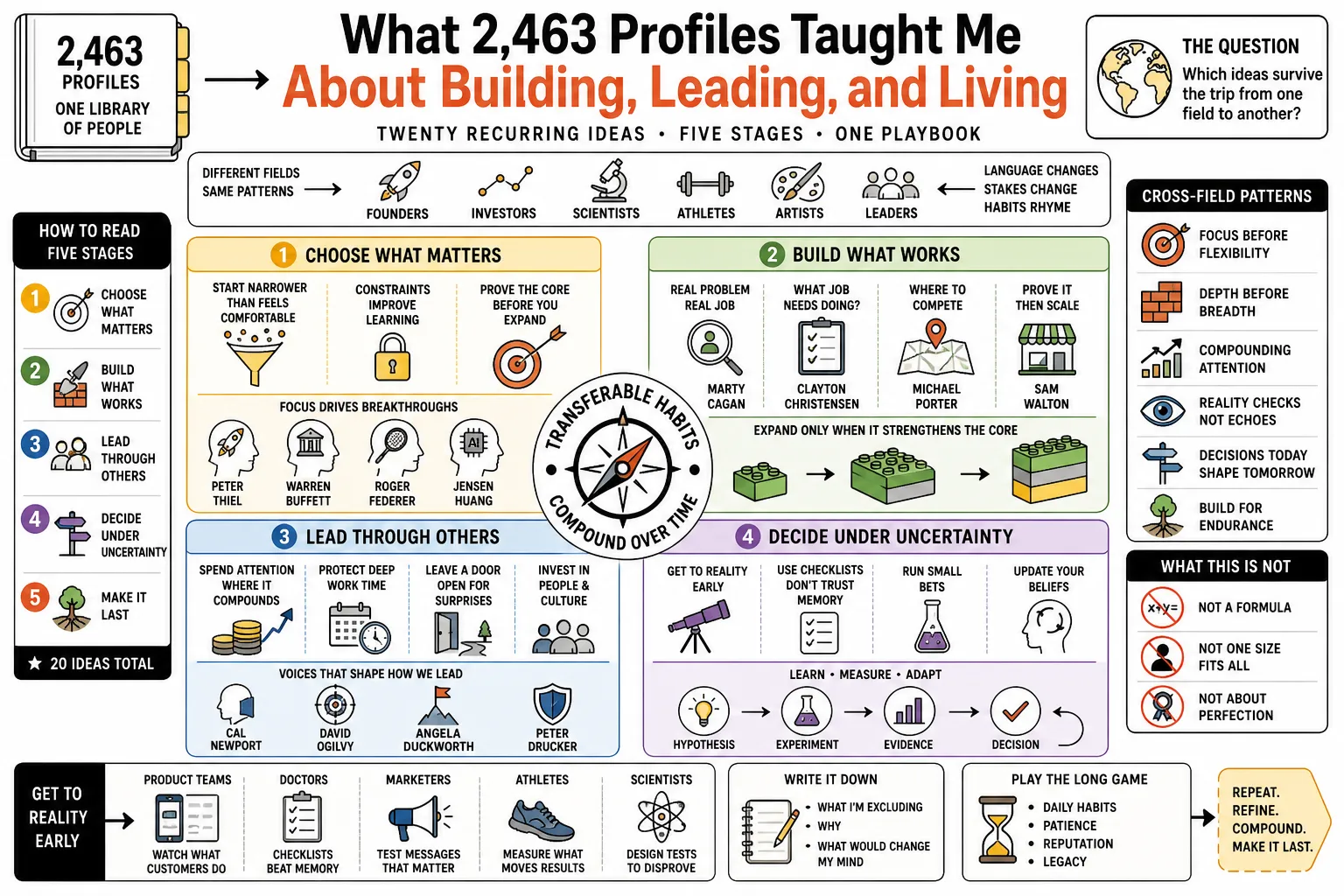
How to read this
I grouped the principles into five stages:
Choose what matters
Start narrower than feels comfortable
Many exceptional careers begin with a refusal. A focused investor limits the opportunities worth studying. A product builder chooses a specific user and job. An athlete reduces a season to a few trainable variables. Peter Thiel, Warren Buffett, Roger Federer, and Jensen Huang reached very different destinations, but each benefited from concentrating effort before expanding it.
A constraint is useful only while it improves learning. Yesterday’s focus can become tomorrow’s blind spot. Write down what you are excluding, why, and what evidence would persuade you to widen the field.
Prove the core before you expand
Expansion feels like progress because it creates visible activity. Often it simply spreads attention before the original promise works. Marty Cagan starts with the customer’s real problem. Clayton Christensen asks what job needs doing. Michael Porter forces a choice about where to compete. Sam Walton built outward from a retail engine that had already proved itself.
Breadth is sometimes necessary from day one, especially in a crisis or a public mission. But every new surface should strengthen something that already works—or clearly explain why it cannot wait.
Spend attention where it compounds
Attention behaves more like capital than a personality trait. Uninterrupted thought improves judgment, timing, and taste. Cal Newport makes the case for deep work; David Ogilvy for sustained attention to the customer; Angela Duckworth for long practice; and Peter Drucker for protecting the work that matters most.
Total insulation is not the answer. Wandering, conversation, and unfamiliar fields can produce the best ideas. Protect time for the hardest problem, but leave a door open for useful surprises.
Get to reality early
A plan becomes useful when the world gets a chance to disagree with it. Product teams watch what customers do. Doctors use checklists because memory fails. Marketers listen for the words customers already use. Marty Cagan, Atul Gawande, April Dunford, and David Ogilvy all shorten the distance between an idea and the evidence that can correct it.
The first signal is not always the right one. Early users may be unusual, metrics can be gamed, and experts can be wrong. Before gathering feedback, decide what observation would genuinely change your mind.
Build what works
Write down what good looks like
Taste starts as judgment built through exposure. It becomes useful to a team only when other people can see the standard. Ed Catmull made candid creative review part of Pixar’s process. Warren Buffett made investment criteria explicit. Ben Thompson and Michael Porter use clear models to separate a promising exception from an attractive distraction.
Standards can harden into bureaucracy. Keep examples of what passed, what failed, and what surprised you. A good rubric learns from the exceptions.
Run small tests that can change the plan
A useful experiment is a relatively cheap way to learn something that affects the next decision. Eric Ries tests assumptions with products, John Boyd with rapid observation and adjustment, Annie Duke with probabilistic thinking, and Kent Beck with tight development cycles.
Experiments become theatre when they are designed to reassure the person running them. Before you start, name the decision the result could change, the signal that counts, and the point at which you will stop.
Fix the system before you scale it
Scale magnifies whatever is already there. A confused process becomes more confusing; an unclear responsibility becomes a larger queue. Donella Meadows showed how structure drives outcomes. Andy Grove and Peter Senge treated systems as something leaders must design, while Jensen Huang built the tools and organization needed to support greater ambition.
There is an opposite failure: building an elaborate machine before the work deserves one. Standardize the repeated path. Leave unusual work room to remain unusual.
Build distribution that gets easier over time
The strongest distribution assets reduce the cost of the next conversation. A reputation, product habit, community, trusted channel, or clear category can keep working after the original promotion ends. Marc Andreessen, Seth Godin, Ben Thompson, and Sam Walton built very different forms of reach, but none depended on starting from zero every morning.
Compounding channels also create dependency. Platforms change their rules, audiences become echo chambers, and brands can outlive the products beneath them. Build one channel that compounds and keep another path you control.
Make handoffs easy to follow
Work disappears in the gaps: founder to team, research to product, strategy to execution, one shift to the next. Peter Drucker and John Doerr made ownership visible. Atul Gawande reduced errors with shared checks. Amy Edmondson showed why people must also feel able to raise what the process missed.
A useful handoff answers four questions: what changed, who owns the next move, what could go wrong, and where the source of truth lives. More documentation is not automatically more clarity.
Get feedback before mistakes compound
Speed matters because it determines how long a mistaken assumption survives. Kent Beck found fast feedback in code; Roger Federer in practice and competition; Eric Ries in product experiments; and Angela Duckworth in deliberate repetition.
The goal is not motion for its own sake. A fast loop around the wrong metric only helps you fail faster. Shorten the delay where feedback is reliable, and be honest about areas where results take time to mature.
Lead through others
Reward the behavior you actually want
People respond to the game that exists, not the values printed on the wall. Ray Dalio makes decision rules explicit. Elinor Ostrom shows how communities design rules people can live with. Peter Drucker and Indra Nooyi connect measures to responsibility and execution.
Every metric makes something visible and something else easier to ignore. Ask what behavior wins the game, what behavior disappears, and what damage a clever person could do while still hitting the target.
Make it safe to say what is not working
Bad news usually arrives as a weak signal before it becomes a crisis. Amy Edmondson calls the needed climate psychological safety. Peter Senge looks for feedback the organization has learned to ignore. Daniel Kahneman and John Boyd remind us how easily judgment loses contact with what is happening.
Disagreement without standards becomes noise. Ask for a specific observation, the evidence behind it, and a clear owner for the final decision.
Add controls where mistakes are costly
Not every choice deserves the same oversight. A high-stakes, hard-to-reverse decision needs safeguards. A low-stakes choice usually benefits from local speed. Howard Marks is careful about downside, Atul Gawande about preventable error, Andy Grove about organizational leverage, and Peter Drucker about placing authority where the work happens.
More approval does not always mean more safety. Set control by the size of the downside, how easily the decision can be reversed, and how quickly a mistake would become visible.
Use stories to align people—not hide the facts
A good story helps distributed people make compatible choices. Satya Nadella used narrative to reset a culture. Seth Godin uses it to define categories and communities. Jim Collins and David Ogilvy show how a clear idea can coordinate a company or campaign.
Stories become dangerous when they make contrary evidence feel disloyal. Tie the story to something observable, and give uncomfortable facts a place to be heard.
Decide under uncertainty
Move fast when the decision is reversible
Some decisions deserve careful debate. Others can be tried, observed, and undone. Jeff Bezos popularized the distinction between one-way and two-way doors. Annie Duke, Howard Marks, and John Boyd approach the same problem through probability, risk, and tempo.
The hard part is classification. A supposedly reversible choice can become expensive through reputation, emotion, or accumulated dependencies. Name the cost of delay and the point when turning back would stop being cheap.
Keep your options open until it is time to commit
Keeping options open means resisting the urge to trade away future choices simply to feel certain now. Nassim Taleb looks for asymmetric bets. Rita McGrath treats strategy as something that must adapt. Howard Marks respects uncertainty, and David Deutsch insists that better explanations remain possible.
This is not an excuse to drift. A closing window, safety concern, or promise to another person may require commitment before certainty arrives. Set a date or signal that ends exploration and starts action.
Use a decision rule, not a mood
Emotion is part of judgment, but it should not quietly change the standard from one day to the next. Daniel Kahneman exposes predictable biases. Annie Duke separates decision quality from outcome luck. Warren Buffett and Ray Dalio use written criteria to resist the pressure of the moment.
Rules can turn into rituals when circumstances change. Record the assumption behind the rule and the exception that would justify setting it aside.
Make it last
Turn setbacks into practice
Resilience becomes useful when hardship leads to a repeatable response: understand what happened, recover, adjust, and return to the work. Serena Williams and Michael Jordan trained that response in competition. Susan David and Viktor Frankl explored how people can face difficult reality without surrendering agency.
Not every hardship deserves endurance. Some environments are abusive, structurally impossible, or simply wrong. Distinguish a demanding season that builds capacity from a situation that consumes the capacity needed to leave.
Let habits—not self-image—do the talking
Identity can make difficult behavior easier to repeat: I am someone who trains, tells the truth, or finishes the experiment. But the label can become a costume that protects the ego from evidence. James Clear and Cal Newport emphasize repeated practice. Brené Brown and Marshall Goldsmith show why honesty about behavior matters more than the story we tell about ourselves.
Define identity through actions someone else could observe. If those actions no longer serve the work, change them—and let the identity catch up.
Build so someone else can carry it forward
The final test is whether the work can survive its creator. Elinor Ostrom designed for shared stewardship. Jim Collins studied organizations that outlast individual leaders. Peter Senge and Satya Nadella show how learning can become part of an institution rather than the property of one person.
Leaving something behind does not mean freezing it. Preserve the principles, decisions, and evidence well enough that a successor can change the system without first decoding its mythology.
What carries forward
Across technology, investing, science, sport, media, psychology, and public life, the durable lessons are rarely glamorous. Choose a problem where learning can accumulate. Get close to reality before polishing the story. Make good behavior easier through simple systems. Give people enough clarity to act and enough freedom to tell you when the plan is wrong. Commit in proportion to the consequences. Leave the work understandable enough that someone else can improve it.