How effective leaders build culture and drive execution
Across 109 leadership & management thinkers profiles and 6,017 lessons, 19 patterns recur often enough to matter. They are not universal rules; recurrence indicates breadth within this collection, not agreement across an entire field.
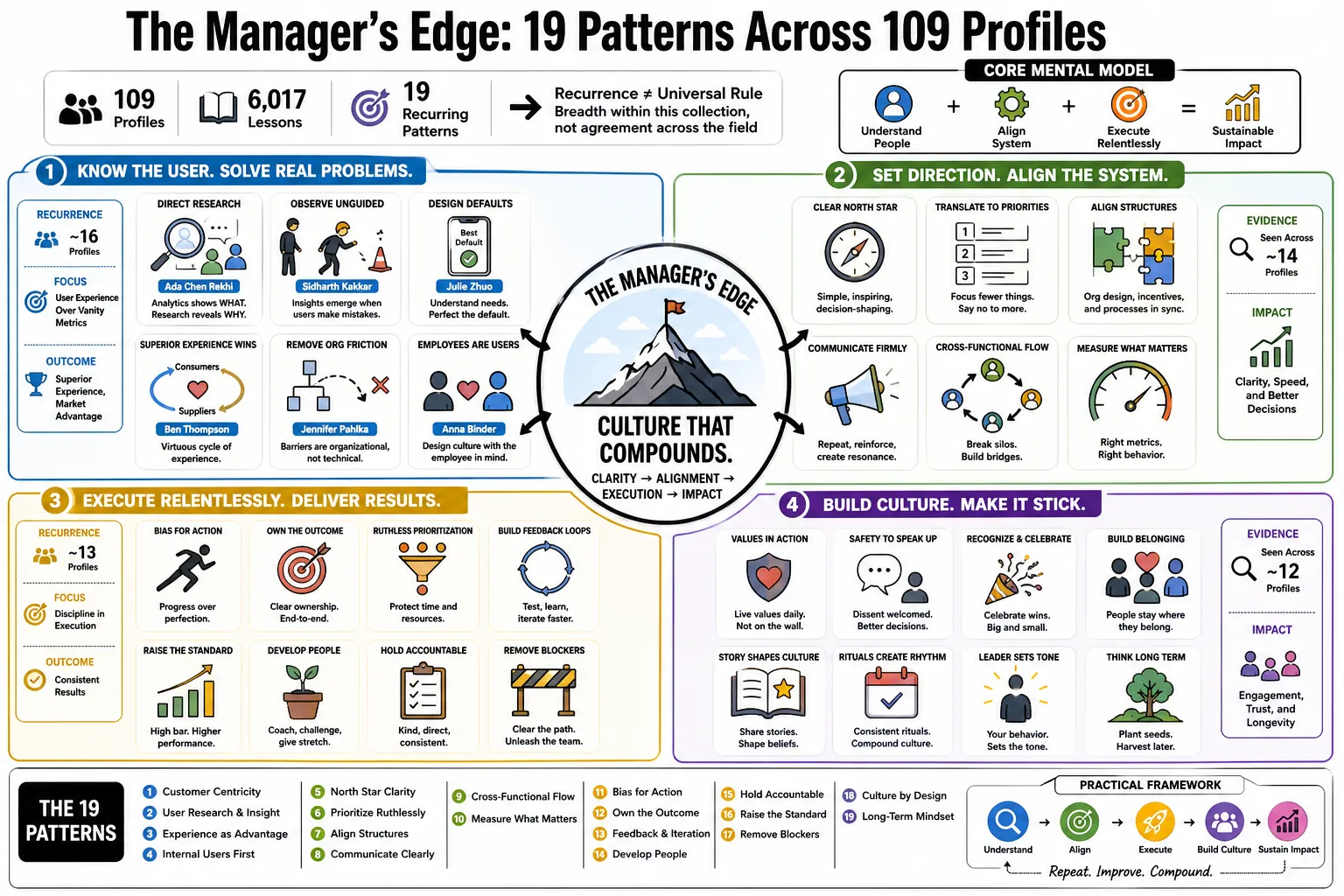
1. Customer Centricity
Obsessing over the user experience, conducting direct research, and solving genuine pain points over vanity metrics. · recurs across ~16 profiles
True customer centricity demands a relentless obsession with the user experience, prioritizing genuine pain points over vanity metrics. The distinction lies in looking beyond superficial engagement data to uncover human motivations. As Ada Chen Rekhi emphasizes, analytics show what users do, but only direct qualitative research explains why. Observing unguided behavior is crucial. Sidharth Kakkar notes that profound insights emerge when users confidently make mistakes; observing their uncorrected recovery process reveals actual friction points.
The implications fundamentally shape product strategy. For Julie Zhuo, design means deeply grasping human needs to perfect the default experience, rather than relying on customization options as a crutch. This focus on seamlessness drives market dominance. Ben Thompson argues that successful aggregators win through superior experiences, creating a virtuous cycle that attracts consumers and suppliers alike.
However, execution requires aligning internal operations with user realities. Jennifer Pahlka warns that the main barriers to great service are rarely technical, stemming instead from organizational structures disconnected from the actual user journey. This philosophy even extends inward; Anna Binder contends that employees are the users of company culture, making direct internal research essential to avoid building blindly. Ultimately, Sangeet Paul Choudary shows that embedding customer-centricity directly into the product experience, rather than treating it as an isolated marketing goal, is what sustainably drives organic growth.
2. Decision Making
Utilizing mental models, first principles, and structured frameworks to make choices under conditions of uncertainty. · recurs across ~6 profiles
Under conditions of uncertainty, leaders must actively evaluate how their cognitive tools map to reality, rather than relying on default assumptions. Herbert A. Simon observed that while heuristics provide necessary shortcuts through complex environments, these same mental efficiencies inevitably introduce systematic biases. This underscores a central tension: efficiency often trades off against accuracy. In fact, established success can become a vulnerability, as C.K. Prahalad cautioned that prevailing mental models born of past triumphs routinely obscure nascent opportunities.
Rather than treating decision-making as a purely logical exercise, which James G. March critiqued as an almost religious devotion to rationality, effective leaders build adaptable frameworks. As Elinor Ostrom asserted, “When the world we are trying to explain and improve, however, is not well described by a simple model, we must continue to improve our frameworks and theories so as to be able to understand complexity and not simply reject it.” [Source]
To operationalize this understanding, Sara Clemens advocates for continuous systemic adaptation, ensuring that outdated choices are discarded as organizational learning evolves. This proactive stance prevents legacy decisions from becoming structural impediments. Furthermore, making these evolutionary processes explicit is crucial for scaling. Nadia Singer stresses the importance of codifying decision-making architectures early on, providing new team members with transparent blueprints for how choices are formulated. By continuously refining their mental models and documenting their structural logic, leaders can navigate complexity without succumbing to the rigid constraints of past successes or overly simplistic theories.
3. Execution
Translating ideas into reality through speed, bias for action, momentum, and operational hygiene. · recurs across ~10 profiles
Execution is the crucible where theoretical strategies become tangible outcomes. For modern organizations, translating ideas into reality relies heavily on cultivating momentum and a relentless bias for action. Thinkers like Nikhyl Singhal emphasize that operational velocity serves as a paramount competitive advantage. In resource-constrained environments, Matt Clifford argues that rapid iteration is often the sole mechanism to outpace better-funded competitors. Cultivating this speed requires dismantling bureaucratic hurdles; as Sidharth Kakkar observes, demanding broad consensus before shipping updates inherently paralyzes progress. Instead, organizations should treat most choices as flexible experiments. Bill Carr champions the practice of making swift choices on easily reversible actions, allowing teams to pivot rather than stagnating in analysis.
However, raw speed introduces operational risks if uncoupled from structural hygiene. While John Doerr advocates for urgent, massive-scale implementation, Gretchen Howard warns that acceleration is only productive when a company actively maintains its internal principles. Operational leaders must ensure that rapid execution does not outstrip institutional trust and practical controls. This balancing act involves maturing from ad-hoc systems into robust models without sacrificing initial agility, a necessary transition highlighted by Nadia Singer.
Sustaining execution also requires disciplined focus. Henrik Kniberg points out that true momentum comes from strictly limiting ongoing tasks to guarantee actual delivery, prioritizing functional value over exhaustive planning. By combining this lean focus with the compounding momentum described in Jim Collins’s flywheel framework, organizations can sustain high-velocity execution while systematically building the sturdy managerial foundations historically detailed by Alfred D. Chandler Jr..
4. Signal Detection
The systematic approach to filtering critical feedback from background noise, designed to surface hard truths from the silent majority. · recurs across ~7 profiles
Effective signal detection is the deliberate practice of separating fundamental truths from institutional noise. Because inherent power dynamics naturally suppress honest communication, Sidharth Kakkar argues that leaders must build structured, anonymous channels to capture harsh realities from the silent majority. This perspective is echoed by Russ Laraway, who considers upward feedback surveys an absolute requirement for identifying managerial blind spots. Treating workplace environment as a product, Anna Binder asserts that failing to conduct regular employee research through listening tours and surveys leaves leaders operating completely in the dark. Furthermore, Julie Zhuo emphasizes that proactively drawing out these signals requires frequent, highly specific inquiries delivered with genuine curiosity to ensure psychological safety.
Beyond cultural feedback, signal detection is equally critical in strategic planning. Internal politics and self-preservation often corrupt strategy with what Chris Bradley describes as overly optimistic, hockey-stick projections meant solely to secure budgets. Overcoming this requires introducing reliable, external benchmarks to anchor decisions in reality. Navigating this modern era of information abundance, as Rohit Krishnan points out, hinges on filtering out such background noise while remaining highly receptive to valid insights. In this saturated environment, Jonah Berger notes that highly actionable and practical concepts naturally cut through the clutter. Ultimately, strong signal detection mandates replacing passive assumptions with systematic, objective filters that force uncomfortable but necessary facts to the surface.
5. Distribution
Strategies for acquiring customers, managing pricing, and leveraging marketing channels to drive sustainable growth. · recurs across ~7 profiles
The challenge of distribution requires leaders to treat growth not as an isolated marketing function, but as an integrated system spanning product, pricing, and community. For established offerings, Nikhyl Singhal separates growth management from early-stage product development, noting that growth specialists must rely on tight iteration cycles, data science, and clear accountability to translate an existing foundation into measurable retention and acquisition. Yet, buying users is futile if they immediately churn. Ada Chen Rekhi emphasizes that customer acquisition is fundamentally flawed without deep alignment between marketing and product teams to seal the underlying retention loops. Rather than treating expansion solely as external outreach, Sangeet Paul Choudary argues that virality should be architected directly into the core user experience, organically rewarding natural sharing behavior.
Pricing and market positioning act as equally essential levers for distribution. Sidharth Kakkar asserts that pricing transcends mere financial calculation; it is a deliberate positioning choice that dictates your exact audience and their perception of value. In the context of aggressive expansion, Lina Khan observes that platform economics often incentivize prioritizing scale over immediate profitability. Under these conditions, investors readily reward a strategy where predatory pricing emerges as a highly rational tactic to capture dominance. Ultimately, sustainable reach often relies on decentralization rather than top-down spending. Don Faul illustrates this through community-led models, demonstrating that empowering local advocates to build dedicated networks generates grassroots momentum far more effectively than massive corporate marketing campaigns.
6. Culture
Establishing shared values, behavioral norms, and psychological safety that shape how teams interact and operate. · recurs across ~11 profiles
Culture is an engineered environment that guides behavioral norms, rather than a mere collection of individual mindsets. Instead of attempting to alter internal attitudes directly, leaders should adjust the external conditions to which people adapt, an approach emphasized by Claude Steele and Dave Snowden. This treats leadership as an architectural discipline; as Anna Binder notes, a toxic workplace is a failure of its architects. Practical execution involves the strategy championed in Learnings from Chip Heath & Dan Heath: smoothing the path for desired actions while introducing friction for unproductive ones.
A crucial pillar of this architecture is psychological safety. Without it, organizations risk developing a culture of silence where critical warnings go ignored, a phenomenon outlined by Amy Edmondson. Establishing this safety requires distinct environmental cues. Hal Gregersen stresses the need for spaces that welcome bold inquiries, and Nadia Singer advocates for settings where errors can be acknowledged without reprisal. Similarly, Mike Boufford highlights allowing engineers to raise structural concerns without being stigmatized.
These environments must remain adaptable to evolving social dynamics, such as younger generations reshaping corporate responsibility, as noted by Karl Moore. Such adaptation is vital because, as Rita McGrath observes, “A strategic inflection point is a change, typically in the environment, that could be caused by technology, social norms or many other different things. The key insight is that an inflection point causes the -taken for granted- assumptions on which your business is based on, to no longer be true.” [Source] Ultimately, Kelly McGonigal suggests that engaging, supportive communities foster a profound sense of shared identity.
7. Talent
Acquiring, interviewing, evaluating, and retaining high-performing individuals who elevate the organization. · recurs across ~8 profiles
Building an exceptional organization requires treating talent acquisition and retention as a core strategic function rather than a mere administrative process. Sara Clemens emphasizes that operational excellence relies fundamentally on having the right leaders and a team structure capable of scaling with the company’s overarching strategy. To achieve this, Bradford D. Smart advocates for rigorous methodologies to identify and promote high performers, which ultimately accelerates business growth.
The responsibility for this high bar does not rest solely on recruiting teams. Anna Binder points out that hiring managers must own the final results, actively participating in both sourcing and closing candidates. This active involvement helps ensure that every addition to the team elevates the group’s overall caliber; as Bill Carr observes, failing to hire above the current average slowly diminishes the organization’s talent pool. Furthermore, the hiring process must be equitable. Nadia Singer highlights the importance of analyzing the recruiting funnel to pinpoint and fix stages where diverse candidates are disproportionately lost.
Once individuals join, retaining them requires deliberate effort, especially as a company grows. Don Faul notes that culture ceases to be organic at larger scales and must be explicitly integrated into performance evaluations and hiring criteria. Beyond formal structures, holistic support is vital. Keith Ferrazzi argues that addressing an employee’s mental well-being and personal purpose drives sustained performance, while Dave Kline champions the creation of deep personal relationships and a strong sense of community as powerful mechanisms to keep top talent engaged over the long term.
8. Leadership
Inspiring action, modeling desired behaviors, setting the vision, and managing the emotional state of the organization. · recurs across ~8 profiles
Effective leadership fundamentally requires distinguishing between formal authority and genuine influence. Gary Hamel observes that while titled managers rely on positional power, true leaders mobilize others through moral authority and shared purpose. This perspective aligns closely with Don Faul, who notes that rank merely grants authority; actual influence must be earned on the ground alongside your team. Similarly, Paul R. Lawrence and Jay W. Lorsch argue that effective integration relies on influence built upon expertise rather than organizational hierarchy.
While organic influence is essential, formal hierarchy still offers tactical advantages. Jade Rubick points out that “Reflected Power is using the authority of those above you to amplify your influence and achieve your goals.” (Source)
Beyond establishing influence, leaders must actively manage the organization’s emotional state to drive lasting change. John P. Kotter emphasizes that successful transformation is rarely about systems or structural adjustments; it is fundamentally about altering human behavior. To overcome resistance, leaders must shift the narrative from hazard to opportunity. Because human brains are wired for narratives rather than raw analytics, Kotter stresses that communicating a vision through compelling stories strikes an emotional chord, replacing anxiety with energy. Ultimately, leadership requires both the emotional intelligence to connect with people on a human level and the strategic foresight to foster an adaptable culture where employees are empowered to take intuitive leaps, a practice Adam Brandenburger considers vital for exploring unconventional ideas.
9. Communication
Mastering active listening, written clarity, context setting, and radical candor to align organizational understanding. · recurs across ~6 profiles
Effective organizational alignment relies not on the sheer volume of communication, but on the disciplined application of active listening, written clarity, and rigorous context setting. The foundation of this alignment begins with listening. As Gretchen Howard advises, incoming executives must prioritize absorbing institutional context during their initial months rather than hastily overhauling established systems. This deep comprehension lays the groundwork for strategic decisions, which Sara Clemens notes must be preceded by vigorous debate and the localized contextualization of options before an organization commits to complex initiatives like global expansion.
When transitioning from understanding to articulation, written clarity becomes paramount. Bill Carr highlights that drafting narrative documents, such as a PR/FAQ, exposes the quality of underlying logic because coherent prose demands coherent thought, stripping away the ambiguity often hidden in bulleted presentations. This aligns closely with Barbara Minto’s framework for structural clarity, which emphasizes that organizing ideas logically makes them inherently more accessible and actionable for the audience.
In distributed settings, context setting requires deliberate systemic design. Sidharth Kakkar points out that silence in asynchronous environments breeds ambiguity, making the over-communication of both intent and context essential for maintaining team alignment without constant synchronous meetings. To sustain this rhythm, Anna Binder advocates for defining specific windows of overlapping core hours for necessary synchronous collaboration, while fiercely protecting the remaining time for focused, asynchronous execution. Together, these practices transform communication from a mere exchange of information into a forcing function for organizational clarity.
10. Founder Transition
The personal and structural challenges founders face when relinquishing control, delegating authority, and scaling their own roles as the company grows. · recurs across ~6 profiles
As founders transition from doing everything to scaling the company, they face the profound challenge of relinquishing control. A core realization is that scaling requires intentional self-replacement; as Julie Zhuo points out, managers must constantly seek ways to hand off their current duties so they can focus on higher-level strategic priorities, embedding these new workflows into codified playbooks to prevent themselves from becoming bottlenecks.
Delegating effectively requires more than just assigning tasks—it demands building a structure of trust and autonomy. Sara Clemens emphasizes that micromanagement is fundamentally unscalable; leadership should focus on providing resources and establishing direction, then stepping aside. This echoes the military principle of mission intent championed by Russ Laraway, where clarifying the ultimate goal empowers teams to operate independently without constant oversight.
To make this structural autonomy succeed, organizations must align incentives and operational parameters. Gary Hamel argues for giving teams entrepreneurial freedom, including financial stakes, while Tony Schwartz adds that autonomy should extend to working conditions, judging people entirely on the value they produce rather than hours logged. Even at a systems level, Stafford Beer notes that decentralized networks thrive when local units are given maximum independence, with central leadership intervening only when those local systems fail to cope. Ultimately, a successful founder transition means shifting from being the primary engine of the company to designing an ecosystem where autonomous individuals can flourish.
11. Organization Design
Structuring teams, managing complexity, and minimizing organizational debt to preserve agility at scale. · recurs across ~4 profiles
Organization design requires balancing structure and agility to manage complexity at scale. Alfred D. Chandler Jr. observed that once a managerial hierarchy is established to coordinate administration, it tends to transform into a self-perpetuating engine for power and continued expansion. This structural permanence can quickly accrue organizational debt. Echoing skepticism about rigid systems, Michael Jacobides highlights the inherent limitations of formal architectures and the frequently unrealized potential of traditional hierarchies.
To preserve agility against this bureaucratic gravity, structural design must shift from rigid frameworks to adaptable cultures. Henrik Kniberg argues that effective scaling relies on cultivating a mindset of continuous improvement rather than installing static methodologies. He advocates for balancing high autonomy with strong strategic alignment, where leadership defines the problems and loosely coupled, cross-functional teams engineer the solutions. This approach reduces external dependencies and accelerates delivery by aggressively limiting work-in-progress.
However, as organizations grow and divide labor, operational integration becomes increasingly difficult. Paul R. Lawrence and Jay W. Lorsch determined that as internal departments become more specialized and distinct, aligning their diverse efforts into a cohesive whole becomes significantly harder. The implication is that modern organizational design cannot rely solely on reporting lines; it must actively foster interpersonal trust and shared context to bridge isolated silos. Ultimately, managing complexity means recognizing that all operating models are merely temporary snapshots, and long-term scalability depends on dynamic alignment, restricted hierarchical bloat, and a relentless focus on customer outcomes.
12. Accountability
Taking extreme ownership, delegating effectively, setting clear expectations, and enforcing peer standards. · recurs across ~4 profiles
Accountability in leadership demands a careful balance between assigning ownership and maintaining clear parameters. Modern management philosophy, as articulated by Dave Kline, suggests that leaders must empower their teams by handing over full responsibility for outcomes, provided they simultaneously establish explicit expectations and firm boundaries. This approach transforms accountability from a punitive measure into a framework for autonomy. Similarly, Gary Hamel argues for a fundamental paradigm shift away from traditional top-down control. He emphasizes that organizations must instead cultivate a deep-seated sense of ownership across every level of the workforce, ensuring that strategy and innovation become collective responsibilities rather than executive privileges.
However, historical perspectives reveal a stark conflict in how this responsibility is distributed. Frederick Taylor envisioned a system where accountability was structurally divided, insisting that managers take on the exclusive burden of planning and organizing while workers focus solely on execution. Taylor believed that enforcing strict standards and removing decision-making from the front line was the optimal path to efficiency. This mechanistic view directly contradicts the modern consensus championed by Hamel and Kline, which argues that stripping agency from employees stifles the very ownership required for contemporary success.
Ultimately, true accountability hinges on behavioral alignment. As Luca Dellanna notes, the expectations leaders set today reliably predict the future state of their teams. Effective delegation is not merely assigning tasks, but actively enforcing peer standards and ensuring that the scope of authority matches the weight of the responsibility given.
13. Macroeconomics
Navigating global supply chains, industrial policy, market cycles, and the financialization of broader economies. · recurs across ~4 profiles
Navigating the complexities of macroeconomic policy and market cycles requires moving beyond rigid economic orthodoxies. As Elinor Ostrom demonstrated, shared resources can be governed effectively through localized, community-based arrangements. This challenges the traditional assumption that strict privatization or top-down government regulation are the only viable solutions for managing common assets. Such decentralized governance provides a vital framework for building resilience across global supply chains.
Meanwhile, the financialization of the broader economy has profoundly shifted how value is captured during market cycles. Matt Stoler highlights how concentrated market power enables dominant firms to exploit inflationary periods, converting the majority of recent price escalations directly into corporate profits rather than reflecting pure cost pressures. Within these distorted market dynamics, Bruce Greenwald argues that investors analyzing companies with protected franchises must meticulously evaluate a management team’s historical track record of expanding the specific earnings generated by those structural advantages.
Finally, shaping effective industrial policy requires acknowledging the harsh realities of technological advancement. Rather than romanticizing innovation as the product of isolated genius, Bhu Srinivasan notes that true breakthroughs demand massive, long-term capital commitments and a systemic tolerance for high-risk failures. Together, these principles dictate that adapting to modern macroeconomic shifts requires a pragmatic synthesis of localized resource management, rigorous capital allocation, and an unflinching assessment of corporate monopolization.
14. Technology
Leveraging infrastructure, artificial intelligence, software architecture, and technical tools as strategic multipliers. · recurs across ~6 profiles
Technology serves as a potent strategic multiplier when integrated thoughtfully, though leaders differ on its foundational principles. At a macroscopic level, both Tony Blair and Jennifer Pahlka highlight the public sector’s need for comprehensive technological overhauls. Blair advocates for using digital systems to completely restructure government operations around individual citizen needs, while Pahlka emphasizes the immediate necessity of shared digital infrastructure to prevent agencies from wastefully duplicating efforts during crises.
In the private sector, the focus shifts toward scaling and pragmatic architecture. For Rohit Krishnan, the apex objective for modern startups is leveraging software to amplify human intelligence and radically boost productivity. Achieving this scale requires careful infrastructural choices. Mike Boufford advises that leaders must select technical tools that resolve immediate bottlenecks while maintaining a viable trajectory for future expansion.
However, the human element introduces complications to these structural designs. Manuel Pais and Matthew Skelton warn that just as software blueprints become obsolete the moment coding begins, rigid organizational charts fail to capture the dynamic reality of how teams actually function. Taking this human-centric perspective further, Kent Beck fundamentally challenges the primacy of the technology itself. He asserts that the true foundation of software development is empathy for the user and teammates, rather than an obsession with programming languages, algorithms, or technical toolchains.
15. Ecosystems
Orchestrating platforms, partnerships, and multi-sided networks where value is co-created with external participants. · recurs across ~4 profiles
The transition from traditional industrial pipelines to multi-sided networks requires leaders to rethink where value originates. Rather than relying solely on internal resources and technological innovation, organizations must learn to orchestrate external ecosystems where value is continuously co-created by decentralized producers and consumers. Sangeet Paul Choudary emphasizes that a platform’s true worth depends on enabling these external exchanges and actively managing the resulting network effects, with careful curation acting as the primary defense against negative dynamics.
However, designing for ecosystems involves distinct strategic choices. Ben Thompson offers a critical distinction in this space, contrasting true platforms—which are built to empower third-party participants—with aggregators that seek to control and intermediate those relationships. Sustainable differentiation in these models relies on understanding the value chain and identifying the precise point of integration. Extending these ideas into practical organizational design, Simone Cicero highlights that future-proof enterprises must embrace networked structures and boundaryless partnerships to tackle challenges that outpace the capabilities of single entities.
While the platform economy offers immense scale, it also presents systemic risks. Lina Khan observes that as platforms solidify their market positions, their tendency toward vertical integration can entrench monopolies and stifle the very markets they helped create. Consequently, leaders orchestrating these ecosystems face the dual challenge of designing systems flexible enough to foster rapid, organic adoption, while recognizing that unchecked dominance can lead to significant commercial and regulatory friction. The ultimate mandate is to leverage emerging demand patterns to attract users naturally, without suffocating the independent external participants that generate the ecosystem’s fundamental value.
16. Moats
Building defensible competitive advantages, network effects, and switching costs to protect long-term margins. · recurs across ~4 profiles
Bruce Greenwald establishes the foundational reality of moats: without the protection of barriers to entry, a company’s only survival mechanism is flawless operational efficiency. Because efficiency is grueling and easily copied, companies must instead build structural advantages to permanently protect long-term margins.
One of the most powerful structural moats is the platform ecosystem. As Sangeet Paul Choudary explains, managing network effects creates a formidable barrier against competitors. In a platform model, defensible advantage stems from the ecosystem’s ability to facilitate value creation between external producers and consumers rather than internal resources. As each new participant joins, the network becomes intrinsically more valuable, which naturally locks in users and steadily increases switching costs.
However, achieving raw size is insufficient on its own. Felix Oberholzer-Gee cautions that scale only acts as a sustainable advantage when it directly translates into an increased willingness to pay from customers or a decreased willingness to sell from suppliers. If network effects do not improve these core economic drivers, the moat is an illusion.
Finally, while structural barriers define strategic moats, organizational health acts as a crucial execution moat. Patrick Lencioni notes that a cohesive leadership team united by a clear thematic goal can eliminate internal silos and turf wars. Cultivating employees who are humble, hungry, and smart creates a highly adaptive culture. This internal alignment forms a distinct competitive advantage, ensuring the company can successfully defend its strategic boundaries without collapsing under internal dysfunction.
17. Wellbeing
Managing physical and emotional energy, recognizing burnout, and sustaining long-term personal and team performance. · recurs across ~7 profiles
Sustaining long-term performance requires a deliberate shift from merely managing time to actively managing physical and emotional energy. Lara Hogan points out that leadership is inherently emotionally exhausting, making this proactive energy management critical for avoiding severe depletion. Relying on adrenaline for quick boosts is a toxic strategy; Tony Schwartz explains that chronic adrenaline use floods the body with cortisol and inevitably leads to burnout. Recognizing that personal wellbeing is a core professional asset is crucial. As Don Faul observes, failing to protect your mental and physical health transforms you from an asset into a liability to your own organization.
However, preventing burnout is not solely an individual burden. Nicole Forsgren emphasizes that burnout fundamentally stems from systemic organizational environments rather than personal shortcomings, posing a profound threat to a company’s overall sustainability. To counteract this, structural interventions are necessary. For instance, Anna Binder notes that offering extended time away from work can effectively prevent burnout while restoring an employee’s perspective and vitality.
This imperative for organizational wellbeing also connects to broader societal health. Donella Meadows suggests that achieving true sustainability relies on the collective behaviors of billions of people rather than isolated entities. Addressing these interconnected challenges demands comprehensive transformation. As Simone Cicero argues, “We must rethink our entire society, e.g. transport, food and energy supply and consumption, sustainability, accountability for wider issues, increase cooperation between organisations and citizen-led groups.” [1]
18. Learning
Fostering continuous education, embracing feedback loops, and adapting through deliberate reflection and unlearning. · recurs across ~5 profiles
At the heart of modern leadership is the commitment to continuous learning, which requires organizations to embrace rapid adaptation and robust feedback mechanisms. Instead of treating growth as a straightforward path, John Boyd conceptualized it as a perpetual loop of receiving information and adjusting course. This agility is the true competitive edge of new ventures. Sidharth Kakkar emphasizes that a startup’s primary advantage lies not in its financial resources or market distribution, but in its unparalleled ability to digest criticism rapidly and deploy immediate improvements.
To foster this environment of rapid iteration, managers must weave education seamlessly into daily operations. Russ Laraway advocates for delivering coaching as an immediate, ongoing dialogue rather than hoarding observations for formalized, infrequent performance reviews. This approach ensures that individuals can course-correct before bad habits solidify. Navigating this dynamic landscape requires leaders to adopt multifaceted approaches to team development. Lara Hogan points out that effective management involves fluidly transitioning between various supportive roles, such as championing employees, guiding their development, and providing candid evaluations.
Crucially, the pursuit of learning necessitates a willingness to confront uncomfortable truths. Sian Beilock illustrates this by actively seeking out her harshest critics, recognizing that unfiltered, critical perspectives are vital for uncovering profound areas of personal improvement. Ultimately, fostering an educational culture demands moving beyond comfortable assumptions, constantly seeking rigorous external perspectives, and maintaining the operational flexibility to transform those insights into immediate action.
19. Innovation
Challenging orthodoxies, experimenting systematically, and pursuing breakthrough ideas that disrupt the status quo. · recurs across ~4 profiles
True innovation demands abandoning rigid playbooks in favor of a mindset rooted in continuous experimentation and calculated risk-taking. As Henrik Kniberg observes, agile frameworks should not be rigidly installed; rather, organizations must cultivate an environment that continuously tests hypotheses and learns from failure. This shifts the focus from simply delivering features to validating that a product actually solves a real customer problem, ensuring teams build the right solution before optimizing how it is built. In this context, early iterations should function as complete, value-delivering vehicles—much like a skateboard rather than a standalone wheel—allowing for immediate user feedback.
Achieving such breakthroughs, however, requires an appetite for uncertainty. Steven Kotler emphasizes that exceptional discoveries are fundamentally impossible without taking significant risks. Supporting this, Michael Tushman & Charles O’Reilly III argue that organizations must actively foster a flexible culture that not only tolerates but encourages bold experimentation. A culture that penalizes failure ultimately stifles the creative leaps necessary for disruption.
Furthermore, individual adaptability plays a crucial role in navigating the turbulence of innovation. Jonathan Brill suggests that cultivating skills and networks outside of one’s primary domain provides a vital safeguard against industry-wide disruptions. By combining a broad, interdisciplinary skill set with a high-trust environment that empowers cross-functional teams, organizations can transform abstract ideas into tangible value. Ultimately, the goal is not to strictly adhere to a methodology, but to relentlessly pursue better outcomes by challenging the status quo and embracing the unpredictable nature of discovery.