Core Principles of Product Building
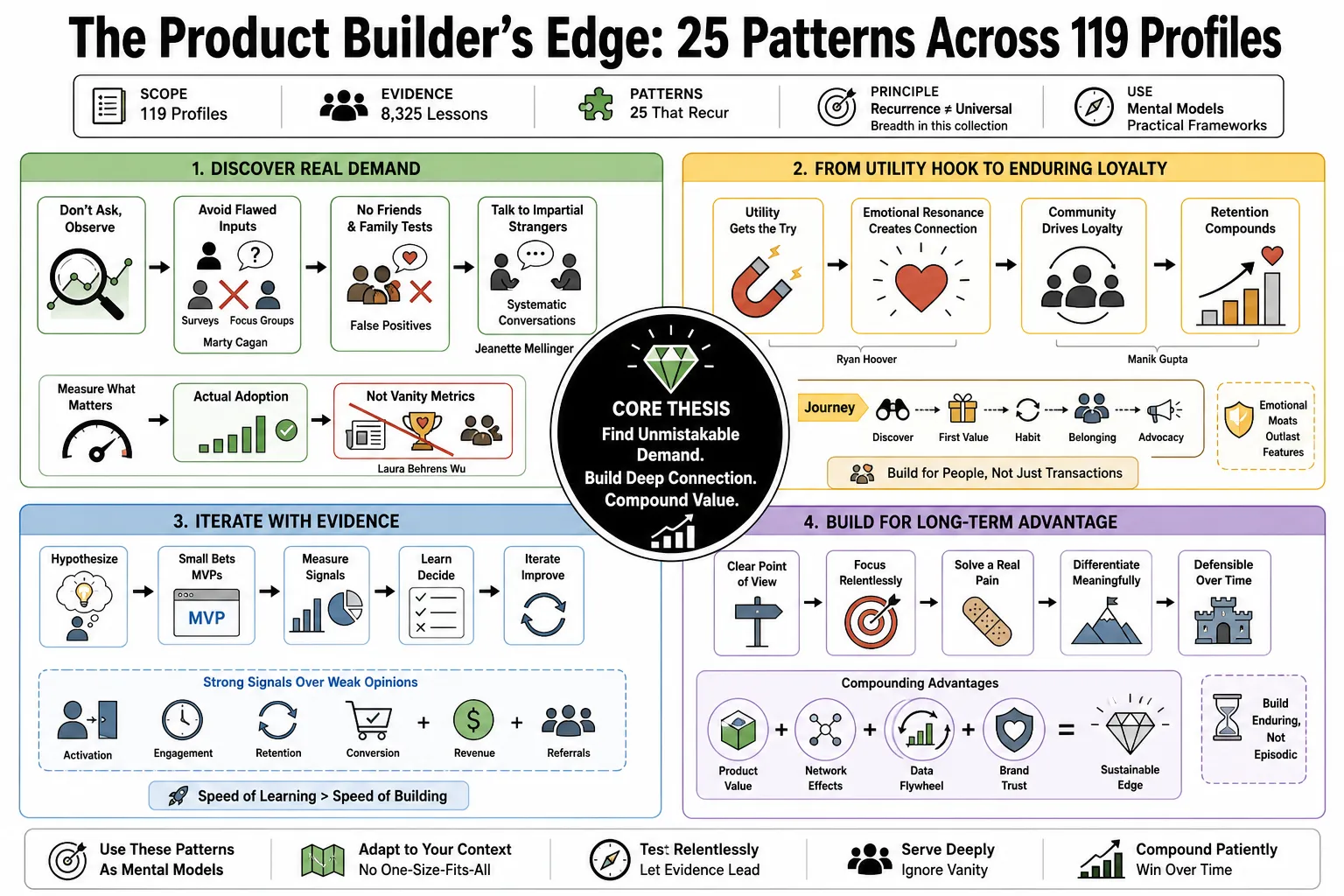
Across 119 product management profiles and 8,325 lessons, 25 patterns recur often enough to matter. They are not universal rules; recurrence indicates breadth within this collection, not agreement across an entire field.
1. Product-Market Fit
Validating core assumptions, discovering extreme demand, and iterating toward deep market resonance. · recurs across ~6 profiles
Achieving product-market fit requires a rigorous shift from seeking validation to discovering undeniable demand. True market resonance cannot be uncovered by asking people what they want; instead, it demands observing how they actually behave. As Marty Cagan notes, relying on hypothetical answers from focus groups or surveys is inherently flawed because they fail to capture real-world actions when users face a prototype. This necessity for objective truth means founders must avoid testing ideas with friends or family, who often provide falsely positive feedback to be supportive. Instead, Jeanette Mellinger advocates for systematic conversations with impartial individuals who have no personal investment in the creator’s feelings.
Once a product enters the market, the metric for success must remain focused on actual adoption rather than superficial accolades. Laura Behrens Wu highlights the danger of confusing external validation—such as media attention or investor enthusiasm—with genuine utility and user engagement. When extreme demand is discovered, it creates a foundation of utility that draws users in. However, long-term retention relies on a deeper connection. Both Ryan Hoover and Manik Gupta emphasize a critical distinction: while practical utility serves as the initial hook, it is emotional resonance and community that ultimately foster enduring loyalty. Cultivating this deep resonance is rarely a linear path; as Janna Bastow points out, maintaining product-market fit requires the strategic flexibility to continuously pivot initiatives in response to inevitable constraints, all while aiming for the same broad objectives.
2. Iteration
Establishing tight feedback loops and continuous discovery to rapidly test, validate, and refine product hypotheses. · recurs across ~18 profiles
Effective iteration relies on tight feedback loops that transform hypotheses into validated solutions. Rather than shipping finished concepts, successful teams use rapid experimentation to uncover what works. Sam Schillace demonstrated this by pushing unproven browser capabilities to build an early document editor, while Patrick Forquer notes that early prototypes quickly clarify complex use cases for field experts.
The medium of discovery matters. Marty Cagan emphasizes that prototypes are not deployable software, but tools to cheaply validate assumptions. Presenting concepts in a rough state is advantageous; Jeanette Mellinger observes that low-fidelity designs invite candid criticism because they look deliberately unfinished. To build these habits, Jake Knapp recommends mastering testing mechanics through structured five-day sprints before attempting faster cycles.
Continuous discovery navigates different scales of learning. Bob Moesta contrasts systemic prototyping, which uncovers broader causal behaviors, against reactionary, isolated testing. This aligns with Sanchan Saxena, who argues that rigorous A/B testing—championed by data-driven leaders like Peter Deng—serves to refine a strong product vision rather than replace it. Through these feedback cycles, Kiren Sekar found teams can narrow broad explorations into exact features customers will buy. Ultimately, as Yuhki Yamashita and Todd Jackson observe, initial designs rarely win. Iterating based on emotional responses from a beta community drives refinement and growth. This adaptability, whether shortening cycles via Eric Ries’s continuous deployment or risking temporary engagement drops to disrupt your own model like Cem Kansu, ensures products evolve faster than competitors.
3. User Empowerment
Designing products and features that fundamentally upgrade the user’s capabilities and leave a lasting positive legacy. · recurs across ~12 profiles
True product leadership transcends merely shipping features or optimizing narrow tasks; it fundamentally focuses on user empowerment by augmenting their capabilities and leaving a lasting legacy of value. As Melissa Perri emphasizes, the core purpose of product management is building beloved, valuable solutions rather than obsessing over rigid formats like Jira tickets. This requires a profound understanding of the user’s specific context, because, according to Bob Moesta, value is inextricably tied to the unique situations customers find themselves in.
When designing for empowerment, the focus shifts from incremental efficiency to visionary expansion. Patrick Forquer exemplifies this approach by positioning AI as a tool for expanded capability, illustrating a transformative future state for customers rather than just pitching narrow productivity gains. Ultimately, as Christian Idiodi argues, the mere release of a feature does not constitute success; true success is defined by altering customer behavior in ways that generate meaningful value.
However, realizing this ambitious vision requires navigating differing market realities. While Forquer champions selling the promise of future capability, Raaz Herzberg notes that in some domains, such as security, buyers prioritize immediate technical demonstrations over future promises, illustrating a distinct tension between immediate utility and long-term empowerment. Furthermore, creating a lasting legacy is rarely an overnight phenomenon. Bill Buxton reminds us that while innovation begins with a spark, the overwhelming majority of its economic value is unlocked through gradual, iterative augmentation over many years. To sustain this long-term focus, organizations must structure around empowered product teams entrusted to solve hard problems rather than merely executing feature roadmaps, as advocated by Marty Cagan.
4. Customer Empathy
Deeply understanding user workflows, pain points, and implicit needs to drive human-centered design. · recurs across ~5 profiles
Deep customer empathy requires more than superficially collecting feedback; it demands a systematic approach to decoding user pain points and translating them into actionable product decisions. Jessica McKellar argues that product leaders must validate their focus by identifying friction that is both intensely felt and strategically valuable to solve. She points to the origin of her company, Pilot, as a direct result of repeatedly hearing operators express severe frustration with financial workflows. This active listening must be paired with direct observation. As Gibson Biddle notes, regularly watching customers struggle during usability sessions and focus groups provides essential raw material for generating accurate product hypotheses.
However, translating empathy into design requires a crucial distinction between diagnosing the illness and prescribing the cure. Noam Lovinsky points out that while users are exceptionally reliable at pinpointing their workflows’ breakdowns, they are typically poor at conceptualizing the optimal solutions. Product managers must deeply internalize the user’s struggle but maintain the agency to architect the fixes themselves. To systematically operationalize this empathy, Geoff Charles integrates continuous product discovery directly into the company’s go-to-market motions, ensuring that frontline insights constantly shape the product. Ultimately, this deep connection to the customer only yields results if organizations adjust their structures accordingly. Jeanette Mellinger emphasizes that fostering a genuine culture of discovery means granting product teams the authority to act immediately on the human-centered insights they gather, rather than stalling progress through executive approval cycles.
5. Product Simplification
Intentionally reducing complexity, removing user friction, and maintaining cognitive simplicity in design. · recurs across ~5 profiles
In product management, creating a seamless user experience requires a deliberate commitment to product simplification. Rather than equating strategic depth with adding features, the most effective approach is to strip away unnecessary complexity until the fundamental value of the product becomes undeniable. As Maggie Crowley suggests, robust product strategy centers on relentlessly removing friction rather than layering on new capabilities. This philosophy forces teams to distill their offerings down to their most essential elements.
This drive toward cognitive simplicity has practical implications across contexts. Adam Guild highlights that digital storefronts must prioritize usability by featuring mobile-friendly layouts, readable interfaces, and direct pathways to core actions like ordering, bypassing convoluted menus. When users face cognitive overload, the product fails its primary mission. As Sachin Kansal observes, seemingly minor usability flaws that might be overlooked in aggregate metrics become glaring obstacles when a customer attempts to use an application under real-world pressure.
Achieving this clarity is rarely easy, but it is often catalyzed by external constraints. Bryant Chou points out that limited resources naturally enforce a strict focus on clarity; when teams cannot spend their way out of a poorly designed experience, they are compelled to engineer inherently better, streamlined solutions. Furthermore, designing for true ease of use requires stepping outside the tech bubble. Manik Gupta notes that building frictionless products for global audiences demands that creators immerse themselves in local environments rather than relying on intuition, guaranteeing that the intended simplicity actually aligns with user realities.
6. Decision Making
Balancing data with intuition, applying first-principles thinking, and moving decisively amidst ambiguity. · recurs across ~28 profiles
In product management, the tension between data and intuition is a defining challenge, demanding both analytical rigor and decisive action amid ambiguity. While data illuminates what is happening, leaders like Lane Shackleton and Mike Krieger emphasize that navigating uncertainty often requires trusting one’s core conviction over waiting for perfect metrics. When faced with analytical paralysis, Sachin Kansal suggests applying first-principles thinking to break the stalemate before committing to a path.
The distinction often lies in the nature of the problem. Tony Fadell argues that while data is vital for optimizing existing experiences, relying on it too heavily can suffocate bold, category-defining ideas that require strong conviction. Conversely, Gibson Biddle advises that high-stakes, irreversible decisions necessitate gathering as much data as possible. Though Claire Vo cautions against decisions based solely on gut feelings, Diya Jolly and Nilan Peiris contend that in highly ambiguous environments, an intuition honed by years of experience and customer conversations serves as a valid data point.
To bridge this gap, product managers must constantly calibrate their decision-making. Marty Cagan, Bryant Chou, and Tal Raviv highlight the importance of rigorously evaluating raw behavioral data to continuously validate their strategic bets. When data is simply unavailable, Suhail Doshi recommends mitigating risk through devil’s advocate exercises and deep technical fluency. Ultimately, as Marcel Weekes and Noam Lovinsky point out, product leadership rarely affords perfect clarity; success requires making decisive choices with incomplete information, adjusting as new insights emerge, and fully owning the consequences.
7. Product Intuition
Trusting human intuition, personal taste, and deep qualitative insights when quantitative metrics fall short. · recurs across ~20 profiles
While quantitative metrics define modern product development, raw data is rarely sufficient for building beloved products. Leaders agree metrics reveal what users are doing, but intuition and qualitative context uncover why. Lane Shackleton, Mike Krieger, and Sachin Kansal emphasize that a strong innate sense of the product often reveals the underlying human motivations that analytics simply cannot capture.
Intuition is not arbitrary guesswork. Nickey Skarstad and Sam Schillace describe it as accumulated heuristics—crystallized judgment formed by witnessing failures and successes over time. Paul Adams defines this refined taste as accurately predicting customer values. Without concrete data, Suhail Doshi and Nilan Peiris advise relying on deep empathy forged through extensive customer interactions. Bryant Chou suggests that a well-calibrated gut instinct is built upon a foundation of deep, continuous immersion in the product ecosystem, while David Lieb notes that personal conviction often serves as the final tie-breaker.
This emphasis on personal judgment is especially salient today. Peter Deng, Tal Raviv, and Christian Idiodi argue that while AI can process information and lower production costs, human craft, taste, and empathy remain the ultimate differentiators. Tony Fadell acknowledges that trusting this instinct is daunting and requires immense self-belief.
There is a notable counter-perspective: Gibson Biddle advocates for replacing executive gut instinct entirely with rigorous scientific methods and hard evidence. Yet for the majority, product sense represents the necessary bridge between what can be measured and what users feel. Ultimately, Maya Prohovnik points out that building a product your team genuinely loves remains essential for selling a compelling vision.
8. Prioritization
Ruthlessly editing scope, avoiding feature bloat, and focusing resources on the most critical initiatives. · recurs across ~16 profiles
At its core, product strategy is the discipline of defining what a team will intentionally ignore. As Gibson Biddle points out, strategy restricts the playing field so teams know precisely where to focus their energy. This means prioritizing a few vital qualities—like speed or simplicity—and obsessing over them, according to Todd Jackson. By defining these strict parameters, teams do not stifle creativity; instead, as Ryan Singer notes, constraints channel ingenuity toward solving genuine problems.
Ruthlessly cutting scope is less about avoiding work and more about uncovering the absolute core value of an idea, a distinction emphasized by Paul Adams. In practice, this often requires leaders to discard valid user feedback to stay aligned with their central mission, an approach Andrew Ofstad found necessary during early product development. The alternative—feature bloat—not only dilutes quality, as Chandra Janakiraman warns, but also actively harms the user by increasing cognitive load. Noam Lovinsky argues that defending the simplicity of the core experience is paramount, favoring utility over complex engineering, as Sam Schillace echoes.
Tactically, imposing strict timeboxes can prevent scope creep and accelerate delivery, a method championed by Daniel Lereya. Jeremy Epling attributes rapid product launches to aggressively narrowing scope to the essential user journey. Ultimately, losing focus stalls momentum. Damien Tampling observes that growth falters when teams pursue too many adjacent ideas at the expense of their foundational engine. Often, it takes a crisis to enforce these brutal constraints, forcing organizations to abandon pet projects and focus solely on what matters to customers, as described by Sanchan Saxena.
9. Strategic Pivoting
The ability to gracefully update mental models, discard outdated assumptions, and fundamentally change direction when necessary. · recurs across ~8 profiles
Strategic pivoting requires product leaders to gracefully discard outdated mental models in favor of entirely new operational paradigms. This is not about iterative optimization, but about fundamentally restructuring how value is created and delivered. For example, Lane Shackleton highlights that transitioning from a massive, established platform to a nascent startup demands unlearning the instincts of scaling and relearning the chaotic art of zero-to-one invention. Similarly, Noam Lovinsky emphasizes that building AI-native products requires completely reimagining value delivery, rather than merely grafting conversational interfaces onto legacy systems. The catalyst for these massive shifts is often empirical evidence; as David Lieb found with Bump, observing actual user behavior can prompt a complete departure from original premises toward entirely new use cases.
These pivots extend beyond feature sets into foundational architecture and philosophy. Anneka Gupta notes that moving to software-as-a-service mandates a total redesign of data architecture to ensure robust tenant isolation. When platforms evolve, such as Eric Simons shifting from a standard online environment to an AI-powered coding tool, or when Jeremy Epling deploys autonomous AI agents, it forces a radical reassessment of system access and security governance. Even open-source initiatives require a structural pivot; Gabe Monroy observes that transitioning a single-vendor tool into a global standard requires abandoning informal control for transparent governance models. Ultimately, successful pivoting might even require a philosophical shift, as Mauro Porcini advocates for leaving behind profit-first compromises to embrace product development rooted in genuine care. The defining trait of these leaders is their willingness to let go of what worked yesterday to build what is necessary today.
10. Execution Momentum
Cultivating organizational urgency, maintaining high pacing, and capitalizing on strategic timing. · recurs across ~32 profiles
In high-growth startups, speed is a primary competitive advantage. For Mayur Kamat and Manik Gupta, executing a flawless strategy too late equals failure. When entering nascent markets, Patrick Forquer argues that slow delivery poses greater risks than early imperfections. This bias for action is crucial; as Scott Belsky notes, “When the next step is unclear, the best way to figure it out is to take action. Constant motion is the key to execution.” Source
Maintaining this momentum requires deliberate structure to overcome organizational inertia, a challenge highlighted by Diya Jolly and Claire Vo. Sustaining velocity means designing for team autonomy (Des Traynor) and using process to clarify ownership rather than create bureaucracy (Anique Drumright). Fast organizations prioritize iteration over initial polish—endorsed by Tara Seshan and Geoff Charles. True velocity, according to Jeremy Epling, is measured by adapting to feedback, exemplified when Adam Guild shipped pivot features daily based on morning feedback. Lane Shackleton advises optimizing for speed mostly on reversible choices.
However, evidence conflicts on treating speed as an absolute good. While most praise urgency, Alex Komoroske argues that although rapid execution works in complicated environments, moving fast in complex ones causes systemic crashes. Furthermore, David Lieb warns that pacing cannot degrade the core user experience, aligning with Daniel Lereya’s assertion that execution momentum must serve durable business outcomes rather than just maximizing short-term output.
11. Cross-Functional Collaboration
Breaking down silos and building shared context to synchronize engineering, design, and business teams. · recurs across ~9 profiles
Effective cross-functional collaboration transforms isolated departments into a synchronized engine, requiring product managers to deliberately engineer shared context. Rather than relying on organic alignment, leaders emphasize the necessity of structured systems across disciplines. For instance, Anique Drumright focuses on how distinct departments integrate, arguing that embedding shared team rituals and common goals into the company’s operating system bridges functional gaps so that inter-departmental collaboration isn’t left to chance. This structured approach to cross-team workflow requires focus, as Damien Tampling underscores that as organizations scale, ruthless prioritization is the only way to keep separate departments marching toward a unified deliverable rather than fragmenting across diverging priorities.
Achieving this cohesion often demands dismantling traditional barriers through transparency and strategic restructuring. Yuhki Yamashita emphasizes radical transparency across boundaries, noting that exposing real-time design work to non-designers demystifies the process and naturally breaks down disciplinary silos. In some cases, structural changes are necessary to force this cohesion; Raaz Herzberg points out that true inter-departmental synergy sometimes requires reorganizing traditional charts—such as moving marketing under sales—to ensure distinct functions operate seamlessly across conventional hierarchies. Similarly, large-scale company objectives can serve as a unifying force, which Daniel Lereya observes can dissolve departmental silos almost instantly.
Ultimately, these collaborative efforts rely heavily on human-centric skills rather than purely technical prowess. Both Maya Prohovnik and Ken Norton assert that while technical acumen might be a prerequisite, it is profound empathy and communication that dictate a product manager’s true success in bridging team divides. Janna Bastow highlights that roadmaps are fundamentally cross-functional communication vehicles, designed to translate complex strategy into a shared language that—when paired with OKRs—diverse units can collectively execute against. Even during massive organizational shifts, as Carl Rivera experienced during acquisitions, cultural alignment remains the critical binding agent that makes cross-functional integration viable.
12. Quality Standards
Maintaining high bars for design and engineering craftsmanship to prevent broken user trust during rapid growth. · recurs across ~7 profiles
As product teams scale rapidly, the tension between shipping quickly and maintaining high engineering and design craftsmanship becomes acute. Most product leaders argue that speed should not compromise user trust. Maggie Crowley emphasizes that operating quickly requires intention and elevated standards rather than reckless execution. Similarly, Marcel Weekes notes that while growth creates pressure to sacrifice reliability for speed, leaders must strictly defend testing and quality protocols.
This commitment must be modeled from the top. Yuhki Yamashita points out that leaders must continuously illustrate what acceptable quality looks like until it becomes ingrained in the team’s culture. Furthermore, Sanchan Saxena clarifies that although executives should delegate specific tasks, they ultimately own the product’s final caliber.
This rigorous standard extends beyond the core team and initial release. Damien Tampling emphasizes that maintaining a high bar requires holding external partners and third-party contributors to the same rigorous quality expectations as internal developers. Moreover, Nickey Skarstad reminds us that quality assurance extends past the release date, as the swift resolution of initial user-reported issues dictates the product’s perceived reliability.
Despite this consensus on craftsmanship, there is a notable divergence regarding early-stage prioritization. Eric Ries presents a contrasting perspective, advocating that teams must temporarily abandon conventional professional standards to accelerate the cycle of validated learning, prioritizing rapid feedback over initial polish.
13. Distribution Strategy
Engineering organic growth, leveraging community-led models, and architecting scalable acquisition channels. · recurs across ~24 profiles
Distribution strategy requires moving beyond isolated marketing tactics toward cohesive engines where the product itself drives growth. Product leaders emphasize that sustainable acquisition cannot rely solely on paid channels, as costs will eventually outpace the customer’s lifetime value (Nilan Peiris). Instead, the priority must be validating organic traction, such as word-of-mouth or content, before deploying significant advertising budgets (Camille Ricketts). This organic foundation frequently stems from intuitive user experiences that naturally generate advocacy (Maya Prohovnik).
When architecting scalable channels, focus is critical. Rather than attempting to activate every avenue, teams should identify and rigorously maximize one or two high-performing channels from the primary growth engines: virality, content, direct sales, or performance marketing (Bryant Chou; Lenny Rachitsky). However, acquiring users remains futile if retention fails; a successful top-of-funnel cannot compensate for fundamental product flaws (Manik Gupta).
To integrate these efforts effectively, organizations must dismantle internal silos. Growth initiatives should align tightly with product, marketing, and sales departments through shared goals and clear service-level agreements (Hila Qu; Leah Tharin). This strategic alignment facilitates sophisticated distribution models like freemium tiers, which transform the product into the primary marketing mechanism and dramatically reduce acquisition costs (Patrick Campbell). As free-tier usage generates rich behavioral data, teams can systematically identify product-qualified accounts that have demonstrated sufficient intent to warrant direct sales outreach (Naomi Ionita). Ultimately, effective distribution becomes an organizational system where scalable demand generation relies on cross-functional alignment and a product doing the heavy lifting (Todd Jackson).
14. Pricing Strategy
Aligning price with value delivery, optimizing packaging tiers, and leveraging monetization as a growth lever. · recurs across ~19 profiles
Pricing strategy extends far beyond simply recovering development costs. As Des Traynor emphasizes, monetization must be directly aligned with the actual benefits customers receive rather than internal expenses. This sentiment is echoed by Ashley Kramer, who warns that failing to provide more utility than the cost charged will inevitably result in churn. Consequently, Naomi Ionita argues that commercialization models should evolve continuously alongside the product roadmap.
Optimizing packaging tiers is a powerful communication mechanism. Camille Ricketts views pricing as a marketing exercise where structural choices signal the intended audience, while Leah Tharin advocates for designing tiers that highlight outcomes instead of merely inventorying features. To achieve this alignment, Patrick Campbell advises leveraging data-driven buyer personas to appropriately structure plans for distinct user segments. Without such targeted segmentation, Madhavan Ramanujam cautions that excessive customization can paralyze sales motions and obscure the product’s core promise.
Treating monetization as a growth lever requires strategic positioning. Damien Tampling identifies price adjustments as highly effective yet frequently underutilized tools for expansion due to anxieties over losing users. When adopting product-led growth, Hila Qu notes the necessity of frictionless, transparent tiers that facilitate immediate self-serve purchases. Conversely, Cameron Adams suggests a more organic approach for premium conversions, designing paywalls that trigger only once the user has organically experienced the platform’s worth. Ultimately, Milin Desai and Lane Shackleton agree that strong return on investment unlocks creative commercialization, cementing pricing not as an afterthought, but as a foundational element shaping the perception of value.
15. Organizational Culture
Defining core values, preserving early-stage ethos during hyper-growth, and operationalizing cultural rituals. · recurs across ~23 profiles
Organizational culture is not defined by corporate posters, but by the actions leadership incentivizes and the inadequacies they allow to persist. Product leaders like Marcel Weekes, Oliver Jay, and Adrian McDermott emphasize that a company’s true ethos is revealed during highly stressful periods, while Manik Gupta specifies it is simply the lowest standard of behavior a leader accepts. Rather than abstract words, Cameron Adams frames these principles as the singular truth guiding daily execution.
When operationalized effectively, culture becomes a tangible competitive advantage. Jessica McKellar and Lenny Rachitsky describe values alignment as a mechanism that accelerates difficult founding decisions. This velocity requires practical rituals. For example, Anique Drumright champions turning speed into an operating habit by strictly designating owners, setting deadlines, and immediately escalating blockers, while Laura Behrens Wu highlights building a bias toward solution-oriented responses during crises.
As companies scale, preserving this environment requires structural reinforcement. Snir Kodesh advises drilling core values throughout onboarding to survive hyper-growth, and Nilan Peiris notes that maintaining team autonomy depends on an unyielding adherence to foundational principles as headcount explodes. The shift to distributed work amplifies this need; Noam Lovinsky points out that remote teams cannot depend on spontaneous office interactions and must establish explicitly documented cultural rituals. Ultimately, sustaining this ecosystem starts at the individual level. As Patrick Campbell and Sanchan Saxena argue, both team-building and accepting a job offer must be predicated on shared convictions to avoid endless friction against the organization’s underlying identity.
16. Goal Setting
Defining clear outcomes, avoiding vanity metrics, and aligning organizations through rigorous measurement frameworks. · recurs across ~17 profiles
Effective goal setting requires distinguishing between activity and actual business impact. Marty Cagan emphasizes anchoring team objectives in measurable business outcomes rather than output-driven feature roadmaps. Matt LeMay similarly warns against the false comfort of shipping features that fail to move core metrics. As organizations scale, Manik Gupta notes vanity metrics become hazardous, demanding rigorous focus on foundational outcomes that every product team’s goals support.
Achieving alignment requires transparency and precise definitions. Daniel Lereya stresses the importance of establishing shared, unambiguous success criteria early to ensure cross-functional teams work toward unified targets. Meanwhile, Oliver Jay points out metrics like retention can trigger unwarranted panic if revenue leaders fail to explicitly define their calculation for the board.
The metrics chosen profoundly shape team behavior. While Meron Colbeci argues product and marketing should share business targets to ensure collaboration, Nilan Peiris prefers focusing teams on specific customer behaviors rather than overarching financial goals. Camille Ricketts emphasizes goals must be directly influenceable by the team to prevent anxiety. Hila Qu expands this for growth teams, arguing they should be judged on experimentation velocity and insight quality, not merely the metrics they shift. Raaz Herzberg cautions that chasing quarterly targets cannot sacrifice planting seeds for future market realities. Ultimately, Chandra Janakiraman observes that any strategy lacking clear success metrics makes it impossible to validate execution.
17. Stakeholder Management
Navigating board dynamics, managing executive expectations, and maintaining alignment across leadership. · recurs across ~14 profiles
Navigating executive expectations requires a fundamental shift from local feature optimization to global company-wide priorities. As Jessica Fain notes, product managers who optimize locally will struggle to influence executives focused on the global maximum; success demands aligning with broader leadership goals. Damien Tampling reinforces this, arguing that as companies scale, leaders must tightly align the executive tier and board around a few core priorities to prevent diluted execution.
To build this alignment without formal authority, product leaders must rely heavily on communication and trust, a dynamic Maggie Crowley identifies as essential. Shreyas Doshi breaks this down explicitly: “Influence = storytelling, alignment, trust, authority, rigor, charisma.” [Source] Tools play a critical role here; Janna Bastow positions roadmaps coupled with OKRs as the ideal frameworks for upward stakeholder management, offering leadership necessary structure while preserving tactical flexibility.
Further reinforcing the need for trust, Lane Shackleton warns that hoarding information breeds political dysfunction. Conversely, defaulting to transparency builds confidence. Gokul Rajaram advocates for formalized upward visibility to maintain executive confidence, while Yuhki Yamashita finds that exposing work-in-progress demystifies processes and manages executive expectations long before formal reviews. Ultimately, maintaining leadership alignment requires treating stakeholder dynamics as a deliberate operating system. According to Anique Drumright, product leaders and their sponsors must develop shared rituals to ensure strategic alignment isn’t left to chance, sometimes even requiring structural shifts—like Raaz Herzberg’s decision to prioritize true stakeholder alignment over traditional reporting charts.
18. Psychological Safety
Creating environments where teams can be vulnerable, take risks, and trust leadership without fear of retribution. · recurs across ~11 profiles
Psychological safety forms the invisible infrastructure of high-performing product teams, acting as a prerequisite for meaningful goal-setting and innovation. As Christina Wodtke observes, introducing rigorous frameworks like OKRs into an environment devoid of foundational trust and safety merely generates confusion and misery, as teams struggle to execute objectives they do not fully grasp. Creating this necessary safety requires a culture where members can rigorously challenge core assumptions without facing personal retaliation, a dynamic Naomi Ionita identifies as absolutely essential.
A critical distinction in establishing this trust lies in how leaders handle adversity and uncertainty. While some managers reflexively hide challenges in a misguided attempt to protect their teams, Kevin Wang argues that such secrecy ultimately undermines team cohesion, making radical transparency an essential requirement for a safe environment. Diya Jolly emphasizes that leaders must openly differentiate between solid knowledge and educated guesses during ambiguous periods, modeling the vulnerability that breeds confidence. This approach extends to external communication as well; Ryan Hoover notes that sharing technical struggles and bugs alongside triumphant metrics cultivates deeper trust than a sanitized narrative. Ultimately, sustaining psychological safety demands that leaders exhibit humility and actively defer to their team’s specialized expertise, which Sam Schillace frames as a cornerstone of effective technical leadership. By embracing transparency and vulnerability, organizations transform potential fear of retribution into the confidence required for ambitious risk-taking.
19. Talent Acquisition
Designing rigorous interview processes, assessing potential, and onboarding high-density talent. · recurs across ~8 profiles
Attracting and retaining elite product talent requires treating talent acquisition with the same rigor as product development. The foundation of this process begins before a candidate even joins. Todd Jackson argues that interviewers should discard abstract brain teasers, favoring structured evaluations that expose a candidate’s genuine potential and their capacity to navigate complex challenges. Once a candidate is hired, the focus shifts to onboarding, a phase product leaders view as the primary lever for long-term retention.
Much like user adoption, the initial employee experience is decisive. Nickey Skarstad and Ravi Mehta note that the first few minutes of an onboarding experience often dictate retention over the subsequent months; if new arrivals fail to grasp the core value immediately, they are likely to disengage. Consequently, Patrick Campbell insists that new hires must reach a moment of delight early in their tenure. To systemize this, Hila Qu recommends defining the specific actions that correlate with long-term retention and orienting the entire onboarding journey around achieving them. Meanwhile, Janna Bastow highlights the importance of continuously optimizing these flows through active listening and experimentation.
However, experts disagree on the ideal level of friction during this period. While the prevailing view advocates for a seamless path to early value, Andy Johns counters that deliberately injecting friction into the onboarding process serves as an effective filter, yielding higher retention among those who persist. Regardless of the chosen friction level, as organizations undergo hyper-growth, Snir Kodesh emphasizes that actively reinforcing core values during onboarding remains vital for preserving engineering culture.
20. Accountability
Building systems of extreme ownership, transparent retrospectives, and high integrity. · recurs across ~22 profiles
Accountability in product management operates as a structural mechanism rather than a personal virtue, transforming how teams navigate challenges and claim responsibility. This manifests in extreme ownership, where leaders reject the notion that any problem belongs to someone else. Adam Guild emphasizes that genuine ownership requires taking daily responsibility to systematically improve the company. This level of dedication cannot happen in the dark. Cultivating it demands radical information sharing; as Daniel Lereya and Cameron Adams observe, teams cannot take true ownership unless leaders expose the underlying business metrics and goals. Defaulting to this transparency accelerates decision-making across the organization, according to Bryant Chou.
However, accountability is tested most severely when things go wrong. Shielding teams or stakeholders from bad news consistently backfires. For instance, Laura Behrens Wu highlights that concealing setbacks from investors actively destroys the trust needed to survive crises. Instead, high-integrity leaders embrace transparent retrospectives. When facing severe incidents like security breaches, Snir Kodesh argues that publishing rigorous post-mortems fulfills an ethical duty to the broader community. Brian Tolkin and Jessica Fain reinforce that enduring trust is earned through this consistent, objective reporting of both positive impacts and negative realities over time. Ultimately, this transparency must be authentic. Matt LeMay warns that even seemingly benign tactics like self-deprecation can erode trust if they serve to deflect genuine responsibility. By institutionalizing absolute honesty—such as by immediately entrusting new hires with critical tasks, as Tara Seshan suggests—organizations build resilient systems where accountability drives unified alignment.
21. Technological Disruption
Integrating emerging paradigms like agentic AI, navigating platform shifts, and overcoming innovator’s dilemmas. · recurs across ~11 profiles
Technological disruption demands that product managers balance the allure of emerging paradigms with the enduring realities of human and organizational friction. As Bill Buxton observes, studying past technological shifts transforms innovation into a repeatable discipline. However, executing this discipline frequently triggers internal resistance. Alex Komoroske notes that corporate structures inherently optimize for their current state, acting as a defensive immune system against transformative change. To survive this innovator’s dilemma, leaders must differentiate between scaling and inventing; Ravi Mehta warns that while growth teams expand reach, only true product innovation defends against obsolescence.
When integrating agentic AI, resilience stems from focusing on persistent problems rather than technological novelty, as Anneka Gupta emphasizes. In enterprise software, new paradigms only succeed if they integrate flawlessly into existing financial and operational workflows, according to Tara Seshan. Similarly, Jessica McKellar argues that during stressful tasks, predictable and boring interfaces are vastly superior to complex, novel designs. The true leverage of AI lies in automating silent, repetitive business processes—a shift Daniel Lereya highlights—which, as Shiven Ramji notes, returns valuable time to developers.
Because early disruption often involves profound logistical friction before the underlying models mature, Brian Tolkin observes that initial chaos is unavoidable. Navigating this requires deploying early versions to gather empirical usage data instead of relying on theoretical assumptions, an approach championed by Cameron Adams. Ultimately, as automation commoditizes routine tasks, Adrian McDermott predicts that premium human skills will pivot toward emotional intelligence and solving complex problems.
22. Platform Ecosystems
Building developer experiences, nurturing open-source communities, and creating interoperable systems. · recurs across ~8 profiles
Platform ecosystems thrive when product managers balance developer experience, strategic curation, and grassroots community engagement. The foundation of any interoperable system lies in reducing friction for its builders. As Gabe Monroy observes, providing intuitive tooling minimizes the cognitive overhead of navigating opaque architectures, allowing creators to concentrate on their core logic. This seamless approach must extend throughout the development lifecycle; Jeremy Epling emphasizes that integrating security and operational functions directly into the familiar workflows that teams currently utilize is essential for efficient pipelines.
However, technical excellence alone cannot sustain an ecosystem. Kevin Wang notes that developers gravitate toward open-source projects driven by rigorous, community-maintained code quality rather than relying on a permissive license. Fostering this organic community requires meeting users where they naturally collaborate, a strategy Lenny Rachitsky advocates by anchoring efforts within established hubs like Slack. Furthermore, Manik Gupta highlights that these channels must transcend functional information exchange to actively nurture authentic interpersonal bonds on a massive scale. The risk of neglecting this relationship is significant: when platforms conceal essential instructions, Maggie Appleton points out that user communities inevitably join forces to uncover hidden mechanisms via shared experimentation.
Finally, scaling a coherent ecosystem requires deliberate structural alignment. When distinct ecosystems intersect, Carl Rivera advises that unifying them depends entirely on discovering a conceptual compromise that respects the original visions of both offerings.
23. Long-Term Thinking
Looking beyond short-term optimization to build enduring value, legacy, and sustainable strategic horizons. · recurs across ~16 profiles
Long-term thinking requires differentiating between the overarching vision and the strategy used to achieve it. Marty Cagan and Eric Ries agree that while a company’s vision must remain unwavering, its strategy must adapt to market feedback. Product strategy acts as the connective tissue between lofty vision and daily execution, what Paul Adams terms the “messy middle” and Geoff Charles calls the practical bridge. According to Melissa Perri and Chandra Janakiraman, this bridge forces crucial trade-offs, dictating where to invest and which distractions to ignore.
This requires immense discipline. Des Traynor emphasizes that a strategy’s true strength lies in rejecting good ideas outside its scope. Similarly, Peter Yang warns against confusing superficial alignment tasks with the real work of solving core problems.
Maintaining alignment across an organization is a constant effort. Anneka Gupta and Kayvon Beykpour stress that leaders must repeatedly vocalize the vision until it feels exhausting to ensure alignment. Leah Tharin adds that for this repetition to work, the vision must be remarkably simple. As teams scale, leaders like Marcel Weekes and Adrian McDermott note their focus shifts to ensuring technical architectures firmly support the long-term strategy, rather than being hindered by legacy silos observed by Damien Tampling. Ultimately, generating enduring value requires committing to a strategic direction long enough for compounding returns to materialize, a point Camille Ricketts makes, all while balancing this horizon with the flexibility championed by Brian Tolkin.
24. Transparent Communication
Delivering radically honest, context-rich information, especially when addressing difficult news or internal conflicts. · recurs across ~11 profiles
Transparent communication requires democratizing context and confronting difficult truths rather than shielding teams from reality. When organizations face hardship, Sanchan Saxena emphasizes that teams can process difficult news but will struggle with uncertainty and rumors, making radical transparency essential. Similarly, Eilon Reshef argues that leaders must share the unfiltered good, bad, and ugly to cultivate reciprocal trust.
This philosophy extends from leadership rituals to everyday execution. At the executive level, Gokul Rajaram champions consistently communicating strategic rationale and challenges to prevent context from being hoarded at the top. Operationally, Daniel Lereya highlights the value of democratizing access to raw performance realities, establishing a shared baseline of truth across the company rather than confining critical context solely to senior management.
Effective communication also relies on precise context-sharing in all directions. Tara Seshan notes that product managers must bridge the gap for executives who lack ground-level visibility by offering clear tradeoff frameworks. Downstream, providing deep context is just as critical. Yuhki Yamashita points out that equipping engineers with user context early results in superior solutions, while Kevin Wang stresses that remote environments require extreme clarity in asynchronous tickets to prevent compounding delays. Ultimately, as Christian Idiodi, Claire Vo, and Peter Deng suggest, intentionally repeating core messages and providing rich context are foundational for establishing the trust, clarity, and alignment that enable teams to do their best work.
25. Personal Resilience
Managing personal energy levels, overcoming burnout, and optimizing physical and mental well-being for sustained performance. · recurs across ~10 profiles
Sustained performance in product management hinges on treating personal energy—rather than time—as the primary constraint. This requires addressing both the physiological and psychological drivers of stamina. On the biological front, Jake Knapp advises approaching the body and mind like a battery, actively recharging it through foundational habits like movement, adequate rest, and sunlight. Similarly, Tony Fadell highlights the necessity of biological management, arguing that stripping away artificial stimulants forces leaders to cultivate their own enduring energy.
Beyond physical health, preserving cognitive capacity is critical. Adam Guild uses rigid daily routines to drastically reduce decision fatigue, saving his mental bandwidth for complex strategic challenges. The psychological components of energy are equally vital in preventing exhaustion. Hiten Shah notes that burnout rarely originates from simply working long hours; rather, it sets in when individuals toil on draining tasks devoid of visible progress.
To counteract this, leaders must design sustainable environments. Jessica McKellar operationalizes well-being by protecting uninterrupted focus time, matching team members with inherently motivating work, and tracking happiness alongside productivity. Anique Drumright reinforces this broader scope, viewing executive leadership as the orchestration of strategy, functional health, and collective employee vitality. Ultimately, as Bryant Chou emphasizes, building a lasting, generational enterprise is fundamentally incompatible with running people into the ground. Deliberate rest and systemic recovery are not pauses from the work; they are foundational prerequisites for doing it well.