Building, Scaling, and Sustaining Technology
Across 147 science & technology thinkers profiles and 9,802 lessons, 20 patterns recur often enough to matter. They are not universal rules; recurrence indicates breadth within this collection, not agreement across an entire field.
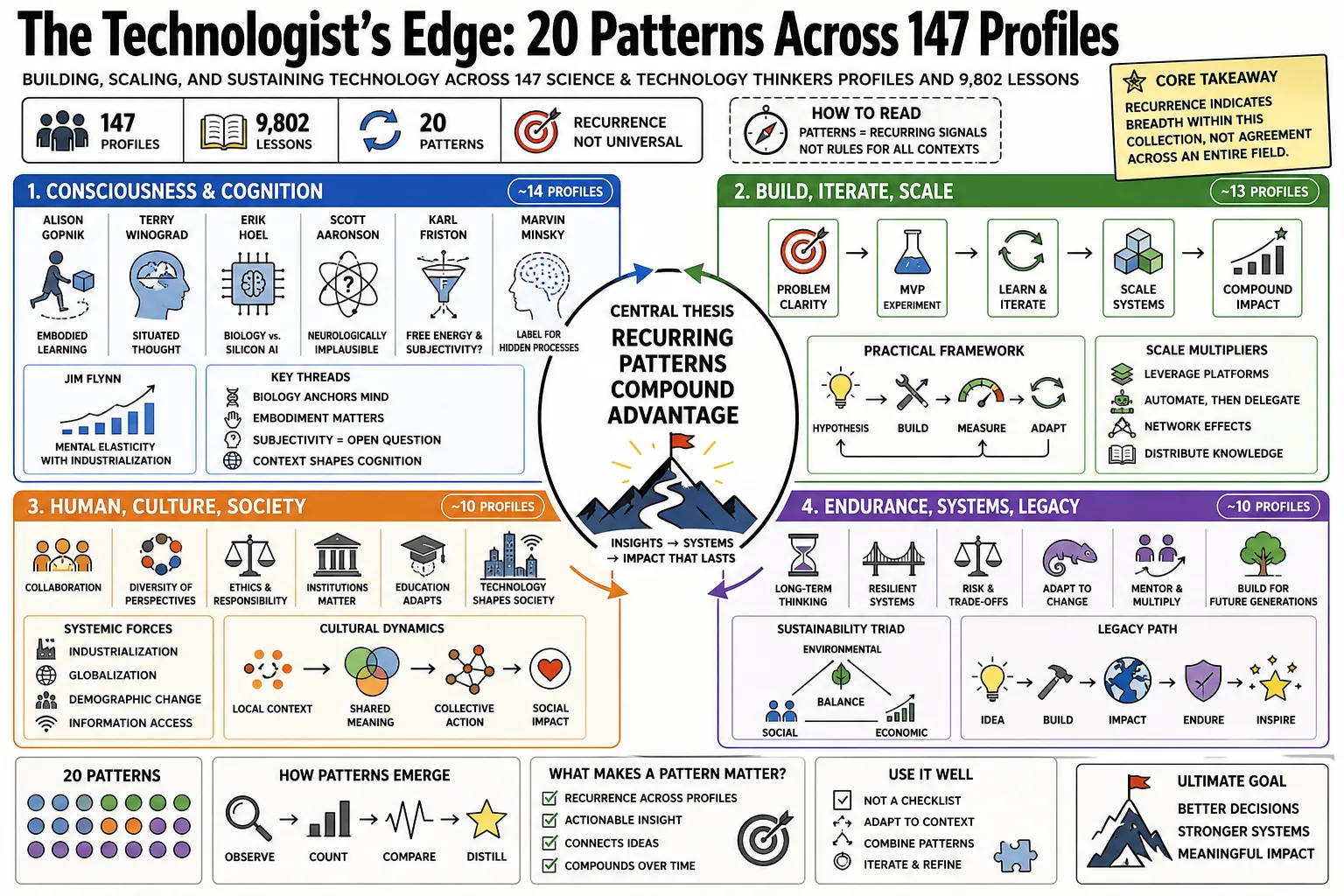
1. Consciousness and Cognition
Philosophical discussions concerning human identity, the physical nature of consciousness, epistemology, and biological intelligence. · recurs across ~14 profiles
The nature of consciousness and cognition reflects a deep intersection of biology, culture, and physical reality. Thinkers emphasize that human intelligence cannot be divorced from its biological roots. Alison Gopnik argues genuine intelligence requires an organism to physically navigate and grasp the causal impacts of its actions, rather than merely processing information. This embodied perspective is echoed by Terry Winograd, who contrasts the situated reality of human thought with the abstract processing of machines, and Erik Hoel, who questions whether silicon-based artificial intelligence can ever replicate a consciousness tied to intrinsic biology.
Even regarding fundamental physics, the mechanisms of mind remain contested. While Scott Aaronson dismisses theories linking consciousness to uncomputable quantum gravity in microtubules as neurologically implausible, Karl Friston maintains that whether an artificial system minimizing free energy experiences subjectivity remains an unresolved philosophical mystery. Pragmatically, Marvin Minsky views consciousness simply as a convenient label for hidden brain processes.
Cognition is also shaped by external forces. Jim Flynn highlights the elasticity of the human mind, noting its capacity to adapt to the analytical demands of industrialization. Furthermore, Joseph Henrich observes that basic epistemology, such as spatial perception, is culturally trained. Understanding these cognitive parameters has practical implications; Matt Webb cautions that acknowledging our biological limits is essential for designing interfaces that avoid overwhelming users. Meanwhile, John Gruber advises that sound epistemology requires remaining open to changing our minds as new evidence emerges. Ultimately, the impermanence of the universe, noted by Brian Greene and Katie Mack, only underscores the extraordinary rarity and preciousness of human consciousness.
2. Decision Making
The frameworks, heuristic models, and rational processes used to evaluate choices and mitigate cognitive biases. · recurs across ~5 profiles
At the individual level, cognitive shortcuts are unavoidable. Foundational work by Amos Tversky established how heavily human judgment relies on these everyday heuristics to navigate choices. However, there is disagreement regarding the utility of these shortcuts. While the traditional view often highlights how heuristics lead to irrational biases and errors, Gary Klein argues that researchers disproportionately fixate on these negative outcomes, completely overlooking the positive, adaptive advantages that heuristic judgments provide in complex environments.
Beyond individual psychology, effective decision-making frameworks are equally critical at the systemic and institutional levels, where the primary objective is optimizing for velocity. For instance, Malte Ubl posits that in software engineering, the fundamental metric of success is the speed of the feedback loop—specifically, how quickly developers can observe the outcomes of their incremental changes. This principle of rapid evaluation extends to macro-level institutions. Tim Hwang views science reform as fundamentally an effort to overhaul evaluation mechanisms, ensuring that capital is rapidly deployed to the most promising ideas without bureaucratic delay. Similarly, Eli Dourado applies this framework to regulatory agencies, emphasizing that groups like the FAA’s commercial space office must cultivate a culture of speed and secure adequate resources. By doing so, the pace of aerospace advancement is constrained only by actual engineering limitations rather than sluggish administrative approval processes. Ultimately, whether navigating daily choices or reforming massive organizations, the overarching goal of rational design is building processes that reduce friction, leverage human intuition appropriately, and accelerate the feedback loops necessary for progress.
3. Ambiguity and Uncertainty
Managing unknown unknowns, applying probabilistic thinking, and recognizing the limits of human intuition when dealing with complex adaptive systems. · recurs across ~12 profiles
Navigating complex adaptive systems requires acknowledging the fundamental limits of human intuition. Amos Tversky demonstrated that our minds naturally default to mental shortcuts because calculating precise probabilities demands excessive cognitive effort. This cognitive boundary becomes problematic in environments defined by unknown unknowns, where John Ousterhout warns that complexity’s greatest danger is losing track of which components must be modified to act safely.
Thinkers diverge on whether this ambiguity is fundamental or merely a veil over hidden order. John Gribbin argues that highly intricate phenomena ultimately operate on simple deterministic mechanics. Conversely, Scott Aaronson maintains that genuine Knightian uncertainty exists, positing that a system possesses functional free will precisely when its future states remain entirely unpredictable despite full physical access.
Regardless of its ontological nature, managing uncertainty demands practical, probabilistic frameworks. Sean Carroll highlights how effective field theories enable accurate predictions at accessible scales without requiring an ultimate theory of everything, while Ian Wong similarly advises starting with basic heuristics before scaling up to complex machine learning models. Embracing ambiguity also necessitates active adaptation. Karl Friston notes that agents instinctively seek new information to resolve uncertainty, and Maya Shankar suggests deliberately exposing ourselves to manageable doses of unpredictability to build psychological resilience. Ultimately, thriving at what M. Mitchell Waldrop calls the fluid boundary between order and randomness relies on adaptable strategies over rigid intuition.
4. Resilience
The capacity to endure failures, survive adverse conditions, and persistently navigate through periods of extreme difficulty. · recurs across ~6 profiles
The pursuit of meaningful innovation demands an extraordinary capacity for resilience, defined not merely as surviving hardship, but as the active willingness to endure repeated failures and navigate extreme difficulty. A critical distinction emerges in how visionaries frame these obstacles: rather than viewing setbacks as anomalies, they are integrated into the creative process as a structural necessity. For instance, Stewart Brand notes that ambitious endeavors invariably pass through deeply discouraging phases, demanding steadfast persistence. This expectation of difficulty is echoed by Edwin Land, who believed that achieving eventual success inherently involves confronting an endless succession of defeats.
The practical implications of this resilience are far-reaching. In technical domains, Thorsten Ball emphasizes that navigating failure is the foundational skill required for effective debugging. Similarly, John Ternus observes that an initial rocky start can be transformed into a remarkable achievement provided there is an unyielding commitment to the underlying vision. However, enduring these adversities requires specific psychological framing. Ben Lamm argues that optimism is mandatory; approaching novel problems with cynicism precludes the very risk-taking essential for breakthroughs. Furthermore, the capacity to weather these professional storms often draws upon deep-seated personal fortitude. As Jackie Cochran demonstrated, the raw toughness forged during early life struggles—such as surviving severe economic hardship—translates seamlessly into the tenacity needed to dominate competitive boardrooms and pioneering aviation efforts. Ultimately, resilience transforms inevitable failure from a terminal endpoint into a necessary stepping stone toward greatness.
5. Innovation and Discovery
The mechanisms of ideation, experimentation, and serendipity that lead to scientific breakthroughs and paradigm shifts. · recurs across ~12 profiles
The path to scientific breakthroughs is often romanticized as a series of sudden epiphanies, but Katie Mack and Katalin Karikó clarify that genuine progress primarily stems from tedious experimentation, collective effort, and enduring long stretches of negative results. Terence Tao echoes this reality, emphasizing the adaptability and patience required to navigate research without immediate rewards. Collaborative discovery remains essential to this process, as Amos Tversky highlights the intrinsic joy found in shared intellectual pursuit. However, institutional habits frequently impede this synergy. George Church warns that hoarding data severely delays medical advances, arguing for the unencumbered cross-referencing of massive datasets. Furthermore, Michael Nielsen notes the irony that the scientific establishment has been notably sluggish in adopting the web for cooperative investigation.
Conversely, ideation does not exclusively rely on traditional institutional frameworks. Nadia Asparouhova champions the self-directed rigor of independent research, while Richard Hamming argues that overly idyllic academic environments can actually ruin scientists by eliminating the friction necessary for deep creativity. Achieving true paradigm shifts—which Alan Kay identifies as the catalyst for entirely new industries—requires undertaking extraordinary risks. Gordon Moore asserts that philanthropic foundations must finance endeavors with massive failure rates to cover speculative areas governments avoid, a systemic gap Ben Reinhardt addresses by building independent laboratories specifically for neglected technologies. Ultimately, while machine learning excels at pattern recognition, Sarah Constantin cautions that current AI models still lack the unconstrained reasoning capabilities essential for autonomous scientific discovery.
6. Long-Term Vision
The ability to forecast future trajectories, maintain purposeful strategy, and build legacies optimized for longevity. · recurs across ~5 profiles
Long-term vision requires moving beyond immediate horizons to understand how future trajectories influence present decisions and build lasting legacies. Forecasting is frequently misunderstood as clairvoyance, but as Paul Saffo clarifies, “The goal of forecasting is not to predict the future but to tell you what you need to know to take meaningful action in the present.” [source] This distinction implies that anticipating tomorrow must directly shape the strategies implemented today. Amy Webb echoes this by advocating for the integration of foresight and strategy, recognizing they must function together as a unified discipline.
At a macro level, purposeful strategy shapes societal trajectories. Carlota Perez emphasizes that establishing a collective vision and robust state support for innovation are indispensable prerequisites for navigating technological transitions and unlocking widespread prosperity. This long-term orientation is deeply ingrained in human development; Robin Dunbar notes that our ancestors adopted sustained partnership models specifically to guarantee the intensive, prolonged parental investment required to raise complex, vulnerable offspring.
Ultimately, maintaining a long-term vision requires shifting focus from ephemeral outputs to self-sustaining systems. Gordon Moore observed that a leader’s true legacy is defined not by the products they invent, but by the succeeding generations of innovators they cultivate. By optimizing for longevity—whether through strategic foresight, state innovation, biological investment, or human capital—enduring impact depends on preparing others to build upon today’s foundations.
7. Power Laws and Scale
The exponential dynamics of hypergrowth where outlier successes drive the majority of returns and systemic expansion. · recurs across ~6 profiles
The concept of hypergrowth is characterized by compounding knowledge and digital scale, enabling a few outlier successes to reshape the economy. Joel Mokyr argues that unlike traditional drivers like trade, the accumulation of knowledge serves as the ultimate engine for sustained long-term progress. This compounding effect is central to systemic expansion; as Dan Wang observes, “Knowledge can compound. I’d like for us to think more about how to accelerate the growth of learning.”[source]
In the modern era, Andrew McAfee highlights how tech behemoths harness digital operating models to sidestep historic tradeoffs between agility and execution. By wiring talent and data together, these organizations achieve exponential scale, proving that economic expansion can now occur alongside a shrinking environmental footprint in developed nations.
However, achieving this scale requires distinct operational shifts. Gian Segato emphasizes that crossing massive revenue thresholds demands moving away from traditional marketing toward product-led growth, turning the software itself into the primary engine of distribution. Simultaneously, Tido Carriero notes that operational hypergrowth relies on maintaining a rigorous engineering culture where the entire team shoulders the responsibility of upholding hiring standards.
Yet, these periods of boundless expansion are not infinite. Carlota Perez cautions that every technological revolution experiences a deployment phase of widespread synergy and societal benefit, inevitably followed by a maturity phase where the underlying paradigm exhausts its potential and returns ultimately diminish.
8. Talent Acquisition
The methodologies for identifying, interviewing, hiring, and retaining high-density, capable individuals for organizations. · recurs across ~4 profiles
Building a high-performing organization requires rethinking traditional approaches to discovering and keeping exceptional individuals. When sourcing candidates, organizations often compete fiercely for individuals with perfect resumes. However, Tido Carriero points out that prioritizing latent potential over pristine credentials offers a distinct strategic advantage, allowing companies to capitalize on inefficiencies in the broader job market.
Once potential is identified, the focus must shift to elevating the overall capability density of the team. Leaders should actively seek out candidates who surpass their own knowledge in specialized areas. As Malte Ubl notes from his experience in highly concentrated expert environments, assembling a team where each member is a domain authority fosters a humbling yet incredibly powerful dynamic.
Successfully acquiring this caliber of talent is only the beginning; keeping them requires deliberate onboarding and a strong cultural foundation. Drawing a parallel to product experiences, Tom Hale highlights that early interactions dictate long-term retention, meaning an organization must actively earn a new arrival’s patience from day one. Furthermore, building a diverse workforce is fundamentally ineffective if the internal environment alienates the very people it worked so hard to recruit. According to Nick Caldwell, genuine inclusion is the essential mechanism that makes diversity sustainable over the long term. Ultimately, talent acquisition is an integrated lifecycle: identifying undervalued potential, hiring superior experts, earning their initial trust, and cementing loyalty through genuine inclusion.
9. Organizational Culture
The shared values, psychological safety, and behavioral norms that dictate how a team operates and collaborates internally. · recurs across ~18 profiles
Organizational culture is the foundational operating system of any team, determined by its behavioral norms and shared trust. Developing a thriving engineering or technical culture often requires shifting away from individual ownership toward collective responsibility. For instance, Farhan Thawar highlights that practices like pair programming and routine code deletion naturally foster a communal mindset where code belongs to the entire team rather than any single developer. Similarly, Jim Rutt envisions decentralized, cooperative structures that eliminate dominance hierarchies to better harness collective intelligence.
However, building this necessary trust is increasingly difficult. Nadia Asparouhova points out that modern digital ecosystems often structurally reward low-trust behavior, making the deliberate creation of high-trust institutional environments a primary challenge. Achieving this requires intentional organizational design. Tim Hwang argues that true technological accountability cannot be merely imposed externally; it must stem from fundamentally altering internal engineering incentives and norms.
A critical component of these new norms is psychological safety, a concept encompassing both security and rigor. Camille Fournier views it as an environment where individuals feel secure enough to make errors and learn. Building on this, Andrew McAfee clarifies that psychological safety is not an immunity from being challenged; rather, it is a culture of rapid experimentation where success is measured by how quickly one can discover they are wrong. Furthermore, a resilient culture must be structurally diverse; Nick Caldwell warns that homogeneous leadership teams inevitably develop costly institutional blind spots.
10. Vulnerability and Trust
Building cross-functional trust, maintaining psychological safety, and leveraging human vulnerability to foster authentic connection. · recurs across ~15 profiles
In modern organizations, cultivating trust and psychological safety is a prerequisite for innovation and cohesion. Drawing on biology, Robin Dunbar argues that human connection is fundamentally physiological, tied to opiate responses and physical warmth. This drive for connection scales to societal structures; Joseph Henrich observes that democratic systems depend on a foundation of impersonal trust requiring centuries of cultural evolution.
Within teams, interpersonal trust is rooted in vulnerability. Camille Fournier and Nick Caldwell observe that leaders who transparently model their own limitations build a deeper sense of mutual reliance. Grounded in this baseline of trust, Andrew McAfee notes that teams are equipped to engage in intense, unvarnished debate without damaging their interpersonal bonds. This robust discourse must span hierarchies and functions. Michael Lopp warns that reluctance to speak candidly to management indicates systemic dysfunction. Similarly, Jean-Denis Grèze notes employees need security to pursue internal role changes without fearing retribution. Expanding this cross-functional trust remains vital, as Ian Wong highlights the mutual respect required between engineering and operations.
Organizations can leverage practices to foster these dynamics. Gary Klein recommends premortem exercises to elicit constructive dissent without triggering defensiveness. As Maya Shankar points out, empathy is an actionable skill rather than a fixed trait. Cultivating it restores the authentic human relationships that technology might otherwise erode—a potential Eric Topol hopes will guide the integration of AI in medicine. Furthermore, Tom Hale notes that as digital platforms transition into clinical environments, establishing durable trust will rely heavily on rigorous evidence and responsible data stewardship.
11. Technology Foundations
The core software and hardware architecture, tooling, and primitives that enable scalable and reliable technical systems. · recurs across ~55 profiles
The foundation of reliable technology increasingly relies on the seamless integration of hardware and software. Bryan Cantrill argues computing’s future requires co-designing integrated, rack-scale servers from the ground up, while Chris Lattner emphasizes that silicon is useless without compiler teams present from the beginning of hardware development. Evaluating this complete stack—from applications down to the physical machine—is essential for understanding systems performance, as noted by Brendan Gregg. As hardware creation adopts software’s agile methodologies of rapid prototyping and destructive testing, advocated by Casey Handmer, builders must also accept the inevitability of failure. Bill Joy reminds us that robust systems must be explicitly designed to accommodate the breakdown of both physical and digital components.
Moreover, managing this complexity requires deliberate constraint. Dan McKinley warns that operating fragile infrastructure drives engineering burnout, suggesting that utilizing proven, boring technology is a necessary form of team preservation. When systems demand perfect tracking, Martin Fowler recommends recording all state changes as an immutable sequence of events rather than overwriting current data.
Despite these technical architectures, the digital world rests heavily on hidden human labor. Both Nadia Eghbal and Nadia Asparouhova point out that we often take foundational software for granted. Finding capital to fund the unglamorous maintenance of existing dependencies remains a persistent structural challenge, contrasting with the massive, potentially fragile capital expenditures defining AI infrastructure cycles, observed by James Bessen. Ultimately, whether building AI-native tools like those described by Jean-Denis Grèze or shifting to software subscriptions to continuously deliver value as Will Ahmed suggests, these primitives dictate our technological resilience.
12. Artificial Intelligence
The implications, mechanics, and capabilities of algorithmic automation, generative models, and machine inference. · recurs across ~30 profiles
The transition to “Software 2.0”—where systems are trained on datasets rather than explicitly programmed by humans—forces a radical shift in how we validate technology, as noted by Guido van Rossum. Unlike biological entities that learn through active environmental engagement, modern generative models depend heavily on brute-force data processing. Karl Friston highlights this computational inefficiency as a stark departure from natural intelligence, while Sarah Constantin points out that lacking structural, causal models of the world leaves these algorithms entirely reliant on human oversight to verify ground-truth facts.
This structural dependence on data means that historical flaws can be easily amplified. Amy Zhang warns that without rigorous, community-driven corrections, models will inevitably reproduce existing social toxicity. Consequently, as Ankur Goyal observes, the era of mere data hoarding has ended; contemporary value lies in actively utilizing data to evaluate and refine machine inference. There remain massive untapped domains for this refinement—Eric Topol laments that life-saving intensive care data is routinely discarded rather than being aggregated for predictive models.
When deploying these capabilities, mechanical transparency is crucial for adoption. Ian Wong cautions that internal teams will reject opaque algorithms unless their reliability is proven alongside existing human operations. Similarly, Carl T. Bergstrom argues that an inability to explain an algorithm simply is often a red flag for deception. To optimize both trust and computational efficiency, Harrison Chase advocates for architectural splits: deploying swift, compact models for basic tool-routing while reserving larger architectures for complex reasoning. When applied methodically, their capabilities are profound—Martin Kleppmann notes they excel at executing the tedious coding required for formal software verification.
13. Technical Debt and Maintenance
Addressing the hidden costs of complexity, the burden of maintaining legacy systems, and the pragmatic value of choosing boring technology. · recurs across ~8 profiles
The relentless pursuit of innovation often obscures the inevitable burden of maintenance, a reality that thinkers increasingly frame as a core sustainability issue rather than just an engineering annoyance. Stewart Brand emphasizes that upkeep is frequently undervalued despite being foundational to long-term viability, a sentiment mirrored by Camille Fournier, who advocates renaming technical debt to system sustainability work to underscore its critical nature. This shift in perspective reframes the hidden costs of complexity. For instance, farhan thawar notes that the most effective engineers actively minimize code because every additional line introduces ongoing testing and refactoring obligations. Similarly, choosing boring, pragmatic technology over complex patterns reduces friction; as Addy Osmani observes, shoehorning intricate design structures where simpler solutions suffice only generates avoidable maintenance debt. The challenge of legacy systems further highlights the limits of superficial fixes. Scott Hendrickson warns that merely migrating old applications to the cloud without restructuring them simply transports existing technical debt to a new environment, missing out on native architectural benefits. While artificial intelligence offers promising avenues for managing these burdens—with Tristan Handy suggesting that AI will significantly lower the expense of refactoring data pipelines and transitioning away from outdated infrastructure—it is not a panacea. The primary obstacle to using AI for modernization is not technological capability but rather the loss of institutional knowledge. Dennis Pilarinos identifies this context debt as the most significant roadblock, demonstrating that no tool can replace a deep understanding of why a system was built a certain way.
14. Operational Rigor
The disciplined application of metrics, monitoring, and quality control to maintain consistency across complex operations. · recurs across ~7 profiles
Operational rigor demands more than just collecting data; it requires ensuring that metrics are both structurally sound and fundamentally meaningful. The foundation of this rigor lies in accurate baseline observability. As Brendan Gregg advises, complex analytical layers like machine learning are useless unless underlying system metrics are demonstrably accurate. To maintain this consistency across organizations, Tristan Handy argues for a unified semantic layer, warning that without one, disparate tools and scripts will calculate the same core metrics differently, spawning needless debate over data validity.
However, this pursuit of rigid, measurable quantification often conflicts with assessing genuine quality. Maya Shankar cautions against optimizing for hollow, easily measured targets that lack deeper significance, urging a focus on the qualitative value of the effort itself. Similarly, Scott Hendrickson emphasizes looking past superficial headline numbers to assess the fundamental economics and cost structures that dictate true business quality.
When qualitative elements are difficult to measure systematically, rigor shouldn’t be abandoned. Ankur Goyal notes that subjective vibes actually function as a highly accurate, albeit expensive, human-driven scoring mechanism for aesthetic quality. Ultimately, operational discipline must serve long-term usability and stability. Addy Osmani asserts that optimizing the user experience is paramount for enduring success on the web, regardless of your role. Meanwhile, farhan thawar applies operational rigor directly to engineering maintenance, emphasizing that systematic discipline is essential for managing the ongoing complexities of software systems. Together, these perspectives illustrate that true operational rigor requires balancing meticulous technical execution with a relentless focus on durable, meaningful outcomes.
15. Design and User Experience
The practice of crafting accessible, human-centric interfaces driven by user empathy, aesthetics, and usability research. · recurs across ~12 profiles
True design and user experience extend far beyond aesthetics, representing a profound commitment to empathy, accessibility, and human-centric systems. The transformation of interfaces requires rethinking fundamental interactions. As Terry Winograd suggests, shifting our perspective from viewing language merely as a representation of reality to seeing it as a mechanism for social coordination fundamentally changes interaction design. This sociological approach must intersect with deep user empathy. Tom Hale emphasizes that product teams must actively cultivate an understanding of user frustrations to build truly meaningful solutions, a sentiment echoed by Dennis Pilarinos, who views support interactions as vital opportunities to respect a developer’s time.
When empathy is scaled, it influences systemic and policy design. Maya Shankar notes that robust design prevents bureaucratic complexity from penalizing vulnerable populations. Similarly, Amy Zhang highlights the necessity of interfaces that acknowledge and optimize the often-invisible digital labor of volunteer moderators. Inclusive and accessible interfaces remain the industry standard we strive toward, a goal Jared Palmer associates with the ongoing evolution of modern development tools. Furthermore, as Romain Huet observes, the early adoption of artificial intelligence is sparking a revolution in how computer interfaces are conceptualized.
However, human-centric design also demands developmental humility. Linus Torvalds warns against relying solely on individual intellect, advocating instead for the rigorous, parallel trial-and-error of continuous feedback cycles. We must also recognize the limits of quantification. Lucy Suchman cautions that interface design must respect the boundaries of what can be converted into data without erasing the nuance of lived human reality.
16. Product-Market Fit
The alignment between a product’s value proposition and the actual demands and pain points of its target customers. · recurs across ~4 profiles
Product-market fit is not a static destination but a continuous process of aligning a solution with the deepest pain points of a specific audience. A crucial distinction lies between listening to what customers want versus understanding what they suffer from. Alyssa Henry emphasizes that while customers are excellent at identifying their problems, they are rarely equipped to design the optimal solution; the key is to prioritize their underlying pain rather than their explicit feature requests. This deep understanding is often easier to achieve when building for an audience whose struggles are familiar. Ankur Goyal found his alignment by targeting software developers, leveraging his intimate knowledge of their workflow to empathize directly with their needs.
However, empathy alone is insufficient without relentless execution and adaptation. Romain Huet asserts that achieving and maintaining this fit demands rapid cycles of iteration, constantly validating the product against actual, real-world usage rather than theoretical models. This need for continuous improvement extends even to deep tech and infrastructure. As Doug O’Laughlin observes in the semiconductor industry, sustaining a dominant market position and robust margins requires aggressively advancing hardware capabilities just to stay ahead of the custom solutions that major customers might build for themselves. Ultimately, true product-market fit requires both the profound empathy to understand the true nature of a customer’s problem and the operational velocity to iteratively deliver a superior solution that they could not have effectively built themselves.
17. Distribution
Strategies and channels used to acquire customers, deliver products, and achieve widespread market penetration. · recurs across ~6 profiles
Achieving widespread market penetration often requires discarding traditional playbooks for hybrid approaches that integrate product development, engineering, and community engagement. For example, Gian Segato characterizes modern growth engineering as an interdisciplinary practice where coding inherently merges with marketing and product design. This alignment means distribution is no longer a downstream afterthought but built directly into the technology itself. Similarly, Alyssa Henry argues that impactful technical executives must grasp overarching profit dynamics and promotional strategies, treating software as merely a single variable in driving broader corporate outcomes.
When building initial traction, organic community involvement frequently outperforms conventional marketing channels. Tristan Handy found that authentic participation in specific networks—namely addressing queries and resolving practical issues within Slack groups—served as the primary catalyst for his product’s early adoption. This grassroots strategy mirrors the educational outreach of Grant Sanderson, whose compelling visual explanations aim to scale a cultural shift where wider audiences naturally develop a personal affinity for mathematics.
However, scaling distribution ultimately confronts physical and structural limits. Doug O’Laughlin notes that the rapid proliferation of artificial intelligence models remains strictly bound by the material constraints of hardware manufacturing pipelines. Illustrating a parallel bottleneck, Alain Bertaud highlights how municipal zoning borders artificially restrict the availability of developable parcels, which inherently drives up real estate costs. Whether navigating semiconductor supply chains or urban planning, these insights underscore that successful distribution requires not only clever acquisition channels, but also a deep understanding of the inescapable physical realities governing capacity and scale.
18. Ecosystems
The cultivation of interdependent networks, platforms, and communities that foster collaborative innovation and open-source contributions. · recurs across ~6 profiles
The cultivation of thriving digital ecosystems requires a deliberate shift away from the centralized, algorithmic architectures that dominate today’s web. As Nadia Asparouhova observes, modern platforms have largely reduced online interaction to shallow, asynchronous broadcasting, eroding the deep, synchronous connections that once defined internet forums. Reversing this trend means empowering users to reclaim agency over their digital environments. Matt Webb argues that escaping algorithmic control necessitates a revival of decentralized tools like chronological timelines, RSS feeds, and personal websites.
When platforms provide the right infrastructure, they can transform scattered data into cohesive, enriching experiences. Andrew Gils highlights how successful platforms elevate mere file aggregation by integrating rich metadata to create immersive, magazine-like curation. Within organizations, Andrew McAfee notes that emergent social software can facilitate organic knowledge sharing and unstructured collaboration, proving that rigid hierarchies are not the only path to innovation.
Effective ecosystems also demand adaptable systems of self-determination. Amy Zhang suggests that providing modular governance tools enables communities to dynamically test distinct democratic frameworks, from consensus-building to randomized juries, rather than relying on one-size-fits-all administration. Finally, these collaborative models can scale to the highest levels of industry, as Aaron Frank points out regarding the partnerships between traditional financial institutions and major technology firms. Ultimately, robust ecosystems thrive not through top-down enforcement, but by offering interoperable platforms that nurture organic collaboration, flexible governance, and meaningful digital connections.
19. Physical and Biological Constraints
Navigating the transition from digital environments to physical manufacturing, energy limits, thermodynamics, and biological realities. · recurs across ~26 profiles
While software has fueled immense economic expansion, our future relies on manipulating physical matter. Eli Dourado observes that the digital boom obscured a prolonged stagnation in fundamental physical sectors like energy and transportation. Addressing global challenges necessitates a shift back to atoms, as Casey Handmer points out. However, physical manufacturing introduces strict limitations absent in code. Doug O’Laughlin notes hardware production is constrained by inflexible realities rather than theoretical demand, while Alyssa Henry emphasizes that even digital scaling is bound by thermal and power capacities. At the microscopic level, Gordon Moore warned that traditional electronics fail as components approach atomic scales.
Scaling physical production presents further hurdles. Matt Webb highlights the difficulty independent creators face bridging the gap between custom crafting and mass industrial manufacturing. When addressing planetary constraints, experts clash sharply. Vaclav Smil maintains perpetual economic growth is impossible on a finite planet, rejecting the idea we can decouple growth from material consumption. Conversely, Andrew McAfee contends modern technology and markets have successfully achieved this exact decoupling, generating greater output with fewer resources.
Beyond manufacturing, researchers look to biology as a model for complex physical systems. Lee Cronin views biology as the universe’s most sophisticated manufacturing platform, suggesting synthesizing artificial life represents the pinnacle of nanotechnology. Yet, unified models remain elusive; Carl Zimmer cautions the messy nature of biology defies simple mathematical definitions.
20. Public Goods and Institutions
Reflections on legacy, effective altruism, digital public infrastructure, and the historical context of institutional support for progress. · recurs across ~21 profiles
The architecture of human progress depends on how institutions support public goods, revealing a tension between maintaining vital infrastructure and chasing the technological frontier. Historically, Carlota Perez observes that technological revolutions threaten established institutions. However, Ben Reinhardt clarifies that legacy entities are not malicious, but merely optimized for outdated historical contexts. This mismatch explains why Cate Hall notes traditional scientific bodies prioritize routine paper production over genuine breakthroughs, and why Michael Nielsen warns that failing to maintain intellectual infrastructure inevitably causes civilization-level stagnation.
In response, new philanthropic models are emerging. Nadia Eghbal highlights effective altruism as a potent framework because it pairs strict ideological rigor with substantial funding. Similarly, Gordon Moore argued that philanthropic capital should be deployed strategically to build enduring societal frameworks, an approach Adam Marblestone echoes by urging philanthropists to fund focused public-good infrastructure rather than relying on conventional grant lotteries.
Yet, a critical distinction remains between funding the new and preserving the old. As Nadia Asparouhova points out, treating the digital commons as essential public goods requires cultivating dedicated institutional stewardship rather than merely supporting initial creation. This systemic vulnerability is perilous; Tim Hwang emphasizes the extreme fragility underlying the modern internet’s advertising ecosystem. Resilience requires foresight, as Tal Zaks argues that crisis response is entirely constrained by pre-built infrastructure. Expanding on this, Audrey Tang shows that transparent civic infrastructure is vital for collective understanding. Finally, Paul Saffo reminds us that infrastructure moves slowly to provide essential stability, reinforcing Ezekiel Emanuel’s broader point that a true legacy is measured by enduring societal contributions.