Power and Psychology in Modern Markets
Across 115 finance & economics profiles and 8,279 lessons, 22 patterns recur often enough to matter. They are not universal rules; recurrence indicates breadth within this collection, not agreement across an entire field.
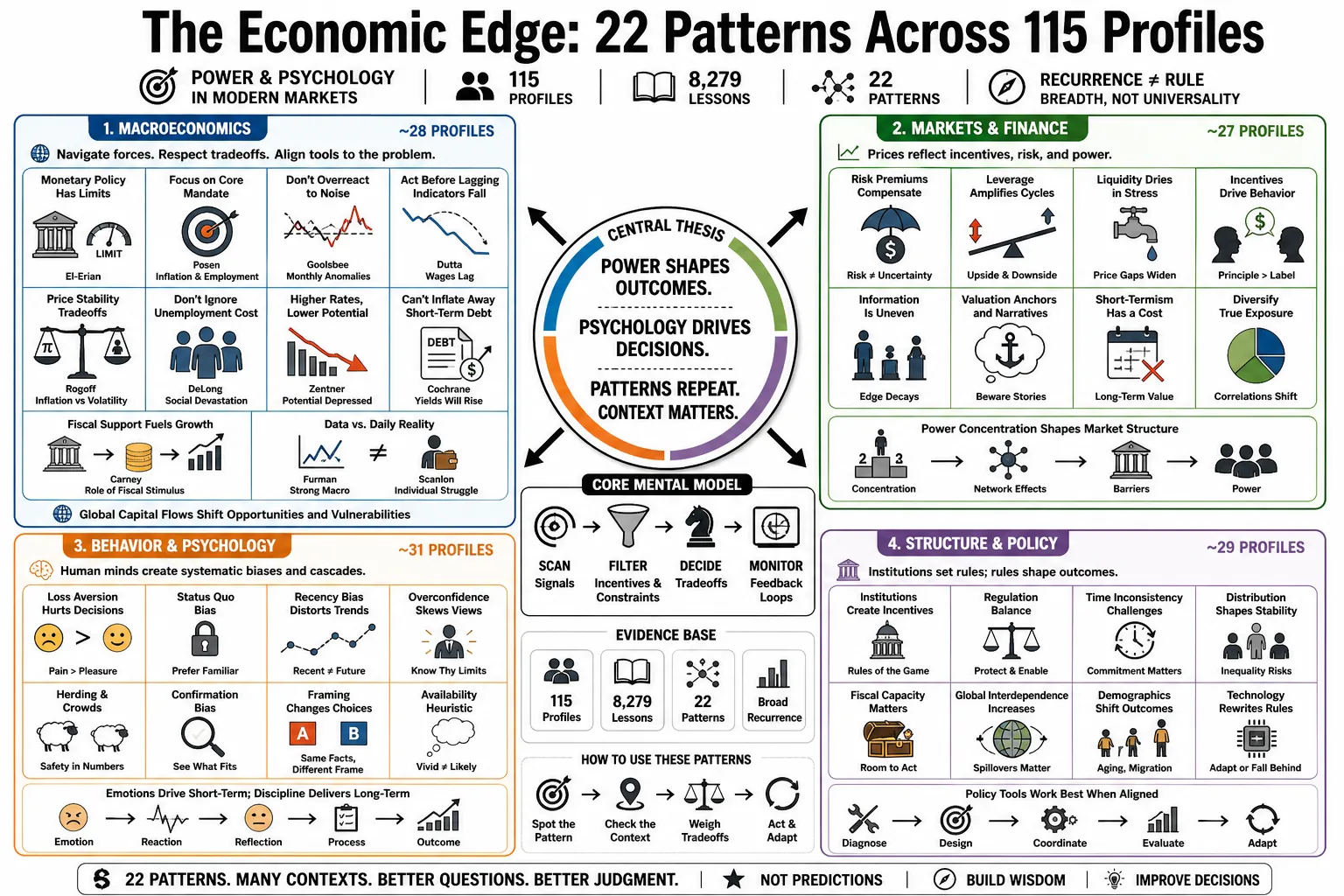
1. Macroeconomics
Navigating broad economic forces, structural shifts, and monetary policies that affect global markets. · recurs across ~28 profiles
Navigating macroeconomic shifts requires recognizing monetary policy’s limits. As Mohamed El-Erian observes, blunt interest rate adjustments cannot repair structural labor mismatches. Consequently, Adam S. Posen advises central banks to focus strictly on inflation and employment, avoiding asset bubbles. Austan Goolsbee cautions against overreacting to volatile monthly anomalies, while Neil Dutta notes authorities shouldn’t wait for lagging wage indicators to collapse before easing rates.
The pursuit of price stability involves tradeoffs. Kenneth Rogoff highlights that hawkish central bankers suppress inflation but increase employment volatility. Countering this, Brad DeLong argues policymakers overemphasize modest inflation risks while underestimating the social devastation of mass unemployment. Extended restrictive policies carry consequences; Ellen Zentner warns elevated rates depress economic potential. Furthermore, John Cochrane explains governments cannot inflate away short-term debt, as investors demand higher yields upon rollover. Thus, Mark Carney emphasizes the essential role of fiscal stimulus for true growth.
Beneath sweeping statistics, everyday realities diverge. Despite robust labor trends highlighted by Jason Furman, Kyla Scanlon emphasizes a persistent disconnect between macroeconomic data and individual financial struggles. Globally, capital flows face structural shifts, like the Bank of Japan’s exit from negative rates noted by Torsten Slok. Meanwhile, Brian Deese highlights that domestic firms struggle against heavily subsidized foreign competitors. To navigate inflationary pressures, Karen Karniol-Tambour recommends portfolios of real assets. Ultimately, Steve Rattner reminds investors wealth is generated through decades of patient compounding, while Abby Joseph Cohen concludes that productivity and policy shape the severity of inevitable business cycles.
2. Central Planning
The ongoing tension between centralized economic planning, fiscal dominance, and the self-correcting dynamics of free markets. · recurs across ~27 profiles
The ongoing tension between centralized economic interventions and self-correcting markets has increasingly coalesced around the concept of fiscal dominance. While figures like Brad DeLong and Mark Carney contend that monetary policy alone cannot boost growth during severe crises without the aid of direct fiscal stimulus, this approach frequently overshoots. Austan Goolsbee notes that although pandemic-era transfers successfully prevented a spending collapse, they undeniably fueled demand-side inflation.
However, economists diverge on how aggressively states should wield this power, especially given recent outcomes. Noah Smith observes that policymakers wrongly assumed that massive stimulus is always beneficial, while both Jason Furman and Larry Summers argue that deploying excessively large stimulus packages generated demand shocks that were erroneously dismissed as temporary supply chain issues.
Consequently, centralized spending now dictates broader market dynamics. Karen Karniol-Tambour and James Aitken warn that fiscal dominance is returning, effectively relegating central banks to secondary roles. Torsten Slok highlights that trillions in deficit spending are directly undermining the Federal Reserve’s inflation-fighting mandate. This dynamic reinforces the fiscal theory advocated by John Cochrane, who argues that inflation naturally adjusts upward to balance government debt against the present value of future surpluses. Without a credible plan to curb deficits, Kenneth Rogoff warns of protracted global volatility characterized by higher real rates and persistent inflation. Furthermore, Abby Joseph Cohen emphasizes the dangerous mathematical mismatch between proposed tariff revenues and soaring debt service costs, illustrating the long-term limits of centralized economic planning.
3. Political Economy
The intersection of ideological blind spots, political polarization, and government interventions, including the weaponization of global trade. · recurs across ~13 profiles
The weaponization of global trade increasingly exposes the perilous intersection of ideological ambition and economic reality. As Doug Irwin observes, the contemporary conservative shift toward protectionism represents a dramatic break from its historical commitment to open markets. This political realignment is fueled by a narrative contest for the future global order, a rift that Mohamed El-Erian notes is sharply dividing the G7 and the expanded BRICS nations.
However, economists warn that these politically motivated interventions carry severe consequences. Adam S. Posen and Raphael Arndt emphasize that prioritizing national security over supply chain efficiency generates structural inflation and negative supply shocks. The damage extends beyond macroeconomic indicators to everyday citizens; Jason Furman, Larry Summers, and Russ Roberts agree that sweeping tariffs act as regressive taxes that penalize consumers without actually saving legacy industrial jobs. Furthermore, the volatility introduced by these policies creates deep uncertainty for corporate leaders trying to manage fragile supply chains, a concern highlighted by both Torsten Slok and Abby Joseph Cohen, who warns against treating tariffs as mere negotiating tactics.
Understanding these dynamics requires moving beyond orthodox models. Adam Tooze argues that human agency and ideological choices are central reactions to financial instability, while Dani Rodrik criticizes the economics profession for operating in isolation from other social sciences, blinding it to complex political realities. Whether addressing trade tensions, which Neil Dutta notes are already inflicting damage, or democratizing corporate governance as advocated by Luigi Zingales, navigating the modern political economy demands recognizing how ideological blind spots complicate government intervention.
4. Institutional Legacy
The historical persistence of economic trends and how centuries-old institutions or past paradigms continue to dictate modern financial realities. · recurs across ~21 profiles
The persistence of structural forces shapes modern economic realities far more than individual agency. Marko Papic argues that investors should discard the Great Man theory of history and focus instead on the underlying constraints binding decision-makers. This echoes James Dale Davidson, who contends that understanding history requires stripping away ideological narratives to examine the fundamental mechanisms of coercion. Often, these mechanisms are enshrined in systems that outlast their creators. Melissa Dell demonstrates that contemporary economic outcomes remain tethered to historical institutions long after their initiating laws are abolished. Daron Acemoglu extends this principle globally, attributing the modern wealth gap directly to the legacy of whether early colonial frameworks were inclusive or extractive.
Yet, institutional focus can drift over time. Luigi Zingales observes that decades of Chicago School influence restricted the breadth of antitrust regulation, obscuring its original mandate to safeguard democratic systems. When political bodies fail to implement necessary architectural reforms, Mohamed El-Erian warns that central banks are compelled to shoulder an unsustainable policy burden. While analytical communities increasingly distrust these legacy organizations and favor distributed networks—a skepticism noted by Nate Silver—the impulse to establish lasting institutions remains powerful. Mellody Hobson illustrates this by championing permanent spaces at elite universities to ensure marginalized groups possess a guaranteed sense of belonging for future centuries. Despite these enduring structural legacies, Robin Wigglesworth cautions that markets suffer from perpetual amnesia, as investors continually convince themselves that the newest paradigm has finally eradicated systemic risk.
5. Systemic Fragility
The analysis of moral hazard, systemic vulnerabilities, and the unintended consequences arising from complex financial plumbing and regulation. · recurs across ~14 profiles
The architecture of global finance remains haunted by the enduring specter of systemic fragility. At the core of this vulnerability is moral hazard, which John Cochrane argues is institutionalized by the “too big to fail” doctrine; anticipating public bailouts encourages reckless gambling with taxpayer funds. This dynamic nearly destroyed the economy, as Adam Tooze observes that prestigious Western banks pushed capitalism to the brink of collapse through profound negligence.
In the aftermath, policymakers sought to fortify the system. Austan Goolsbee contends that frameworks like the Dodd-Frank Act successfully mandated higher capital buffers to curb implicitly guaranteed risk-taking. However, Anat Admati disputes this, warning that the global economy is still highly susceptible to contagion because regulators allow perilous levels of banking leverage. The fundamental challenge, according to Andrew Lo, is that quantifying interconnected risks before they trigger a disaster remains largely impossible.
Furthermore, attempts to regulate can yield unintended consequences. Stuart Hoegner cautions that while frameworks like the EU’s crypto-asset rules aim for stability, rigid requirements—such as forcing large reserve deposits into traditional banks—might inject novel systemic risks. Contrasting financial and industrial fragility, Brian Deese distinguishes banking bailouts from auto sector interventions, which focused on preserving tangible manufacturing supply chains rather than absorbing speculative losses. Finally, Kenneth Rogoff points out that future shocks may not originate in Western banking, identifying China’s economy as the paramount vulnerability capable of destabilizing the world.
6. Structural Inequality
The examination of systemic barriers to social mobility, the impact of unearned privilege, and long-term demographic headwinds on economic outcomes. · recurs across ~22 profiles
Extreme wealth concentration is not an inevitable feature of capitalism but the consequence of specific choices regarding taxation, labor rights, and regulation, according to Esther Duflo. When the distance between the rungs of the economic ladder increases, upward mobility becomes mathematically more difficult to achieve, as Steve Rattner observes. This relationship is further reinforced by the Great Gatsby Curve, which Alan Krueger used to project how rising inequality limits intergenerational mobility.
A key driver of these disparities is the differing treatment of capital and labor. Dani Rodrik notes that unrestricted capital mobility limits the ability to tax the wealthy, shifting the burden onto immobile workers. Conversely, completely opening borders to labor represents the fastest method for global poverty reduction, as Bryan Caplan argues. Domestically, immigration also serves to offset aging demographics and supply essential labor, according to Abby Joseph Cohen.
Technological shifts introduce conflicting outcomes. While Daron Acemoglu argues that deploying automation solely to replace workers without creating new avenues for labor leads to stagnant wages, Jason Furman contends that artificial intelligence will primarily transform tasks and reshape inequality rather than outright destroying jobs. Meanwhile, Michael Kremer highlights how highly skilled individuals become exponentially more productive when collaborating, steeply widening wage premiums.
Looking forward, demographic headwinds are tightening labor markets, which Raphael Arndt notes is beginning to reverse decades of wage suppression. Ultimately, structural barriers must be addressed; as Mark Blyth warns, allowing the economy to accumulate bugs like extreme inequality or stagnant wages risks forcing a chaotic systemic reboot.
7. Physical Infrastructure
The capital-intensive requirements of the energy transition, addressing physical supply shocks, and modernizing foundational economic systems. · recurs across ~36 profiles
The modernization of foundational economic systems requires a massive pivot toward physical assets, driven by the energy transition and digital expansion. Sarah Samuels and Larry Fink characterize this as a multi-decade capital deployment cycle targeting power grids, pipelines, and data centers. Similarly, John Zito orientates his strategy around these megatrends, while Ellen Zentner emphasizes that the most immediate economic impact of artificial intelligence lies not in software, but in its voracious physical infrastructure and energy demands. Financing this transformation, as Ashby Monk observes, demands direct capital investment rather than relying on secondary market trading.
However, rebuilding industrial capacity introduces profound physical supply shocks. Karen Karniol-Tambour and Peter Zeihan note that electrification guarantees a structural demand surge for highly vulnerable industrial metals. Mohamed El-Erian, Torsten Slok, and Liz Ann Sonders argue that these supply-chain constraints and geopolitical disruptions will act as persistent inflationary frictions that complicate economic expansions.
Executing this capital-intensive transition also exposes tensions between state intervention and regulation. While Brian Deese argues that capital markets cannot substitute for clear government mandates and carbon pricing, John Cochrane counters that environmental regulations have become endless litigation tools that actively paralyze green infrastructure development. Reconciling this requires careful policy design; Noah Smith advocates for permitting reform and deregulation as central to modern industrial strategy, while Adam S. Posen warns that using closed-economy policies to manage supply shocks risks generating negative economic feedback loops. Ultimately, as Raphael Arndt and Abigail Wattley suggest, underwriting this generational opportunity requires navigating both severe physical constraints and a complex regulatory environment.
8. Private Markets
The structural shift of capital from public to private arenas, focusing on illiquidity premiums and the valuation of alternative assets. · recurs across ~29 profiles
The structural shift of capital from public to private arenas reflects a fundamental reevaluation of portfolio construction. As Tim McCusker notes, private equity has matured from a niche alternative into a core engine for institutional growth. Rather than treating private markets as an undifferentiated bucket, Kim Lew approaches asset allocation by assigning precise risk-management roles to venture capital, buyouts, and real assets. This evolution is vital because, according to John Zito, the traditional leveraged buyout represents only a fraction of what modern alternative managers execute today.
A central premise of private market investing is the pursuit of an illiquidity premium, yet its true value requires rigorous scrutiny. Both Sarah Samuels and Matt Whineray emphasize that allocators must continually verify whether returns genuinely compensate them for locking up capital for a decade and sacrificing public market optionality. Furthermore, capturing these returns has grown increasingly complex. Raphael Arndt points out that extracting today’s premium demands far deeper operational expertise than in previous decades. This aligns with observations from Steve Rattner, who notes that while private capital enforces discipline on inefficient businesses, the model falters when relying primarily on excessive leverage.
Ultimately, the shift toward private markets involves capitalizing on time horizons. As André Perold explains, capital that cannot wait is inevitably transferred to capital possessing the patience to endure illiquidity. Moreover, in environments characterized by sticky inflation and elevated interest rates, Torsten Slok highlights that private infrastructure and real assets offer essential inflation protection.
9. Capital Allocation
The strategic deployment of resources across different opportunities to maximize long-term shareholder value. · recurs across ~6 profiles
Capital allocation requires balancing robust foundations with agile, forward-looking investments to navigate an increasingly complex and evolving global landscape. Effective deployment demands strategies that can structurally withstand evolutionary market shifts rather than relying solely on theoretical mathematical optimization, as Andrew Lo suggests. This long-term endurance often stems from reliable compounding mechanisms; Jeremy Siegel points out that consistent dividend distribution and reinvestment serve as the fundamental engine for enduring wealth generation over time.
However, historical resilience must be actively paired with strategic adaptability. To thrive amid wider global dispersion, Mohamed El-Erian advocates for a specialized barbell approach, balancing deep defensive resilience on one side with highly convicted, nimble investments on the other. This agility is crucial when capitalizing on multi-decade transformations, such as the massive capital deployment cycle driven by the renewable energy transition that will fundamentally redefine infrastructure portfolios, as noted by Sarah Samuels. Similarly, deploying resources in cutting-edge fields like artificial intelligence requires intentional financial strategies designed specifically to support the safe and responsible deployment of frontier models, according to Krishna Rao.
Simultaneously, prudent allocators must avoid systemic behavioral blind spots. Richard Bernstein warns that the market frequently neglects foundational industries, such as energy and basic materials, until sudden macroeconomic supply shocks unexpectedly expose their fundamental necessity. Ultimately, successful capital allocation marries the compounding power of traditional assets with the strategic foresight to properly fund both essential frontier innovations and traditionally underappreciated economic sectors.
10. Capital Discipline
Rigorous management of financial resources, focusing on efficiency, cash flow, and optimal allocation. · recurs across ~12 profiles
Capital discipline demands rigorous financial stewardship, prioritizing efficiency and optimal allocation. At the core of this discipline is strategic asset allocation, though experts debate its ideal structure. Charles Ellis argues that deciding between stocks and bonds drives the vast majority of long-term outcomes, suggesting a highly structured framework. In contrast, Sandra Robertson favors a fluid approach over strict categorization, allowing capital to dynamically chase the best risk-adjusted opportunities without rigid buckets.
Tactical precision further enhances these macro decisions. Brian Portnoy highlights that everyday choices regarding taxes and budgets execute broader financial priorities. This tactical execution is complemented by Marko Papic, who notes that geopolitical dynamics typically unfold over a medium-term horizon, making them crucial for allocation adjustments. Furthermore, inefficiencies driven by market psychology can linger because, as Kent Daniel observes, rational investors face constraints that prevent them from fully correcting behavioral mispricings.
A major threat to capital discipline is prioritizing asset gathering over performance. André Perold and Sarah Samuels warn that when funds grow beyond the capacity of their target markets, returns inevitably compress in hyper-competitive environments. Consequently, Collette Chilton emphasizes that superior performance requires managers to cap fund sizes. This discipline is essential for institutions depending on private markets for growth, which Kim Lew advocates for achieving target returns. Finally, broader operational efficiency dictates success. Christine Edmonds advises shifting expenditures toward high-retention product development, Avi Goldfarb identifies artificial intelligence as the key to removing prediction bottlenecks, and Ashby Monk highlights a growing, tangible link between corporate carbon efficiency and financial returns.
11. Risk Management
Identifying, assessing, and mitigating potential threats to minimize downside while capturing upside. · recurs across ~4 profiles
Effective risk management requires recognizing that both threats and the tools used to mitigate them are highly nuanced, demanding precision rather than broad-brush applications. A common pitfall is treating complex instruments as monolithic solutions. For example, Tim McCusker points out that hedge funds are not a uniform asset class but rather highly specialized mechanisms designed to deliver uncorrelated returns or limit downside exposure. Similarly, Campbell Harvey highlights that commodities exhibit such diverse hedging characteristics that relying on a general market index can wash out the very inflation protection an investor seeks. Precision must also extend to the methods of protection themselves. Kent Daniel argues that maintaining static hedges against tail events often acts as a costly drag on overall portfolio performance; instead, dynamically scaling factor exposures can yield a more cost-effective defense against market shocks. Beyond the mechanical implementation of these strategies, the scope of what constitutes risk must be broadened. Josh Steiner contends that traditional risk assessments are inherently incomplete if they focus exclusively on monetary downside while failing to account for the emotional toll and reputational damage incurred when financial forecasts prove incorrect. Together, these perspectives suggest that robust risk mitigation depends on carefully aligning specific instruments with precise threats, while maintaining a holistic view of the potential non-financial consequences of failure.
12. Strategic Patience
The power of long-term compounding, holding conviction during cyclical underperformance, and recognizing the slow decay of competitive advantages. · recurs across ~7 profiles
True strategic patience demands an unwavering focus on decades-long compounding rather than reacting to short-term market fluctuations or macroeconomic noise. For instance, Steve Rattner emphasizes that sustainable wealth is built over extended periods, an idea mirrored in professional development by Adam Nash, who notes that the benefits of a robust network also compound gradually over years. Yet, executing this patience often means navigating structural shifts between investment frameworks and maintaining conviction through cycles of underperformance. Charles Ellis argues that the widespread adoption of index funds is a logical adaptation to the inherent inefficiencies of stock picking. However, maintaining unyielding conviction in purely passive models can carry hidden risks. Louis-Vincent Gave warns that over-reliance on index funds is perilous if traditional diversifiers stop yielding positive real returns.
Furthermore, the competitive advantages of different strategies slowly decay and evolve over time, leading to differing views on market mechanics. While Robin Wigglesworth points out that passive vehicles ultimately depend on the price-discovery mechanisms provided by active managers, Liz Ann Sonders suggests that recent increases in interest rates and market volatility have leveled the playing field, restoring the viability of active management as a complementary approach. Simultaneously, the distinction between the two philosophies is deteriorating; Eric Balchunas observes that modern index creators are increasingly packaging specific active tactics into customized, rules-based products. Ultimately, investors must practice patience not just in holding assets, but in thoughtfully evaluating how the foundational tools of wealth creation transition across economic cycles.
13. Behavioral Finance
The study of how psychological biases, overconfidence, and emotional regulation affect market participants and leadership choices. · recurs across ~5 profiles
Behavioral finance fundamentally challenges the assumption that markets operate purely on rational calculation. As Nicolai Tangen observes, the underlying engines of financial systems are not strictly mathematical; they are equally powered by human psychology and the predictable irrationalities of market participants. The central vulnerability of modern trading is not an absence of data, but rather how individuals process it. Kent Daniel emphasizes that investors frequently rely on flawed heuristics, disproportionately weighting certain information while ignoring other critical signals, which distorts market efficiency.
This psychological dimension extends beyond individual trades to the structural design of economic theory itself. To construct truly accurate models, Colin Camerer argues that economists must incorporate social preferences, quantifying human traits like altruism and reciprocity directly into utility functions. Recognizing these human elements is equally vital for institutional leadership and capital allocation. When building teams or selecting fund managers, Kim Lew advocates for strict, proactive measures to identify and mitigate both conscious and subconscious biases. Without deliberate cognitive regulation, decision-makers remain blind to their own limitations. Even on a macro scale, Robin Hanson points out that understanding our cognitive biases is essential when evaluating long-term probabilities and historical emergence timelines. Ultimately, embracing behavioral finance requires abandoning the illusion of perfect rationality. By mapping out exactly how overconfidence and emotional impulses interfere with objective analysis, leaders can design better systems, make more resilient investments, and navigate the inherent unpredictability of human-driven markets.
14. Decision Making
Frameworks and psychological processes used to select optimal choices under conditions of uncertainty. · recurs across ~4 profiles
The mechanics of decision making under uncertainty reveal that optimal choices rarely stem from pure, unadulterated logic. Instead of being fundamentally irrational, individuals operate within the constraints of bounded rationality. As Colin Camerer highlights, people rely on mental shortcuts and heuristics that serve them well in familiar contexts but predictably break down when applied to novel or highly complex environments. This distinction implies that poor decisions are less about an inherent lack of reason and more about deploying the wrong cognitive tools for a given situation.
Consequently, mitigating these systemic errors requires deliberate effort. Bryan Caplan emphasizes that effective economic reasoning extends far beyond mathematical models; it demands a continuous, disciplined struggle against our innate psychological biases. No demographic is immune to this reality. For instance, Adam Nash notes that even technical professionals, such as engineers who base their identities on rigorous logic, fall victim to the exact same cognitive distortions as the general public.
The implications of these psychological failures scale dramatically when placed in high-stakes arenas. At the geopolitical level, Chris Blattman points out that flawed judgment and cognitive blind spots are often the underlying culprits that convince leaders to mistakenly view armed conflict as a practical or easily winnable solution. Ultimately, mastering decision making is not about achieving perfect rationality, but rather cultivating the self-awareness necessary to recognize and systematically correct for our inevitable cognitive limitations before they culminate in catastrophic choices.
15. Learning
Continuous acquisition of knowledge, adaptation of mental models, and empirical testing of hypotheses. · recurs across ~5 profiles
The continuous acquisition of knowledge serves as the foundational compound interest of a successful career, often outstripping early monetary gains. As André Perold suggests, the dividends paid by intellectual investments made early in one’s professional life yield lifelong returns. However, acquiring this knowledge is neither automatic nor effortless. Paul Romer highlights that translating human capital into codified knowledge, and integrating that knowledge back into human capital, is a complex and resource-intensive process.
Effective learning requires an active, outward-facing approach to refining mental models. For leaders like Nicolai Tangen, the process begins with an intrinsic curiosity; without a genuine desire to listen, decision-makers remain blind to the critical information necessary to adapt their strategies. This adaptation is increasingly occurring in the public sphere, where hypotheses are empirically tested against real-world friction. Simon Taylor deliberately leverages public discourse as a crucible for improving his ideas, using external feedback to stress-test his understanding. Similarly, Kyla Scanlon treats her educational content creation as an iterative learning loop. She embraces the challenging feedback of the digital environment, using daily public engagement to continuously evaluate and refine her communication and economic interpretations. Ultimately, learning in finance and economics is not merely about private study; it demands the humility to remain curious and the courage to subject one’s mental models to relentless public scrutiny and empirical refinement.
16. Authentic Leadership
The role of vulnerability, empathy, and active mentorship in fostering resilient team dynamics and trusting professional relationships. · recurs across ~9 profiles
In the high-stakes realm of finance, authentic leadership transcends technical prowess to become the bedrock of resilient team dynamics and enduring relationships. Rather than projecting an illusion of infallibility, effective leaders recognize that vulnerability and transparency are essential for cultivating trust. Samara Cohen asserts that playing a character undermines one’s ability to lead, positioning genuine authenticity as the baseline for trust. This is reinforced by Wes Hall, who notes that revealing personal challenges fosters deeper organizational trust than attempting to maintain a flawless facade.
This ethos of vulnerability extends into operational transparency. Admitting leadership mistakes is not a weakness; as Nicolai Tangen observes, such humility generates critical professional support from the broader team. Larry Aschebrook emphasizes that trust must be continually earned through honesty in both prosperous and difficult times. Similarly, Christine Edmonds highlights how frequently discussing degrading metrics with a board accelerates crisis decision-making, while Collette Chilton points out that communicative humility involves preparing stakeholders for inevitable downturns rather than falsely promising uninterrupted growth.
Beyond transparency, authentic leadership requires a proactive commitment to developing others. Sandra Robertson highlights the profound impact of apprenticing under seasoned investors, viewing the active mentorship of her team as a fundamental responsibility. Ultimately, as Mark Carney suggests, the stewardship of financial systems relies heavily on an art grounded in solidarity, resilience, and trust—qualities nurtured through empathy, mentorship, and authentic human connection.
17. Culture
The shared values, behaviors, and norms that define an organization’s internal environment and work ethic. · recurs across ~4 profiles
Culture shapes the foundational behaviors and norms that dictate how organizations operate internally and collaborate externally. At its core, a strong culture aligns a firm’s mission with its daily practices. For instance, Kevin Busque illustrates how shared values around championing small enterprises create seamless partnerships, demonstrating that cultural alignment effectively extends beyond internal teams to enhance external alliances.
Within a company, cultivating specific attitudes can define its long-term success. Murray Edwards emphasizes the importance of building a collaborative, resilient environment, likening the ideal corporate mindset to the gritty entrepreneurship of early pioneers. This historical framework fosters a robust internal work ethic driven by shared determination and a collective sense of ownership.
However, cultural differences can also be a significant source of organizational friction. Nate Silver highlights a fundamental distinction between two opposing cultural archetypes: one that prioritizes narrative and social harmony, and another that champions analytical truth over social comfort. When these contrasting norms interact, conflicts frequently emerge, underscoring the necessity of understanding the underlying values that drive different factions.
Furthermore, as macroeconomic volatility returns to historical norms—a shift observed by James Aitken—maintaining a cohesive internal culture becomes even more critical for navigating uncertain financial environments. Ultimately, an organization’s work ethic and internal dynamics are not merely byproducts of its operations, but deliberate, foundational frameworks that dictate how effectively it can adapt to external challenges and execute its strategic vision.
18. Corporate Governance
Designing mechanisms for the alignment of incentives, mitigating principal-agent problems, and checking executive ego to protect shareholder welfare. · recurs across ~12 profiles
Effective corporate governance depends heavily on resolving principal-agent conflicts through the deliberate alignment of incentives. Achieving a long-term strategy relies entirely on this harmony between board oversight and management execution, as Matt Whineray highlights. A core mechanism is ensuring that individual compensation rewards collective, whole-portfolio outcomes (Raphael Arndt) and that external managers have their personal incentives structurally tied to long-term objectives (Mark Baumgartner). Similarly, deploying proprietary capital alongside client funds serves to bridge the gap between principal and agent (John Zito), while downside protection mechanisms must be carefully designed to avoid misaligning investor and founder interests (Larry Aschebrook).
Beyond compensation, robust governance requires active board engagement to check executive hubris. Boards must challenge overly optimistic management forecasts before capital is depleted, rather than passively rubber-stamping decisions (Steve Rattner). For massive institutional investors, enforcing these standards demands transparent, active engagement with the companies they own (Nicolai Tangen) and continuously assessing material risks to protect long-term beneficiaries (Larry Fink). This vigilance must extend to equipping teams with adequate technological resources to fulfill modern fiduciary obligations (Ashby Monk) and ensuring portfolios can withstand historical, existential crises (Sandra Robertson).
Yet, defining the ultimate goal of this oversight remains a point of contention. While some institutions prioritize broad risk frameworks, John Cochrane contends that environmental and social initiatives are politicized distractions that compromise a board’s primary duty to maximize shareholder value. Moreover, establishing sound governance is frequently obstructed by external forces; successful political lobbying allows distorted incentives to persist unchecked in sectors like banking (Anat Admati).
19. Founder-Investor Dynamics
The relationship, alignment, and ongoing communication between company founders and their financial backers. · recurs across ~13 profiles
The relationship between company founders and their financial backers hinges on a delicate balance of trust, education, and appropriately defined roles. At the core of this dynamic is effective communication. Founders must act as translators for their investors. As Abigail Wattley observes, a founder’s success depends on distilling complex business mechanics into concepts a varied investor group can champion. This proactive education is a structural necessity; Ashby Monk argues that an enterprise’s capacity for innovation is fundamentally constrained by its backers’ willingness to permit it, making continuous investor education the bedrock of institutional transformation.
Communication must also be tempered with realism. Collette Chilton emphasizes that founders must demonstrate humility by managing expectations and bracing backers for inevitable underperformance, rather than guaranteeing perpetual growth. This psychological preparation is critical because, as Tim McCusker points out, even sophisticated business strategies will unravel if the financial backers lose their nerve during a market downturn.
The investor’s role requires balancing rigorous scrutiny with operational distance. Mark Baumgartner stresses that effective investors provide high-level oversight without meddling in daily managerial decisions. Yet, this hands-off approach does not excuse passivity. Steve Rattner notes that financial backers frequently wait until resources are critically depleted before interrogating founders. He asserts that true governance involves actively challenging excessively rosy financial forecasts. Ultimately, enduring alignment requires founders to continuously educate and manage expectations, while investors remain critically engaged without micromanaging.
20. Ecosystems
The complex network of interdependent organizations, platforms, and users that create mutual value. · recurs across ~4 profiles
The concept of economic ecosystems—interdependent networks of organizations, platforms, and users generating mutual value—reveals both profound opportunities for shared prosperity and hidden structural fragilities. When properly aligned, these networks dramatically lower friction and broaden participation. For example, Michael Kremer highlights how embedding agricultural economies into mobile financial platforms sharply cuts transaction costs, giving farmers the liquidity management tools necessary to smooth seasonal income and invest in crop inputs. This ecosystem approach can also be applied to regional development; Murray Edwards advocates for expanding indigenous loan guarantee programs, effectively transforming local communities from passive stakeholders into active financial participants in major infrastructure projects.
However, constructing and maintaining these complex integrations carries significant, often underestimated risks. At the corporate level, Tim Koller warns that companies frequently fail to properly budget for the structural costs of ecosystem integration—such as system alignment and workforce restructuring—leading to execution failures that destroy anticipated synergies. On a macroeconomic scale, the interdependencies that define global ecosystems present even starker vulnerabilities. As Adam S. Posen observes, the deep international economic integration that historically served as a bulwark against geopolitical conflict is increasingly being weaponized. National security apparatuses now view these interconnected networks not as engines of mutual value, but as landscapes of strategic weakness to be actively exploited. Ultimately, while ecosystems have the power to democratize capital and streamline commerce, their intricate dependencies demand rigorous risk assessment and a clear-eyed understanding of the costs of connectivity.
21. Technology
The application of scientific knowledge and software to automate processes and create new capabilities. · recurs across ~16 profiles
The modern financial ecosystem increasingly relies on applying scientific advancements to automate operations, splitting competitive focus between underlying infrastructure and data mastery. Samara Cohen observes that managing contemporary index funds is impossible without robust data science and automated trading systems. This digital transformation requires staggering physical resources. Ellen Zentner, Larry Fink, and Krishna Rao highlight that the true economic engine of artificial intelligence lies in the massive capital required for power grids, computing hardware, and data centers. Ed Grefenstette notes that these hardware limitations heavily influence the trajectory of research itself. Ed Yardeni equates this infrastructural buildout to the foundational electrification of the 1920s.
Strategic approaches to this technology stack conflict. While Simon Taylor suggests companies should outsource infrastructure to specialists so they can focus on user experience, Mohamed El-Erian argues that ultimate market winners will vertically integrate the entire ecosystem from physical hardware to proprietary datasets. This drive for data is critical; Avi Goldfarb contends that algorithms are now mere commodities, making exclusive information the true competitive moat.
However, delegating decisions to automated systems introduces profound risks. Thomas Peterffy warns that institutions desperately need redundant software safeguards to prevent algorithmic market crashes, while Robin Wigglesworth cautions that computerized capital allocation could generate unprecedented, unpredictable systemic shocks. More broadly, Tyler Cowen sees smart automation as a primary driver of rising economic inequality, and Daron Acemoglu argues that concentrating data and decision-making authority within algorithmic systems poses a fundamental threat to democratic structures.
22. Execution
The discipline of translating strategy into operational reality through rigorous process and accountability. · recurs across ~7 profiles
Execution separates theoretical strategy from operational reality through relentless discipline and structural accountability. While leaders often state intentions, true execution requires tangible mechanisms that enforce consequences and streamline action. For instance, Wes Hall emphasizes that corporate sympathy remains meaningless unless translated into measurable initiatives. This operational rigor must be embedded in system design. Historically, Jacob Fugger bypassed the inability to sue sovereign monarchs by architecting operations where the threat of withholding future capital enforced compliance more effectively than legal contracts.
Execution also relies on minimizing administrative friction. Michael Kremer demonstrates that streamlining bureaucratic steps for accessing social programs drives participation more powerfully than increasing monetary benefits, proving process efficiency governs outcomes. In finance, execution speed is paramount; Charles Ellis notes that institutions have eradicated the retail investor’s advantage by processing new data instantaneously. Yet, speed must be paired with precise outcome valuation. As Avi Goldfarb outlines, execution requires accurate judgment to weigh the penalties and rewards of actions taken in response to predictions. Furthermore, organizations must maintain functional resilience under pressure. Even amidst intense regulatory scrutiny, execution means keeping operations unbroken, a principle reflected when Stuart Hoegner highlights that platforms maintained continuous customer withdrawals throughout investigations. Finally, execution demands anticipating external shifts. Brian Deese warns that markets frequently misjudge how rapidly technological and regulatory changes can render operational assets obsolete. Ultimately, strategy is merely a hypothesis until rigorous execution validates it.