The underlying mechanics of building and retaining market demand
Across 211 sales, gtm & marketing profiles and 13,696 lessons, 22 patterns recur often enough to matter. They are not universal rules; recurrence indicates breadth within this collection, not agreement across an entire field.
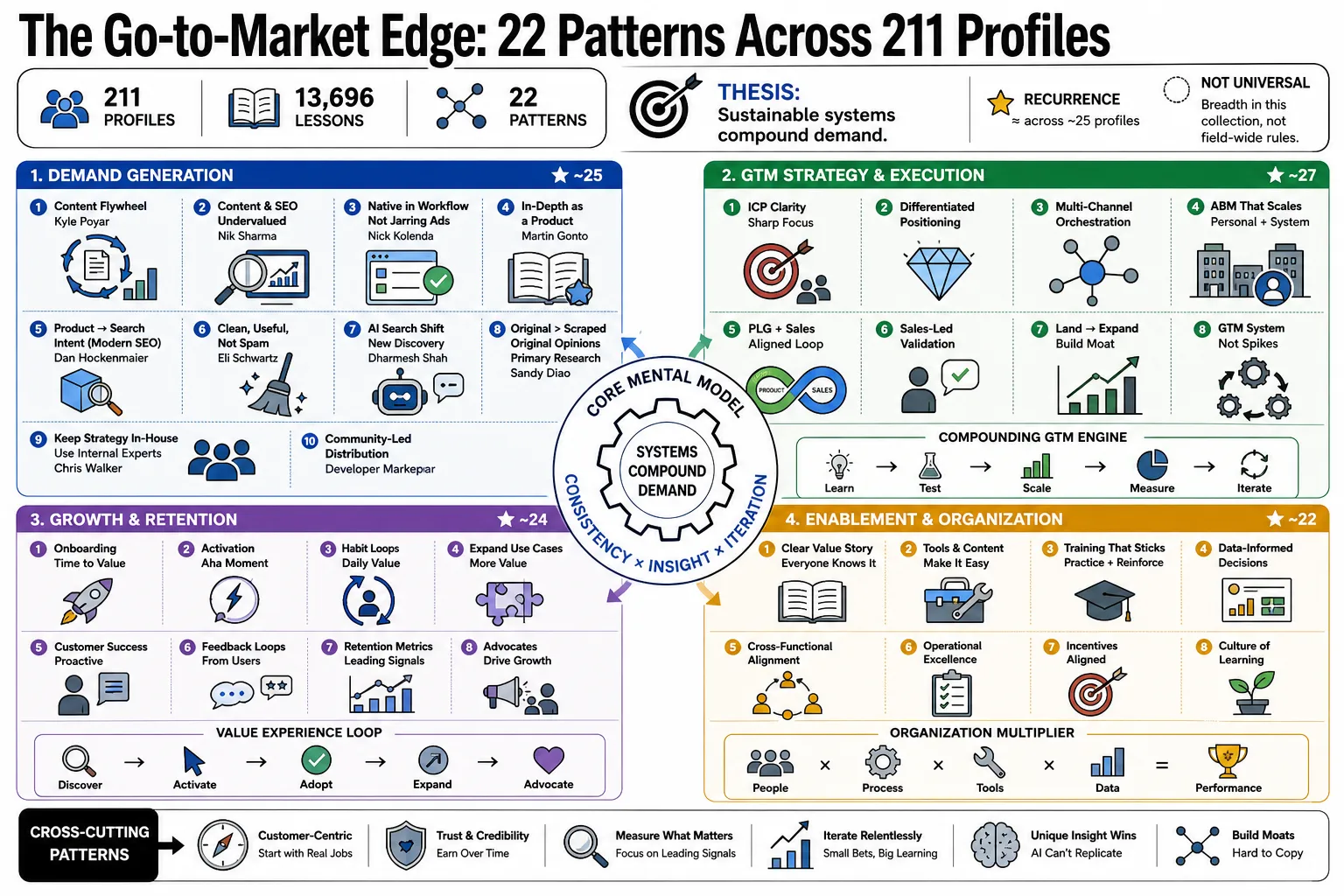
1. Demand Generation
Designing high-performing campaigns, leveraging account-based marketing, and creating compelling content to build predictable revenue pipelines. · recurs across ~25 profiles
Building a predictable revenue pipeline often benefits from prioritizing sustainable, compounding systems over short-term marketing spikes. Kyle Poyar notes that while one-off campaigns generate temporary growth, treating content as a flywheel yields durable results. This aligns with Nik Sharma, who views content and SEO as undervalued mechanisms for long-term, low-cost acquisition. To achieve this organically, Nick Kolenda suggests integrating promotions naturally into the user’s workflow rather than using jarring ads, while Martin Gonto recommends designing in-depth content that functions as a standalone product. Similarly, Dan Hockenmaier and Eli Schwartz argue modern SEO focuses on translating core product experiences into search intent, stripping away spam to genuinely serve users.
However, the proliferation of AI search fundamentally shifts content discovery. Dharmesh Shah observes that optimizing for AI chatbots is replacing traditional SEO. Consequently, Sandy Diao warns that driving traffic now demands highly original opinions or primary research that AI cannot simply scrape. Chris Walker emphasizes keeping strategic content creation in-house, leveraging internal experts to generate authentic insights, a practice endorsed by Developer Markepear.
Effective demand generation also mandates precision in translating engagement to pipeline. Latane Conant champions a frictionless, customer-first experience without artificial barriers. While Elena Verna successfully leverages free public content to generate leads, capturing true intent requires operational rigor. Maxence de Villepion notes that basic signals like downloads must be validated against external data to confirm buying intent. Ultimately, Brent Adamson argues content success is measured by its utility in helping buyers navigate internal purchasing tasks, necessitating Craig Rosenberg’s disciplined approach to defining handoffs across various lead qualification stages.
2. Customer Empathy
Leveraging qualitative feedback and active listening to deeply understand user struggles and guide product iteration. · recurs across ~43 profiles
Customer empathy often involves moving beyond superficial metrics to grasp the true struggles of users. GC Lionetti establishes a foundational distinction: quantitative data reveals what users are doing, but qualitative feedback explains the underlying reasons. This qualitative layer is critical for iteration, as Crystal Widjaja notes that relying solely on structured A/B testing will miss nuanced product outcomes. However, observing actions remains essential; Dharmesh Shah cautions that authentic feedback is often found in user behavior rather than their spoken words.
To systematically capture this empathy, organizations must treat discovery and sales calls as primary research channels. Chris Walker emphasizes that marketing teams operate blindly if they ignore recorded sales conversations, while John Barrows adds that discovery bridges the gap between generic marketing content and the specific context of a buyer’s problem. Implementing this requires intense curiosity rather than aggressive questioning, transforming discovery into a diagnostic exercise according to John Kaplan.
Interestingly, perspectives differ on the ideal balance of conversation. Elay Cohen argues that the most successful representatives speak the least during discovery. Conversely, Steve Richard provides conflicting evidence, indicating that top performers actually maintain a slight speaking majority, typically around a 55-to-45 ratio.
Ultimately, building this empathetic feedback loop hinges on a receptive culture. Deb Liu suggests leaders must actively reshape permission structures to encourage genuine input. This standard is rigorous enough that Becca Lindquist screens candidates based on their defensiveness to critique, knowing that an inability to absorb feedback internally predicts failure when facing customer rejection.
3. Customer Retention
Minimizing churn, accelerating time-to-value, tracking health scores, and transforming satisfied users into vocal advocates to drive expansion. · recurs across ~36 profiles
Customer retention often involves transforming defensive support into proactive value creation, yet experts disagree on the direct role of Customer Success (CS) in revenue. Eleanor Dorfman and Matt Plank argue that CS must operate as a primary revenue engine responsible for identifying expansion opportunities rather than merely saving at-risk accounts. In contrast, Allison Pickens distinctly separates these duties, suggesting that true success management prioritizes advocacy and long-term user triumphs without the pressure of short-term commercial selling, leaving expansion to account managers.
Despite this structural debate, the overarching goal remains shifting from defense to offense. Nick Mehta emphasizes that proactive retention means helping users extract continuous value rather than just mitigating churn. Foundational to this shift is treating every interaction as an opportunity to earn trust; Mayur Gupta notes that loyalty is a daily outcome of consistent touchpoints, while Rob Giglio reinforces that solving for the paying customer must remain an organization’s highest priority.
Practically, avoiding churn also requires cross-functional alignment. Archie Abrams warns against treating customer support as a cost center, noting it serves as a critical frontline for tracking health scores and spotting churn risks early. Dave Kellogg adds a structural safeguard, advising against non-prepaid multi-year contracts because they often devolve into finance collection efforts rather than genuine renewals. Ultimately, as Maggie Hott and Sarah Patterson illustrate, creating vocal advocates requires years of sustained performance, gratitude, and the willingness to offer unscalable, personalized support to guarantee initial time-to-value.
4. Product-Market Fit
Validating core hypotheses, understanding deep user pain points, and iterating quickly to build solutions that the market genuinely demands. · recurs across ~11 profiles
Achieving product-market fit often involves a rigorous sequence of hypothesis validation. As Pete Kazanjy outlines, founders must isolate a genuine pain point, confirm its reality, demonstrate their product resolves it, and secure commercial exchange. Building on this, Eric Seufert notes users only pay when a product fulfills a fundamental need, with upgrades occurring naturally when the pain of restriction outweighs transaction costs. Uncovering these exact pain points can take creative forms; Adan Schoenfekd suggests using a media arm to generate top-of-funnel insights that reveal precisely what software needs to address.
Once a baseline is established, rapid iteration is paramount. Manny Medina insists true fit requires testing the product with live users immediately and evolving based on reactions. This feedback loop must be remarkably fast, as Graham Moreno argues adjusting sales strategies after a lost deal should happen in hours, not fiscal quarters. To sustain momentum, Matt Lerner emphasizes experimentation must be the default state for all company decisions.
This testing culture applies across all functions. Matt Plank advises treating outbound scripts like software code by constantly A/B testing components. Regarding pricing, Elena Verna notes: “Leaving a lot on the table as the monetization model needs to adjust to market needs and your product evolution continuously. Instead, testing and knowing what works and doesn’t within your monetization is the most significant strategic advantage you can have in your business.” [1] Ultimately, Sean Ellis views product-market fit surveys as leading indicators to guide iteration, not definitive proof of success.
5. Strategic Planning
Formulating long-term vision, evaluating competitive landscapes, executing strategic pivots, and focusing organizational resources effectively. · recurs across ~27 profiles
Rather than bolting messaging onto finished products, Krithika Shankarraman and Archana Agrawal emphasize that marketing must engage during early development to ensure outward messaging reflects market demands. This deep integration is fundamental to establishing a long-term vision, which Rahul Moodgal suggests should be reverse-engineered from multi-decade objectives.
Achieving this vision relies on deliberate trade-offs. April Dunford notes that strategy demands choosing a distinct path, advising companies to let their most satisfied customers guide their positioning. This precision is echoed by Adan Schoenfekd, who advocates for strict segmentation to concentrate resources on high-value accounts. When executing these strategies, Maja Voje and Ketty Slonimsky argue that growth models must unify pricing, acquisition, and channels around a single portfolio-level strategy.
Successfully adapting to competitive landscapes requires foresight. Chad Peets stresses anticipating shifts well before they impact the bottom line, supported by predictive analytics as highlighted by Mark Velthuis. To maintain focus, tactical experimentation must always serve broader objectives (Ashley Mayer). Maintaining tight feedback loops—from early sales hires translating market reality (Kyle Parrish) to shared data dashboards that turn disputes into collaborative planning (Sarah Kennedy) and proactive stakeholder alignment (Natalie Furness)—ensures resources are effectively deployed. Pragmatic planning also extends to capacity, with Rich Rao reminding leaders that operational scaling must account for realistic ramp-up periods. Finally, Maggie Hott underscores that hiring individuals motivated by these concrete missions rather than abstract visions is what ultimately grounds a strategy in reality.
6. Analytics
Defining leading indicators, executing rigorous quantitative tracking, breaking down data silos, and driving decision-making with objective metrics. · recurs across ~24 profiles
Effective analytics programs prioritize predictive insight over retrospective reporting. Leaders consistently warn against relying on lagging indicators like pure revenue or profit, which Matt Lerner argues can degrade the customer experience if optimized directly. Instead, organizations must instrument their operational process to capture early business movement. Pete Kazanjy emphasizes establishing sales telemetry by monitoring stage advancement, while Latane Conant and David Rudnitsky highlight tracking account engagement as critical health markers.
To achieve clarity, leaders must rigorously prune operational noise. Mark Velthuis and Philip Lacor advocate limiting dashboards to variables that demonstrably influence outcomes. This means moving away from vanity metrics—a shift echoed by Sara Varni and Denise Persson, who stress accountability to actual pipeline generation. This focus demands breaking down data silos. Dini Mehta notes that revenue and marketing teams looking at different dashboards suffer fundamental misalignment, while Ketty Slonimsky champions centralized acquisition infrastructure to evaluate growth coherently. Furthermore, Natalie Furness adds that operations teams must baseline these metrics before starting any project.
Tracking approaches must also adapt to qualitative realities. Kyle Poyar points out that traditional benchmarks fail product-led structures, requiring new frameworks. Similarly, GC Lionetti warns that aggregate data obscures behavioral trends without cohort analysis, Eli Schwartz advocates prioritizing intent-driven metrics over raw volume, and Chris Walker advises layering self-reported attribution to understand buyer intent. While rigorous measurement is standard, there is notable dissent regarding its universal application: Archie Abrams deliberately prohibits KPIs for core product teams, arguing that rigid metrics stifle necessary experimentation.
7. Power Laws
Leveraging compounding effects, asymmetric upside, and high-leverage activities to disproportionately drive outsized results and revenue. · recurs across ~9 profiles
In sales and marketing, exponential outcomes rarely stem from linear effort; they emerge from exploiting power laws through compounding systems and asymmetric bets. True growth requires identifying activities with disproportionate returns. Matt Lerner distinguishes between mere hustles—tactics that force teams to start from scratch monthly—and genuine growth levers that steadily build momentum.
This compounding effect is structurally driven by rapid experimentation. Sean Ellis emphasizes that high-velocity testing transforms isolated wins into cumulative learning, allowing organizations to reliably scale what works. Similarly, Maya Spivak notes that continuous output generates a perception of unstoppable momentum that naturally draws in both talent and customers. At an even more granular level, Melissa Tan suggests that taking action on a localized scale can break broader systemic inertia, building the initial momentum necessary for outsized impact.
Asymmetric upside is another crucial dimension, where downside is capped but potential rewards are immense. Jay Yang points out that delivering high-value cold outreach carries zero real risk while offering life-changing opportunities upon success. Kyle Norton applies this logic to careers, arguing that a startup’s inherent dangers must be offset by massive equity payoffs. Even counterintuitive metrics reveal power law dynamics: Dan Hockenmaier observes that low retention is acceptable if acquisition costs approach zero and the retained cohort yields exponential returns. Taking a broader systemic view, Brian Balfour warns that ultimate viability cannot rely on single variables; it requires a holistic alignment of multiple interacting factors. Finally, to maximize high-leverage opportunities, Krithika Shankarraman advises automating low-value tasks to fiercely protect the creative core where outsized returns are actually generated.
8. Execution
Operating with extreme velocity, enforcing rigorous prioritization, building replicable processes, and maintaining a relentless bias toward action. · recurs across ~36 profiles
Operational excellence separates enduring organizations from those that stall out. Rather than depending on the isolated heroics of individual contributors, Chad Peets contends that top-tier sales organizations are structured around replicable methodologies. This perspective aligns with Cedric Pech, who stresses that long-term success is a byproduct of the unwavering discipline to follow proven systems without deviation. The key distinction lies in abandoning the search for a magical quick fix—what Eric Seufert describes as hunting for the perfect ad—and instead dedicating focus to operational engines that incrementally raise conversion probabilities.
High execution velocity often requires rigorous prioritization. Jeff Shiner notes that healthy scaling is less about doing more and entirely about narrowing focus, deliberately preventing every worthwhile idea from fighting for limited resources. This disciplined narrowing of scope must be paired with extreme urgency. Scott Leese highlights that embracing immediate action and outworking competitors is often the ultimate differentiator, warning against the paralysis caused by overthinking. To enforce this pacing, David Sacks advises using public launches as strict forcing functions, creating rigid deadlines that organically drive team alignment.
Sustaining momentum requires tracking the right inputs. Matt Plank recommends prioritizing leading metrics like conversion velocity over lagging outcomes, while Rob Giglio insists on applying upfront rigor to validate demand before committing heavy investments. When systems are sound, raw ability becomes secondary; Colin Jones points out that steadfast discipline consistently outperforms erratic brilliance. Ultimately, scaling successfully hinges on a relentless bias for action, coupled with the agility—as Maja Voje details—to rapidly identify and discard failing market assumptions.
9. Distribution
Building sustainable go-to-market engines, aligning channels, and leveraging product-led or sales-led motions to efficiently acquire users at scale. · recurs across ~38 profiles
Building a sustainable distribution engine typically involves aligning your acquisition channels with your business model, as Julian Shapiro notes different models demand distinct approaches. For SaaS, this means establishing product-led growth where retention drives acquisition, according to Elena Verna. In this motion, Archana Agrawal explains the product is the primary acquisition channel, and marketing simply accelerates it. Maja Voje emphasizes success hinges on perfectly aligning product capabilities, pricing, and positioning with these channels. Pricing must continuously evolve, as Kyle Poyar observes leading companies constantly iterating on plans.
However, over-reliance on a single motion introduces risk. Adan Schoenfekd warns relying exclusively on inbound creates go-to-market debt that surfaces during economic slowdowns, making outbound muscles essential. Highlighting a different scaling mistake, Benyamin Holley warns against hastily hiring sales representatives when companies actually need product engineers. Overcoming these scaling challenges requires overarching frameworks, like the operating systems championed by Sangram Vajre, combined with the problem-solving methodology advocated by Martin Gonto.
Outbound remains a potent, underutilized lever, according to Sam Blond. Mike Weinberg insists proactive effort cannot be replaced by passive marketing. To optimize execution, Ghazi Masood recommends separating development teams into dedicated inbound and outbound functions early. Effective outreach requires persistence; Matt Plank advises using multiple touches across channels. Beyond direct sales, alternative channels offer immense leverage. Maggie Hott highlights deep partnerships create enduring relationships, while Sandy Diao suggests engineering affiliate programs with the rigorous incentives of paid acquisition. Looking forward, these strategies must adapt to changing user expectations, as Rob Giglio notes the incoming generation demands AI-powered, cloud-based tools.
10. Sales Mechanics
Mastering the tactical elements of selling, from discovery and qualification to objection handling, forecasting, and closing complex enterprise deals. · recurs across ~32 profiles
Developing strong sales mechanics involves consistent effort across prospecting, qualification, and forecasting. A common failure is the revenue rollercoaster, where salespeople stop prospecting to focus on active deals. Mike Weinberg warns that relying on a few prospects leaves reps empty-handed if they fall through, while Trish Bertuzzi suggests specialized roles to prevent this. To maintain momentum, Scott Leese recommends assuming every deal will collapse, and Brandon Clauser notes that closing enterprise deals fundamentally requires enduring continuous rejection. To improve outreach, Morgan Ingram advises mining customer success teams for ROI data.
Moving deals forward demands a buyer-centric approach, championed by Force Management. Carles Reina cautions against artificial end-of-quarter pressure; true urgency stems from understanding the buyer’s internal timelines. When securing deals, Jacco van der Kooij reframes the objective as committing and trading rather than closing and negotiating. This aligns with Jeb Blount, who emphasizes asking confidently, staying silent, and methodically handling objections.
Finally, scaling relies on objective forecasting rather than optimism. Becca Lindquist, Matt Plank, and Brian McCarthy argue that committed revenue must be backed by historical data, rigorous qualification, and specific deal stages. As companies grow, Adan Schoenfekd warns founders against throttling revenue by holding onto sales too long, noting that early hires, described by Kyle Parrish, must execute and write the playbook. Ultimately, Ben Braverman argues leaders must absorb hypergrowth chaos to foster the absolute transparency advocated by David Rudnitsky, allowing the floor to simply focus on closing.
11. Pricing
Structuring packaging tiers, testing willingness to pay, optimizing freemium models, and utilizing value metrics to capture maximum market value. · recurs across ~25 profiles
Pricing strategies can explicitly align with delivered outcomes, ensuring customers pay more only as they succeed (Archana Agrawal). Rich Rao argues effective packaging architecture directs users to tiers maximizing their received value, rather than merely optimizing company margins. Structuring these tiers correctly is critical. Dini Mehta notes that smart bundling allows new products to pull core offerings into fresh accounts, whereas poor packaging forces companies to discount everything to zero. This architecture grows complex with AI, prompting Carl Eschenbach to advocate a blended approach of seat, role, and consumption-based metrics.
Providing a free self-serve experience before a paywall is essential for modern buyers to discover this value (Kyle Poyar). Eric Seufert adds that this unpaid user base provides the necessary liquidity for premium tiers to survive. While most advocate for these freemium motions, Wes Bush diverges slightly, cautioning against over-indexing on specific models to instead focus purely on user outcomes. Still, Elena Verna asserts, “This approach to building companies is here to stay - like it or not, this methodology isn’t going anywhere.” source Ultimately, users already experiencing product value represent the most accessible revenue (GC Lionetti).
When executing deals, companies must vigorously defend their pricing power. Matt Plank warns that discounting to accelerate a signature destroys long-term lifetime value. Instead, Douglas Hanna, Philip Lacor, and John Kaplan universally agree: discounts must only be traded for structural assets like multi-year terms, upfront payments, or public case studies. Maintaining this integrity is crucial when balancing monetization against retention (Brian Balfour).
12. Communication
Mastering internal and external storytelling, maintaining extreme clarity, presenting effectively, and cutting through corporate jargon. · recurs across ~12 profiles
Effective communication in modern go-to-market strategies often prioritizes simplicity and the reduction of corporate jargon. Shannon Brayton and Claude Hopkins both emphasize that defaulting to technical terminology alienates audiences; products must be explained in everyday language. This philosophy is echoed by Dave Gerhardt, who argues that the secret to effective business writing is avoiding traditional business writing altogether. The implication is severe: Ben Braverman notes that an overly complex pitch fundamentally impedes both fundraising and operational execution. Leaders must possess a sharp, unambiguous articulation of their product’s market fit.
While verbal presentations are often celebrated, the discipline of writing offers structural advantages. Amol Avasare champions written documentation over verbal delivery because asynchronous, searchable context scales faster across organizations. Similarly, Nate Nasralla and Adam Fishman argue that the writing process forces rigorous cognitive clarity, refining deal messaging and preventing half-baked product execution.
Beyond format, the core message must resonate emotionally and logically. Dan Pink suggests abandoning aggressive closing tactics in favor of attunement—understanding the buyer’s specific perspective—and clarity. This aligns with the presentation philosophies of Carmine Gallo and Gene Zelazny, who champion data-driven storytelling as the ultimate tool for persuasion. The necessity for directness now extends beyond human audiences; Eli Schwartz points out that burying answers beneath lengthy preambles actively hinders AI models from parsing information. Ultimately, Pete Kazanjy highlights that storytelling is not static, requiring a rapid, continuous feedback loop between pitching, listening, and product development.
13. Cross-functional Alignment
Fostering deep operational harmony between product, marketing, and sales departments to eliminate organizational silos. · recurs across ~12 profiles
Achieving operational harmony across product, marketing, and sales is often viewed as a structural necessity for modern growth. When companies reach a threshold of maturity, Latane Conant observes that go-to-market functions must fundamentally align. Mark Velthuis and Douglas Hanna argue that these departments can no longer operate in isolation, requiring a contiguous revenue engine to manage handoffs seamlessly. Echoing this, Loren Padelford describes sales and marketing as inseparable halves of the revenue equation, while GC Lionetti emphasizes they must share unified metrics.
This convergence demands rigorous infrastructure. Rosalyn Santa Elena clarifies that true alignment is driven by strict agreement on lead definitions and success criteria, rather than mere goodwill. To support this, leadership must actively dismantle silos by enforcing a shared tech stack, which Natalie Furness identifies as critical for RevOps maturity. Denise Persson adds that this unified data architecture turns marketing campaigns into a compounding competitive advantage.
The implications extend to product-led strategies and brand identity. Justin Dignelli highlights the necessity of bridging self-serve and sales-led businesses. This ensures that end-users, whom Lauryn Isford views as primary purchasing catalysts, are equipped to champion products internally. Furthermore, Shannon Brayton notes that protecting a company’s narrative requires centralizing communications under one leader. Ultimately, eliminating these silos creates a unified go-to-market motion capable of driving sustained performance.
14. Talent
Sourcing, interviewing, and onboarding top-tier generalists and specialists while maintaining high standards and avoiding costly mis-hires. · recurs across ~23 profiles
When building a go-to-market organization, leaders like Matt Plank and Leela Srinivasan treat talent acquisition with the same rigor as revenue generation. They argue that recruiting engines must be as sophisticated as sales funnels, actively tracking conversion metrics at every stage. A proactive strategy is essential because elite sales professionals are rarely active job seekers; as Mark Roberge observes, capturing them demands tailored, passive sourcing strategies. This effort should be complemented by deliberately widening the search. Michelle Benfer and Tara Robertson warn that relying on homogeneous networks creates market blind spots, necessitating structural friction in legacy processes to intentionally source from non-traditional pipelines. Network vetting remains valuable, with Maggie Hott and Ghazi Masood emphasizing early back-channeling through investors and advisors to uncover disqualifying traits early.
During interviews, behavioral cues trump polished resumes. Becca Lindquist tests directly for coachability by measuring candidates’ defensiveness to feedback, predicting their resilience to customer rejection. Similarly, Noah Desai Weiss prioritizes the self-awareness required to dissect past failures, while Lauryn Isford bypasses abstract frameworks by asking candidates to explore the live product and generate concrete growth ideas. When weaknesses emerge, Sydney Sloan recommends addressing red flags transparently during the interview to construct customized day-one onboarding plans. Finally, standards cannot drop for internal talent. Trish Bertuzzi cautions that internal promotions should face the same rigorous evaluation as external hires, ensuring that anyone advancing, as Denise Persson notes, fundamentally grasps how their daily execution drives overarching revenue. This approach requires playbooks covering everything from hiring profiles to validation steps, as Mark Cranney advises.
15. Culture
Fostering an environment of psychological safety, accountability, radical transparency, and shared values that scales alongside the organization. · recurs across ~20 profiles
In many high-performing organizational cultures, radical transparency nurtures the psychological safety required for rigorous accountability. As Douglas Hanna and Kevin Aluwi observe, teams are far more resilient to bad news than to being kept in the dark. This principle extends from a company’s genesis, where Linda Lian advises candor among co-founders regarding risks, to early-stage operations, where Kyle Parrish stresses the necessity of admitting what is broken to maintain leadership credibility. Jason Lemkin suggests aiming for ninety percent transparency so the team grasps the business stakes.
Transparency also builds trust externally with users, as Fahd Ananta notes. Ben Braverman adds that managing a brand’s inventory demands total operational visibility, while Dan Hockenmaier highlights that high-stakes B2B relationships require significantly more trust to function. Internally, cross-functional cohesion blossoms through open data sharing, a strategy Archana Agrawal champions for bridging departments. Crucially, this openness fosters psychological safety; Noah Desai Weiss illustrates that employees only engage in radical candor if confident their honesty won’t penalize their performance reviews.
This foundational trust makes accountability manageable rather than adversarial. John Kaplan warns that enforcing rules without relationships breeds rebellion, echoing Cedric Pech, who asserts accountability becomes frictionless when anchored in a shared goal. Aligning on these standards is vital. Denise Persson and Dini Mehta emphasize that individuals must match the company’s operating rhythm, since misalignment on accountability inevitably causes turnover. Conversely, recruiting based on shared values, as Colin Jones found, establishes a reliable baseline for collective success.
16. Leadership
Empowering managers, practicing servant leadership, guiding cross-functional teams, and making difficult personnel decisions with empathy. · recurs across ~12 profiles
Effective leadership in go-to-market and sales functions transcends simple authority, resting fundamentally on applied empathy and the deliberate empowerment of others. A core distinction emerges between merely directing a team and actively practicing servant leadership. As Kelly Watkins emphasizes, empowerment involves understanding individual motivations rather than applying a universal management style. This individualized approach extends to recognizing diverse learning styles and consciously adapting communication to support every team member, a practice advocated by Natalie Furness. Furthermore, leaders must be mindful of their impact; Shannon Brayton notes the importance of providing clear direction to avoid causing unnecessary anxiety for direct reports.
Beyond direct management, guiding cross-functional teams often demands leading without formal power. Both Crystal Widjaja and Rosalyn Santa Elena highlight that influencing others relies on building credibility through deep empathy and strong business acumen. Cultivating this empathy is sometimes born from personal adversity, with Amol Avasare reflecting on how experiencing hidden limitations fosters a deeper understanding of a team’s unspoken struggles.
The implications of such empathetic leadership are profound, directly affecting organizational capability. Archana Agrawal argues that a marketing leader’s greatest impact comes from coaching the subsequent tier of management. However, fostering this talent can be challenging; Chad Peets warns that remote work strictly schedules mentorship, stifling the organic coaching that best develops potential. Ultimately, equipping teams with tools and decision-making power ensures they can optimally serve their audience, a principle championed by Tiffany Bova. This empathy for the customer’s friction is essential for effective selling, echoing Peter Kazanjy and Merci Grace.
17. Capital Discipline
Managing cash flow, optimizing burn rates, and balancing bootstrapped efficiency with venture-backed scale to ensure long-term business survival. · recurs across ~13 profiles
The era of unrestricted capital has ended, forcing companies to demonstrate a clear path to profitability much earlier in their lifecycles, as noted by Kevin Aluwi. Survival increasingly requires rigorous capital discipline. As Danielle Morrill observes, burn rates are entirely within a company’s control and easier to manage than acquiring new customers, though CJ Gustafson points out that runway is often dictated by both bank balances and founder egos.
This financial reality demands careful pacing in go-to-market strategies. Injecting capital into a flawed sales mechanism (Carles Reina) or scaling a sales team prematurely (Peter Kazanjy) only accelerates cash depletion. Similarly, outsourcing sales before securing a repeatable playbook obscures vital market feedback and drains resources (Jen Abel). Heavy marketing investments are equally dangerous if executed before resolving core growth bottlenecks (Matt Lerner) or establishing sound unit economics (Arnie Gullov-Singh).
Instead of buying revenue, organizations must systematically engineer it (Michelle Benfer). This involves measuring capital efficiency through metrics like the Burn Multiple to evaluate the actual cost of new recurring revenue (David Sacks). Leaders must ensure their software delivers undeniable return on investment to justify premium pricing (Adan Schoenfekd) and continuously monitor cash health when planning growth (Adam Fishman). By focusing on cash flow break-even and leveraging automation, companies can minimize the traditional trade-off between scaling and staying profitable (Kyle Poyar).
18. Stakeholder Management
Navigating board communications, investor expectations, and internal messaging during critical business transitions. · recurs across ~12 profiles
During critical business transitions, effective stakeholder management often involves shifting from tactical updates to strategic alignment. Rosalyn Santa Elena emphasizes that boards ignore operational outputs like email volume, focusing entirely on high-level impacts like net revenue retention. Consequently, Kelly Watkins advises active board management, where leaders present concrete solutions rather than unstructured problems. In high-stakes meetings, Shannon Brayton observes that delivering facts with a neutral demeanor is far more persuasive than relying on emotional arguments.
Setting realistic expectations is a vital mandate, particularly during hypergrowth. Kevin Aluwi notes that rapid scaling fosters unsustainable investor expectations, forcing leaders to carefully calibrate projections against unit economics. Similarly, Sydney Sloan and Chad Peets highlight the challenge of balancing enthusiasm with realism. They recommend establishing grounded targets for enterprise pipeline maturity and relentlessly executing to surpass them. This builds trust, which Sara Varni emphasizes must be established through consistent reporting cadences well before requesting budget increases.
Beyond the boardroom, communication distinctions shape internal alignment. Ashley Mayer suggests that proactively addressing hurdles inspires confidence across both investor and employee bases. Internally, sharing unfiltered performance data builds cross-functional trust, according to Archana Agrawal, while Leela Srinivasan points out that explicitly defining roles and cultural realities prevents mismatched expectations down the line. Ultimately, Danielle Morrill asserts that investors expect executives to decisively navigate difficult choices to protect the company’s vision. In massive transactions, this executive leadership even extends to enlisting the board to backchannel with prospects, a strategic move noted by Jamal Reimer.
19. Moats
Establishing long-term competitive advantages, building defensibility, and creating enduring brand value to protect against incumbents and rivals. · recurs across ~17 profiles
Establishing defensibility often involves moving beyond feature wars. Geoffrey Moore emphasizes concentrating resources on differentiating core activities rather than non-differentiating context. Simply building a marginally superior product is insufficient; Rosalyn Santa Elena observes that solving problems fundamentally differently is vastly more effective than mimicking rivals. Sheila Joglekar Vashee advises anchoring positioning in distinct customer pains rather than feature bloat, while Deb Liu underscores identifying a narrow right to win.
Technological leads are fleeting, but cognitive dominance lasts. Christopher Lochhead argues that monopolizing a category in the public mind yields the strongest protection, a trait Denise Persson notes is shared by consistently loyal brands. While category creation is heralded, practical execution often diverges; Alex Kracov and Manny Medina counter that it is actually simpler to redefine established spaces and poach competitor users than to educate markets and demand net-new budget allocations.
Ultimately, narrative forms the most sustainable defense. Dave Gerhardt and Loren Padelford view authentic brand stories as vital assets when functionality commoditizes. If removing a logo renders a website indistinguishable, Kelly Watkins warns, the brand is nonexistent. Companies must cultivate compounding advantages through a human-centric identity, as Mishti Sharma highlights, or by building a dedicated audience, as championed by Nik Sharma. While challengers exploit agility and hands-on time advantages against incumbents—moats identified by Maya Spivak and Fahd Ananta—Maryam Banikarim notes that legacy brands can maintain their deep-rooted trust if they continuously adapt to buyer needs.
20. Technology
Architecting scalable data infrastructure, integrating AI workflows, managing technical debt, and building internal tooling for organizational leverage. · recurs across ~14 profiles
The push to integrate AI and scale data infrastructure reveals a divide between foundational redesigns and incremental additions. Jason Eubanks argues against merely attaching AI to legacy CRM architectures, advocating for systems built intrinsically around unified data and agentic automation. This approach resonates with Crystal Widjaja, who advises architecting data systems for ideal outcomes rather than current constraints, reflecting Kevin Aluwi’s view on building infrastructure from scratch.
However, organizations struggle with tool proliferation. While Natalie Furness encourages linking diverse no-code tools into a centralized CRM, others warn of mounting technical debt. Krithika Shankarraman and Toni Hohlbein counter that complex stacks generate busywork, advocating instead for the synthesis of existing data. Philip Lacor agrees, emphasizing that software cannot fix fundamentally broken processes. To prevent this friction from stalling growth, Rosalyn Santa Elena recommends aggressively pruning the technology stack annually.
Architectural consensus favors agility. Loren Padelford observes a shift from monolithic structures to composable ecosystems where speed dictates success—a requirement Becca Lindquist notes is essential for AI-enabled sales teams outrunning competitors. Maxence de Villepion highlights that headless stacks empower teams to orchestrate workflows securely without third-party servers. Adopting this cloud-native mindset, as Ed Lenta observes, requires engineering teams to fundamentally rethink risk. Ultimately, as Archana Agrawal warns, a disjointed technology stack creates a disjointed funnel; your marketing, product, and sales data must seamlessly communicate.
21. Ecosystems
Cultivating passionate communities, building strategic partner networks, and leveraging open platforms to generate network effects. · recurs across ~13 profiles
Ecosystems generate powerful network effects when companies transition from merely capturing audiences to cultivating genuine, peer-driven communities. Adan Schoenfekd draws a critical distinction here: an audience is a one-way channel, whereas a community requires two-way dialogue. This evolution demands shifting away from top-down broadcasts toward facilitating peer-to-peer mentorship, as Merci Grace observes. When done correctly, this results in self-sustaining ecosystems where users actively educate and recruit one another, a dynamic noted by Denise Persson.
Achieving this requires meeting users on their own terms. Companies cannot dictate where engagement happens; instead, Linda Lian advises interacting across the diverse platforms where users already exist. Similarly, Maya Spivak cautions that communities cannot be artificially manufactured, only supported in their natural gathering spaces. Treating these platforms as venues for trust-building rather than lead-generation is essential, according to Maxence de Villepion. Authenticity remains paramount; Sara Varni highlights that technical audiences quickly detect inauthentic content not vetted by experts. In these spaces, Developer Markepear notes that specialized influencer marketing becomes highly effective.
Beyond organic community, strategic platforms rely on structured partner networks to win markets. Sydney Sloan argues that category winners surround their products with implementation partners and power users. Cameron Deatsch emphasizes the importance of marketplace infrastructure that allows partners to build plugins and extend core capabilities. Scaling this requires clear value propositions that articulate why developers should invest their time, as suggested by Paige Paquette, ultimately allowing developer relations teams to scale from a handful of enthusiasts to massive international ecosystems, as seen by Danielle Morrill.
22. Resilience
Managing founder psychology, overcoming imposter syndrome, navigating burnout, and maintaining endurance through inevitable failures and crises. · recurs across ~12 profiles
Endurance in high-stakes go-to-market roles often involves managing physical energy limits alongside the psychological weight of failure. Navigating burnout begins with rejecting the myth of the constant sprint. Michelle Benfer approaches sales leadership as a marathon, relying on non-negotiable boundaries—like evening shutdowns and protected thinking time—to sustain performance. Crystal Widjaja similarly strips the glamour from overwork, arguing that firm time constraints are prerequisites for long-term survival, while Scott Pugh emphasizes that a leader’s baseline capacity to handle stress is anchored in their morning routine. However, recovering from these limits is complex; Danielle Morrill points out that healing from startup burnout is highly non-linear and often involves unpredictable emotional turbulence.
When confronting inevitable setbacks, the prevailing mindset treats adversity as systemic data rather than personal defeat, though evidence shows differing intensities in this approach. While David Sacks advocates for an absolute determination that refuses to accept failure as a valid outcome, most leaders prioritize adaptation over sheer obstinance. Deb Liu, Mark Velthuis, and Rahul Moodgal collectively frame friction, lost deals, and career turbulence not as reasons to stop, but as stress tests and mandatory tuition fees that build resilience. Dale Dupree channels this perseverance into tackling the strenuous, creative work that competitors abandon. Summarizing this required durability, Elena Verna explicitly notes: “Turn failures into learnings. You will fail a lot when trying to grow your product or career. You must have a thick skin and adopt a growth mindset.” [1]