The Core Disciplines of Business Leadership
Across 250 business leaders & executives profiles and 15,908 lessons, 23 patterns recur often enough to matter. They are not universal rules; recurrence indicates breadth within this collection, not agreement across an entire field.
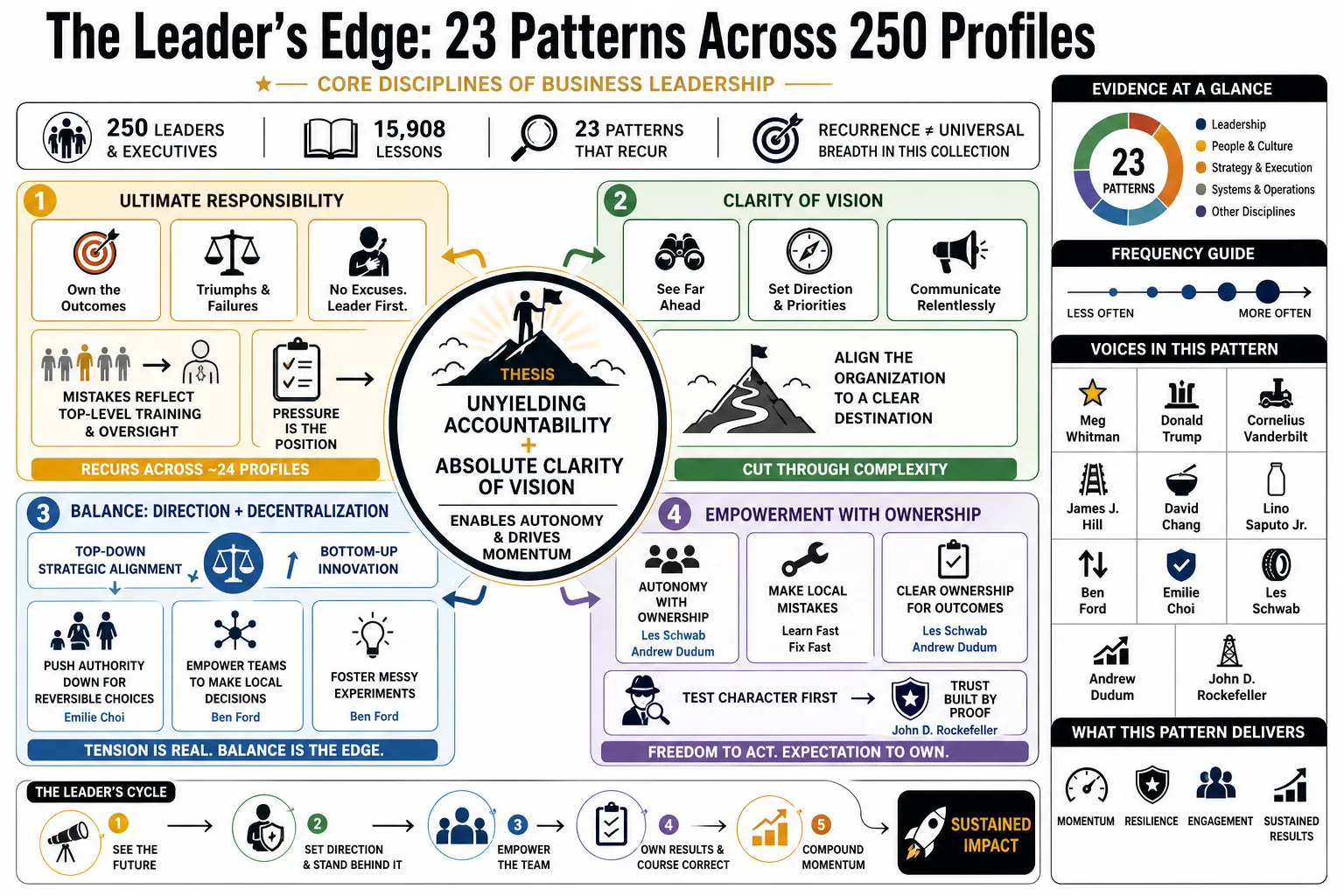
1. Leadership
Setting the vision, taking ultimate responsibility, leading by example, and making difficult decisions with conviction under intense pressure. · recurs across ~24 profiles
Effective leadership rests on the dual pillars of unyielding accountability and absolute clarity of vision. Taking responsibility is not merely a formality; it is an organizational necessity. Executives like Meg Whitman, Donald Trump, and Cornelius Vanderbilt emphasize that true leaders must accept total ownership for both triumphs and failures, framing setbacks as personal miscalculations rather than bad luck. Rather than blaming subordinates, James J. Hill and David Chang argue that staff mistakes inherently reflect a failure of top-level training and oversight. Lino Saputo Jr. actively embraces this intense pressure, recognizing that ultimate accountability always rests at the top.
Yet, asserting this responsibility requires balancing top-down direction with decentralized execution. Ben Ford notes the tension between requiring strategic alignment and fostering messy, bottom-up innovation. To navigate this, Emilie Choi, president of Coinbase advises pushing authority downward for reversible choices, while Les Schwab and Andrew Dudum pair this autonomy with explicit ownership, allowing employees to make localized mistakes as long as they learn from them. Crucially, John D. Rockefeller would only grant such autonomy after rigorously testing a subordinate’s character.
Ultimately, generating organizational momentum relies on conviction rather than mere positional power. David Ko, Jeff Weiner, and Ryan Petersen observe that genuine inspiration stems from a clear vision and the courage to maintain course during difficult times. While most emphasize clear, continuous communication to unite the team—as noted by John Chambers—Enzo Ferrari demonstrates that physical proximity is not strictly necessary if a leader’s personality and authority are forceful enough to project across distances.
2. Self-Awareness
Managing ego, demonstrating emotional intelligence, acknowledging personal flaws, and remaining grounded despite public success and scrutiny. · recurs across ~17 profiles
At the highest levels of leadership, self-awareness is often the defining factor separating success from failure. For most leaders, suppressing arrogance is an absolute necessity. Jocko Willink emphasizes that true accountability demands setting ego aside for profound humility. Similarly, Jiro Ono warns that an inflated sense of self blocks learning, while Les Schwab cautions against confusing genuine pride with unchecked ego. In contrast, Roy Lee argues that ego is actually necessary to declare massive ambitions and relentlessly pursue them.
Despite this divergence, executives agree on the critical need for emotional intelligence. Chip Conley suggests emotional intelligence drives most professional success, noting leaders must act as emotional thermostats for organizations rather than reacting to environments. Workplace conflict frequently stems from a failure to empathize, as Jeff Weiner and Jean Coutu both point out, underscoring that understanding others’ perspectives is as critical as technical competence.
Remaining grounded also requires acknowledging personal flaws. David Chang notes that public failure effectively strips away pretense, forcing humility. Ethan Evans echoes this, advising leaders to immediately own mistakes to rebuild trust. By actively modeling vulnerability—such as sharing personal performance reviews as recommended by Katie Burke or hiring talent that outshines them like Andrew Dudum suggests—executives foster cultures of intellectual humility. Ultimately, as Christopher Payne observes, top performers pair their unique capabilities with an unrelenting growth mindset rather than a need to prove themselves right.
3. Learning
Cultivating an insatiable curiosity, reading widely, embracing intellectual humility, and constantly seeking new information to compound knowledge over time. · recurs across ~33 profiles
The foundation of enduring leadership is an insatiable curiosity and a commitment to continuous learning. Indra Nooyi, for instance, asserts that executives must act as lifelong students who read widely and ask questions rather than leaning exclusively on their existing expertise. This intellectual humility is echoed by Melanie Perkins, who demonstrates that recognizing one’s limits and crediting team contributions fosters an environment where collective knowledge can thrive.
Curiosity operates not merely as a personal virtue but as a strategic imperative. David Ko and Stewart Butterfield both emphasize that a hunger to ask questions and adapt is essential for organizations navigating rapid change. Similarly, Chip Conley considers an inquisitive mind to be the very core of effective leadership, suggesting that leaders should deliberately cultivate inquiry as a habit while identifying and doubling down on their optimal learning styles.
However, the methods of compounding knowledge can diverge. While W. Edwards Deming championed structured, rigorous programs of education and self-improvement, historical figures like Cornelius Vanderbilt succeeded almost entirely through empirical observation and practical, street-level sense rather than formal schooling. Furthermore, Will Guidara points out that within a business setting, informal, observational learning—watching how leaders actually behave when they believe they are unmonitored—often imparts more practical knowledge to new employees than reading official company literature. Regardless of whether the information comes through formal education or empirical awareness, maintaining an open mindset remains the defining mechanism for compounding leadership capability over time.
4. Resilience
Enduring setbacks, surviving crises, maintaining momentum through economic downturns, and managing the psychological burden of leadership. · recurs across ~9 profiles
The trajectory of successful leadership is rarely linear; it is fundamentally defined by resilience—the capacity to absorb shocks, endure systemic crises, and manage the isolating psychological burdens of the role. This resilience manifests across different scales of time and magnitude. For early-stage builders like Varun Anand, company survival demands relentless resourcefulness, treating the startup journey as a constant campaign against obsolescence. This raw grit is equally essential for emerging talent; as Lindsey Scrase observes, tenacity and humility often qualify leaders for stretch roles well before their formal experience catches up. In more mature contexts, the challenge shifts from acute survival to prolonged endurance. Brian Moynihan highlights that orchestrating massive corporate turnarounds requires immense physical and mental stamina to weather years of structural reform and external doubt. The psychological toll of leadership often necessitates distinct coping mechanisms. While Enzo Ferrari channeled profound personal grief into an all-consuming dedication to his factory, Chung Ju-Yung adopted a more optimistic philosophy, viewing any setback as temporary so long as one maintains physical health. Cultivating an underdog mentality can also fuel perseverance; Sebastian Siemiatkowski leveraged an outsider perspective from operating beyond traditional tech hubs to outwork global competitors. Ultimately, whether it is the acute crisis management described by Maurizio Cuna, the aggressive determination advocated by Travis Kalanick, or the foundational persistence championed by John D. Rockefeller, the underlying imperative remains: surviving inevitable downturns and personal hardships is the essential prerequisite for enduring momentum.
5. Culture
Establishing shared values, fostering psychological safety, demanding accountability, and creating an environment where employees are empowered to act like owners. · recurs across ~31 profiles
Building a high-performing culture requires transcending job descriptions to cultivate mission alignment and radical ownership. The foundation begins by defining shared principles. As Jeff Weiner suggests, leaders must establish a steady rhythm of organizational purpose, while Claire Hughes Johnson emphasizes that values are the cultural engine driving long-term goals. This resonance requires hiring for intrinsic motivation; Emil Michael and Sarah Friar advocate selecting missionaries who deeply align with the company’s vision. As Tara Viswanathan notes, financial incentives cannot replicate genuine obsession with a problem. Such alignment unlocks peak performance, a dynamic recognized by Shantanu Narayen and maintained when exemplary leaders actively teach these values, according to Laszlo Bock.
With values aligned, leaders must establish trust to enable decentralized execution. Ben Ford points to mission command, where shared understanding allows individuals to make independent decisions at the edge. Similarly, Toto Wolff argues that leadership should provide the operational framework, then step back and trust experts to execute. However, this empowerment is not a lack of structure. True autonomy demands robust accountability, exemplified by Chris Rufer and his system of negotiated agreements that explicitly define personal missions and metrics. Will Thorndike reinforces this, noting that radical decentralization necessitates strict accountability for results. Crucially, Bernadette Nixon observes that the trust required for delegation cannot be forced; it must be continuously earned through reliable conduct. Ultimately, as Adam Foroughi and Lindsey Scrase highlight, integrating trust with accountability transforms individual contributors into an empowered, high-functioning collective.
6. Talent
Attracting, assessing, and retaining top performers, raising hiring standards, and fostering a dense environment of highly capable and driven individuals. · recurs across ~17 profiles
Building a dense environment of highly capable individuals requires an immense time commitment and an uncompromising standard. Leaders must treat recruitment as a constant priority. Tony Xu suggests always looking for talent, as unexpected encounters can yield leaders for new business lines. This search demands significant resources; Michelle Zatlyn notes that managers might dedicate a quarter of their time just to recruiting.
To avoid organizational mediocrity, companies must implement rigorous filters. Dev Ittycheria emphasizes that maintaining a strict hiring bar pulls a company upward. One such filter is the “reverse test”—Sheryl Sandberg advises against hiring anyone you would not willingly report to in another life, while Drew Houston recommends hiring people smarter than yourself and giving them autonomy.
When assessing candidates, leaders often deprioritize traditional credentials. Instead of fixating on past experience or academic records—as Akio Morita and Assaf Rappaport warn against—the focus shifts to adaptability and raw intelligence, a perspective championed by Marissa Mayer. This mindset creates unique opportunities; Jason James views tough labor markets as the perfect chance to capture overlooked early-career candidates.
Once hired, structured systems become vital. Ben Ford and Matt Mochary highlight that thoughtful onboarding quickly turns new hires into productive contributors. Additionally, while Varun Anand notes flexible compensation is necessary for attracting cross-disciplinary talent, Molly Graham argues that using compensation purely for retention is unhealthy. Real retention, according to Laszlo Bock, stems from treating employees like owners and empowering them to shape the company’s future.
7. Communication
Practicing radical candor, ensuring organizational clarity, establishing tight feedback loops, and communicating strategy transparently. · recurs across ~24 profiles
Effective organizational communication requires leaders to move beyond unidirectional directives and instead cultivate ecosystems of radical candor and continuous listening. The distinction lies in treating communication not as a mechanism for projecting authority, but as a responsive tool for uncovering truth and fostering alignment. For instance, Will Guidara stresses that success comes from responding to needs rather than forcing a specific vision onto others. This philosophy extends directly into product development, where Meg Whitman, Varun Anand, and Melanie Perkins recognize that users essentially function as an external research department; ignoring their input risks losing them entirely, as Sam Walton observed. Consequently, when issues arise, the priority must be rapid correction rather than defensive argumentation, a practical reality emphasized by William Rosenberg.
Internally, this transparency relies on tight, high-frequency feedback loops, which Brandon Sammut identifies as the foundation of an open culture. When leaders articulate strategy openly, as Shantanu Narayen notes, they invite higher-quality insights from their teams. Providing this feedback requires balancing brutal honesty with genuine empathy, an approach championed by Toto Wolff and Jeff Weiner. Rather than a punitive measure, feedback must be delivered as a catalyst for growth. Laszlo Bock argues that managers act primarily as coaches who remove roadblocks through attentive listening, which L. David Marquet views as the ultimate validation of an employee’s contributions. Without such clarity, workers quickly become disengaged, a dynamic that Jack Altman sought to resolve. Ultimately, as Bernadette Nixon and Konosuke Matsushita demonstrate, sustained leadership demands an unwavering commitment to operational integrity and the humility to constantly invite constructive critique.
8. Essentialism
Prioritizing simplicity and extreme focus on core objectives by systematically removing organizational friction and eliminating non-essential tasks. · recurs across ~41 profiles
Essentialism in leadership demands an extreme focus on core objectives by systematically eliminating non-essential tasks and organizational friction. As Meg Whitman realized when streamlining a bloated product line, organizations must concentrate efforts on key areas to achieve market victory rather than spreading themselves thin. This echoes Tom Peters’s advice to avoid complex diversification and stick to the core business, a strategy Bernadette Nixon highlights as necessary for surviving downturns.
This prioritization requires profound clarity. For Mark Bertolini, a near-death experience solidified his commitment to declining any initiative misaligned with his central mission. Operational simplicity is the ultimate differentiator. Michelle Zatlyn demonstrated this early by restricting transactions to a single currency to avoid complexity. William Rosenberg stressed that new additions must never distract from flagship quality, and Ryan Gellert emphasizes maintaining core focus despite market volatility.
Crucially, essentialism requires eradicating negative friction. Andrew Dudum champions removing barriers to drive consumer adoption, while Matt Fitzpatrick advises deploying AI strictly for production-ready solutions rather than chasing endless pilots. Rene Haas notes that providing foundational components allows partners to focus purely on unique differentiators. While Jeff Ignacio advocates stripping away negative barriers to increase velocity, he provides a key distinction: positive friction must be retained if it ensures data integrity. Simplicity reflects deep understanding; Jeff Weiner and Assaf Rappaport note that true clarity avoids complex language to embody speed and magic. Both Jean-Michel Lemieux and John Chambers distill leadership down to four core activities centered around clear communication. Even for Jiro Ono, greatness stems from an intense, simplified focus on minute details.
9. Product-Market Fit
Aligning product offerings precisely with customer needs, proving the initial model, and iterating until the value proposition naturally generates organic demand. · recurs across ~8 profiles
Achieving product-market fit means ensuring what you provide creates tangible value that the market actively pulls from you. As Hubert Joly observes, “You find Purpose at the intersection of four areas – what the world needs, what you are passionate about, what you are good at, and the economic value of what you create.” [Source] True fit happens when a customer perceives your offering as indispensable; Donald Trump notes that the greatest leverage stems from controlling an asset the other party fundamentally requires.
Even when economic conditions worsen, underlying demand doesn’t vanish. Instead, consumers focus intensely on securing maximum utility, a reality William Rosenberg navigated during economic downturns by enhancing value for tighter budgets. Structural product decisions must capitalize on this. For instance, Meredith Kopit Levien suggests that bundled offerings present a highly attractive proposition by solving multiple customer needs simultaneously under one predictable price.
Operations must also physically align with demand. Ryan Petersen argues for positioning bottlenecks directly adjacent to customer requests to maximize throughput, while Nick Kokonas treats the business model itself as a creative act, pre-selling perishable restaurant seats to guarantee occupancy and financial viability. Finally, in rigid environments like defense, product fit demands navigating the buyer’s unique constraints. Matthew Steckman highlights that introducing novel tech requires collaborating with insider advocates who understand its mission value and can forge workable procurement paths.
10. Craftsmanship
Maintaining rigorous quality standards and attention to detail to preserve product excellence and avoid complacency during rapid scaling. · recurs across ~21 profiles
True craftsmanship requires an unwavering commitment to quality standards, ensuring a product’s excellence is never diluted by rapid expansion. This dedication often means rejecting complacency and avoiding small, incremental concessions to save money—a trap Todd Graves characterizes as letting a product die by a thousand tiny cuts. Instead, leaders must proactively embed precision into every level of their organization. For example, Barry Zekelman highlights how meticulous factory inspections yield a vastly superior outcome.
The distinction between merely functioning and truly mastering a craft lies in an obsessive focus on detail. Jiro Ono embodies this through “kodawari,” an intrinsic drive to maintain exceptional personal standards without needing external validation. Similarly, Will Guidara emphasizes that excellence cannot exist without profound intentionality behind every minor touchpoint, a philosophy echoed by David Chang, who insists on applying rigorous fine-dining standards in casual environments.
Scaling operations while preserving craftsmanship demands structural alignment. Leaders like Trina Spear maintain vertical control over their supply chains to dictate brand standards rather than outsourcing quality. Harry Snyder achieved consistency by fostering a fiercely protective culture where employees felt personally obligated to uphold rigorous cleanliness benchmarks. Ultimately, as Walt Disney demonstrated, settling for “good enough” sabotages greatness. Achieving mastery requires the continuous loop of executing, analyzing, and meticulously refining that Tadashi Yanai championed. Organizations must continually strive toward unattainable perfection to consistently capture excellence, as Toto Wolff pursues, knowing that thoughtful design, as Tom Peters suggests, provides boundless potential to elevate any offering.
11. Customer Loyalty
Obsessing over the user experience, building emotional connections, and delivering value that turns casual buyers into lifelong advocates. · recurs across ~34 profiles
Customer loyalty transcends transactional satisfaction. Rather than viewing retention as a mechanical growth metric, Dan Hockenhaimer argues that preventing churn requires deeply optimizing core products to match actual customer experiences. This obsession with the user’s reality supersedes corporate mandates. Les Schwab framed exceptional service as an active market differentiator rather than a static policy, and Jon Taffer extends this by asserting that hospitality companies must manufacture emotional reactions rather than merely provide food and beverage.
Building emotional connections demands profound empathy. Ben Van Leeuwen demonstrated this by altering his ice cream formula to include more sugar simply because it improved the guests’ tasting experience. Similarly, Sam Walton believed that viewing retail entirely from the shopper’s perspective was the singular secret to dominance. Anticipating needs can feel magical, a feat Nick Kokonas achieved by using CRM tools to track guest preferences. Katie Burke further operationalizes this empathy by hiring individuals with hospitality backgrounds, ensuring human experiences supersede administrative compliance.
Ultimately, loyalty is anchored in unshakeable trust. Lew Frankfort likened consumer trust to a brand’s defensive moat, warning that every flawed interaction dismantles it. To protect this, Meredith Kopit Levien refused to compromise subscriber reading experiences for advertising revenue. In sensitive industries, Andrew Dudum leverages brand experience to eliminate healthcare shame, while Matthew Steckman notes that defense buyers only trust solutions when companies deeply understand their operational missions. For digital platforms, Meg Whitman emphasizes converting this trust into measurable metrics, enabling communities to self-regulate and sustain lifelong advocacy.
12. Execution
Prioritizing speed, bias for action, and operational rigor, translating strategy into reality through relentless daily discipline and follow-through. · recurs across ~15 profiles
Execution separates strategic intent from commercial reality through a relentless bias for action and operational rigor. The foundational principle is that momentum is often more valuable than perfection. Taiichi Ohno emphasized that rapid implementation surpasses delayed perfection, a sentiment echoed by Caryn Seidman-Becker, who noted that while businesses can recover from incorrect decisions, they will invariably suffocate from chronic hesitation. Doing the work itself often clarifies the strategy, as Michel Leclercq suggested that action actively informs vision.
Speed serves as a distinct competitive weapon. Daniel Ludwig utilized alarming velocity to close massive deals before competitors could react, and Safra Catz highlighted that modern enterprise clients are primarily purchasing agility. This velocity is visible in Sam Walton’s rapid weekend-to-weekday deployment of store concepts and Tadashi Yanai’s insistence on rapid assessment and decision-making. However, pure velocity has strict limits. Meredith Kopit Levien cautioned that moving fast without precision can destroy a brand’s reputation, while Jamie Dimon emphasized that the best execution occasionally means taking no action if the risk outweighs the return.
To prevent chaos, speed must be harnessed by robust operational rigor. Christopher Payne argued that true scale relies on repeatable mechanisms rather than mere good intentions, while Jennifer Tejada noted that systemic transparency fundamentally strengthens an organization. This discipline manifests in Ray Kroc’s highly choreographed, sanitary kitchen environments, Dev Ittycheria’s urgency in removing underperformers, and Galen Weston Jr.’s investments in automated supply chains. Ultimately, as Bud Caddell of Nobl observed, execution demands the decisiveness to implement these systems despite inevitable challenges.
13. Supply Chain
Optimizing logistics, sourcing materials responsibly, managing inventory, and ensuring resilient and efficient production from factory to consumer. · recurs across ~12 profiles
Supply chain mastery hinges on the tension between physical infrastructure and digital integration. One approach emphasizes physical control. For instance, Sam Walton mandated that retail outlets remain within a day’s drive of distribution hubs to guarantee rapid replenishment, while Amancio Ortega achieved global synchronization by centralizing operations through highly automated facilities. Complete control often requires vertical integration, a strategy Also Bensadoun and Zhang Ying utilized to remove intermediaries and connect international sourcing directly to production.
Alternatively, modern logistics rely on digital coordination. Julie Bornstein demonstrated that aligning data science with warehouse operations ensures physical stock matches algorithmic forecasts. Travis Kalanick similarly noted that artificial intelligence streamlines physical movement via digitization. However, as Robert E. Siegel observed, companies rarely master both; manufacturers often struggle to extract actionable data, whereas digital platforms frequently mishandle human relationships.
Strategic sourcing dictates both profitability and market positioning. Joseph Duveen acquired inventory in Europe to sell in wealthy American markets, while Ernie Garcia bypassed auctions to source vehicles directly from consumers, securing superior margins. Ultimately, logistics act as the invisible foundation of retail, which Tony Spring argued is as critical as customer-facing aesthetics. Building resilient systems requires treating manufacturers as genuine partners rather than disposable vendors, as Ben Goodwin emphasized. Efficient supply networks lower overhead and, according to Frederick Smith, actively combat economic inflation by reducing costs associated with stagnant inventory.
14. Distribution
Building the pathways and mechanisms to reach consumers effectively, leveraging marketing, sales channels, and partnerships to drive sustainable user acquisition. · recurs across ~19 profiles
Effective distribution transcends traditional marketing by integrating physical logistics, digital reach, and community trust into a singular acquisition engine. The foundation often lies in operations. Amancio Ortega views rapid, precise supply chains as the primary driver of competitive advantage and sales, rather than a back-office expense. Similarly, Phil Knight acknowledges that while promotional efforts are glamorous, robust logistics ultimately sustain a business. Securing physical space remains a potent channel; Kara Goldin utilized tech-industry partnership strategies to win crucial grocery shelf space, while Harry Snyder minimized ad spend by relying on the inescapable visibility of his storefronts.
In the digital realm, audience dynamics have shifted dramatically. Jens Grede and Roy Lee emphasize that leveraging partners with massive, instant reach completely transforms customer acquisition costs and outdated playbooks. Consequently, Andrew Dudum cautions against the long-term trap of depending purely on paid social media, arguing instead for proprietary channels and genuine word-of-mouth. This organic approach is echoed by Peter Rahal and Varun Anand, who both found that deeply engaging with niche communities turns early adopters into enthusiastic, unpaid evangelists.
Trust itself acts as a powerful distribution mechanism. Frederick Smith discovered that offering clients transparent, real-time logistical data forged stronger brand loyalty than conventional advertising. Ultimately, sustainable growth stems from holistic systems, whether it is Madam C. J. Walker packaging her offerings as a comprehensive scientific regimen, or Lawrence Stroll utilizing a year-round racing schedule to achieve global exposure that standard ad budgets could never replicate.
15. Technology
Leveraging software, automation, and digital infrastructure to streamline operations, reduce friction, and adapt to shifting technological paradigms. · recurs across ~25 profiles
The transition toward digital maturity is fundamentally a challenge of integrating robust infrastructure with actionable data. As Ben Ford observes, fragmented information systems remain a primary bottleneck to enterprise agility. This friction is compounded by outdated architectures; Matt Fitzpatrick and Garrett Langley emphasize that modernizing legacy codebases and decades-old operating systems is necessary to unlock AI capabilities and public safety improvements.
However, there is a diverging perspective on where the greatest future value lies. While leaders often emphasize software solutions—such as Ryan Petersen advocating for client-empowering supply chain platforms and Adam Foroughi highlighting strategic acquisition of proprietary datasets—Chris Power argues enterprise software optimization is reaching its limits, pointing instead to physical infrastructure as the real frontier. This physical shift is undeniable. Rene Haas and Eric Schmidt characterize artificial intelligence as a structural challenge requiring billions in specialized data centers, echoed by Bruce Flatt, who recognizes these facilities as an essential new investment class.
Ultimately, whether managing hybrid cloud deployments like Arvind Krishna suggests or navigating shared security models detailed by Kim Graves, the convergence of data and engineering is reshaping business operations. As Tara Viswanathan points out, infrastructure must contextualize raw numbers into actionable narratives. As Dan Hockenhaimer concludes, “So much of growth and marketing is basically a product now, led with data and engineers building infrastructure to automate it and not wing it.” [Source]
16. Ecosystems
Building platforms and networks where partners, developers, and users co-create value, transitioning from closed products to open, interconnected environments. · recurs across ~24 profiles
The shift from proprietary silos to interconnected ecosystems marks a fundamental evolution in how enterprises generate value. As Lou Gerstner observed, closed systems are relics of the past, superseded by open standards that form the backbone of modern IT. Today, Arvind Krishna champions this by placing interoperability and open AI platforms at the heart of enterprise economics, ensuring cloud environments collaborate rather than compete.
This transition requires a distinct strategic pivot: companies must prioritize collective innovation over extracting immediate revenue. Adam Foroughi emphasizes that nurturing long-term partnerships yields far greater structural advantages than battling over transactional margins. Similarly, Cristina Cordova points out that integrations often serve to drastically elevate the user experience rather than directly drive sales. This is echoed by Art Levy, who stresses that teams must clearly understand how ecosystem connections fundamentally unlock customer value. Even in emerging fields like artificial intelligence, Ron Gabrisko argues that decentralized, purpose-specific models will outpace monolithic private systems.
This collaborative imperative extends beyond software. Christopher Payne notes that winner-take-all outcomes are increasingly obsolete, demanding strategic alliances for breakthroughs. Whether it is Garrett Langley uniting fragmented municipal efforts into a cohesive safety network, Michael Miebach embedding automated trust into complex payment webs, or Bill Campbell fostering the foundational trust required for inter-organizational teamwork, the mandate remains identical. Sustainable growth now relies on cultivating environments where partners and users collaboratively build platforms that are vastly greater than the sum of their independent parts.
17. Moats
Developing structural advantages that protect margins and market share from competitors, including brand equity, network effects, and switching costs. · recurs across ~8 profiles
Enduring competitive advantages, or moats, are essential for defending margins and deterring rivals, yet executives construct them through starkly different structural and psychological mechanisms. A dominant approach centers on manufacturing scarcity and fiercely protecting brand equity. For instance, Enzo Ferrari engineered desire by intentionally capping production below market demand, while leaders like Brian Hill and Isadore Sharp safeguard their premium positioning by actively refusing to participate in discount cycles or broad market appeals that might dilute their core identity. When expansion is necessary, Hans Wilsdorf demonstrated how launching a distinct secondary brand can capture broader market share without compromising the exclusivity of the flagship enterprise.
In contrast to these brand-driven moats, other leaders rely on structural leverage or operational agility. Cornelius Vanderbilt ruthlessly consolidated control to achieve monopolistic scale, enabling him to ultimately raise prices and maximize margins after initially absorbing losses. However, massive scale can also create vulnerabilities that agile newcomers exploit. As Julie Bornstein observes, a startup’s definitive structural advantage is sheer velocity, allowing it to innovate far faster than entrenched incumbents.
Differentiation provides another formidable barrier. Tony Spring builds defensibility through merchandising, ensuring customers must shop with his business to access specific items unavailable elsewhere. Meanwhile, Harley Finkelstein highlights an often-overlooked psychological moat for emerging consumer businesses: the unique, irreplicable identity of the founder. When competing against massive legacy corporations with vastly superior financial resources, the authentic connection an entrepreneur forges with their audience becomes a proprietary asset that cannot be simply outspent or copied.
18. Power Laws
Understanding that a small number of inputs, bets, or features generate the vast majority of returns, and focusing disproportionately on those high-leverage areas. · recurs across ~7 profiles
Power laws dictate that finding points of extreme leverage is essential for outsized returns. Instead of linear effort, leaders focus on the small number of inputs and assets that scale exponentially.
For business models, this means uncoupling growth from headcount. Andrew Dudum highlights that true software businesses see fixed costs shrink relative to revenue, whereas linear cost scaling merely indicates a traditional services model. Matt Fitzpatrick applies this same power-law thinking to services firms, noting that building reusable software assets provides disproportionate leverage. This structural advantage allows a company’s impact to scale without simply adding more personnel.
In capital allocation, power laws reward a disciplined focus on high-yield areas. Brian Jellison achieved exceptional shareholder returns by relentlessly optimizing for cash flow and margins. His strategy proves that concentrated, high-leverage bets require rigorous financial management and swift debt reduction to maximize the vast majority of returns.
At the macroeconomic level, technological shifts create immense power-law dynamics. Jenny Johnson points out that artificial intelligence is concentrating market performance into a handful of foundational technology companies. To capture this exponential value, Julie Sweet emphasizes that organizations must push past isolated, localized pilot programs and pursue enterprise-wide integration.
Finally, human leverage operates on a power law through effective culture. Steven Sinofsky demonstrates that a leader’s highest-leverage input is establishing a shared context and vision. This singular upfront effort empowers countless aligned, independent decisions across an organization, magnifying a leader’s impact exponentially over time.
19. Risk Management
Evaluating calculated bets and mitigating downside exposure while overcoming the fear of failure during periods of market volatility. · recurs across ~4 profiles
Navigating market volatility requires executives to fundamentally reframe their relationship with uncertainty, moving away from a paralyzing fear of failure toward a framework of rigorous preparation and calculated exposure. Effective risk management is defined by the distinction between reckless gambling and deeply researched conviction. Francis J. Greenburger emphasizes that taking risks must be grounded in exhaustive analysis followed by the courage to execute on those insights. Similarly, Ajay Banga views risk not as leaping blindly, but as an exercise in studying the environment, meticulously preparing safety measures, and only then making the jump. This methodical preparation mitigates downside exposure, allowing leaders to act decisively when others hesitate.
Furthermore, shifting focus from avoiding losses to evaluating potential gains transforms how opportunities are assessed. Graham Weaver argues that mature investors accept that downside is ever-present; thus, the critical variable becomes the magnitude of the potential reward if a venture succeeds, rather than merely the probability of it working out. During periods of extreme distress, this mindset allows leaders to identify asymmetric opportunities. For example, Todd Combs demonstrated this by treating the BP Deepwater Horizon crisis as an inexpensive hedge with significant upside potential. By distinguishing between probabilistic safety and asymmetric payoffs, leaders can proactively design strategies where the downside is strictly capped, yet the upside remains vast, turning volatility from a threat into a structural advantage.
20. Capital Discipline
Deploying financial resources efficiently, maintaining strong unit economics, avoiding excessive debt, and prioritizing profitability and cash flow over unsustainable growth. · recurs across ~8 profiles
Capital discipline manifests through a dual commitment to operational frugality and rigorous unit economics rather than growth at all costs. For leaders operating in capital-intensive or low-margin environments, efficiency is not just a preference but a survival mechanism. Jean Coutu demonstrated that thriving on discount pricing demands obsessive optimization of supply chains and distribution. Similarly, Ben Goodwin and Ben Van Leeuwen emphasized that when products rely on premium raw materials, scaling must be leveraged to enhance operational efficiency rather than compromise product quality.
Effective capital deployment also involves managing leverage and internal expenditures with extreme prudence. While Brian Jellison utilized debt to finance acquisitions, he aggressively paid down obligations, famously reducing gross debt by over a billion dollars in a short window while maintaining exceptional operating cash flow margins even during industry downturns. Internally, leaders like Claire Hughes Johnson cultivated discipline by treating budget underruns and returned headcount allocations as markers of successful management.
Frugality extends beyond the balance sheet into competitive strategy and technological investment. Daniel Ludwig weaponized his extreme frugality, believing that obscuring his strong cash flows granted him superior leverage in negotiations. Meanwhile, Sam Walton framed operational efficiency as a moral imperative to lower consumer living costs. Today, this relentless pursuit of margin expansion is increasingly driven by technology, as noted by Chris Power, who observed that continuous software improvements systematically widen profit margins on physical manufacturing. Ultimately, these leaders prove that sustainable value creation requires treating financial resources as finite constraints that force superior operational execution.
21. Founder-Investor Dynamics
Navigating the relationship between company builders and capital providers, aligning incentives, managing board expectations, and preserving autonomy and equity. · recurs across ~10 profiles
Navigating the delicate relationship between company builders and capital providers requires both strategic foresight and structural alignment. According to Emil Michael, founders should capitalize on periods of strength to raise surplus funds, maximizing their leverage. Once capital is secured, the board of directors can become an asset rather than a mere compliance hurdle. Spencer Rascoff advises treating board members as expert part-time employees who provide substantial strategic value. When approaching an exit or major transaction, Steve Mitzenmacher warns that achieving absolute consensus among investors on the lowest acceptable price is a prerequisite to entering serious negotiations.
A central mechanism for aligning incentives is the thoughtful distribution of ownership, though perspectives on outside capital diverge. Will Thorndike emphasizes that operators must hold significant equity tied directly to value creation, matching their interests with investors. Taking this further, Jon McNeill argues for a pure alignment model where every stakeholder holds the exact same security, avoiding complex fee structures. Yet, this harmonious view of equity partnerships is not universally shared. Tamara Mellon contends that traditional private equity can be inherently extractive, suggesting founders utilize direct borrowing to buy out partners and preserve their autonomy. Regardless of the capital source, Andy Sparks notes that assessing equity compensation requires a clear grasp of potential dilution and tax consequences, while Rohan Oza highlights that any equity granted for promotional influence must strictly mirror the actual growth it generates. Finally, Samuel Insull’s historical example serves as a caution against building empires on thin equity, which invites systemic vulnerability during financial panics.
22. Mergers and Acquisitions
Executing strategic buyouts, integrating acquired companies seamlessly, protecting core assets, and achieving synergies without destroying organizational culture. · recurs across ~7 profiles
Strategic mergers and acquisitions demand a rigorous balance between financial mechanics and human dynamics. Executing buyouts effectively often means rejecting abstract financial engineering in favor of concrete fundamentals. Will Thorndike observes that exceptional leaders remain deeply skeptical of projected synergies, preferring to ground deals in present-day cash flows and verifiable cost reductions. This caution is justified, as Bill McNabb highlights how corporate boards routinely neglect to audit whether past deals ever delivered their promised benefits. Furthermore, leaders like Savneet Singh argue that the foundational motive for any acquisition should be strengthening product strategy and the customer experience, rather than chasing hollow financial alignment.
While Samuel Insull demonstrated that sheer corporate consolidation can effectively pool essential resources at scale, technical and operational integration is only half the battle. Both Spencer Rascoff and Lino Saputo Jr. emphasize that cultural compatibility is just as vital as financial due diligence. If an acquired workforce cannot adapt to the new organizational ethos, the entire merger risks collapse regardless of technical fit. Consequently, operational scrutiny must be uncompromising during the valuation phase. As Steve Mitzenmacher points out, any disconnect between a target’s historical financial data and their core business metrics is a glaring indicator of incompetence. Ultimately, achieving seamless integration requires executives to ruthlessly interrogate both the numbers and the organizational culture, ensuring that core assets are protected without destroying the very elements that made the target valuable.
23. Legacy
Building for the long term, considering generational impact, institutionalizing values, and engaging in philanthropy and societal stewardship. · recurs across ~16 profiles
True legacy in business extends beyond quarterly earnings, requiring a deliberate shift from immediate returns to enduring societal stewardship. For leaders like Anthony von Mandl, building for the long term means acting as a temporary custodian of resources, preserving them for future generations. This philosophy requires institutionalizing core values within an organization—a process Sherry Brydson notes demands immense patience.
While some executives focus strictly on maximizing shareholder value, others redefine the purpose of their influence. Sarah Friar, CFO OpenAI asserts this priority: “With my life, I want to work on things that can have a societal impact and not just be in business for cold, hard dollars.” Source This distinction separates those who merely extract value from those who construct a better future.
Philanthropy takes varied forms. Milton Hershey guaranteed his legacy by endowing institutions to operate perpetually. Conversely, Carlo Fidani maximizes his effectiveness by compounding investments within a single geographic ecosystem rather than scattering his efforts. Furthermore, leaders like Amancio Ortega and Michele Ferrero argue that social impact should be pursued quietly, prioritizing tangible results over recognition. Ultimately, sustainable success depends on purpose. As Amy Howe and Hamdi Ulukaya suggest, connecting operations to community empowerment provides the resilience to survive inevitable challenges, proving that a business can serve as a force for good, an ideal championed by Matt Pohlson.