How Founders Balance Customer Empathy and Rapid Execution in Product Development
Across 350 tech entrepreneurs & founders profiles and 21,835 lessons, 22 patterns recur often enough to matter. They are not universal rules; recurrence indicates breadth within this collection, not agreement across an entire field.
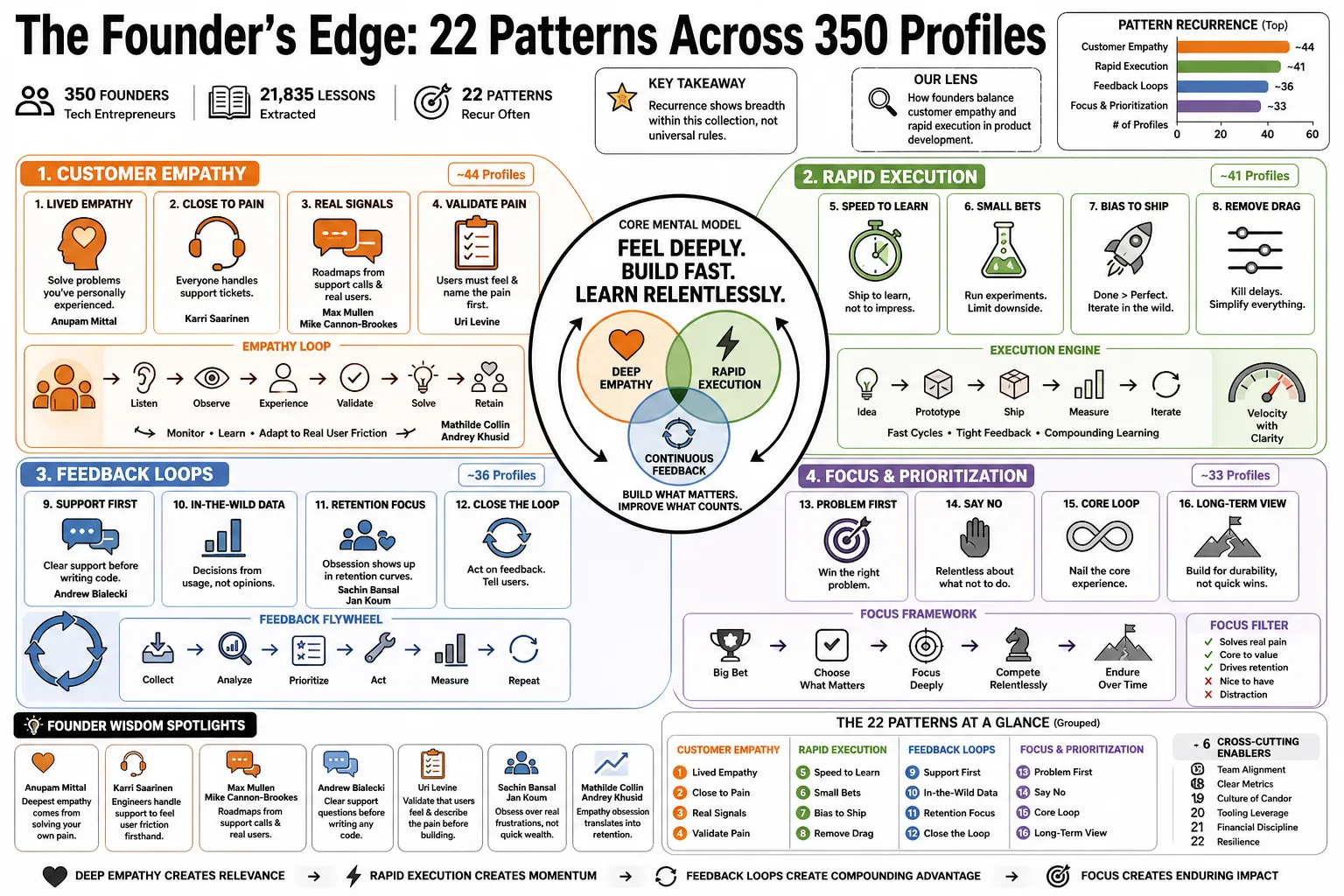
1. Customer Empathy
Developing deep empathy for users, actively listening to their pain points, and relentlessly solving real-world problems. · recurs across ~44 profiles
True customer empathy transcends simply listening to users; it requires structuring an organization to intimately feel their friction. Anupam Mittal notes that the deepest empathy stems from solving a problem you have personally experienced, providing unparalleled insight. However, for broader challenges, founders must deliberately engineer closeness to the customer. Karri Saarinen ensures this by requiring everyone, especially the engineers building features, to handle related support tickets, confronting user issues firsthand.
The distinction lies between theoretical roadmaps and validated pain. Max Mullen and Mike Cannon-Brookes argue that product direction should stem from actual support calls and the people clicking the buttons, rather than top-down executive assumptions. Before writing any code, Andrew Bialecki mandated clearing support questions to tighten the feedback loop, while Uri Levine insists on validating that users actively recognize and describe the pain themselves before a solution is built.
This relentless focus on the user’s reality is foundational. Sachin Bansal and Jan Koum believe enduring success comes from obsessing over real-world frustrations rather than seeking quick wealth. Mathilde Collin and Andrey Khusid translate this obsession into retention by closely monitoring support metrics to build direct solutions for recurring friction. While Don Valentine praises aggressive vision, he cautions that founders must remain deeply attentive to early market feedback. Ultimately, as Colin Zima observes, you cannot fake empathy; whether in sales or product development, success demands a genuine understanding of the user’s operational pain, a sentiment echoed by Jay Kreps, Lei Jun, and Pony Ma.
2. Product Development
Balancing user experience, feature constraints, and iterative design to craft elegant solutions without falling into feature creep. · recurs across ~25 profiles
The essence of product development lies in concealing structural chaos beneath an intuitive user experience. Armon Dadgar and Razorpay founders Harshil Mathur and Shashank Kumar assert that an elegant solution must completely decouple the user interface from underlying infrastructure. This expectation of simplicity is widespread; Abhinav Asthana notes that even developers now demand consumer-grade aesthetics, making clunky enterprise tools obsolete. However, as new capabilities are introduced, Federico Simionato highlights the persistent challenge of preserving this simplicity without succumbing to feature creep.
Resolving these tensions requires prioritizing how a product functions over merely how it looks, a principle famously championed by Steve Jobs. To avoid wasted effort, Adam Wiggins advocates for heavy upfront investment in sketching and ideation, ensuring that backend realities align with usability goals before code is written. Yet, abstract planning has limits. Devon Zuegel demonstrates that physical, real-world prototyping exposes behavioral feedback loops that theory alone cannot predict. This grounded approach is echoed across hardware and infrastructure; Claude Guillemot balances software constraints with physical ergonomics, while Andy Bechtolsheim focuses on solving tangible bottlenecks like heat and power consumption. Ultimately, by maintaining a pragmatic focus on core workflows—as championed by Mitchell Hashimoto—and prioritizing fundamental human needs, creators like Ev Williams and Cliff Obrecht prove that disciplined, user-centric design can successfully democratize even the most complex domains.
3. Product-Market Fit
Finding and validating the intersection between a compelling product and a market that desperately needs it. · recurs across ~13 profiles
Startups cannot simply execute a predefined business model; instead, they must systematically search for a viable model through discovery and testing, distinguishing them fundamentally from established corporations (Steve Blank). This search for product-market fit requires an intense focus on validating actual market needs before building solutions. Developers often mistakenly believe that producing code is their primary job, yet their true responsibility lies in verifying whether that code should exist in the first place (Peter Reinhardt).
Translating real-world business requirements into tangible features is crucial (Tope Awotona), which demands a deep, organization-wide comprehension of the product to maintain alignment with customer needs (Kraig Swensrud). Effective discovery work relies on an inherent curiosity to investigate the specific context of a customer rather than merely delivering a rehearsed presentation (Shaunt Voskanian).
When early concepts fail to gain traction, founders must adapt quickly rather than succumbing to the sunk cost fallacy. Some advise pivoting within just three weeks of sluggish momentum (Lucy Guo). History is replete with successful pivots away from initial ideas that lacked market pull: shifting from complex, overly cluttered applications to streamlined experiences (Kevin Systrom), or abandoning generic offerings in favor of tools that provably accelerate business operations (Christina Cacioppo). Ultimately, achieving product-market fit requires striking a delicate balance between visionary innovation and the pragmatic necessity of generating real revenue and traction (Allen Lau).
4. Technology Strategy
Managing technical debt, building scalable infrastructure, and aligning architectural choices with long-term business objectives. · recurs across ~44 profiles
A successful technology strategy requires proactively resolving the tension between rapid feature deployment and sustainable architecture. Founders must balance the immediate need for speed with the reality that early structural choices determine long-term scalability. Mike Cannon-Brookes observes that architectural decisions made in a company’s infancy dictate its capacity to scale a decade later, requiring a delicate negotiation between momentum and technical debt. While early stages prioritize rapid iteration, Andrew Bialecki and Andrey Khusid emphasize that surviving hypergrowth necessitates investing heavily in foundational infrastructure years before peak demand arrives, warning that deferred maintenance in core data systems can eventually prove fatal.
This proactive investment takes multiple forms. For foundational performance, Ryan Dahl champions leveraging systems languages to ensure low-level speed, while Armon Dadgar advocates for immutable infrastructure to guarantee system reproducibility. As products mature, scaling gracefully demands ongoing structural refinement; Severin Hacker notes the necessity of continually redesigning data fetching patterns so that expanding features do not degrade the core user experience.
Building scalable systems also requires managing integration realities. Abhinav Asthana highlights the inherent messiness of enterprise environments, where tools must bridge modern cloud setups and legacy on-premise systems. Similarly, Avery Pennarun points out that modern security often means retrofitting legacy applications. For others, infrastructure is the competitive moat itself. Jack Zhang demonstrates that embedding direct local integrations into a network’s ground floor is essential operating work, not a secondary cleanup task. Ultimately, as Josh Browder illustrates, translating complex workflows into streamlined internal tooling prevents operational bottlenecks, ensuring that infrastructure empowers long-term business objectives.
5. Artificial Intelligence
Integrating AI agents, generative models, and prompt engineering into workflows to unlock new capabilities and operational efficiencies. · recurs across ~32 profiles
The shift from traditional software to AI-native systems is rewiring enterprise workflows. Hande Çilingir notes that generative models now shoulder the heavy lifting previously handled by static automation. This is echoed by Jesse Zhang of Decagon, who points out that LLM-driven agents dynamically execute tasks rather than following rigid decision trees. This transition unlocks massive efficiencies: Ariel Cohen observes that machines can instantly process complex policies, freeing human workers for nuanced emergencies, while Severin Hacker highlights how AI scales content generation without sacrificing expert oversight.
The implementation of these systems takes many forms. May Habib advocates for headless AI to boost employee creativity, and Solomon Hykes sees developers embedding AI into pipelines to automate coding tasks. Similarly, Ivan Zhao anticipates agents effortlessly interpreting code commits to maintain documentation. To ground these capabilities, Emil Eifrem and Ali Ghodsi emphasize that reasoning over proprietary data via knowledge graphs forms the true competitive moat as underlying models become commoditized. While Liang Wenfeng of Deep Seek and Mike Knoop maintain that advancing core models toward AGI remains critical, Cristóbal Valenzuela contends the immediate need is inventing novel interfaces for human-AI collaboration.
As autonomous agents multiply, their infrastructure remains unsettled. Bret Taylor and Paolo Ardoino foresee conversational agents profoundly shaping the global landscape. However, there is conflicting evidence on their economic viability: Quinn Slack suggests compute costs may force free agents to rely on advertising, whereas Brian Armstrong counters that cryptocurrency will serve as the native financial layer, allowing agents to pay for resources directly.
6. Data Privacy
The strategic balancing of regulatory compliance, user trust, and identity security. · recurs across ~30 profiles
As organizations scale their operations and manage increasingly sensitive data, balancing identity security, regulatory compliance, and user trust becomes the foundation of enterprise viability. Rather than treating these constraints as hindrances, leaders increasingly view them as structural advantages. Adam Gross advises treating compliance as a distinct value proposition rather than an obstacle. This requires architectural foresight; Blake Hall notes that correct system design allows security and privacy to reinforce one another, while Armon Dadgar highlights that critical infrastructure managing identity cannot sacrifice consistency.
The integration of AI further complicates this landscape. Eran Zinman points out that enterprise AI adoption hinges entirely on trust, as organizations fear their proprietary data leaking into public models. To address these vulnerabilities, Rick Song advocates replacing reactive fraud mitigation with proactive identity frameworks that anticipate emerging threats, aligning with Nikesh Arora’s observation that identity security has reached a critical market inflection point. The transition away from legacy data collection, such as the cookie-based strategies critiqued by Jeff Green and the rudimentary identity profiling described by Bill Magnuson, demands modern privacy standards. Consequently, navigating this era requires an optimal balance between individual privacy rights and regulatory compliance, as articulated by Changpeng Zhao. Sometimes maintaining this balance demands drastic prioritization; Eric Yuan famously suspended feature development to rectify privacy and safety flaws, underscoring that without an unimpeachable security posture, technological ambition cannot be sustained.
7. Bootstrapping Independence
The deliberate avoidance of venture capital to maintain creative control, enforce strict financial discipline, and prioritize long-term sustainability over hyper-growth. · recurs across ~41 profiles
For many technology founders, self-funding is less about financial mechanics and more about a philosophical commitment to sovereignty. By deliberately avoiding early venture capital, entrepreneurs prioritize long-term sustainability over the aggressive, external pressures of hyper-growth. Tom Preston-Werner exemplified this by rejecting a lucrative corporate offer to bootstrap his vision, preserving absolute ownership over his product’s direction.
Without the cushion of venture funding, strict financial discipline becomes a mandatory survival mechanism rather than a corporate talking point. Nithin Kamath discovered that the resource constraints of bootstrapping organically forge frugality and ruthless focus, turning scarcity into a durable competitive advantage. This aligns closely with the concept championed by Dalton Caldwell that early-stage companies must obsess over reaching profitability before their cash reserves dry up. When a strong balance sheet is self-generated, founders like Howie Liu can navigate market downturns without relying on the unpredictable grace of outside investors.
Maintaining equity control also shields a company’s fundamental mission from the relentless scorecard of public markets or impatient venture boards. Jan Koum intentionally built a sustainable business model that ignored the typical Silicon Valley playbook of growing fast at all costs. To cement this independence, Francis Pedraza champions self-funding as a vital structural defense to protect a company’s long-term vision from outside interference. By funding their own platforms, communities and founders alike retain absolute authority over their tools, ensuring that product roadmaps serve users rather than external financial entities.
8. Capital Discipline
Managing financial resources efficiently, optimizing unit economics, and strategically deploying capital for maximum return. · recurs across ~15 profiles
Capital discipline demands prioritizing micro-level profitability and operational efficiency over unchecked scale. Scaling a business with flawed unit economics merely accelerates cash burn, an outcome Jake Rosser cautions against, while Don Valentine dismisses top-line revenue entirely if it fails to yield sustainable cash flow. This rigor requires granular attention; Niraj Shah notes that even fractional costs dictate e-commerce survival, requiring a continuous, company-wide mindset of frugality championed by Tom Murphy and Lucy Guo.
Constraints fundamentally improve execution. Daniel Debow argues that excessive early funding stifles creativity and obscures bad economics, whereas Andrew Bialecki finds that lean budgets organically force founders closer to their customers to prevent expensive errors. Mathilde Collin applies this efficiency directly to capital acquisition, compressing fundraising into short, intense sprints to protect operational momentum.
While Christina Cacioppo advises establishing sound fundamentals from day one to automatically attract investment, others—including Sachin Bansal, Dax Dasilva, and Ernest Garcia II and III—ultimately pivoted away from hyper-growth toward sustainable models after experiencing the limits of unchecked scale. Mastering this balance grants strategic freedom. Elias Torres balances aggressive growth with realistic cash awareness, and Francis Pedraza similarly exercises strict financial discipline to preserve his long-term strategic optionality. However, this financial orthodoxy faces some tension; Liang Wenfeng contends that when a venture aims for profound societal impact, obsessing over transitional business models can distract from fulfilling the core technological mission.
9. Execution Velocity
Prioritizing speed, momentum, and rapid action over perfection to outmaneuver competitors and capture market opportunity. · recurs across ~18 profiles
For leading tech founders, execution velocity is the critical advantage that allows organizations to outmaneuver competitors. Max Mullen argues that an extreme sense of urgency must be embedded in a company’s fundamental DNA, an idea echoed by Sebastian Barrios, who emphasizes that this startup-like urgency must be maintained even as organizations achieve massive scale. This relentless momentum is rarely accidental. Frank Slootman notes that combating a company’s natural drift toward inertia requires leaders to actively dictate the organizational pace and intensity.
Maintaining this velocity requires systematically eliminating friction. Alan Chang prioritizes hunting down and removing whatever bottlenecks—whether processes, misaligned incentives, or talent—threaten to stall momentum. On a practical level, productivity relies heavily on this friction-free momentum, a concept Devon Zuegel underscores when describing how removing daily speed bumps keeps teams running smoothly. For developers, this means shortening feedback loops; Quinn Slack observes that slow infrastructure inevitably destroys a team’s focus.
However, raw speed is not without its nuances and potential pitfalls. Elias Torres cautions against confusing urgency with desperation, warning that rushing to hire merely to relieve exhausted teams often backfires. Furthermore, while many emphasize personal productivity, Andrey Khusid contrasts individual rapidity with organizational velocity, arguing that true success depends on the collective speed of outcomes rather than isolated efforts. Ultimately, speed is a deliberate, structural practice. As Steve Kenning suggests, velocity isn’t generated by inspirational slogans but by rigorous operating systems, while Hiroshi Mikitani adds that treating speed as a daily habit ensures organizations remain highly responsive to technological shifts.
10. Distribution
Engineering sustainable channels for customer acquisition, driving organic growth, and leveraging word of mouth and storytelling. · recurs across ~21 profiles
Founders approach distribution by treating customer acquisition not merely as a marketing function, but as an engineered product experience. The most sustainable growth engines blur the line between the product and its channels. For Tope Awotona and Dylan Field, the product acts as its own acquisition vehicle; inherently collaborative tools naturally introduce themselves to new users, transforming bottoms-up adoption into efficient sales. This virality is echoed by David Vélez, who emphasizes that intense customer love turns the user base into an autonomous marketing department.
Tactics diverge on channel strategy. While Gagan Biyani advocates dominating a single unique channel rather than spreading efforts thinly, Mark Barrocas argues that consumer-centricity requires ubiquitous availability across all retail and direct avenues. Justin Mares notes founders often default to familiar methods, yet breakthroughs stem from rigorously testing unconventional channels. This is exemplified by Tom Digan, who leveraged organic social media precisely because his team lacked traditional performance marketing expertise.
Furthermore, distribution can be engineered through structure and narrative. Casey Winters scaled acquisition by treating search optimization as a product challenge rather than a tactical afterthought. Meanwhile, Gabe Whaley drives organic attention by architecting social experiments that challenge cultural norms, proving provocation can substitute for ad spend. Ultimately, as Nikesh Arora observes, deliberately avoiding hyper-competitive markets lowers acquisition costs, shifting the advantage from brute-force marketing to strategic positioning.
11. Competitive Moats
Building structural advantages, network effects, and defensibility to protect market position and outpace competitors. · recurs across ~12 profiles
Enduring market dominance requires founders to construct structural advantages that compound over time, shifting competition from a battle of features to a game of entrenched defensibility. The nature of these moats varies significantly based on whether they rely on physical infrastructure, network effects, or deep customer integration.
Richard Liu of JD.com and RJ Scaringe demonstrate that massive capital investments in physical and operational architecture create formidable barriers to entry. Liu transformed JD.com by building an independent, technology-driven logistics network, ensuring delivery speeds that competitors could not match. Similarly, Scaringe vertically integrated Rivian’s entire vehicle software stack and propulsion platform, securing long-term cost and performance advantages.
Digital businesses, meanwhile, often leverage scale and switching costs. John Malone notes that major tech companies function as natural monopolies because network phenomena and sheer scale make them nearly impossible to unseat. Once a product embeds itself into a community, as Sam Chaudhary observed with educational platforms, the shared context naturally drives up switching costs. Rather than fighting an uphill battle, Andrew Wilkinson advises positioning companies where structural market dynamics inherently pull the business forward.
Even as underlying technologies like artificial intelligence become commoditized, Jesse Zhang of Decagon argues that true defensibility stems from intimately understanding customer pain points and designing specialized software to resolve them. This requires immense internal agility. As Erik Bernhardsson warns, “A failure to realign the factory means lower iteration speed. A lack of engineers means a temptation to adopt tools to build technology without using engineers, with associated costs that are much larger.” (Source) Ultimately, as Larry Ellison understood, software profitability is fundamentally dictated by scale.
12. Ecosystems
Cultivating platforms, open-source communities, and strategic partnerships that create compounding value outside the core organization. · recurs across ~52 profiles
Cultivating a thriving ecosystem requires a fundamental shift from selling isolated products to curating interconnected platforms. As Howie Liu notes, centralizing operational data transforms a single tool into an expansive app store-like environment. This transition empowers external contributors to create compounding value. For instance, Andrey Khusid highlights that evolving a product into a platform involves giving users the architectural freedom to build customized extensions while the core company orchestrates the surrounding ecosystem.
A robust platform must also protect and nurture its participants. Tom Digan emphasizes that software should shoulder the administrative burden of community management to prevent creator burnout, while David Baszucki underscores that prioritizing participant safety and well-being is essential for sustainable growth. When these elements align, the resulting shared context creates organic loyalty. Sam Chaudhary observes that consolidating an entire community’s communications onto one platform naturally increases switching costs.
However, building these networks often requires gritty, unscalable groundwork. Ali Ghodsi recalls early employees traveling to individual startups to manually bootstrap their developer community from the ground up. Similarly, Anil Varanasi views networking as an ongoing, lifecycle-spanning partnership rather than a one-off hardware transaction. Whether establishing a global art toy culture like Wang Ning or fostering global media demand like Anna Bateson, the prevailing philosophy remains consistent. As Craig Newmark demonstrates, sacrificing immediate monetization to maximize long-term utility ultimately yields the most resilient and enduring community model.
13. Talent Acquisition
The strategic process of identifying, attracting, assessing, and retaining high-caliber individuals to build an exceptional team. · recurs across ~18 profiles
For early-stage startups, the shift to focusing heavily on talent acquisition is pivotal. As Don Valentine points out, technical founders often struggle to accept that their primary role must transition from coding to recruiting. This phase demands intense dedication; Zach Perret emphasizes founders should personally source and interview their first hundred employees rather than outsourcing.
Attracting initial talent requires nuanced messaging. While Andy Raskin notes a compelling narrative filters for candidates aligned with a specific vision, Elias Torres cautions against overselling the dream. He advocates for transparency regarding the chaos and pressure of early-stage environments to prevent misaligned hires.
The assessment process remains notoriously challenging. Erik Bernhardsson observes that predicting performance is inherently noisy, warning against overconfidence in simplistic algorithmic tests, much like Alex Buder Shapiro criticizes pipelines rewarding mere memorization. Passive strategies often fail for exceptional traits; Sid Sijbrandij advises abandoning inbound applications to actively hunt for individuals displaying a bias for action. Meanwhile, Eric Yuan prioritizes uncovering whether a candidate is intrinsically driven by peer success.
Finally, scaling requires rigorous processes. Paul Copplestone suggests treating interviewing as an exclusive honor restricted to a CEO-approved committee. Concurrently, building an equitable funnel is an obligation; both Ryan Carson and Harry Glaser stress that structurally addressing unearned advantages and tracking diversity metrics are essential to crafting a truly exceptional team.
14. Organizational Design
Structuring teams for agility, breaking down silos, decentralizing authority, and managing the complexities of hyper-growth. · recurs across ~19 profiles
As startups transition into hyper-growth, the structural agility that once came naturally often degrades into bureaucratic silos. To preserve speed without sacrificing stability, founders must intentionally redesign their operating structures. Organizing by customer problems rather than functional departments, as advocated by David Cancel, is a dominant approach to maintaining velocity. This philosophy manifests practically in small, cross-functional pods. Harshil Mathur and Shashank Kumar of Razorpay demonstrate that giving these compact teams complete ownership over specific features ensures accountability, a sentiment echoed by Elias Torres, who prefers three-person autonomous pods to bypass administrative bottlenecks.
However, decentralizing authority necessitates profound alignment. Both Amit Bendov and Anthony Tan emphasize that when decision-making is distributed across a massive workforce, leaders must constantly reiterate core values and strategy to prevent the organization from fracturing. While Ryan Carson experimented with completely flat hierarchies offering employees total control over time, most leaders find that structure itself becomes a critical product. Henry Schuck observes that automation alone cannot manage scaling operations; rigorous management layers are essential.
Moreover, structural power dynamics dictate product outcomes. For example, Jony Ive benefited from an organizational model engineered to grant the design team operational supremacy, ensuring aesthetic vision remained uncompromised. Ultimately, whether maintaining adaptability by avoiding rigid roadmaps like Jeff Yan of Hyperliquid or delaying team expansion until unit economics are proven like Jason Droege, a company’s architecture dictates its ability to scale. Binny Bansal & Sachin Bansal of Flipkart recognize these cultural and operational puzzles as the defining challenge for maturing ventures.
15. Organizational Culture
Cultivating shared values, trust, transparency, and behavioral norms that align a team and drive company performance. · recurs across ~50 profiles
Cultivating a robust organizational culture requires an intentional alignment of shared values, prioritizing environments characterized by deep trust and radical transparency over those constrained by rigid rules. Brian Chesky emphasizes that a culture rooted in trust enables autonomy and rapid execution, effectively replacing the bureaucracy required in low-trust organizations. Establishing this foundation starts deliberately, as Joe Gebbia notes regarding the early, intentional design of hospitality and belonging. Sustaining these behavioral norms requires continuous calibration. Henry Ward points out that onboarding should transcend logistical setup to serve as an intensive alignment of performance standards. Furthermore, Dara Khosrowshahi demonstrates that resetting behavioral norms can involve actively crowdsourcing values directly from the workforce to ensure collective buy-in.
Transparency acts as the primary mechanism for generating this trust, particularly during adversity. Max Mullen and Mathilde Collin both advocate for sharing information openly to drive engagement and productivity, even when details are uncomfortable. When failures occur, leaders like Eric Yuan and Marc Benioff assert that publicly taking responsibility is the only effective method to repair fractured trust. Jake Rosser and Dan Siroker echo this sentiment, observing that management teams earn credibility by candidly addressing mistakes or delivering difficult news, whereas deflecting blame signals a toxic environment. While technical systems might increasingly rely on zero-trust architectures, as noted by Armon Dadgar, human organizational performance depends on maximizing trust and shared integrity across the entire team, an approach championed by John Mackey.
16. Leadership Dynamics
Navigating co-founder relationships, managing board dynamics, leading by example, and resolving conflicts through mutual respect. · recurs across ~12 profiles
Effective leadership demands navigating complex dynamics, from co-founder alignment to board management. As organizations scale, leaders must balance authority and collaboration. Michael Eisner emphasizes that while executives distribute decision-making power, they ultimately retain full responsibility. This accountability necessitates decisive action; Dave Girouard notes that avoiding choices is often detrimental, advocating for a strong bias toward forward momentum.
In the boardroom, Parker Conrad highlights the inherent moral authority directors hold, requiring founders to carefully manage these relationships. This dynamic should be intellectually rigorous; Don Valentine argues that investors must push management by raising difficult issues. For founders whose passions lie in early-stage ideation, Garrett Camp suggests transitioning to a board seat can be a necessary evolution.
Resolving friction requires distinct approaches. Within technical teams, Neha Narkhede advises settling disputes through empirical evidence and prototypes rather than hierarchical dictates. Building cohesive teams requires what Jason Droege describes as modest cooperation—assembling complementary abilities while minimizing interpersonal friction. Structural conflicts also demand attention, as Adam Gross points out that aligning competing business motions presents a fundamental challenge. Furthermore, Marco Zappacosta notes that virtual environments require managers to be highly intentional about structuring collaboration. Ultimately, leading by example means taking risks and embracing unconventional thinking. Much like Eric Wu sought out distinctive architectural designs that stood apart from traditional models, Lucille Ball demonstrated the importance of leveraging influence to back projects despite initial failures, and Larry Ellison champions the necessity of actively challenging conventional wisdom to achieve true innovation.
17. Decision Making
Navigating ambiguity, balancing intuition with data, and acting decisively to overcome decision fatigue in high-stakes environments. · recurs across ~24 profiles
In high-stakes environments, founders utilize different combinations of data-driven objectivity and human intuition. Leaders like Dan Siroker and Kraig Swensrud prioritize empirical data to eliminate the bias of executive gut feelings, an approach supported by Brad Wilson, who cautions that intuition can falter during periods of high variance. At the same time, figures such as Michael Eisner and Johnny Carson have historically achieved significant successes by heavily weighting their gut instincts over formal research.
Many successful operators navigate this spectrum by defining specific roles for both elements. Dylan Field frames intuition as a hypothesis generator that data must subsequently validate. Similarly, Casey Winters and Federico Simionato observe that data explains what is happening, while intuition often reveals why. This approach requires leaders to merge quantitative signals with human empathy, a practice championed by Anna Bateson.
Regardless of the information available, ambiguity is inevitable. Justin Mares and Josh Browder emphasize that early-stage founders must act with absolute conviction long before sufficient data exists. As companies scale, this decisiveness becomes about making tough, unpopular choices for the organization’s broader good, as Waseem Daher points out. Ultimately, overcoming decision fatigue relies on continuous, rapid iteration. As Joseph Jacks observes, “The best founders I work with are extremely decisive and take in new data constantly, iterating on that new data and improving what they are doing very rapidly, what almost feels like in real-time. This process should be like breathing.” [Source]
18. Continuous Learning
Maintaining intellectual honesty, embracing curiosity, and adapting mental models based on new information and feedback loops. · recurs across ~30 profiles
The foundation of continuous learning is an unrelenting curiosity and the intellectual honesty to admit one is never a finished product. Mark Barrocas and Zack Kanter emphasize getting smarter daily and recognizing that personal evolution often means cringing at past versions of oneself. Cristóbal Valenzuela similarly identifies raw curiosity as the primary engine for navigating unfamiliar territory, while Jan Koum proved that formal education is secondary to self-directed learning.
Adapting mental models requires rigorous engagement with market feedback loops, though founders apply these insights differently. Michele Romanow and Emmett Shear prioritize sheer speed over polish, arguing that rapidly deploying products to discard bad ideas based on user feedback is vastly superior to isolated planning. Eric Wu adds a necessary filter, advising leaders to seek input relentlessly but edit habits only where genuine truth is found. Furthermore, Avery Pennarun warns against sacrificing the positive feedback loop of user love for short-term control when growth slows.
Acting on these continuous learnings ultimately unlocks structural advantages. Howard Lerman argues that decisive, experimental bets force a company into better market positions, a sentiment echoed by Jay Simons regarding growth hacking at scale. For Wade Foster, iterative development directly triggered expansion: “When we added Multi-Step, you could have many actions on it which opened up a whole new set of use cases for Zapier which really helped from like a growth and differentiation standpoint.” [Source] As Pony Ma and Michael Dell observe, embedding this capability to self-correct and continuously adapt is essential for long-term survival.
19. Founder Psychology
Managing ego, combating impostor syndrome, maintaining self-awareness, and navigating the emotional isolation of leadership. · recurs across ~7 profiles
For technology founders, navigating the psychological burdens of leadership requires untangling personal identities from professional outputs. The emotional isolation and intense pressure of building a company often trap entrepreneurs in a cycle where self-worth fluctuates with their startup’s performance. Combating this requires profound self-awareness and deliberate ego management. Mark Pincus emphasizes that founders must separate their ego from their creations, acknowledging that a product’s failure does not reflect personal inadequacy. This detachment is a strategic requirement for scale. Mike Knoop highlights the necessity of this fluidity, noting, “The main way to do great work as a cofounder is by consistently and repeatedly identify the most important gap and then solve it. In order to repeat, you have to replace yourself. And in order to replace yourself, you can’t have your identity wrapped up in the role you created.” Source
This evolution of self is echoed by Guillermo Rauch, who transitioned his internal self-image from merely a coder to a comprehensive product builder. Maintaining psychological resilience also means embracing vulnerability to combat impostor syndrome. Mathilde Collin demonstrated that by publicly acknowledging her battles with anxiety, leaders can destigmatize mental health challenges and cultivate a supportive company culture. Furthermore, avoiding ego traps involves keeping a beginner’s mindset. Francis Pedraza advocates adopting the identity of an amateur across diverse disciplines, using a polymathic approach to foster creativity and avoid rigid expertise. Ultimately, sustainable leadership is about cultivating an adaptable, healthy psychology throughout the emotional isolation of entrepreneurship.
20. Regulatory Navigation
Strategies for operating in legally ambiguous sectors, managing governmental relations, and shaping the legislative frameworks that govern emerging industries. · recurs across ~15 profiles
Entrepreneurs often view regulatory frameworks not merely as bureaucratic hurdles, but as strategic assets. For founders like Sachin Bansal and Renaud Laplanche, operating in sensitive sectors demands discarding the typical ‘move fast and break things’ ethos in favor of deep regulatory collaboration. This proactive stance is essential for global stability; as Joseph Tsai notes, “We need to ensure that we comply with laws and policies in operation around the world, so you don’t clash with regulators and then attract politicians’ attention.” source
Mastery of these frameworks creates robust business moats. However, Alan Chang warns that incumbents often use regulations as shields to stifle startup competition, necessitating early investment in robust compliance functions. Shashank Kumar echoes the necessity of deep regulatory alignment to navigate these barriers, while founders like Chris Dean operationalize this by translating complex legal codes directly into unbypassable software rules.
Navigating the public sector unlocks massive operational scale. Joshua Baer and Daniel Debow view governments not just as regulators, but as vital early customers whose enormous purchasing power can validate domestic technologies. Engaging with these agencies elevates internal standards, as Jason Droege observes regarding security in defense contracting. Shaping this legislative environment is equally crucial; Mati Staniszewski and Jeff Green argue that standardized, clear regulations level the playing field, preventing enforcement from defaulting to industry monopolies. Finally, driving systemic change requires reforming public sector incentives to prioritize the rapid, economical deployment of solutions over risk-averse processes, a shift championed by Cameron McCord.
21. Crisis Management
Tactical leadership, radical transparency, and survival mechanisms employed when navigating severe macroeconomic downturns or existential threats to the business. · recurs across ~10 profiles
Tactical leadership during severe downturns separates durable companies from those that falter under pressure. As Micha Kaufman notes, a founder’s true capability is proven through their capacity to adapt and communicate when economic conditions worsen, rather than during periods of effortless expansion. This adaptability often requires a recalibration of business models; for instance, Nicholas Thompson emphasizes that long-term survival necessitates structures capable of withstanding both macroeconomic shocks and algorithmic shifts.
A recurring mechanism for navigating these existential threats is radical transparency. Eran Zinman argues that periods of crisis demand open sharing of financial realities and strategic pivots, a sentiment echoed by Peter Reinhardt, who believes exposing the team to raw metrics builds essential trust. When organizational goals are entirely visible, as Daniel Debow observes, employees can clearly connect their daily output to the company’s ongoing survival.
Operationally, leaders must prioritize fundamental value over reckless scaling. Josh Reeves asserts that survival depends on consistently solving core customer pain points, even if it means deliberately slowing growth to protect product integrity. This focus on capital efficiency and foundational utility was demonstrated by Mathilde Collin during a funding round amid economic uncertainty, where she deliberately pitched a leaner, resilience-focused strategy. Furthermore, economic contractions can actually strengthen businesses built on extreme consumer value, as seen in the resilience of Larry Rossy’s retail empire. Ultimately, weathering extreme volatility requires tuning out market noise to support true builders, an approach championed by Alex Ohanian, coupled with the sheer stubborn endurance described by Henry Ward, where success is often defined simply by a refusal to surrender.
22. Legacy & Impact
Defining success beyond profit, focusing on social responsibility, environmental stewardship, and building enduring institutions. · recurs across ~24 profiles
For visionary leaders, ultimate success transcends financial return, manifesting instead as lasting societal and environmental stewardship. This distinction shifts corporate strategy from maximizing short-term shareholder value to establishing enduring institutions that benefit humanity. For example, Sol Price demonstrated that a company is obligated to serve society and drive community development, proving ethical conduct is foundational to business achievement. Similarly, Ilkka Paananen champions returning value to communities that enable corporate growth.
This expansive view of responsibility dictates that technological and operational advancements must be guided by ethical considerations. Pat Gelsinger emphasizes innovation absent a moral compass is merely machinery, whereas value-driven technology can elevate populations. In the food sector, John Mackey ties business purpose directly to the holistic health of consumers, supply chains, and the broader global ecosystem.
Building a legacy requires recognizing that accumulated capital is primarily a vehicle for societal reinvestment, a philosophy echoed by Robert Noyce. Philanthropic devotion illustrates this principle, seen in David Duffield’s commitment to animal welfare and Donald Bren’s investments in early childhood education. As leaders mature, often catalyzed by milestones like parenthood, their perspectives evolve. Alex Ohanian notes family shifts focus from immediate wins to generational influence, while Nicholas Thompson suggests true prominence is measured by enduring frameworks left for successors—an idea championed by Katharine Graham regarding institutional continuity. Ultimately, figures like Jeff Skoll show that even if enterprises conclude, the impact of purpose-driven models inspires future generations, fulfilling Evan Spiegel’s vision of leaving the world more connected.