Across 247 hedge funds & investing profiles and 16,864 lessons, 22 patterns recur often enough to matter. They are not universal rules; recurrence indicates breadth within this collection, not agreement across an entire field.
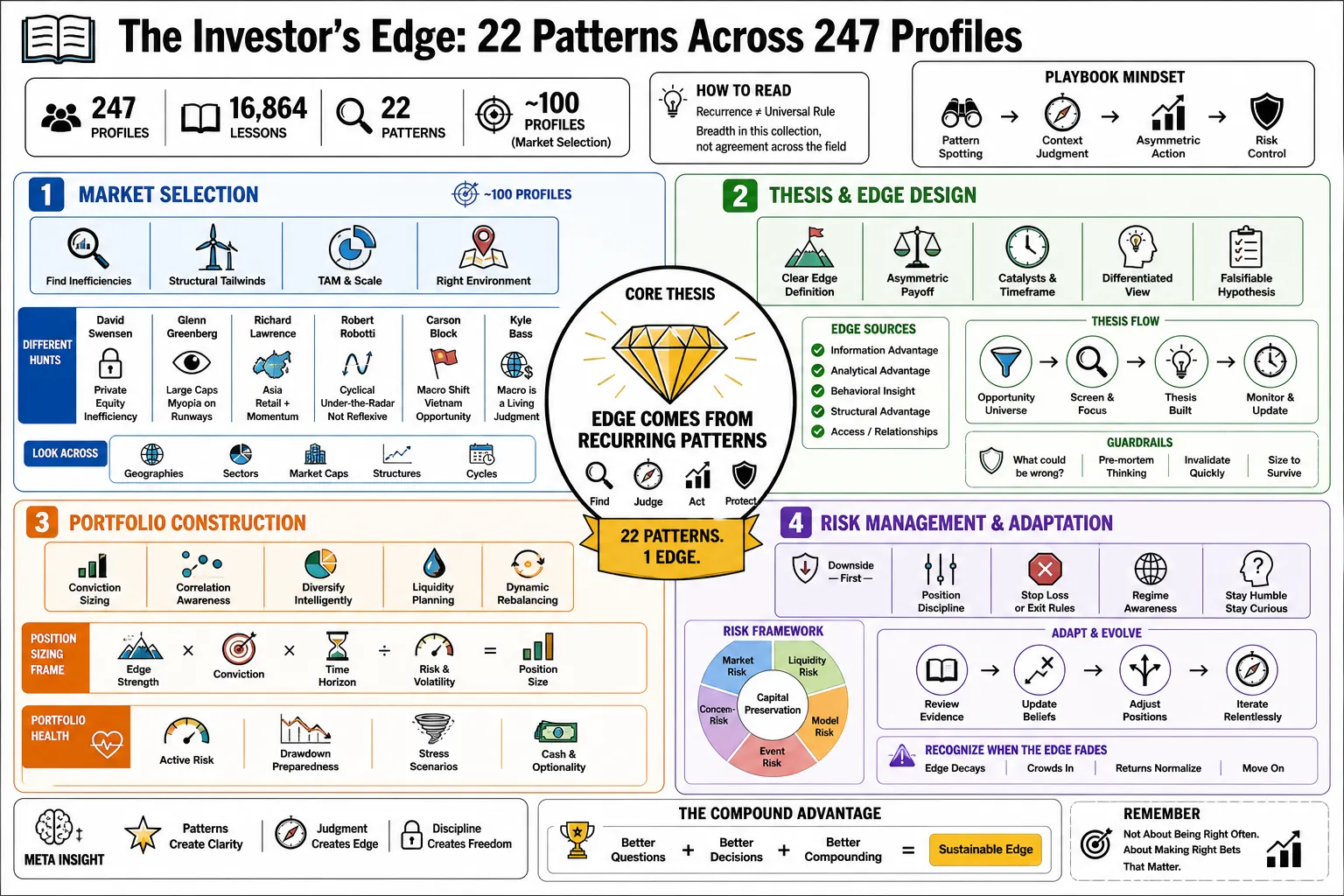
1. Market Selection
Identifying market inefficiencies, evaluating structural tailwinds, understanding total addressable market size, and targeting environments conducive to growth. · recurs across ~100 profiles
The hunt for market inefficiencies takes many forms, often diverging on where to find the best opportunities. David Swensen argues that active management thrives best in inherently inefficient arenas like private equity, where individual asset selection fundamentally dictates returns. In contrast, Glenn Greenberg asserts that significant mispricings persist even within heavily scrutinized large-cap public equities, primarily because analysts remain obsessively fixated on quarterly earnings rather than long-term runways.
This behavioral myopia creates structural advantages across different geographies and sectors. Richard Lawrence points out that Asian equities offer massive inefficiencies driven by high retail participation and institutional momentum trading. Domestically, Robert Robotti targets structural inefficiencies by focusing on cyclical, under-the-radar public companies rather than engaging in reflexive contrarianism.
Evaluating broader structural tailwinds and shifting growth environments is equally critical. Carson Block identifies compelling macro-driven opportunities, such as directing capital toward Vietnam as it benefits from structural shifts away from Chinese manufacturing. Similarly, Kyle Bass stresses that macro variables like trade relations, tariffs, and currency pressures must be treated as living judgments that constantly reshape the playing field.
Ultimately, navigating these environments requires filtering out the noise of modern market structures. Matthew McLennan cautions that the combination of high leverage, passive investing flows, and algorithmic trading routinely generates violent market dislocations. To survive and capitalize on these environments, investors must heed the approach of Ricky Sandler, isolating the few critical variables that genuinely determine a business’s ultimate value rather than getting distracted by the daily data points that obsess the broader market.
2. Temperament
Maintaining emotional detachment, behavioral control, and rational discipline during periods of extreme market panic, volatility, or exuberant speculative manias. · recurs across ~81 profiles
In the world of high-stakes investing, sustainable outperformance hinges less on raw intellectual horsepower than on behavioral control and emotional detachment. As Matthew McLennan observes, the primary advantage of a successful investor is their temperament. While the mathematical mechanics of valuation are relatively straightforward, the psychological fortitude required to act rationally amid chaos is exceedingly rare, distinguishing the great from the average (Jan Hummel). Because human psychology remains consistent across generations, the market continuously operates as a pendulum swinging between irrational exuberance and unjustified despair (Chris Davis, Rishi Renjen). These cycles predictably generate mispricings that disciplined professionals exploit (David Samra). Notably, the emotion of terror exerts a far stronger force than greed, triggering the most rapid and dramatic market dislocations (David Zorub).
To navigate such volatility without capitulating, practitioners must intentionally decouple their emotions from daily price fluctuations, anchoring their focus squarely on fundamental business performance (Matthew Fine). Establishing deep, concentrated knowledge of specific companies provides the conviction necessary to resist emotionally driven mistakes during severe drawdowns (Glenn Greenberg). Because market hysteria is highly infectious on trading floors, physically and mentally insulating oneself from the crowd’s noise becomes a vital survival skill (Eric Peters). This emotional discipline is not about lacking feeling, but rather acknowledging fear while allowing reason to dictate action (Joel Tillinghast). Ultimately, the most lucrative decisions—such as purchasing universally hated assets—are inherently uncomfortable (Ricky Sandler). Since investing relies entirely on probabilities rather than hope, those who succumb to their emotions have already lost their structural edge (Arthur Hayes, Mason Hawkins).
3. Time Arbitrage
Leveraging extended investment horizons, deferred gratification, and the capacity to suffer short-term underperformance to exploit the market’s structural obsession with quarterly earnings. · recurs across ~39 profiles
As public markets become highly efficient at pricing widely available information, the edge for investors has shifted toward behavioral resilience and extended duration. According to Kristin Gilbertson, Anouk Dey, and Vlad Barbalat, time arbitrage is the most pronounced inefficiency remaining in modern finance. The market’s hyper-focus on quarterly estimates misprices long-term structural shifts, which Steve Mandel observes are often incorrectly modeled as linear rather than exponential transformations.
Exploiting this mismatch requires what Thomas Russo describes as the capacity to suffer—the deliberate acceptance of ugly financial optics and depressed stock prices today for the promise of enduring rewards tomorrow. Kelly Granat similarly views enduring short-term pain as a prerequisite for structural compounding. Bypassing the competitive noise of the next ninety days allows managers to operate in a less crowded arena. Investors like Ricky Sandler, Jan Hummel, Matthew McLennan, and Django Davidson argue that extending underwriting horizons to three to five years yields a massive structural advantage. Andrew Golden takes this further, utilizing time to evaluate ten-year plans while competitors panic over earnings misses.
This short-term obsession isn’t merely an investor hurdle; David Swensen points out it forces companies into decisions that destroy value. Allocating to businesses with profound tailwinds, as Samantha McLemore advises, enables persistent compounding. As Shelby Cullom Davis noted, earnings growth protects patient investors while they wait for multiple expansion, ultimately proving Eric Mandelblatt’s thesis that quarterly fixations offer a distinct mispricing for long-term capital.
4. Contrarianism
Isolating true signal from pervasive market noise and confidently maintaining independent conviction against prevailing institutional consensus or herding behavior. · recurs across ~20 profiles
True contrarianism goes beyond reflexive disagreement; it demands rigorously filtering pervasive market noise to cultivate independent conviction. Elite investors note that most financial news is mere distraction designed to provoke emotional reactions. Jim O’Shaughnessy, Angela Aldrich, and Vlad Barbalat emphasize focusing on historical data and structural realities, as the daily information deluge obscures actionable insights. For quantitative managers like David Harding and Boaz Weinstein, success relies on systems that ignore narratives entirely to isolate probabilistic signals. Similarly, Nick Sleep notes that maintaining a clear long-term view turns daily price fluctuations into irrelevant noise.
Recognizing the signal is only the first step; exploiting it requires the courage to stand against institutional consensus. Because widely held beliefs are already priced in, Laura Sloate and Kyle Bass argue the true edge lies in uncovering hidden opportunities before the crowd recognizes them. Waiting for collective validation is fatal to returns; Alan Waxman points out that once an asset is universally deemed safe, its alpha has evaporated. This independence must be rooted in primary research rather than Wall Street reports, as Amit Wadhwaney suggests. Executing this strategy involves uncomfortable but rational allocation. David Swensen highlights the necessity of persistently buying out-of-favor assets and selling what is popular. This dynamic is echoed by Allison Fisch, who observes that unpopular, capital-starved sectors eventually constrain supply, creating fertile ground for future profitability. In private markets, Geoff Lewis applies a similar standard, seeking ideas that spark intense skepticism as the strongest indicator of a worthwhile pursuit.
5. Product-Market Fit
Aligning product offerings with customer needs, emphasizing customer obsession, value creation, and validating demand through continuous, rigorous iteration. · recurs across ~50 profiles
True product-market fit requires aligning core offerings with intense customer needs through continuous iteration and strategic foresight. Patrick O’Shaughnessy argues that rapidly releasing and refining imperfect software based on user feedback is superior to developing in isolation. This iterative process validates demand, but initial traction is only the beginning. Hamilton Helmer cautions that achieving fit without early strategic positioning is dangerous, as competitive moats are incredibly difficult to retrofit later.
Customer obsession drives sustainable value creation by ensuring a product’s fundamental utility remains irreplaceable. According to Henry Ellenbogen, financial returns are merely a byproduct of balancing customer and employee satisfaction. When a product achieves deep utility, Phil Ruvinsky notes it can endure external shocks like regulatory fines. Similarly, Bill Gross asserts that genuine customer love inevitably leads to viable monetization strategies. A definitive test of this value, proposed by Anu Hariharan, is measuring the level of disappointment users would feel if the service disappeared.
This deep reliance translates directly into pricing power. Both Richard Lawrence and Joel Tillinghast view the ability to raise prices without destroying demand as the ultimate defense against economic pressures. Luca Ferrari observes that while users initially protest price hikes, they will not abandon a continually improving service. Furthermore, Christoph Janz points out that many emerging companies chronically underprice the value they deliver. However, in contrast to those focusing purely on product popularity, Django Davidson warns that strong consumer interest can mask fundamental oversupply; if market supply outpaces demand, structural pricing collapses are unavoidable.
6. Power Laws
Understanding asymmetric returns, letting winners run, and focusing resources on a few high-conviction bets that drive the vast majority of outcomes. · recurs across ~51 profiles
Power laws dictate that the vast majority of investment returns stem from a concentrated number of highly asymmetric outcomes. Samantha McLemore illustrates this mathematical reality: while investors can only lose their initial capital, patience can yield gains of thousands of percent. Gautam Baid highlights how understanding this convexity completely shifts one’s perspective on risk and reward. Capturing these returns requires immense patience; David Rolfe stresses waiting years for elite businesses to become temporarily misunderstood before initiating a meaningful bet.
Capitalizing on power laws demands that position sizing strictly reflects conviction and the asymmetry of potential returns, ignoring arbitrary benchmarks. Phil Ruvinsky, Angela Aldrich, Ricky Sandler, Cliff Sosin, and David Zorub emphasize correlating portfolio weights directly to risk-reward profiles. Munib Islam suggests that if an idea does not warrant a significant allocation, the underlying research is likely insufficient. However, managers define conviction differently. While Lauren Taylor Wolfe sizes up when finding wide moats with receptive management, Jenny Harrington focuses on dividend safety. Rishi Renjen offers a contrasting view, arguing top allocations should prioritize the narrowest range of potential outcomes over maximum upside.
Conversely, the negative asymmetry of short selling requires a different approach. Steve Mandel, Philippe Laffont, and Lee Ainslie note the unfavorable math of shorting—upside is capped at 100 percent, but downside is limitless. Short positions demand conservative sizing and strict discipline, much like Chris Rokos cutting rate exposures immediately during sudden shifts. Ultimately, mastering power laws requires ruthlessly focusing resources on favorable asymmetry.
7. Decision Making
Valuing process over outcome, managing cognitive biases, prioritizing objective analysis, and operating effectively under conditions of uncertainty. · recurs across ~14 profiles
In high-stakes investing, distinguishing between skill and luck means prioritizing the mechanics of decision-making over the immediate results. Antti Ilmanen argues that overcoming outcome bias requires scrutinizing the rigor of a decision before observing the final return. To ensure this machinery does not stagnate, Paul Black notes the investment process must continually evolve and widen its competitive moat.
A central component of this rigor is neutralizing cognitive biases. Tobias Carlisle warns that once investors buy an asset, they often fall prey to confirmation bias, filtering out red flags that a detached model would highlight. To combat this emotional attachment, Glenn Greenberg advises persistently re-evaluating assets as if you do not own them, while Samantha McLemore advocates documenting precise reasons for entering positions to prevent hindsight bias. Sustaining objectivity in volatile markets demands the systematic excision of fear and greed, a standard John Arnold emphasizes and Jim Simons notoriously achieved by applying the scientific method.
Firms scale this objectivity differently, leading to varied perspectives on automation. Leda Braga embeds investment knowledge directly into data infrastructure, allowing it to compound beyond any single individual’s judgment. However, discretionary investors caution against total reliance on automation. While Chris Rokos, Steve Cohen, and Phil Ruvinsky acknowledge that advanced models and AI process vast data efficiently, they agree human intuition remains the necessary final filter for interpreting macro environments and edge cases. Furthermore, Chuck Akre notes that evaluating management integrity still relies entirely on subjective imagination rather than algorithmic processing.
8. Execution
The relentless focus on operational excellence, speed, unit economics, and executing strategy with precision while minimizing unnecessary complexity. · recurs across ~47 profiles
Execution in investing separates theoretical brilliance from compounding reality. At its core, it demands a relentless focus on operational realities over paper abstractions. For Carson Block, this means bypassing financial statements to scrutinize actual business mechanics—acting like a customer and directly verifying claims with competitors rather than delegating the dirty work. This hands-on intensity mirrors the urgency of Mitchell Green, who bypasses months of market research by sourcing immediate intelligence from seasoned industry veterans. In both cases, the speed and accuracy of ground-level information eclipse delayed, polished data.
This operational clarity must extend to portfolio companies. Deven Parekh notes that surviving the scale-up phase requires abandoning lagging financial metrics in favor of leading operational indicators. Similarly, Anu Hariharan emphasizes that unit economics dictate capital efficiency; infinite funding cannot fix fundamentally broken customer acquisition costs. The value of removing operational friction is so profound that Thomas Tull prioritizes analytical streamlining as the primary lens for acquisitions, while Bruce Berkowitz observes that ruthless operational discipline can resuscitate dying business models into cash generators.
Yet, execution also requires structural boundaries. David Bonderman makes the crucial distinction that investors should supply capital and define strategic parameters rather than attempting to micromanage daily operations. Within the portfolio itself, execution is synonymous with unwavering discipline. Michael Burry and Geraldine Weiss prove that repeatable, data-grounded processes outlast market cycles. Protecting this focus requires cognitive stamina, as Samantha McLemore highlights, and strict sell rules to eliminate distracting positions, according to Laura Sloate. Ultimately, superior execution builds robust systems that minimize friction and maximize compounding.
9. Valuation
Maintaining strict valuation discipline, understanding the difference between price and intrinsic value, and avoiding value traps or overpaying for growth. · recurs across ~95 profiles
Mastering valuation requires distinguishing between fluctuating market prices and actual business worth. Matthew Fine grounds this discipline by valuing enterprises as if buying them entirely with private capital for permanent ownership. This foundational perspective anchors investors against market volatility. John Templeton enforced a rigorous comparative approach, deploying capital only into opportunities offering the steepest discount to their underlying worth across all available options.
When assessing growth, perspectives diverge on entry multiples. Chris Hohn contends that for truly exceptional businesses, long-term expansion in intrinsic value easily overshadows the initial price paid, making short-term multiples less relevant. In contrast, Eric Mandelblatt highlights the dangers of overpaying, warning that management teams actively destroy enterprise value when executing share buybacks at peak valuations.
To capitalize on valuation gaps, patience is a structural advantage. Robert Robotti utilizes his long time horizon to hold dormant stocks for years, provided the core business continues growing. This aligns with Jan Hummel, who observes that market panics rarely impair true corporate worth but instead facilitate wealth transfers to disciplined buyers. Bill Miller actively exploits these moments, adding to positions during indiscriminate sell-offs. Conversely, valuation discipline also dictates exits; Pat Dorsey mandates selling once business fundamentals erode or when prevailing prices drastically exceed intrinsic reality. Ultimately, true value investing relies on tracking core business momentum rather than chasing thematic narratives, as Ricky Sandler notes that fundamentals only matter again once sector hype exhausts itself.
10. Distribution
Scaling sales motions, acquiring customers efficiently, expanding geographic reach, and leveraging organic or inorganic channels for sustainable revenue growth. · recurs across ~39 profiles
Efficient customer acquisition and sustainable go-to-market strategies dictate whether scaling efforts create or destroy value. Kat Cole stresses that underlying unit economics must be fixed before scaling marketing, as fundamentally flawed math cannot be masked by brand affinity. This is echoed by Bucky Moore, who cautions that indiscriminately adding sales representatives to an unproven process merely accelerates cash burn; a repeatable playbook is a prerequisite for expansion. Moreover, Mitchell Green highlights customer acquisition cost payback periods as the ultimate litmus test for efficiency, noting that requiring three years to break even on a customer resembles banking rather than true growth.
When these economic foundations are solid, distribution can take different forms. David George points to companies achieving hyper-growth through sheer market pull with minimal sales and marketing expenditures. For enterprise software, Mike Volpi observes that transitioning from bottom-up developer adoption to top-down sales motions remains one of the most perilous hurdles. In the realm of financial products, Kipp deVeer illustrates that expanding distribution networks—such as building out private-wealth channels and servicing advisors—demands both brand recognition and strict adherence to underwriting standards.
Conversely, pursuing growth indiscriminately can be hazardous. While Anouk Dey and Cliff Sosin argue that currently depressed margins in rapidly scaling businesses can present value opportunities if future customer acquisition costs stabilize, manufactured growth carries steep risks. Joel Tillinghast warns against aggressive, debt-fueled rollup strategies, and Jim Chanos identifies such inorganic, acquisition-heavy expansion as a frequent harbor for obfuscating poor accounting and enriching management at the expense of sustainable revenue generation.
11. Leadership
Assessing and cultivating management quality, driving organizational structure, guiding succession planning, and leading by example with absolute integrity. · recurs across ~40 profiles
In the high-stakes realm of asset management, exceptional leadership transcends financial acumen, demanding an unwavering commitment to integrity and strategic foresight. For seasoned investors, assessing the moral compass of corporate executives is just as vital as analyzing their balance sheets. As David Swensen, Chuck Akre, and Thomas Russo have emphasized, evaluating a management team’s ethical foundation is a fundamental prerequisite for investment. This scrutiny is especially crucial in public markets where investors lack the direct control enjoyed by private equity sponsors, a dynamic highlighted by Rishi Renjen. A recurring consensus among investors — including Chris Davis and Francisco García Paramés — is that a lucrative partnership with an untrustworthy individual is fundamentally impossible. Consequently, Joel Tillinghast warns against engaging with firms exhibiting opaque accounting or questionable candor.
Effective leadership also requires cultivating a culture of absolute accountability and transparent governance. Luca Ferrari observes that while tasks can be delegated, ultimate responsibility remains with the leader. Similarly, Leda Braga views capital management as a sacred trust built on fairness and transparency, while Victor Niederhoffer notes that market participation itself tests one’s character.
Finally, visionary leadership demands proactive organizational structuring and succession planning. Mason Morfit points out that leadership transitions are frequently chaotic, often triggered during crises rather than executed seamlessly. To counteract this, forward-thinking managers like Steve Mandel prioritize building resilient, multi-generational partnerships designed to thrive long after the founder’s departure. Together, these principles reveal that enduring financial success is deeply rooted in cultivating elite, principled management.
12. Culture
Building a shared set of values, promoting intellectual honesty, accountability, and a cohesive environment that drives execution and adaptability. · recurs across ~14 profiles
A resilient organizational culture is not a generic template, but a deliberate alignment of values with a firm’s specific competitive edge, as Paul Black notes. While an innovator requires psychological safety, a cost leader demands frugality. The foundation always relies on trust, intellectual honesty, and clear accountability. Fostering an environment where the best ideas surface means stripping away hierarchical barriers. Thomas Tull and Philippe Laffont emphasize that junior analysts must feel empowered to challenge leadership’s highest-conviction ideas if the data dictates otherwise. This meritocracy requires what Warren Buffett describes as the rare trait of unvarnished honesty, which Bill Gross and Leda Braga argue is essential for maintaining long-term trust.
Crucially, adapting to shifting markets requires a willingness to acknowledge errors. Mark Leonard, Alan Waxman, and Bruce Berkowitz agree that acknowledging a flawed thesis must be celebrated as a vital component of risk management. Without this transparency, leaders may defend failing strategies out of ego, which Nelson Peltz identifies as a root cause of chronic underperformance.
However, a collaborative environment does not mean decision-making is purely democratic. John Armitage maintains a highly collaborative research atmosphere while operating as a benevolent autocracy to ensure clear accountability. Whether encouraging the creative risks championed by Brian Grazer or aligning with decentralized operators like Alex Behring, establishing a shared long-term vision, as Bilal Zuberi highlights, ultimately drives cohesive execution.
13. Liquidity
Managing cash flow, debt profiles, and balance sheet strength to ensure financial flexibility and avoid the permanent loss of capital or forced selling. · recurs across ~109 profiles
For value-oriented investors, leverage is often viewed as the primary catalyst for forced selling. Joel Tillinghast, Bruce Berkowitz, and Robert Vinall uniformly warn that excessive debt strips away an investor’s ability to be patient, rapidly transforming temporary operational stumbles into permanent, unrecoverable capital losses. To manage this vulnerability, David Samra emphasizes that a company’s debt load must be calibrated against the stability of its cash generation, with highly cyclical enterprises requiring far more conservative financial footing.
Determining true liquidity relies on strict accounting. Chris Bloomstran and Sheldon Stone argue that corporate health is defined strictly by the residual cash available after covering essential maintenance capital expenditures, as only these funds can safely service liabilities. When businesses operate with pristine balance sheets, they insulate themselves from macroeconomic shocks, such as sudden interest rate spikes, according to Amit Wadhwaney. Similarly, Francisco García Paramés observes that family-owned businesses naturally employ under-leveraged structures to survive severe economic downturns.
Crucially, robust liquidity shifts a company’s posture from defensive to offensive. Nancy Zevenbergen and Mason Hawkins highlight that cash-rich firms can aggressively consolidate market share while their over-leveraged competitors are forced to retreat. Furthermore, excess liquidity provides management with the luxury of time. As Matthew Fine and Anouk Dey note, a fortress balance sheet empowers executives to let cash pile up patiently until depressed markets yield deeply discounted assets. Although Samantha Greenberg advocates for strategically optimizing the debt-to-equity mix to minimize capital costs without sacrificing agility, preserving a resilient cash buffer remains the ultimate safeguard for enduring financial flexibility.
14. Unit Economics
Analyzing the underlying characteristics of cash generation, microeconomic profitability, and sustained corporate pricing power that protect margins during inflationary environments. · recurs across ~56 profiles
In an environment where structural factors indicate a higher and more persistent floor for inflation, as observed by Chris Rokos, investors must rigorously evaluate unit economics and corporate pricing power. Historical margins often become distorted when rising input costs obscure true microeconomic profitability, prompting Allison Fisch to advocate for adjusting financial models to reflect current pricing dynamics. Rather than seeking the cheapest assets, Thomas Russo emphasizes prioritizing franchise businesses that possess deep goodwill and the capacity to continually reinvest capital. This philosophy aligns with Munib Islam’s assertion that true compounding machines pair high returns on invested capital with massive reinvestment runways.
During periods of severe inflation, Dan Loeb views pricing power as the most critical determinant of a long equity position’s durability. This power functions mathematically as a lever; Chris Hohn illustrates that raising prices slightly above inflation on a wide-margin product disproportionately accelerates profit growth compared to revenue, since those marginal price increases carry no additional costs. Consequently, elevated profit margins act as a vital defense mechanism, providing a structural buffer against both pricing wars and macroeconomic shocks that low-margin competitors lack, an advantage highlighted by Richard Lawrence. To secure this defensive posture, Joel Tillinghast warns against commodity producers whose only differentiator is price, as they inherently lack the leverage to protect long-term margins. However, investors must remain vigilant; Jim Chanos cautions that reported gross margins can sometimes reflect aggressive accounting rather than authentic cash generation, underscoring the need to verify the underlying reality of a company’s cash flow.
15. Operator-Investor Dynamics
Navigating the relationship between builders and capital providers, focusing on board governance, mutual trust, aligned incentives, and constructive engagement. · recurs across ~41 profiles
The foundation of any enduring partnership between builders and capital providers rests on structural alignment and unwavering reliability. Charlie Munger asserts that a partner’s dependability supersedes raw intellect, while Sam Zell considers trustworthy collaborators a business necessity. Establishing this mutual faith early is critical; as Brent Beshore notes, initiating deals with fair terms prevents adversarial negotiations that erode trust. Once capitalized, open communication dictates success. Mike Volpi observes that optimal relationships permit founders to candidly discuss failures without risking board abandonment.
Psychological trust must be anchored by concrete incentives. Paul Black argues that compensation frameworks directly dictate corporate behavior, warning against structures that incentivize myopic earnings over sustained growth. Similarly, Mason Hawkins and Mason Morfit emphasize that authentic alignment requires personal financial exposure; directors must have their own wealth tied to long-term outcomes.
Governance inevitably evolves as companies mature. David Bonderman highlights that transitioning from a disruptor to an incumbent necessitates sophisticated board oversight. This oversight requires courage; Mario Therrien cautions that independent directors must challenge leadership rather than passively approving decisions. Taking a board seat, according to Bruce Berkowitz, reveals whether executives operate in reality. When management falters, investor engagement diverges. While Daniel Loeb generally prefers backing exemplary leaders over rescuing poorly run enterprises, his track record shows he will launch combative activist campaigns against egregious governance. If boards remain stagnant, Nelson Peltz finds the mere threat of a proxy contest often forces action, though Eric Mandelblatt contends the best activist victories occur when directors concede to shareholder logic before public battles erupt.
16. Technology
Capitalizing on technological disruption, artificial intelligence, platform shifts, and continuous innovation to create new markets or redefine existing ones. · recurs across ~28 profiles
Perpetual technological disruption systematically dismantles legacy profit pools, driving the continuous creation of new market winners at an unprecedented historical pace (Nancy Zevenbergen, Steve Mandel). At the center of this transformation, artificial intelligence acts as a foundational accelerant for all other platforms (Cathie Wood), creating a horizontal disruption that forces a fundamental repricing of labor and capital across every industry (Vlad Barbalat). As artificial intelligence reduces the cost of cognition and significantly lowers the barrier to entry for developing new applications (Phil Ruvinsky), competitive advantage shifts away from pure software architectures toward the concrete outcomes those applications deliver (Bucky Moore). This new paradigm challenges traditional venture capital models by enforcing higher upfront capital requirements and tighter software margins (Mike Volpi). Consequently, investors must evaluate codebases as rigorously as financial statements (Deven Parekh), demanding an engineering capability that many conventional private equity firms entirely lack (Luca Ferrari). While software has conquered digital realms, the primary bottlenecks to human progress now remain in the physical world (Scott Nolan). Future technological dominance requires mastering physical supply chain realities (Gavin Baker) and overcoming regulatory friction. For instance, defense technology demands as much ingenuity in government contracting as in engineering (Darren Farber), while global automation depends heavily on establishing complex infrastructure for rights, audits, and standards (Mason Morfit). Furthermore, internal organizational inefficiencies, such as sales processes burdened by technical debt, require structural fixes before scaling (Kareem Amin). Ultimately, the most groundbreaking breakthroughs often emerge from highly funded, intensely focused teams operating without rigid bureaucratic oversight (Byrne Hobart).
17. Moats
Developing sustainable structural advantages, network effects, and switching costs that protect the business from competition and preserve pricing power. · recurs across ~25 profiles
Moats arise from scale, complexity, and specialized infrastructure that insulate a business from competition. Pat Dorsey prefers finding industries with naturally low competitive hurdles over fighting in high-barrier sectors. Conversely, Chuck Akre and Alex Sacerdote argue durable dominance is forged through massive scope, brand strength, and logistics that repel new entrants. However, Patrick O’Shaughnessy clarifies scale only forms a true moat if it lowers marginal costs and enhances customer experience. In fact, Alex Behring asserts the real benefit of scale lies in attracting superior talent and deploying advanced systems.
Moats take varied forms. They range from hyper-local monopolies—like Peter Lynch’s example of possessing the sole gravel pit in a region—to global manufacturing behemoths cited by Carl Kawaja, where technical expertise and immense capacity make replication impossible. Supply chain control is equally critical; Darren Farber notes brilliant engineering fails without the operational scale to secure foundational materials. Furthermore, Richard Lawrence points out distribution networks and brand loyalty represent formidable advantages requiring decades to establish.
Structural moats also exist in the investment landscape. Vlad Barbalat, David George, and Arthur Patterson emphasize how massive capital pools and deep investor networks unlock exclusive partnerships necessary for scaling. Complexity offers a similar edge; David Bonderman embraces convoluted deals that repel others, while Alan Waxman demonstrates that correctly pricing feared risks provides a distinct structural advantage. Ultimately, true competitive insulation means pricing power. As Phil Ruvinsky observes, a genuine moat allows effortless price hikes, though Eric Mandelblatt warns executives in insulated duopolies often mistake this systemic advantage for managerial brilliance.
18. Margin of Safety
Implementing rigorous frameworks to ensure absolute downside protection, valuing asset coverage, and demanding deep discounts to intrinsic value to survive tail risks. · recurs across ~87 profiles
A margin of safety acts as a critical bulwark against market uncertainty and forecasting errors. For traditional value investors like Mohnish Pabrai, Chris Davis, and Michael Burry, this protection is achieved primarily through price: demanding a severe mathematical discount to a company’s intrinsic value. This conceptual buffer, as Matthew McLennan describes it, defends portfolios against ignorance of the future, while Joel Greenblatt and Tobias Carlisle note that it simultaneously caps downside risk and enables outsized returns.
However, investors strongly disagree on whether a price discount alone is sufficient. Bill Nygren and Richard Lawrence argue that buying a rapidly declining business at a steep discount is a trap, as the margin of safety vanishes alongside shrinking intrinsic value. They align with Samantha McLemore, who insists that genuine safety comes from businesses that compound their intrinsic value over time. Jean-Marie Eveillard highlights this split, contrasting Graham’s focus on price discounts with Buffett’s reliance on competitive moats. Synthesizing these perspectives, Jan Hummel and Chris Bloomstran advocate for a dual margin of safety, warning that overpaying for great businesses is just as dangerous as buying deteriorating ones cheaply.
Beyond equity selection, a margin of safety also dictates structural risk management. Tom Gayner builds protection by avoiding leverage entirely, while Alan Waxman and Royce Yudkoff stress that capital preservation requires structuring downside scenarios so tightly that worst-case outcomes remain survivable before ever modeling potential upside. Peter Cundill summarizes the ultimate mandate: always prioritize downside protection.
19. Alignment
Establishing structural mechanisms and compensation incentives that bind fiduciary duty between managers, executives, and limited partners to ensure long-term value creation. · recurs across ~83 profiles
Alignment in asset management transcends philosophy, manifesting in structural mechanisms that bind fiduciary duty between managers, executives, and limited partners. A fundamental distinction exists between firms structured for asset gathering and those engineered for value creation. Investors like Andrew Golden and Sheldon Stone argue that true fiduciary behavior requires managers to invest heavily alongside clients. This owner-operator model is exemplified by Mason Hawkins, whose firm requires employees to invest through their own funds to guarantee shared incentives. From an allocator’s view, David Swensen notes that alignment also means investments must be sized meaningfully to impact the broader portfolio.
At the corporate level, compensation mechanisms dictate outcomes. Anouk Dey and Matthew Fine emphasize that executive pay must reward long-term cash generation and equity ownership, not short-term revenue milestones. This mirrors the private equity model, which Lauren Taylor Wolfe, Royce Yudkoff, and Dan Rasmussen note succeeds by anchoring operators around equity value creation. Alex Behring and Rishi Renjen similarly demand management teams with significant wealth tied to common equity.
Fee structures act as a final lever. While David Zorub insists fees should reward outperformance over scale, Gautam Baid and Warren Hellman advocate eliminating fixed management or monitoring fees entirely so managers profit only when partners do. Conversely, Bobby Jain defends pass-through models as essential for funding the talent required by complex trading operations. Meanwhile, Vlad Barbalat points out that mutual structures protect these incentives from external market distortions. Through these diverse mechanisms, alignment ensures all participants share the same economic fate.
20. Institutional Constraints
Overcoming the structural disadvantages, career risks, forced selling pressures, and benchmark-tracking mandates that inhibit optimal capital allocation in large organizations. · recurs across ~83 profiles
Large investment organizations are fundamentally hampered by structural constraints that prioritize self-preservation over optimal capital allocation. As Jean-Marie Eveillard and Tobias Carlisle observe, portfolio managers routinely prioritize career risk over the risk of permanent capital loss, choosing the safety of the herd rather than risking underperformance by holding unpopular assets. This fear of lagging peers forces institutional capital to abandon fundamental valuation in favor of benchmark hugging, a dynamic highlighted by Eric Mandelblatt and Nick Sleep. Consequently, Jeremy Grantham notes that the true patience required to ignore consensus is structurally nearly impossible for these managers to achieve.
Internal mandates and strict risk limits also trigger forced selling during market stress, compelling institutions to liquidate assets regardless of underlying quality, as observed by Allison Fisch. Boaz Weinstein points out that banks will even trade against their own economic interests simply to satisfy internal risk metrics. When large funds dump out-of-favor assets like small-caps or fallen angels, Jan Hummel, Sheldon Stone, and Amit Wadhwaney capitalize on the resulting liquidity vacuums, acquiring securities at steep discounts.
There is, however, some disagreement regarding the timeframe institutions can tolerate. While Ashvin Chhabra argues that institutions’ perpetual existence allows them to endure multi-year drawdowns better than individuals with mortal constraints, the prevailing consensus from managers like David Rolfe and Joel Greenblatt is that performance pressure traps most institutions in short-termism. Ultimately, as Django Davidson suggests, structural disadvantages leave the most lucrative opportunities to independent investors willing to appear foolish in the short term.
21. Regime Shifts
Evolving fundamental underwriting frameworks to account for unprecedented industrial constraints, geopolitical supply chain disruptions, and shifting macroeconomic regimes. · recurs across ~70 profiles
As global markets transition into a new regime, investors are fundamentally evolving their underwriting frameworks to navigate unprecedented industrial constraints and geopolitical fractures. Dan Loeb argues that nearshoring and supply chain rewirings are actionable macroeconomic catalysts demanding immediate portfolio reallocation. Recognizing this shift, Nelson Peltz observes corporations prioritizing supply chain resilience over pure cost efficiency—an awakening driven by logistical fragilities highlighted by Eric Mandelblatt. These realignments present distinct regional opportunities, such as the logistics tailwinds Samer Sarraf identifies in the GCC, while Django Davidson points out that state-backed investments and uneven regulations are distorting industrial capacity globally. Similarly, Anouk Dey warns that trade policy pivots permanently alter corporate operations in ways models frequently underestimate.
As state interventions drive asset prices, Kyle Bass has pivoted toward macro positioning. Yet, forecasting approaches differ. While Louis Bacon seeks to front-run structural interest rate shifts, David Rolfe contends predicting top-down movements is futile, preferring to analyze macro impacts on individual corporate moats. Evidence on inflation and monetary policy also conflicts: Alan Howard views inflation as structurally sticky, whereas Cathie Wood cautions that central banks risk overtightening just as technological deflation takes hold. Conversely, Jeffrey Sherman warns that prematurely cutting rates could unleash a damaging secondary inflationary wave. Furthermore, Eric Peters suggests heavy debt loads leave central banks trapped, unable to crush inflation without sparking a credit crisis. To mitigate this uncertainty, Chris Rokos advocates blending directional and relative value trades to limit exposure to single monetary outcomes.
22. Institutional Legacy
Deliberately constructing enduring governance structures and transferring accumulated investment wisdom through formal mentorship to ensure the organization outlives its founders. · recurs across ~21 profiles
An enduring investment firm transcends the tenure of its founders by deliberately institutionalizing both its philosophy and its talent pipeline. Building a multigenerational institution requires embedding a shared culture and a repeatable framework, rather than relying solely on the brilliance of the original partners. Alan Waxman and Steve Mandel underscore that true success lies in forging a partnership capable of thriving after the founders depart, a sentiment echoed by Sheldon Stone and Paul Black, who emphasize that a firm’s ultimate test is whether its core philosophy outlives its creators. Furthermore, Arthur Patterson from Accel argues this continuity demands an aligned investment culture beyond mere financial returns.
Succession planning is often the most vulnerable transition for any partnership. Andrew Golden notes that navigating this fragile period requires years of proactive dialogue about leadership handovers. A crucial component of this transition is hands-on mentorship. Warren Hellman asserts that a leader’s true impact is defined by the caliber of successors they cultivate. Practically, this mentorship takes the form of an apprenticeship model. Kristin Gilbertson highlights the immense value of observing how veterans navigate adversity, while Ana Marshall adds that effectively training future allocators involves entrusting them with actual capital and allowing them to make recoverable errors. Finally, Steve Schwarzman and Chris Begg view educating the next generation as an essential, infinite responsibility of management. While most emphasize human capital, Luke Ellis cautions that lasting firms must also continuously overhaul their technological infrastructure, ensuring their foundational systems are as resilient as their leadership.